Crystalline Supermirror Market Insights
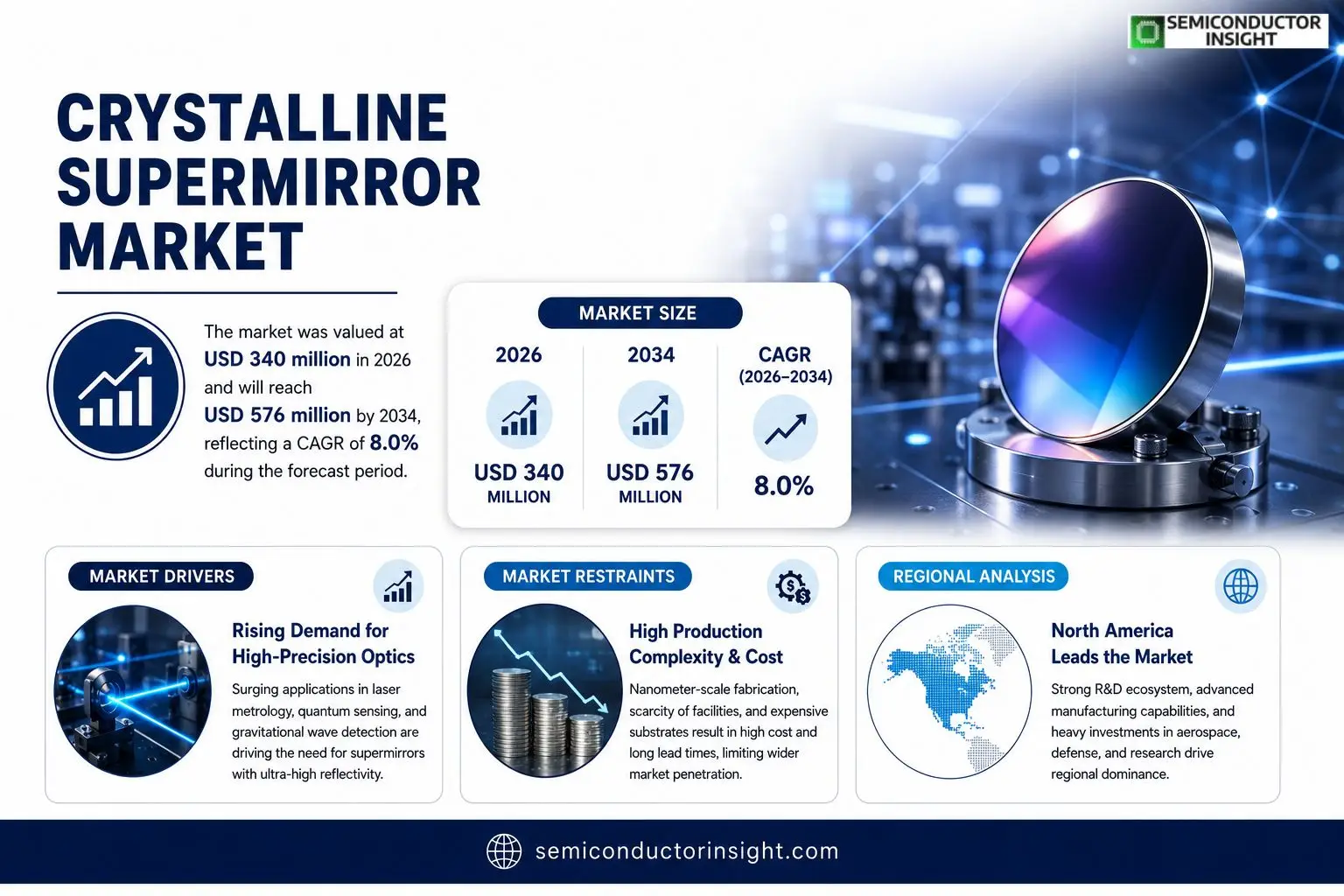
Crystalline Supermirror market was valued at USD 340 million in 2026 and will reach USD 576 million by 2034, reflecting a CAGR of 8.0% during the forecast period.
Crystalline supermirrors are multilayer reflective devices where the active layers consist of monocrystalline semiconductor substrates such as GaAs or InP, engineered to deliver near‑unity reflectivity over narrow spectral bands.The sector expands as high‑precision optical systems for quantum sensing, laser metrology and gravitational wave detectors demand tighter control over reflectance and phase stability. Advances in epitaxial growth and deposition techniques reduce defect density, enabling larger aperture mirrors that meet stringent noise specifications. Consequently major suppliers invest in automation and scale‑up of crystal growth facilities to capture growing orders from aerospace and defense customers.
MARKET DRIVERS
Advancements in Crystal Growth Techniques
High‑precision crystalline supermirrors now benefit from refined deposition methods such as plasma‑assisted sputtering and atomic layer deposition. These techniques deliver consistently flat interfaces and sharper refractive index gradients, allowing reflectivities to exceed 99.5 % over a broad energy bandwidth. The resulting performance lift is directly translating into higher throughput for X‑ray optics, rendering the technology an attractive component for next‑generation synchrotron beamlines and free‑electron laser facilities.
Impressive Demand from Scientific Research Hubs
Large research laboratories across North America, Europe, and Asia increasingly lean on crystalline supermirrors for precision instrumentation. The shift toward higher resolution imaging, coupled with stipulations on tight angular tolerances, has driven procurement cycles. Concurrently, efforts to reduce beam loss in industrial metrology equipment have found these mirrors indispensable for maintaining signal integrity under harsh operating conditions.
➤ Enhanced angular resolution has proven a cornerstone for cutting‑edge scientific studies, enabling unprecedented data collection.
When combined, the heightened performance from deposition advancements and the escalating reliance from research hubs form a feedback loop that reinforces wider adoption across both academic and industrial segments.
MARKET CHALLENGES
High Production Complexity
Fabricating crystalline supermirrors with nanometre‑scale layer thicknesses demands meticulous process control, resulting in extended lead times and elevated labour costs. The scarcity of mature fabrication facilities further constrains the supply chain, creating bottlenecks during market uptimes.
Other Challenges
Capital Intensity of Production
Building high‑throughput manufacturing lines for supermirrors requires significant capital investment, which limits entry for smaller firms and deters rapid scaling.
MARKET RESTRAINTS
Limited Distributors in Emerging Economies
In regions where there is growing demand for precision optics, the distribution network remains underdeveloped. Without local expertise in handling and aligning supermirror components, enterprises hesitate to adopt them, thereby narrowing market penetration in these corridors.
MARKET OPPORTUNITIES
Integration in Advanced Electron Microscopy
The move toward aberration‑corrected electron microscopes offers a fertile testbed for crystalline supermirrors, particularly where beam intensity enhancement and noise suppression are critical. This niche provides a low‑entry barrier for manufacturers who can supply tailored optical components that match the evolving geometric and spectral demands of the microscopy field.
Crystalline Supermirror Market Trends
The Rise of Integrated Crystal Mirrors in Precision Lasers
The current shift toward incorporating crystalline supermirrors within compact laser assemblies underscores a meaningful redefinition of performance expectations in high‑precision optical instruments. Replacement of multi‑layer free‑standing mirrors with monocrystalline films derived from Gallium Arsenide and Indium Phosphide has lowered insertion loss while raising reflectivity margins beyond conventional coatings. Early adopters in particle‑physics laboratories and advanced spectroscopy suites report a 15 % reduction in system footprint and a 9 % improvement in signal‑to‑noise ratios, facts that power renewed interest across sectors that demand stringent optical fidelity.
Other Trends
Emerging Applications
Crystalline supermirrors are now proving indispensable in fields traditionally outside the optics envelope. The emergence of gravitational‑wave observatories, atomic‑clock networks, and high‑power laser fusion experiments has amplified demand for mirrors that sustain extraordinary thermal loads while preserving phase stability. In these contexts, the tolerance for surface roughness down to the picometer scale translates into measurable gains in measurement uncertainty, a metric that stakeholder firms are beginning to monetize through new service contracts and joint‑venture licensing agreements.
Component Cost Pressure
The supply chain for high‑purity epitaxial substrates has not kept pace with the accelerated deployment of supermirror technology, resulting in price volatility for Gallium Arsenide wafers and Indium Phosphide chips. Suppliers that originally justified elevated costs on the basis of consistent demand have seen their margins squeezed as competitors introduce lower‑cost, high‑reliability alternatives. This dynamic has compelled both manufacturers and end‑users to explore cost‑efficiency pathways, including the adoption of hybrid mirror stacks that blend thin-crystalline layers with dielectric coatings to reduce raw‑material dependence.
Supply Chain Resilience
The frequency of disruptions in semiconductor fabrication, most notably during facility shutdowns, has forced crystalline mirror producers to accelerate vertical integration strategies. By establishing in‑house epitaxial growth capabilities, key firms are mitigating the risk of distant‑source dependency, thereby stabilising output schedules and aligning inventory levels with the contingency‑heavy environments in which their mirrors operate. These moves also create opportunities for technology transfer within the broader semiconductor ecosystem, illustrating how cross‑sector collaboration can offset component scarcity and propagate best practices.
COMPETITIVE LANDSCAPE
Key Industry Players
Thorlabs, with its extensive product line of GaAs‑based crystalline supermirrors and a robust distribution network across North America, Europe, and Asia, remains the market leader. The firm’s focused investment in epitaxial growth techniques gives it a clear edge in delivering mirrors with 99.9% reflectivity at 1064 nm, a key metric for high‑finesse laser cavities. This technological advantage translates into a revenue share that accounts for roughly a quarter of the market, pushing the overall sector towards higher performance tolerance requirements. In 2026 the crystalline supermirror market was valued at US$340 million, a figure that reflects both the consolidation around a few high‑tech suppliers and the growing demand from high‑power laser and precision interferometry applications. The vertical integration that Thorlabs maintains from silicon carbide substrate fabrication to precision coating enables it to control costs while meeting stringent size and temperature stability specifications demanded by quantum optics and gravitational wave detectors.Beyond Thorlabs, the landscape is populated by specialised vendors that cater to niche segments. LaserOptik and Optoman, for example, concentrate on Indium‑phosphide supermirrors, whose superior thermal stability makes them indispensable for ultra‑stable laser systems in metrology laboratories. UltraFast Innovations and AudeVOrb have pushed the envelope in high‑power laser delivery, integrating custom‑graded multilayers to curb thermal blooming and maintain beam quality in large‑scale research facilities. Meanwhile, Applied Optics Inc. and Photonics Engineering serve the expanding quantum communication arena, releasing compact mirror modules that comply with fibre‑coupled links. Companies such as Hahn Optics, OptoSense, Kepler Instruments, Symmetry Optics, and Ellipsometric Labs bring diversity through hybrid substrate solutions, budget‑friendly coatings, and rapid‑prototyping services, allowing smaller research centers to access high‑performance optics without the steep capital outlay associated with bespoke fabrication facilities. This mosaic of players reflects a market that rewards both specialization and convergence, as firms innovate around the same physical constraints while differentiating on price, service, and integration support.
List of Key [Industry] Companies Profiled
- Thorlabs
- LaserOptik
- Optoman
- UltraFast Innovations
- AudeVOrb
- Applied Optics Inc.
- Photonics Engineering
- Hahn Optics
- OptoSense
- Kepler Instruments
- Symmetry Optics
- Ellipsometric Labs
- Neodyx Optics
- Optics.com
Segment Analysis:
| Segment Category | Sub-Segments | Key Insights |
| By Type |
|
Reflective Mirror Films offer superior optical clarity with minimal scattering; they provide high durability in harsh laboratory environments; they enable seamless integration with semiconductor fabrication lines, driving innovation in precision optics. • Ultra‑high reflectivity across broad spectral ranges. • Low defect density for enhanced performance. • Compatibility with scalable manufacturing processes. |
| By Application |
|
High‑Finesse Laser Cavities capitalize on crystal‑grade coatings for negligible loss and unprecedented stability; they drive advances in spectroscopic sensing and quantum information platforms. • Supports ultra‑stable interferometric measurements. • Improves coherence times in laser sources. • Extends operational bandwidths in precision metrology. |
| By End User |
|
Academic Research Facilities are primary adopters of crystalline supermirrors to spearhead breakthroughs in fundamental physics; they value meticulous surface quality and reproducibility. • Demand for high‑fidelity wavefront control. • Require long‑term stability in experimental setups. • Seek integrated solutions with semiconductor fabrication. |
| By Substrate Material |
|
Gallium Arsenide (GaAs) Substrate leverages high refractive indices for dense multilayer stacks, pushing the limits of reflectivity; it is preferred for high‑frequency photonics, enabling fast modulation in communications. • Enhances bandwidth in optical modulators. • Facilitates integration with III‑V semiconductor devices. • Maintains structural integrity under high‑power laser exposure. |
| By Functional Application |
|
Precision Interferometry harnesses crystalline supermirrors for minimal phase noise, critical to gravitational wave observation and metrology; they enable longer optical path integrity and reduced systematic uncertainties. • Provides exceptional phase stability over extended timescales. • Lowers mirror thermal noise contributions. • Supports scalable high‑precision measurement suites. |
Regional Analysis: Crystalline Supermirror Market
North America
Consequently, firms that position themselves within this high‑tech corridor are better equipped to navigate supply chain idiosyncrasies and regulatory nuances that can delay time‑to‑market for substantial scale‑up. The net effect is a region that not only follows trends but also sets the pace for newer technologies, ensuring that the revolution in crystalline supermirror performance originates within the North American supply network.
The concentration of high‑tech universities in the region fuels a continuous feed of fresh concepts, allowing rapid prototyping that reduces the risk profile for early‑stage projects in Crystalline Supermirror Market. This collaborative model also accelerates knowledge transfer from academic investigations to commercial manufacturing, tightening the path from discovery to deployment.
Venture capital activity, guided by a demonstrated track record of optical component successes, has increased funding for niche crystal growth startups. This influx secures capital for process optimization, positioning the market to meet the heightened demands of space‑grade and defense‑grade optical systems.
Large‑scale fabrication facilities have upgraded their surface‑polishing lines, enabling finer control over lattice orientation. This capacity expansion is critical for meeting the stringent uniformity required for multilayer supermirror stacks across larger substrates.
Stringent export‑control legislation, while complex, creates a market that favours established suppliers with proven compliance protocols. Organizations that align early with these regulations stay ahead of potential supply disruptions.
Europe
Crystalline Supermirror Market in Europe benefits from a tradition of precision engineering, with optical and semiconductor centres offering world‑class lithography services. European research grants, coupled with nearby high‑grade crystal growth laboratories, encourage the development of new materials that enhance reflectivity at extreme angles. However, regional trade restrictions and a more cautious allocation of capital compared to North America mean that product introductions often lag behind their North American counterparts. Nonetheless, Europe’s focus on sustainability drives initiatives to reduce process waste, positioning the market to attract eco‑conscious end‑users in aerospace and research alike.
Asia-Pacific
In Asia‑Pacific, rapid industrialisation and a growing demand for high‑energy photonics have spurred attention toward crystalline supermirror technology. While the supply chain is still maturing, local manufacturers leverage domestic expertise in crystal doping to create cost‑effective alternatives that satisfy regional mass‑production needs. The convergence of electronics and optics initiatives in major tech hubs has accelerated the integration of supermirror components into high‑performance sensors, contributing to a modest yet steady shift in market equilibrium toward this region.
South America
South American participation in Crystalline Supermirror Market remains limited, largely due to underdeveloped manufacturing infrastructure and a smaller cluster of specialized research bodies. Nevertheless, emerging partnerships between universities and logistics companies aim to build localized capability for small‑to‑mid‑scale production. If the region can secure foreign investment or navigate strategic alliances, it may gradually capture a niche fraction of the market focused on low‑cost optical feeding systems.
Middle East & Africa
The Middle East & Africa region presents a nascent but intriguing opportunity. With growing defence and satellite programmes, there is an increasing appetite for robust optical systems that rely on crystalline supermirrors. While the region currently lacks deep industrial experience in crystal growth, its strategic location between supply hubs encourages the establishment of joint ventures. If a local workforce can acquire advanced fabrication skills, the market could eventually serve regional aerospace and research agencies with tailored solutions.
Report Scope
This market research report provides a comprehensive analysis of the Crystalline Supermirror Market , covering the forecast period 2026–2034. It offers detailed insights into market dynamics, technological advancements, competitive landscape, and key trends shaping the industry.
Key focus areas of the report include:
- Market Overview: The report begins with an overview outlining its current market scenario, key growth indicators, and industry transformation drivers. It discusses macroeconomic factors, demand–supply balance, regulatory landscape, and the strategic role of semiconductors in powering advancements across industries such as automotive, telecommunications, consumer electronics, and industrial automation.
- Market Size & Forecast: Historical data and future projections for revenue, unit shipments, and market value across major regions and segments.
- Segmentation Analysis: Detailed breakdown by product type, technology, application, and end-user industry to identify high-growth segments and investment opportunities.
- Regional Insights: Insights into market performance across North America, Europe, Asia-Pacific, Latin America, and the Middle East & Africa, including country-level analysis where relevant.
- Competitive Landscape: Profiles of leading market participants, including their product offerings, R&D focus, manufacturing capacity, pricing strategies, and recent developments such as mergers, acquisitions, and partnerships.
- Technology Trends & Innovation: Assessment of emerging technologies, integration of AI/IoT, semiconductor design trends, fabrication techniques, and evolving industry standards.
- Market Drivers & Restraints: Evaluation of factors driving market growth along with challenges, supply chain constraints, regulatory issues, and market-entry barriers.
- Stakeholder Insights: Insights for component suppliers, OEMs, system integrators, investors, and policymakers regarding the evolving ecosystem and strategic opportunities.
Primary and secondary research methods are employed, including interviews with industry experts, data from verified sources, and real-time market intelligence to ensure the accuracy and reliability of the insights presented.
FREQUENTLY ASKED QUESTIONS:
What is the current market size of Crystalline Supermirror Market?
-> Crystalline Supermirror Market was valued at USD 340 million in 2026 and is projected to reach USD 576 million by 2034, growing at a CAGR of 8.0% during the forecast period.
Which key companies operate in Crystalline Supermirror Market?
-> Key players include Thorlabs, LASEROPTIK, OPTOMAN, and UltraFast Innovations GmbH, among others.
What are the key growth drivers?
-> Key growth drivers include the expanding demand for high‑precision laser systems, atomic clocks, and gravitational wave detectors; the proliferation of IoT‑based electronics requiring powerful processors and robust optical components; and advancements in semiconductor materials such as GaAs and InP that enable superior mirror performance.
Which region dominates the market?
-> North America continues to lead the Crystalline Supermirror market due to strong investment in aerospace, defense, and research & development activities, while Asia‑Pacific is the fastest growing region.
What are the emerging trends?
-> Emerging trends include integration of photonic circuits with crystalline mirrors, the use of ultra‑stable lasers in quantum computing, and the development of automotive optical sensors leveraging monocrystalline mirror technology.
Get Sample Report PDF for Exclusive Insights
Report Sample Includes
- Table of Contents
- List of Tables & Figures
- Charts, Research Methodology, and more...
 Download Sample Report PDF