Copper Clad Laminate for Consumer Electronics Market Insights
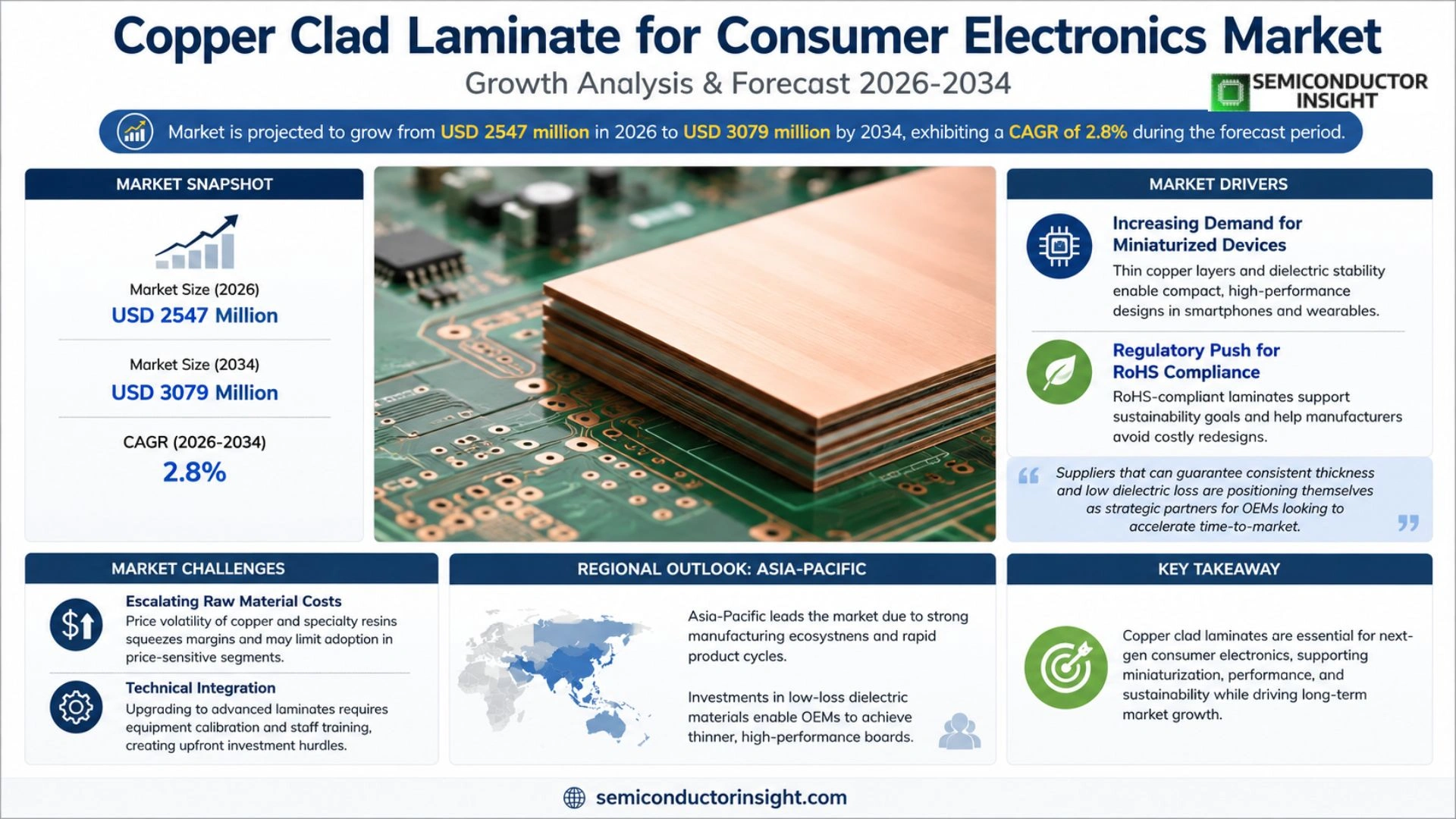
Copper Clad Laminate for Consumer Electronics market is projected to grow from USD 2547 million in 2026 to USD 3079 million by 2034, exhibiting a CAGR of 2.8% during the forecast period.
Copper clad laminate (CCL) serves as the foundational substrate for printed circuit boards used across televisions, radios, computers and mobile communication devices. Its conductive copper layer bonded to resin‑based laminates enables reliable signal transmission while maintaining mechanical stability.
The sector is expanding because consumer demand for smarter devices intensifies production volumes, prompting manufacturers such as KBL, SYTECH, Panasonic and Isola to broaden their high‑frequency FR‑4 and halogen‑free offerings. Recent collaborations on low‑loss materials aim to meet stricter electromagnetic compatibility standards, while supply‑chain adjustments address raw‑material price volatility.
MARKET DRIVERS
Increasing Demand for Miniaturized Devices
Design engineers are seeking substrates that enable tighter circuit routing while preserving signal integrity. Copper Clad Laminate for Consumer Electronics Market meets these criteria by offering thin copper layers that fit within the limited real‑estate of wearables and smartphones. The material’s dielectric stability also reduces the need for additional shielding, which cuts both cost and assembly time.
Regulatory Push for RoHS Compliance
Legislation that restricts hazardous substances has forced manufacturers to replace lead‑based laminates with greener alternatives. The copper‑clad options that comply with RoHS standards are gaining traction because they align with corporate sustainability goals and avoid costly redesigns later in the product lifecycle.
➤ “Suppliers that can guarantee consistent thickness and low dielectric loss are positioning themselves as strategic partners for OEMs looking to accelerate time‑to‑market.”
Because the supply chain for high‑frequency laminates remains relatively concentrated, vendors that maintain tight inventory controls are able to provide the reliability that brands demand, especially when product launch windows are unforgiving.
MARKET CHALLENGES
Escalating Raw Material Costs
The price volatility of copper and specialty resins has squeezed margins for manufacturers. When input costs rise, end‑users often face higher component prices, which can slow adoption of premium laminate grades in price‑sensitive segments such as entry‑level smartphones.
Other Challenges
Technical Integration
Integrating new laminate formulations into established production lines can require equipment calibration and staff retraining. These upfront investments deter some midsize manufacturers from upgrading to the latest copper‑clad technologies.
MARKET RESTRAINTS
Limited Access to Advanced Manufacturing Facilities
High‑end copper laminates often need cleanroom environments and precision lamination ovens that are scarce outside major industrial hubs. Companies located in peripheral regions must either ship raw materials long distances or partner with contract manufacturers, both of which add lead time and complexity.
MARKET OPPORTUNITIES
Growth in High‑Frequency Connectivity
Emerging 5G‑enabled wearables and IoT gateways operate at frequencies where dielectric loss becomes a performance bottleneck. Laminate providers that can deliver copper‑clad boards with ultra‑low loss tangents stand to capture a niche yet expanding segment of the market. This opportunity is amplified by the shift toward edge computing, where device‑level processing demands high‑speed interconnects.
Furthermore, regional incentives for advanced manufacturing are encouraging new fab investments in Southeast Asia and Eastern Europe. Firms that align their product roadmaps with these policy‑driven expansions can establish early footholds, leveraging localized supply chains to outpace competitors still reliant on legacy European sources.
Copper Clad Laminate for Consumer Electronics Market Trends
Rising Demand from Mobile Devices
The surge in smartphone and wearable production has placed copper clad laminate (CCL) at the core of PCB manufacturing. 2024 saw global revenue of roughly $2,547 million, and the trend of thinner, high‑frequency boards is pushing suppliers to refine material formulations. Consumers now expect thinner devices with longer battery life, which drives engineers to select CCL with lower dielectric loss and tighter tolerance. As a result, manufacturers are expanding capacity in regions that host major contract assemblers, notably China and Vietnam, to shorten lead‑times and reduce freight costs. This geographic shift not only improves service levels but also creates pricing pressure that favors firms with integrated production lines.
Other Trends
Shift Toward Halogen‑Free Boards
Environmental regulations in Europe and North America have accelerated adoption of halogen‑free CCL variants. Companies such as Isola and Showa Denko have introduced low‑smoke formulations that meet RoHS‑like standards without sacrificing thermal performance. Buyers in automotive infotainment and medical wearables are increasingly specifying these grades to avoid costly re‑certification. The move is reshaping supplier negotiations, as buyers demand transparent supply‑chain traceability and suppliers respond with dedicated product portfolios.
Growth of Composite Substrate Offerings
Composite substrates, blending glass‑reinforced epoxy with high‑Tg resins, are gaining traction in high‑speed data‑center networking equipment. The higher glass transition temperature enables boards to operate reliably under increased power density, a requirement for 5G base stations and edge‑computing nodes. Despite higher material costs, the premium is justified by the longer product life cycles and reduced failure rates reported by OEMs. This dynamic is prompting legacy manufacturers to invest in R&D or acquire niche players to broaden their technology base.
Supply Chain Realignment in Asia
While the United States remains a sizeable market, most of the production volume now originates from Asian hubs. Recent capacity expansions by KBL, Panasonic, and GDM in the Pearl River Delta have lowered unit costs by 4‑5 % over the past twelve months. At the same time, geopolitical tensions have encouraged diversification toward South‑East Asian countries, where labor costs are stable and infrastructure improvements accelerate ramp‑up times. For customers, this translates into more resilient sourcing options; for suppliers, it means intensified competition that rewards operational efficiency and rapid innovation cycles.
COMPETITIVE LANDSCAPE
Key Industry Players
Copper Clad Laminate for Consumer Electronics – Competitive Overview
The market is anchored by KBL, whose extensive production capacity and deep integration with major PCB fabricators grant it a decisive edge in pricing and supply reliability. KBL’s strategic investments in high‑frequency FR‑4 and halogen‑free grades have reinforced its position among tier‑1 OEMs, especially in mobile and wearables where trace‑level performance drives component selection. Its ability to align R&D with emerging standards on thermal management has compelled rivals to seek partnerships or niche differentiation rather than direct confrontation.
Beyond the dominant tier, a constellation of specialized firms fills critical gaps. SYTECH and Panasonic leverage proprietary substrate chemistries to cater to high‑speed computing boards, while Nan Ya Plastics and GDM focus on cost‑effective paper‑board solutions for mid‑range consumer devices. Regional players such as DOOSAN in South Korea and ITEQ in Taiwan excel in custom composite substrates that address miniaturization trends. Meanwhile, Showa Denko Materials, EMC, and Isola sustain a pipeline of environmentally compliant laminates that align with stricter European RoHS enforcement, offering a competitive lever for manufacturers targeting that market.
List of Key Copper Clad Laminate for Consumer Electronics Companies Profiled
- KBL
- SYTECH
- Panasonic
- Nan Ya Plastics
- GDM
- DOOSAN
- ITEQ
- Showa Denko Materials
- EMC
- Isola
- Rogers Corporation
- Shanghai Nanya
- Mitsubishi Materials
- TUC
- Wazam New Materials
- JinBao
- Chang Chun
- GOWORLD
- Sumitomo Chemical
- Grace Electron
- Ventec
- Chaohua
Segment Analysis:
| Segment Category | Sub-Segments | Key Insights |
| By Type |
|
Normal FR4 is the dominant type because it balances cost, manufacturability and performance for mainstream consumer devices. – Engineers favor its well‑understood process flow, which reduces time‑to‑market for new product designs. – The material’s thermal stability supports reliable operation of smartphones, tablets and affordable wearables. – Its widespread availability underpins supply‑chain resilience, allowing OEMs to maintain steady production volumes even during component shortages. |
| By Application |
|
Phone segment drives the majority of demand as mobile devices continue to proliferate and integrate richer functions. – The need for thin, lightweight board structures pushes manufacturers toward high‑frequency copper clad laminates that support rapid signal transmission. – Consumer expectations for longer battery life encourage the adoption of low‑dielectric loss materials that improve power efficiency. – Rapid product refresh cycles force PCB suppliers to develop flexible design kits that accelerate onboarding of new phone platforms. |
| By End User |
|
Consumer Electronics OEMs shape the market landscape through their scale and design specifications. – Their preference for reliable, cost‑effective substrates leads to steady demand for standard FR‑4 and emerging halogen‑free options. – Close collaboration with laminate suppliers drives innovation in high‑ Tg formulations that meet thermal challenges of next‑generation devices. – OEMs’ global footprint pushes the supply network toward consistent quality standards across regions, fostering a uniform market experience. |
Regional Analysis: Copper Clad Laminate for Consumer Electronics Market
Asia‑Pacific
Over 60 % of the world’s copper‑clad laminate output now originates from the Asia‑Pacific basin, where high‑volume fabs benefit from economies of scale and a skilled labor pool adept at handling delicate copper foils.
Localized raw‑material sourcing and government incentives keep unit costs below those of competing regions, allowing producers to price premium low‑dielectric laminates competitively.
Integrated logistics corridors,from port to fab,reduce lead times and buffer the market against disruptions that have plagued more fragmented supply networks elsewhere.
The surge in foldable smartphones and ultra‑thin laptops is prompting local developers to experiment with high‑frequency laminates, further diversifying the product mix within the region.
North America
North America sustains a niche advantage through its focus on high‑performance laminates tailored for defense‑grade electronics and premium automotive infotainment systems. While overall volumes lag behind Asia‑Pacific, the region’s emphasis on reliability testing and compliance with stringent electromagnetic‑interference standards drives demand for specialty copper‑clad products. Partnerships between U.S. research institutes and laminate manufacturers accelerate the introduction of ultra‑low‑loss materials, positioning the market to capture premium segments where performance outweighs cost considerations.
Europe
European players leverage a legacy of precision engineering, directing copper‑clad laminate development toward compact medical devices and industrial IoT sensors. Regulatory frameworks that prioritize energy efficiency compel manufacturers to adopt thinner, high‑frequency boards, prompting a modest but steady uplift in demand. Collaborative clusters in Germany and the Benelux region enable rapid prototyping, ensuring that local OEMs can swiftly adapt to evolving design specifications without relying on external suppliers.
South America
In South America, market activity is anchored by growing consumer electronics assembly plants in Brazil and Colombia. The region’s cost‑sensitive environment nurtures demand for mid‑range laminates that balance performance with affordability. Recent trade agreements have lowered import duties on copper raw material, encouraging domestic producers to scale capacity and target regional handset assemblers seeking localized supply options.
Middle East & Africa
The Middle East & Africa segment reflects a nascent but evolving demand pattern, driven largely by the rollout of smart city initiatives and renewable‑energy‑linked consumer gadgets. Investment in petrochemical‑based copper foil production has begun to lower material costs, while emerging electronics hubs in the United Arab Emirates and Kenya experiment with lightweight laminate solutions for wearables and low‑power devices. Although volumes remain modest, the region’s strategic focus on diversification creates a fertile ground for future growth in the Copper Clad Laminate for Consumer Electronics Market.
Report Scope
This market research report provides a comprehensive analysis of the Copper Clad Laminate for Consumer Electronics Market , covering the forecast period 2026–2034. It offers detailed insights into market dynamics, technological advancements, competitive landscape, and key trends shaping the industry.
Key focus areas of the report include:
- Market Overview: The report begins with an overview outlining its current market scenario, key growth indicators, and industry transformation drivers. It discusses macroeconomic factors, demand–supply balance, regulatory landscape, and the strategic role of semiconductors in powering advancements across industries such as automotive, telecommunications, consumer electronics, and industrial automation.
- Market Size & Forecast: Historical data and future projections for revenue, unit shipments, and market value across major regions and segments.
- Segmentation Analysis: Detailed breakdown by product type, technology, application, and end-user industry to identify high-growth segments and investment opportunities.
- Regional Insights: Insights into market performance across North America, Europe, Asia-Pacific, Latin America, and the Middle East & Africa, including country-level analysis where relevant.
- Competitive Landscape: Profiles of leading market participants, including their product offerings, R&D focus, manufacturing capacity, pricing strategies, and recent developments such as mergers, acquisitions, and partnerships.
- Technology Trends & Innovation: Assessment of emerging technologies, integration of AI/IoT, semiconductor design trends, fabrication techniques, and evolving industry standards.
- Market Drivers & Restraints: Evaluation of factors driving market growth along with challenges, supply chain constraints, regulatory issues, and market-entry barriers.
- Stakeholder Insights: Insights for component suppliers, OEMs, system integrators, investors, and policymakers regarding the evolving ecosystem and strategic opportunities.
Primary and secondary research methods are employed, including interviews with industry experts, data from verified sources, and real-time market intelligence to ensure the accuracy and reliability of the insights presented.
FREQUENTLY ASKED QUESTIONS:
What is the current market size of Copper Clad Laminate for Consumer Electronics Market?
-> Copper Clad Laminate for Consumer Electronics market is projected to grow from USD 2547 million in 2026 to USD 3079 million by 2034
Which key companies operate in Copper Clad Laminate for Consumer Electronics Market?
-> Key players include KBL, SYTECH, Panasonic, Nan Ya Plastic, GDM, DOOSAN, ITEQ, Showa Denko Materials, EMC, Isola, Rogers, Shanghai Nanya, Mitsubishi, TUC, Wazam New Materials, JinBao, Chang Chun, GOWORLD, Sumitomo, Grace Electron, Ventec, Chaohua.
What are the key growth drivers?
-> Key growth drivers include the expanding consumer electronics ecosystem, rising demand for high‑frequency printed circuit boards, miniaturization of devices, and the shift toward environmentally friendly (halogen‑free) laminate materials.
Which region dominates the market?
-> Asia dominates the market, driven by large‑scale PCB manufacturing in China, Japan, and South Korea, while North America and Europe also show steady growth.
What are the emerging trends?
-> Emerging trends include increased adoption of high Tg FR‑4 and composite substrate laminates, growth of halogen‑free and low‑loss boards, and development of specialized high‑frequency and wearable‑device oriented laminates.

Get Sample Report PDF for Exclusive Insights
Report Sample Includes
- Table of Contents
- List of Tables & Figures
- Charts, Research Methodology, and more...
 Download Sample Report PDF