Continuous Glucose Monitor (CGM) Sensor ASIC Market Insights
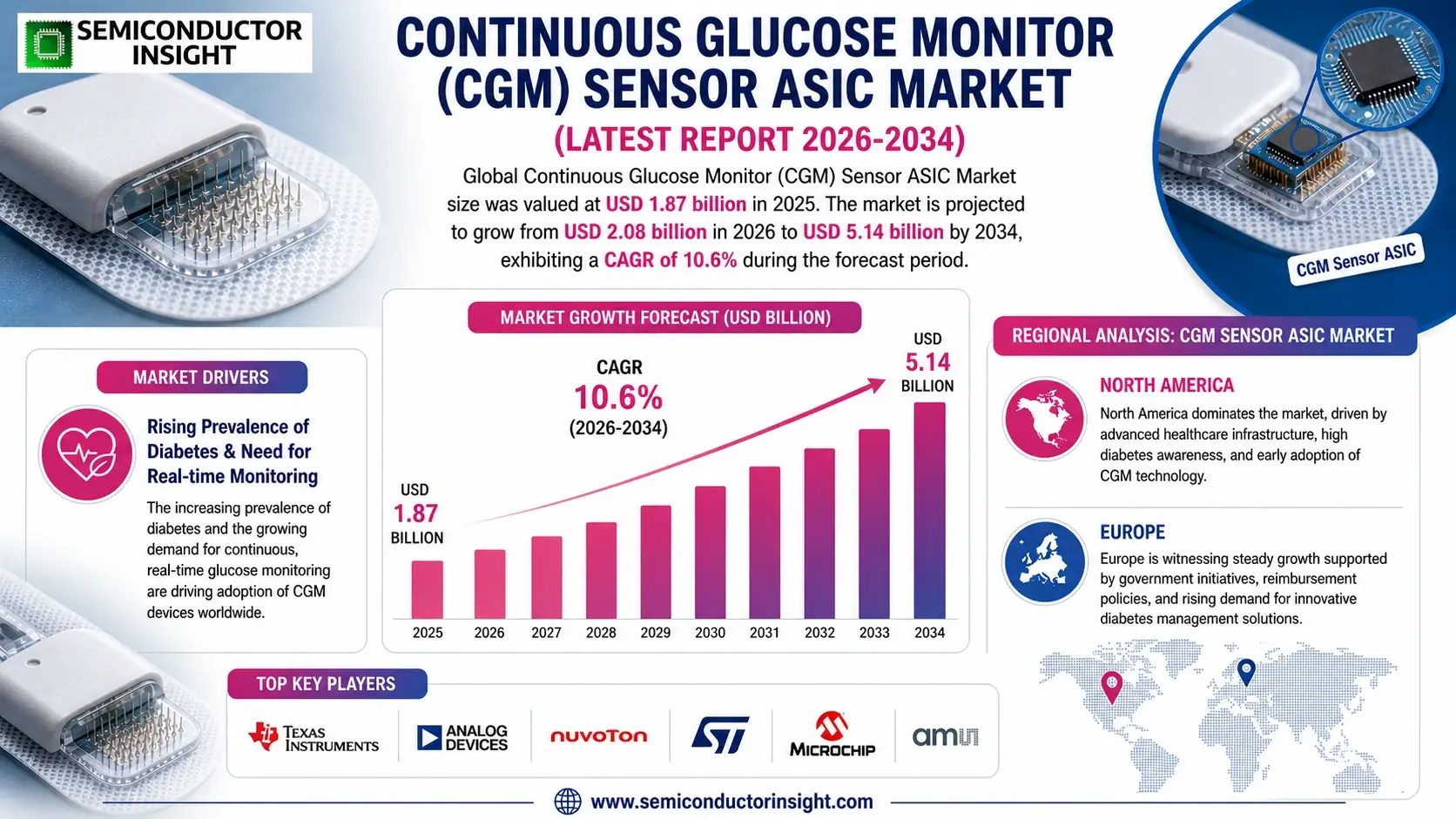
Global Continuous Glucose Monitor (CGM) Sensor ASIC Market size was valued at USD 1.87 billion in 2025. The market is projected to grow from USD 2.08 billion in 2026 to USD 5.14 billion by 2034, exhibiting a CAGR of 10.6% during the forecast period.
CGM Sensor ASICs (Application-Specific Integrated Circuits) are highly specialized semiconductor chips engineered to manage the precise signal acquisition, analog front-end processing, and wireless data transmission functions within continuous glucose monitoring devices. These chips are purpose-built to interface directly with electrochemical biosensors, enabling real-time, minimally invasive blood glucose tracking for diabetic patients. The product category encompasses a range of integrated components including analog front-end ICs, low-power microcontrollers, RF transceivers, and signal conditioning circuits, all optimized for wearable medical device applications.
The market is experiencing strong momentum driven by the rapidly escalating global diabetes burden — with the International Diabetes Federation reporting approximately 537 million adults living with diabetes worldwide in 2021, a figure projected to reach 783 million by 2045. This growing patient pool is directly amplifying demand for advanced CGM devices, and by extension, the specialized ASICs that power them. Furthermore, technological advancements in ultra-low-power chip design and the widespread adoption of factory-calibrated, long-wear sensors are accelerating market expansion. Key industry players such as Abbott Laboratories, Dexcom, Inc., Medtronic plc, and Texas Instruments continue to invest heavily in next-generation sensor ASIC development, reinforcing competitive innovation across the value chain.
MARKET DRIVERS
Rising Global Prevalence of Diabetes Fueling Demand for Advanced CGM Technologies
The escalating global burden of diabetes mellitus remains one of the most significant forces propelling Continuous Glucose Monitor (CGM) Sensor ASIC Market forward. With hundreds of millions of individuals worldwide living with Type 1 and Type 2 diabetes, the clinical need for real-time, accurate, and minimally invasive glucose monitoring has never been more acute. Application-specific integrated circuits (ASICs) designed for CGM sensors are at the heart of this technological evolution, enabling miniaturized, low-power devices that deliver continuous electrochemical signal processing with high precision. The growing diabetic population, particularly in emerging economies across Asia-Pacific and Latin America, is creating sustained downstream demand for CGM-enabled wearable devices that rely heavily on purpose-built sensor ASICs.
Technological Advancements in Low-Power ASIC Design Accelerating Market Adoption
Rapid innovation in semiconductor design, particularly in ultra-low-power analog front-end (AFE) circuits and system-on-chip (SoC) architectures, is a critical driver shaping Continuous Glucose Monitor (CGM) Sensor ASIC Market. Modern CGM sensor ASICs are engineered to operate on microwatt-level power budgets, enabling multi-day or even multi-week continuous operation on compact coin-cell or rechargeable batteries. Advances in CMOS process nodes, noise-reduction techniques, and on-chip signal conditioning have significantly improved the sensitivity and accuracy of glucose readings derived from amperometric electrochemical sensors. These hardware-level improvements directly translate into devices that meet stringent clinical accuracy standards, including ISO 15197 requirements, thereby increasing confidence among healthcare providers and patients alike.
➤ The integration of Bluetooth Low Energy (BLE) and near-field communication (NFC) wireless stacks directly onto CGM sensor ASICs is enabling seamless data transmission to smartphones and cloud platforms, representing a pivotal leap in connected diabetes management ecosystems.
Government initiatives and favorable reimbursement policies in major markets such as the United States, Germany, France, and the United Kingdom are further amplifying the growth trajectory of Continuous Glucose Monitor (CGM) Sensor ASIC Market. Regulatory bodies including the U.S. Food and Drug Administration (FDA) have progressively expanded approvals for CGM devices for use in intensive care settings and non-adjunctive insulin dosing, broadening the addressable patient base. Simultaneously, increasing healthcare expenditure and growing awareness of the long-term cost savings associated with proactive glucose management are encouraging payers to include CGM devices within reimbursement frameworks, indirectly driving volume demand for the specialized ASICs that power these devices.
MARKET CHALLENGES
Stringent Regulatory Requirements Posing Significant Development Hurdles for CGM Sensor ASIC Manufacturers
One of the most formidable challenges confronting participants Continuous Glucose Monitor (CGM) Sensor ASIC Market is navigating the complex and evolving regulatory landscape governing medical-grade semiconductor devices. CGM sensor ASICs are classified as components of medical devices and must comply with rigorous quality management standards such as ISO 13485, as well as device-level regulations under the FDA’s 21 CFR Part 820 and the European Union’s Medical Device Regulation (EU MDR 2017/745). The validation and verification processes required to demonstrate ASIC performance under physiological conditions — including temperature variation, electromagnetic interference, and biocompatibility considerations — add considerable time and cost to the development cycle. Smaller fabless semiconductor companies seeking to enter this specialized market often encounter significant barriers related to clinical testing, documentation, and regulatory submission preparation, slowing overall market innovation velocity.
Other Challenges
High Development and Customization Costs
Designing a CGM-specific ASIC from the ground up requires substantial investment in analog and mixed-signal engineering expertise, which remains relatively scarce compared to digital IC design talent. Non-recurring engineering (NRE) costs associated with custom tape-outs at advanced process nodes, combined with mask costs and multiple design iterations needed to meet clinical-grade accuracy specifications, create high capital requirements. These financial barriers can limit the number of viable competitors Continuous Glucose Monitor (CGM) Sensor ASIC Market and concentrate market share among well-capitalized, vertically integrated device manufacturers or established semiconductor players with dedicated medical divisions.
Signal Interference and Sensor Drift in Long-Wear Applications
Despite advances in ASIC design, maintaining consistent electrochemical signal integrity over extended wear periods of 7 to 15 days remains a persistent technical challenge. Biofouling of the glucose oxidase enzyme layer, variable tissue perfusion rates, and interstitial fluid lag can introduce measurement errors that even sophisticated on-chip signal processing algorithms may struggle to fully compensate for. Ensuring that CGM sensor ASICs can reliably differentiate true glucose fluctuations from noise artifacts across diverse patient physiologies and environmental conditions requires ongoing R&D investment and close collaboration between ASIC designers and biosensor material scientists.
MARKET RESTRAINTS
Supply Chain Vulnerabilities and Semiconductor Shortages Constraining Production Scalability
Continuous Glucose Monitor (CGM) Sensor ASIC Market is not immune to the broader supply chain disruptions that have periodically affected the global semiconductor industry. CGM sensor ASICs typically require fabrication at specialized foundries capable of handling mixed-signal and analog processes, and the available pool of such facilities is narrower than for purely digital CMOS processes. Geopolitical tensions, concentrated manufacturing capacity in specific geographic regions, and raw material availability constraints can create supply bottlenecks that limit CGM device manufacturers’ ability to scale production in response to growing market demand. These vulnerabilities introduce pricing volatility and lead-time uncertainty that complicate long-term procurement planning for device OEMs relying on third-party ASIC suppliers.
Intense Price Pressure from Cost-Sensitive Markets Limiting Margin Expansion
While premium CGM systems command relatively high price points in developed markets, growing pressure to reduce overall device costs — driven by payer cost-containment strategies and competitive market dynamics — is creating a challenging pricing environment for CGM sensor ASIC developers. As the CGM market matures and more manufacturers enter with competing platforms, the average selling price of CGM-compatible ASICs faces compression. This restraint is particularly pronounced in price-sensitive emerging markets where healthcare infrastructure may limit reimbursement availability, requiring device manufacturers to target significantly lower bill-of-materials (BOM) costs. For ASIC vendors, achieving the necessary cost reductions while maintaining medical-grade performance and reliability standards presents a sustained engineering and business challenge that may constrain profitability in the medium term.
MARKET OPPORTUNITIES
Expansion into Non-Diabetic Wellness and Metabolic Health Monitoring Creating New Market Frontiers
Beyond traditional diabetes management, a compelling opportunity is emerging for Continuous Glucose Monitor (CGM) Sensor ASIC Market in the broader consumer wellness and metabolic health segment. Growing consumer interest in personalized nutrition, sports performance optimization, and preventive healthcare is driving adoption of CGM-based wearables among non-diabetic individuals seeking real-time metabolic insights. This trend is catalyzing demand for next-generation sensor ASICs optimized for consumer-grade applications, where design priorities include aggressive cost reduction, ultra-compact form factors, and enhanced wireless connectivity rather than clinical-grade therapeutic accuracy. The addressable market for CGM sensor ASICs in this wellness segment represents a substantial incremental opportunity beyond the established diabetic patient population.
Integration of Artificial Intelligence and Edge Computing Capabilities within CGM Sensor ASICs
The convergence of artificial intelligence (AI) and embedded edge computing with CGM sensor ASIC design represents one of the most transformative opportunities in the market. Incorporating on-chip machine learning inference engines capable of running glucose trend prediction algorithms, anomaly detection, and personalized calibration routines directly within the ASIC eliminates latency associated with cloud-dependent processing and enhances data privacy. This architectural shift toward intelligent, self-contained CGM sensor ASICs aligns with broader trends in edge AI semiconductors and positions ASIC developers to offer significantly differentiated value propositions to CGM device manufacturers. Investment in this capability by ASIC design teams could establish durable competitive moats Continuous Glucose Monitor (CGM) Sensor ASIC Market over the coming years.
Strategic Collaborations Between ASIC Developers and CGM Device OEMs Unlocking Integrated Design Opportunities
The increasing strategic importance of proprietary sensor ASIC technology as a source of competitive differentiation in the CGM device market is prompting leading device manufacturers to pursue deeper, longer-term collaborative engagements with specialized semiconductor partners. These partnerships, which may take the form of joint development agreements, equity investments, or exclusive supply arrangements, create structured opportunities for ASIC developers to secure stable revenue visibility while co-creating application-optimized silicon tailored precisely to next-generation CGM platform requirements. For emerging fabless ASIC companies with deep expertise in electrochemical sensor interface design, positioning within these collaborative ecosystems represents a viable and high-value growth pathway within the broader Continuous Glucose Monitor (CGM) Sensor ASIC Market landscape.
TrendsRising Diabetes Prevalence Driving Sustained Demand for CGM Sensor ASICs
Continuous Glucose Monitor (CGM) Sensor ASIC Market is witnessing robust growth momentum, largely underpinned by the accelerating global diabetes epidemic. According to the International Diabetes Federation, approximately 537 million adults were living with diabetes worldwide in 2021, a figure projected to reach 783 million by 2045. This expanding patient population is directly intensifying demand for advanced continuous glucose monitoring solutions, and by extension, the specialized application-specific integrated circuits that serve as their functional core. As healthcare systems globally pivot toward proactive diabetes management, CGM Sensor ASICs are emerging as critical enablers of real-time, minimally invasive glucose tracking technologies.
Other Trends
Ultra-Low-Power Chip Design Innovation
A defining trend shaping Continuous Glucose Monitor (CGM) Sensor ASIC Market is the rapid advancement in ultra-low-power semiconductor design. Wearable CGM devices demand chips that can operate continuously for extended wear periods — often 10 to 14 days — while drawing minimal energy from compact batteries. Manufacturers are increasingly engineering analog front-end ICs and integrated signal conditioning circuits with optimized power profiles, enabling longer sensor longevity without compromising data accuracy or transmission reliability. This focus on energy efficiency is becoming a key competitive differentiator among ASIC developers targeting next-generation CGM platforms.
Shift Toward Factory-Calibrated, Long-Wear Sensors
The market is observing a meaningful transition from user-calibrated CGM devices to factory-calibrated, long-wear sensor systems. This shift places greater technical demands on the underlying CGM Sensor ASIC architecture, requiring more sophisticated analog processing capabilities and tighter signal conditioning tolerances to ensure clinical-grade accuracy without manual calibration inputs. Leading industry participants including Abbott Laboratories and Dexcom, Inc. have advanced this trend through continued investment in sensor ASIC development, reinforcing the need for highly integrated, purpose-built semiconductor solutions across the CGM value chain.
Integration of Wireless Data Transmission Capabilities
Another prominent trend within the Continuous Glucose Monitor (CGM) Sensor ASIC landscape is the deepening integration of RF transceiver functionality directly within sensor chip architectures. As CGM devices are increasingly expected to communicate seamlessly with smartphones, insulin pumps, and cloud-based health platforms, ASIC developers are consolidating wireless data transmission modules alongside analog biosensor interfaces into single-chip or multi-chip module solutions. Companies such as Medtronic plc and Texas Instruments are actively investing in this area, driving innovation in compact, high-performance CGM Sensor ASICs engineered for the demands of connected, wearable medical ecosystems.
COMPETITIVE LANDSCAPEKey Industry Players
Continuous Glucose Monitor (CGM) Sensor ASIC Market: Competitive Dynamics and Leading Innovators
Continuous Glucose Monitor (CGM) Sensor ASIC Market is characterized by a concentrated yet intensely competitive landscape, with a handful of dominant players commanding significant market share alongside a growing cohort of specialized semiconductor and medical device firms. Abbott Laboratories and Dexcom, Inc. stand as the foremost integrated players, leveraging proprietary ASIC architectures within their respective FreeStyle Libre and Dexcom G-series platforms to deliver factory-calibrated, long-wear CGM solutions. Medtronic plc reinforces its position through continuous investment in next-generation sensor ASIC development embedded within its Guardian Connect ecosystem. On the semiconductor side, Texas Instruments remains a critical enabler, supplying low-power analog front-end ICs and signal conditioning circuits widely adopted across the CGM device value chain. The competitive intensity is further amplified by the market’s robust growth trajectory — expanding from USD 2.08 billion in 2026 to a projected USD 5.14 billion by 2034 at a CAGR of 10.6% — which continues to attract both established chipmakers and emerging fabless design houses into the CGM Sensor ASIC ecosystem.
Beyond the tier-one players, a number of niche yet strategically significant companies are shaping competitive dynamics across the CGM Sensor ASIC market. Analog Devices, Inc. and STMicroelectronics contribute high-precision analog front-end and mixed-signal ICs tailored for electrochemical biosensor interfacing in wearable medical applications. Microchip Technology and Nordic Semiconductor provide ultra-low-power microcontrollers and RF transceiver solutions optimized for the stringent power budgets of continuous glucose monitoring devices. Sensata Technologies and ams OSRAM AG (formerly Austria Microsystems) offer specialized sensor interface ASICs relevant to biosignal acquisition. Meanwhile, companies such as Roche Diagnostics and Insulet Corporation participate as integrated device manufacturers, driving demand for custom ASIC procurement. The collective innovation from these players across analog front-end design, wireless telemetry, and system-on-chip integration is accelerating the deployment of next-generation CGM platforms globally, underpinned by the urgent need to serve the approximately 537 million adults living with diabetes worldwide.
List of Key Continuous Glucose Monitor (CGM) Sensor ASIC Companies Profiled
- Abbott Laboratories
- Dexcom, Inc.
- Medtronic plc
- Texas Instruments Incorporated
- Analog Devices, Inc.
- STMicroelectronics N.V.
- Microchip Technology Inc.
- Nordic Semiconductor ASA
- ams OSRAM AG
- Sensata Technologies Holding plc
- Roche Diagnostics (F. Hoffmann-La Roche Ltd.)
- Insulet Corporation
- Qualcomm Incorporated
- Silicon Laboratories Inc.
- Renesas Electronics Corporation
Segment Analysis:
| Segment Category | Sub-Segments | Key Insights |
| By Type |
|
Analog Front-End ICs represent the leading segment within the By Type category, owing to their critical role in interfacing directly with electrochemical biosensors embedded in CGM devices.
|
| By Application |
|
Diabetes Management stands as the dominant application segment, underpinned by the massive and growing global burden of diabetes that continues to drive urgent demand for real-time, minimally invasive glucose monitoring solutions.
|
| By End User |
|
Home Care and Individual Patients represent the fastest-growing and increasingly dominant end-user segment, reflecting a broader paradigm shift in diabetes care toward patient-centric, self-managed monitoring solutions.
|
| By Sensor Wear Duration |
|
Long-Wear Sensors are emerging as the leading segment within this category, as both patients and healthcare providers increasingly prioritize extended wear durations that minimize the burden of frequent sensor replacement.
|
| By Connectivity Technology |
|
Bluetooth Low Energy (BLE) dominates the connectivity technology segment, having established itself as the industry-standard wireless interface for real-time glucose data transmission between CGM sensors and paired receiver devices or smartphones.
|
Regional Analysis: Continuous Glucose Monitor (CGM) Sensor ASIC Market
North America
North America’s Continuous Glucose Monitor (CGM) Sensor ASIC Market thrives on an unmatched research and development ecosystem. Leading semiconductor firms and university-affiliated labs are continuously pushing the boundaries of ultra-low-power ASIC architectures, enabling longer sensor wear times and improved electrochemical signal fidelity that directly benefit end users managing diabetes.
A well-defined regulatory framework governed by the FDA provides North American CGM sensor ASIC developers with clear pathways to market. Expanding reimbursement coverage across private and public insurance systems has removed financial barriers for patients, indirectly boosting demand for sophisticated ASIC-driven continuous glucose monitoring devices across clinical and home-use settings.
The region demonstrates a high frequency of strategic alliances between CGM device OEMs and ASIC design houses, enabling rapid co-development of custom chips tailored for specific biosensor requirements. Venture capital activity and corporate investment in wearable health electronics continues to accelerate the commercial maturation of CGM sensor ASIC solutions across North America.
North American healthcare systems are rapidly integrating CGM technologies into broader digital health platforms, including remote patient monitoring and chronic disease management programs. This systemic adoption creates sustained demand for advanced CGM sensor ASICs capable of seamless wireless connectivity, real-time data transmission, and compatibility with cloud-based analytics ecosystems.
Europe
Europe represents a highly significant and strategically mature region withContinuous Glucose Monitor (CGM) Sensor ASIC Market. Countries such as Germany, France, the United Kingdom, and the Netherlands host a sophisticated network of medical electronics manufacturers and semiconductor research centers actively engaged in CGM-related ASIC development. The European Union’s stringent Medical Device Regulation framework ensures that CGM sensor ASICs entering this market meet high standards of safety and performance, fostering consumer confidence and long-term adoption. Growing awareness of diabetes prevention and management, supported by national health programs across the region, is generating consistent demand for next-generation continuous glucose monitoring solutions. Europe’s emphasis on energy-efficient semiconductor design aligns well with the low-power requirements of wearable CGM sensor platforms. Cross-border collaboration within EU-funded research initiatives is further accelerating the development of novel ASIC architectures. The region is expected to maintain steady momentum through 2034, particularly as interoperability standards for connected health devices become more formalized.
Asia-Pacific
Asia-Pacific is emerging as the fastest-growing region Continuous Glucose Monitor (CGM) Sensor ASIC Market, underpinned by a rapidly expanding diabetic population, increasing healthcare awareness, and accelerating semiconductor manufacturing capabilities. China, Japan, South Korea, and India are the key contributors driving this growth trajectory. China’s government-backed push toward domestic semiconductor self-sufficiency has spurred local ASIC development for medical applications, including CGM sensors. Japan’s precision engineering heritage and South Korea’s advanced chip fabrication industry are enabling high-quality CGM sensor ASIC production at scale. India’s growing medical device sector, supported by favorable policy reforms and a rising middle class investing in preventive healthcare, adds further dimension to regional demand. The convergence of affordable wearable technology and expanding urban healthcare infrastructure across Southeast Asian economies further broadens the addressable market for CGM sensor ASICs in the region through 2034.
South America
South America occupies a developing but progressively important position in Continuous Glucose Monitor (CGM) Sensor ASIC Market. Brazil and Argentina lead regional activity, supported by growing recognition of the diabetes burden and increasing investment in healthcare modernization. While local semiconductor manufacturing capabilities remain relatively nascent compared to other global regions, South American medical device importers and distributors are actively sourcing CGM technologies embedded with advanced ASICs from international suppliers. Government-led public health initiatives targeting chronic disease management are gradually expanding access to continuous glucose monitoring, creating a downstream pull effect on CGM sensor ASIC demand. The region faces challenges related to economic volatility, limited reimbursement frameworks, and underdeveloped cold-chain logistics for sensitive medical electronics. Nevertheless, rising digital health awareness among healthcare providers and urban patient populations positions South America for measured but meaningful growth in CGM sensor ASIC adoption across the forecast period.
Middle East & Africa
The Middle East and Africa region represents an early-stage yet increasingly relevant market within the Continuous Glucose Monitor (CGM) Sensor ASIC landscape. Gulf Cooperation Council countries, particularly the United Arab Emirates and Saudi Arabia, are advancing their healthcare infrastructure rapidly, with significant investment directed toward digital health and chronic disease management, including diabetes care. The high prevalence of Type 2 diabetes across the GCC, attributed to lifestyle factors, is creating tangible demand for continuous glucose monitoring solutions, indirectly supporting CGM sensor ASIC adoption. In sub-Saharan Africa, market penetration remains limited due to infrastructure constraints and affordability challenges, though international health organizations and NGO-driven programs are beginning to introduce CGM-based monitoring in select clinical settings. South Africa serves as the regional gateway for more sophisticated medical electronics. Over the 2026 to 2034 period, focused policy reforms, growing private healthcare investment, and expanding mobile health platforms are expected to gradually cultivate a more receptive environment for CGM sensor ASIC deployment across the broader region.
Report Scope
This market research report provides a comprehensive analysis of the Continuous Glucose Monitor (CGM) Sensor ASIC Market , covering the forecast period 2026–2034. It offers detailed insights into market dynamics, technological advancements, competitive landscape, and key trends shaping the industry.
Key focus areas of the report include:
- Market Overview: The report begins with an overview outlining its current market scenario, key growth indicators, and industry transformation drivers. It discusses macroeconomic factors, demand–supply balance, regulatory landscape, and the strategic role of semiconductors in powering advancements across industries such as automotive, telecommunications, consumer electronics, and industrial automation.
- Market Size & Forecast: Historical data and future projections for revenue, unit shipments, and market value across major regions and segments.
- Segmentation Analysis: Detailed breakdown by product type, technology, application, and end-user industry to identify high-growth segments and investment opportunities.
- Regional Insights: Insights into market performance across North America, Europe, Asia-Pacific, Latin America, and the Middle East & Africa, including country-level analysis where relevant.
- Competitive Landscape: Profiles of leading market participants, including their product offerings, R&D focus, manufacturing capacity, pricing strategies, and recent developments such as mergers, acquisitions, and partnerships.
- Technology Trends & Innovation: Assessment of emerging technologies, integration of AI/IoT, semiconductor design trends, fabrication techniques, and evolving industry standards.
- Market Drivers & Restraints: Evaluation of factors driving market growth along with challenges, supply chain constraints, regulatory issues, and market-entry barriers.
- Stakeholder Insights: Insights for component suppliers, OEMs, system integrators, investors, and policymakers regarding the evolving ecosystem and strategic opportunities.
Primary and secondary research methods are employed, including interviews with industry experts, data from verified sources, and real-time market intelligence to ensure the accuracy and reliability of the insights presented.
FREQUENTLY ASKED QUESTIONS:
What is the current market size of Continuous Glucose Monitor (CGM) Sensor ASIC Market?
-> Continuous Glucose Monitor (CGM) Sensor ASIC Market was valued at USD 1.87 billion in 2025 and is projected to grow from USD 2.08 billion in 2026 to USD 5.14 billion by 2034, exhibiting a CAGR of 10.6% during the forecast period.
Which key companies operate Continuous Glucose Monitor (CGM) Sensor ASIC Market?
-> Key players include Abbott Laboratories, Dexcom, Inc., Medtronic plc, and Texas Instruments, among others, who continue to invest heavily in next-generation sensor ASIC development, reinforcing competitive innovation across the value chain.
What are the key growth drivers?
-> Key growth drivers include the rapidly escalating global diabetes burden, with approximately 537 million adults living with diabetes worldwide in 2021 (projected to reach 783 million by 2045), along with technological advancements in ultra-low-power chip design and the widespread adoption of factory-calibrated, long-wear sensors.
Which region dominates the market?
-> Asia-Pacific is among the fastest-growing regions driven by increasing diabetic populations, while North America remains a dominant market due to high CGM adoption rates and the presence of leading industry players such as Abbott Laboratories and Dexcom, Inc.
What are the emerging trends?
-> Emerging trends include ultra-low-power ASIC chip design, integration of analog front-end ICs, low-power microcontrollers, RF transceivers, and signal conditioning circuits into wearable medical devices, as well as the advancement of factory-calibrated, minimally invasive, long-wear CGM sensors for real-time blood glucose monitoring.

Get Sample Report PDF for Exclusive Insights
Report Sample Includes
- Table of Contents
- List of Tables & Figures
- Charts, Research Methodology, and more...