Consumer SSD Controller (SATA, PCIe) Market Insights
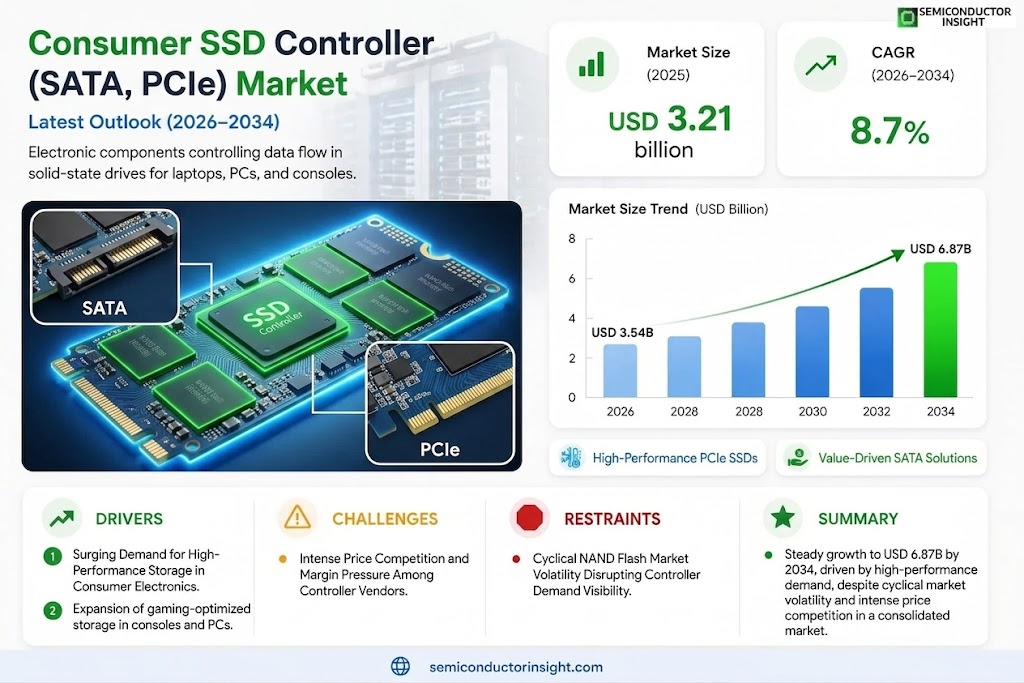
Consumer SSD Controller (SATA, PCIe) Market size was valued at USD 3.21 billion in 2025. The market is projected to grow from USD 3.54 billion in 2026 to USD 6.87 billion by 2034, exhibiting a CAGR of 7.6% during the forecast period.
Consumer SSD controllers are specialized semiconductor chips that manage data storage and retrieval operations within solid-state drives, serving as the core intelligence behind NAND flash memory management. These controllers handle critical functions including wear leveling, error correction, data encryption, and garbage collection, and are broadly categorized by interface type namely SATA (Serial ATA) and PCIe (Peripheral Component Interconnect Express). While SATA-based controllers continue to serve cost-sensitive mainstream applications, PCIe-based controllers, particularly those leveraging the NVMe protocol, have rapidly gained traction due to their substantially higher bandwidth and lower latency advantages.
The market is witnessing robust expansion driven by the accelerating global shift from traditional hard disk drives to SSDs across laptops, desktops, and gaming devices. Furthermore, the rising adoption of PCIe Gen 4 and Gen 5 NVMe SSDs in consumer electronics is pushing controller manufacturers to innovate at a faster pace. Key players such as Silicon Motion Technology Corporation, Phison Electronics, Maxiotek, and Marvell Technology are actively strengthening their product portfolios to address growing consumer demand for higher sequential read/write speeds and improved power efficiency across premium and mid-range storage segments.
MARKET DRIVERS
Surging Demand for High-Performance Storage in Consumer Electronics
Consumer SSD Controller (SATA, PCIe) Market has witnessed sustained growth driven by the widespread adoption of solid-state drives across laptops, desktop PCs, and gaming consoles. As consumers increasingly prioritize faster boot times, application load speeds, and seamless multitasking, original equipment manufacturers have accelerated the transition away from traditional hard disk drives. The proliferation of thin-and-light ultrabooks and gaming laptops has made PCIe-based NVMe controllers the preferred choice, given their substantially higher sequential read and write throughput compared to legacy SATA interfaces.
Gaming and Content Creation Fueling PCIe NVMe Controller Adoption
The global gaming industry has emerged as one of the most significant demand generators for advanced SSD controllers. Modern AAA gaming titles with increasingly large installation footprints, combined with next-generation console architectures that mandate high-speed storage, have pushed both Sony and Microsoft to standardize PCIe Gen 4 NVMe SSDs in their platforms. This ecosystem shift has cascaded into the PC gaming market, where consumers routinely upgrade storage to PCIe Gen 4 and Gen 5 NVMe drives. Simultaneously, the rise of 4K and 8K video editing, 3D rendering, and digital content creation has elevated storage performance requirements, reinforcing demand for sophisticated consumer SSD controllers capable of managing dense NAND flash arrays with minimal latency.
➤ The transition from PCIe Gen 3 to Gen 4 and Gen 5 NVMe interfaces represents one of the most consequential inflection points Consumer SSD Controller (SATA, PCIe) Market, as bandwidth requirements double with each successive generation, compelling controller vendors to invest heavily in advanced semiconductor node migrations and signal integrity engineering.
The increasing penetration of SSDs in mid-range and entry-level consumer devices has further broadened the addressable market for SATA and PCIe controller vendors. As NAND flash prices have trended downward over successive technology cycles, SSD adoption has expanded beyond premium segments, enabling controller manufacturers to achieve greater economies of scale. This democratization of solid-state storage continues to underpin volume growth across Consumer SSD Controller (SATA, PCIe) Market, supporting sustained revenue expansion for fabless controller design houses and vertically integrated NAND manufacturers alike.
MARKET CHALLENGES
Intense Price Competition and Margin Pressure Among Controller Vendors
Consumer SSD Controller (SATA, PCIe) Market is characterized by a highly consolidated competitive landscape dominated by a limited number of established fabless semiconductor companies. This concentration, combined with aggressive pricing strategies from vertically integrated NAND manufacturers who develop proprietary in-house controllers, creates persistent margin compression for independent controller suppliers. Vendors are compelled to continuously reduce bill-of-materials costs while simultaneously investing in next-generation controller architectures, creating a challenging financial equilibrium that disadvantages smaller players lacking the scale to absorb extended periods of reduced profitability.
Other Challenges
NAND Flash Interface Compatibility Complexity
Consumer SSD controller developers must maintain compatibility across multiple NAND flash generations, including TLC, QLC, and emerging PLC technologies, each presenting distinct error correction, endurance, and read-disturb management challenges. The engineering overhead required to develop and validate advanced LDPC error correction engines, wear-leveling algorithms, and garbage collection logic across diverse NAND vendor specifications significantly extends development cycles and increases non-recurring engineering costs, constraining the pace at which controller vendors can bring new products to market.
Thermal Management and Power Efficiency Constraints
As PCIe Gen 4 and Gen 5 consumer SSD controllers push performance envelopes, thermal dissipation has become a critical design challenge, particularly in thermally constrained form factors such as M.2 2280 modules used in ultrabooks and compact desktops. Sustained sequential workloads can trigger thermal throttling that undermines advertised performance specifications, creating consumer dissatisfaction and warranty liability. Balancing peak throughput with power efficiency within strict thermal design envelopes requires advanced low-power design methodologies and process node optimization, adding complexity and cost to controller development programs withConsumer SSD Controller (SATA, PCIe) Market.
MARKET RESTRAINTS
Cyclical NAND Flash Market Volatility Disrupting Controller Demand Visibility
Consumer SSD Controller (SATA, PCIe) Market is intrinsically linked to the cyclical nature of the global NAND flash memory market. Periods of oversupply and aggressive NAND price reductions, while beneficial for end consumers, can trigger inventory correction cycles among SSD manufacturers and OEM customers that temporarily suppress controller shipment volumes. Conversely, supply tightness can slow SSD production ramp, reducing controller attach rates. This inherent demand volatility complicates revenue forecasting for controller vendors and discourages long-term capital commitments, particularly among smaller independent suppliers that lack diversified product portfolios capable of offsetting segment-specific downturns.
Gradual Saturation of SATA SSD Controller Segment
The legacy SATA interface, while still relevant in cost-sensitive consumer applications and replacement storage markets, faces structural demand headwinds as PCIe NVMe becomes the default standard across new consumer device designs. Major PC OEMs have progressively eliminated SATA M.2 slots from mainstream laptop platforms, and the proportion of new consumer PCs shipping with SATA-only storage configurations continues to decline. This secular transition constrains volume growth for SATA SSD controllers, limiting the long-term revenue contribution of this segment within the broader Consumer SSD Controller (SATA, PCIe) Market. Vendors with disproportionate revenue exposure to SATA controllers face strategic pressure to accelerate their PCIe portfolio transitions to preserve competitive relevance.
Geopolitical factors, including export controls on advanced semiconductors and restrictions affecting cross-border supply chains, represent an additional structural restraint for Consumer SSD Controller (SATA, PCIe) Market. Controller vendors that rely on leading-edge foundry capacity concentrated in specific geographies face supply chain concentration risk, while trade policy uncertainty can disrupt customer procurement planning and introduce qualification delays for new controller silicon. These macro-level constraints add complexity to an already capital-intensive market environment and may impede the pace of technology adoption across certain regional consumer markets.
MARKET OPPORTUNITIES
PCIe Gen 5 NVMe Controller Development Opening Premium Market Segment
The commercial introduction of PCIe Gen 5 NVMe consumer SSD controllers represents a significant near-term opportunity for leading controller vendors capable of delivering validated silicon on advanced process nodes. With sequential read speeds exceeding 12 GB/s achievable under the Gen 5 specification, early adopters in the enthusiast PC and professional workstation segments are willing to pay substantial premiums for cutting-edge storage performance. Controller vendors that successfully achieve high-volume production of Gen 5 consumer SSD controllers ahead of competitors can capture disproportionate share in the premium segment, establishing platform relationships with leading SSD brands and OEM customers that generate recurring design-win revenue through successive product generations withConsumer SSD Controller (SATA, PCIe) Market.
Emerging Markets and PC Refresh Cycles Creating Volume Expansion Opportunities
Large consumer electronics markets across Southeast Asia, Latin America, and Sub-Saharan Africa represent underpenetrated growth frontiers for Consumer SSD Controller (SATA, PCIe) Market, as rising disposable incomes and expanding digital infrastructure investments support accelerating PC and consumer device adoption. In these regions, value-segment PCIe Gen 3 and SATA SSD controllers continue to command meaningful volume demand, providing established vendors with opportunities to extend product lifecycles and generate incremental revenue from mature controller platforms. Additionally, the ongoing global PC refresh cycle, driven by the expiration of Windows 10 extended support and the consequent migration to Windows 11-compatible hardware, is expected to sustain elevated SSD replacement demand through the near-to-medium term, benefiting controller suppliers across both SATA and PCIe interface categories.
The integration of artificial intelligence-driven NAND management algorithms within next-generation consumer SSD controllers presents a differentiated technology opportunity for vendors investing in intelligent firmware architectures. AI-enhanced predictive wear leveling, adaptive read-retry optimization, and machine learning-based thermal management can meaningfully extend drive endurance and maintain consistent performance under real-world consumer workloads, providing a compelling value proposition that supports premium pricing and brand differentiation. As consumer awareness of SSD reliability and longevity metrics continues to mature, controller vendors that embed demonstrable AI-driven performance and endurance advantages into their products are well positioned to capture incremental design wins and strengthen their competitive standing within the evolving Consumer SSD Controller (SATA, PCIe) Market landscape.
Trends
Accelerating Transition from HDD to SSD Driving Controller Demand
Consumer SSD Controller (SATA, PCIe) Market is undergoing a significant transformation as the global shift from traditional hard disk drives to solid-state drives gains momentum across laptops, desktops, and gaming devices. Consumer SSD controllers, which serve as the core semiconductor intelligence managing NAND flash memory operations, are increasingly central to this hardware evolution. Functions such as wear leveling, error correction, data encryption, and garbage collection are handled by these controllers, making their performance critical to overall SSD quality. As consumer expectations for faster boot times, quicker application load speeds, and improved system responsiveness grow, manufacturers are under continuous pressure to deliver more capable and efficient controller solutions across both mainstream and premium segments.
Other Trends
Rise of PCIe Gen 4 and Gen 5 NVMe Controllers
One of the most prominent trends shaping Consumer SSD Controller (SATA, PCIe) Market is the rapid adoption of PCIe Gen 4 and Gen 5 NVMe-based controllers. Unlike SATA-based controllers, which continue to serve cost-sensitive and legacy applications, PCIe controllers leveraging the NVMe protocol deliver substantially higher bandwidth and lower latency attributes increasingly demanded by gaming enthusiasts, content creators, and high-performance computing users. Leading players including Silicon Motion Technology Corporation, Phison Electronics, Maxiotek, and Marvell Technology are actively developing next-generation PCIe controller architectures to capitalize on this growing demand for high sequential read and write speeds.
SATA Controllers Retaining Relevance in Cost-Sensitive Segments
Despite the strong push toward PCIe NVMe solutions, SATA-based SSD controllers continue to hold a relevant position withConsumer SSD Controller (SATA, PCIe) Market. Budget laptops, entry-level desktops, and value-oriented consumer devices still rely on SATA interface storage where price-to-performance balance outweighs peak speed requirements. Controller vendors are therefore maintaining dual product strategies, sustaining SATA controller development while aggressively investing in PCIe roadmaps to serve the full spectrum of consumer demand.
Power Efficiency and Thermal Management Emerging as Key Differentiators
As portable and thin-and-light devices become increasingly dominant in the consumer electronics space, power efficiency and thermal management are emerging as critical differentiators Consumer SSD Controller (SATA, PCIe) Market. Controller manufacturers are integrating advanced power-gating technologies and optimized firmware algorithms to reduce active and idle power consumption without compromising storage throughput. This trend is particularly relevant for ultrabooks and handheld gaming devices, where thermal constraints are stringent. Vendors that successfully balance high performance with low power draw are expected to secure stronger design wins across premium consumer SSD platforms in the coming years.
COMPETITIVE LANDSCAPE
Key Industry Players
Consumer SSD Controller (SATA, PCIe) Market: Competitive Dynamics and Leading Semiconductor Innovators
Global Consumer SSD Controller (SATA, PCIe) Market is characterized by intense competition among a concentrated group of specialized semiconductor companies, with Silicon Motion Technology Corporation and Phison Electronics emerging as dominant forces across both SATA and PCIe NVMe controller segments. These leading players have established strong design-win pipelines with major NAND flash manufacturers and SSD brands, enabling them to capture significant market share across mainstream, mid-range, and premium consumer storage tiers. The competitive intensity has further escalated as PCIe Gen 4 and Gen 5 NVMe adoption accelerates, compelling controller vendors to invest heavily in advanced process nodes and firmware architectures that deliver superior sequential read/write throughput, robust error correction capabilities, and optimized power efficiency. Marvell Technology has also reinforced its competitive positioning by targeting high-performance consumer NVMe segments, while Maxiotek has carved a notable presence particularly in cost-sensitive SATA and entry-level PCIe controller applications, especially within the Asia-Pacific supply chain ecosystem.
Beyond the tier-one incumbents, several niche and emerging players are actively reshaping the competitive landscape of the consumer SSD controller market. Innogrit, a Shanghai-based fabless semiconductor firm, has rapidly gained recognition with its high-performance PCIe Gen 4 and Gen 5 controller solutions targeting premium consumer SSDs. Realtek Semiconductor continues to maintain a steady foothold in the SATA controller segment, leveraging its broad customer network across value-tier SSD manufacturers. ADATA’s in-house controller development efforts, alongside contributions from companies such as Yangtze Memory Technologies (YMTC) through its vertically integrated flash-plus-controller approach, reflect a broader industry trend toward vertical integration and supply chain consolidation. As the market is projected to grow from USD 3.54 billion in 2026 to USD 6.87 billion by 2034 at a CAGR of 7.6%, competitive differentiation will increasingly hinge on NVMe protocol optimization, AI-assisted wear leveling algorithms, and seamless compatibility with next-generation NAND flash architectures from leading memory manufacturers.
List of Key Consumer SSD Controller (SATA, PCIe) Companies Profiled
- Silicon Motion Technology Corporation
- Phison Electronics Corporation
- Marvell Technology, Inc.
- Innogrit Corporation
- Maxiotek (MaxLinear Storage)
- Realtek Semiconductor Corp.
- Microchip Technology Inc. (Microsemi)
- Samsung Semiconductor (In-House Controller Division)
- Western Digital Corporation (In-House Controller Division)
- Kioxia Holdings Corporation (In-House Controller Division)
- Micron Technology, Inc. (In-House Controller Division)
- ADATA Technology Co., Ltd.
- Shenzhen Longsys Electronics Co., Ltd.
- Yangtze Memory Technologies Co., Ltd. (YMTC)
- ScaleFlux, Inc.
Segment Analysis:
| Segment Category | Sub-Segments | Key Insights |
| By Type |
|
PCIe SSD Controllers (NVMe) represent the leading and fastest-growing segment within the consumer SSD controller market, driven by a confluence of technological and demand-side forces:
|
| By Application |
|
Laptops & Ultrabooks constitute the dominant application segment for consumer SSD controllers, propelled by persistent global trends toward mobile computing and thin-form-factor device design:
|
| By End User |
|
Individual Consumers form the broadest end-user segment, encompassing mainstream buyers who are progressively upgrading from HDD-based systems to SSD-equipped devices across both laptop and desktop platforms:
|
| By NAND Flash Compatibility |
|
TLC NAND Controllers lead this segment, representing the mainstream standard for consumer SSD deployments due to their well-balanced trade-off between storage density, endurance, and cost-effectiveness:
|
| By Form Factor |
|
M.2 Form Factor controllers dominate this segment, reflecting the industry-wide standardization around the compact M.2 slot across virtually all modern consumer laptop and desktop motherboard designs:
|
Regional Analysis: Consumer SSD Controller (SATA, PCIe) Market
Asia-Pacific
Asia-Pacific hosts the world’s most concentrated cluster of NAND flash and SSD controller manufacturers. Companies based in Taiwan, South Korea, and mainland China command significant global market share in consumer SSD controller design and production. This proximity of chip design, wafer fabrication, and device assembly enables the region to iterate rapidly on SATA and PCIe controller generations, reinforcing its competitive leadership in the Consumer SSD Controller market.
The region is at the forefront of consumer PCIe NVMe controller adoption, with smartphone OEMs and PC brands rapidly transitioning away from legacy SATA interfaces toward PCIe Gen 4 and emerging Gen 5 platforms. South Korean and Taiwanese fabless controller designers are pioneering low-power, high-throughput architectures tailored for ultrabooks and gaming handhelds, ensuring Asia-Pacific leads the technology transition withConsumer SSD Controller (SATA, PCIe) Market landscape.
National semiconductor strategies across China, Japan, South Korea, and India are channeling substantial public and private investment into SSD controller R&D and fabrication capacity. China’s push for domestic semiconductor self-reliance is spurring a new generation of homegrown consumer SSD controller vendors, while Japan and South Korea are reinforcing existing leadership through advanced process node investments, collectively strengthening the regional Consumer SSD Controller (SATA, PCIe) Market ecosystem.
Rising disposable incomes, expanding gaming communities, and accelerating PC penetration across Southeast Asia and India are creating new demand pools for both entry-level SATA and premium PCIe SSD controllers. The proliferation of affordable consumer laptops and gaming devices in emerging Asian markets is encouraging controller vendors to develop tiered product portfolios, broadening the addressable Consumer SSD Controller market across diverse consumer income segments.
North America
North America represents one of the most mature and innovation-driven regions withConsumer SSD Controller (SATA, PCIe) Market. The United States, in particular, is home to influential fabless semiconductor companies that have pioneered PCIe NVMe controller architectures adopted widely across the global consumer market. Robust consumer spending on premium laptops, gaming PCs, and high-performance workstations sustains consistently strong demand for advanced SSD controllers operating on PCIe Gen 4 and Gen 5 interfaces. The region’s well-established retail and e-commerce channels accelerate consumer upgrade cycles, encouraging replacement of older SATA-based drives with faster PCIe NVMe alternatives. Additionally, North America’s position as a global technology trendsetter influences product roadmaps of controller vendors worldwide. Strategic partnerships between North American chip designers and Asian manufacturers further reinforce the region’s pivotal role in shaping Consumer SSD Controller (SATA, PCIe) Market trajectory through the 2026–2034 forecast period.
Europe
Europe occupies a significant position Consumer SSD Controller (SATA, PCIe) Market, characterized by strong demand for high-quality consumer storage solutions across Germany, France, the United Kingdom, and the Nordic countries. European consumers demonstrate a pronounced preference for premium, energy-efficient devices, driving demand for PCIe-based SSD controllers that deliver superior performance without compromising thermal efficiency a consideration particularly relevant in the region’s growing ultrabook and thin-and-light laptop segments. The gradual phase-out of legacy SATA drives in favor of PCIe NVMe solutions is well underway across mainstream consumer PC categories. Europe’s stringent regulatory environment around electronics sustainability and energy consumption is also influencing SSD controller design requirements, prompting vendors to optimize controller firmware and power management architectures. The region’s robust gaming community and growing content creation demographic further bolster demand for high-bandwidth PCIe SSD controller solutions.
South America
South America presents an emerging growth frontier for Consumer SSD Controller (SATA, PCIe) Market, with Brazil and Argentina serving as the primary demand centers. While economic constraints have historically limited rapid technology adoption, the increasing affordability of SATA and entry-level PCIe NVMe SSDs is enabling broader consumer access to solid-state storage solutions across the region. The expansion of consumer electronics retail networks and rising internet penetration are accelerating awareness and adoption of SSD-equipped devices among urban middle-class consumers. Local PC assembly industries in Brazil, supported by government-backed manufacturing incentive programs, are beginning to incorporate more SSD solutions, gradually replacing traditional HDD configurations. Although SATA controller-based drives still command a notable share of the regional market due to cost sensitivity, PCIe adoption is projected to gain meaningful momentum as controller prices continue to decline throughout the forecast horizon.
Middle East & Africa
The Middle East and Africa region represents a nascent but progressively evolving segment of Global Consumer SSD Controller (SATA, PCIe) Market. Rapid urbanization, expanding youth populations with growing digital literacy, and increased government investment in technology infrastructure across Gulf Cooperation Council (GCC) nations are collectively fostering demand for consumer computing devices equipped with SSD storage. In the Middle East, premium consumer electronics markets in the UAE and Saudi Arabia are witnessing increasing uptake of PCIe NVMe SSD-equipped laptops and gaming systems, supporting demand for advanced controller solutions. Sub-Saharan Africa, while still primarily driven by entry-level and cost-optimized device categories where SATA controllers remain relevant, is experiencing gradual modernization. As regional distributors expand their consumer electronics portfolios and SSD-equipped devices become more price-competitive, the Middle East and Africa market is expected to contribute incrementally to Global Consumer SSD Controller (SATA, PCIe) Market growth through 2034.
Report Scope
This market research report provides a comprehensive analysis of the Consumer SSD Controller (SATA, PCIe) Market , covering the forecast period 2026–2034. It offers detailed insights into market dynamics, technological advancements, competitive landscape, and key trends shaping the industry.
Key focus areas of the report include:
- Market Overview: The report begins with an overview outlining its current market scenario, key growth indicators, and industry transformation drivers. It discusses macroeconomic factors, demand–supply balance, regulatory landscape, and the strategic role of semiconductors in powering advancements across industries such as automotive, telecommunications, consumer electronics, and industrial automation.
- Market Size & Forecast: Historical data and future projections for revenue, unit shipments, and market value across major regions and segments.
- Segmentation Analysis: Detailed breakdown by product type, technology, application, and end-user industry to identify high-growth segments and investment opportunities.
- Regional Insights: Insights into market performance across North America, Europe, Asia-Pacific, Latin America, and the Middle East & Africa, including country-level analysis where relevant.
- Competitive Landscape: Profiles of leading market participants, including their product offerings, R&D focus, manufacturing capacity, pricing strategies, and recent developments such as mergers, acquisitions, and partnerships.
- Technology Trends & Innovation: Assessment of emerging technologies, integration of AI/IoT, semiconductor design trends, fabrication techniques, and evolving industry standards.
- Market Drivers & Restraints: Evaluation of factors driving market growth along with challenges, supply chain constraints, regulatory issues, and market-entry barriers.
- Stakeholder Insights: Insights for component suppliers, OEMs, system integrators, investors, and policymakers regarding the evolving ecosystem and strategic opportunities.
Primary and secondary research methods are employed, including interviews with industry experts, data from verified sources, and real-time market intelligence to ensure the accuracy and reliability of the insights presented.
FREQUENTLY ASKED QUESTIONS:
What is the current market size of Consumer SSD Controller (SATA, PCIe) Market?
-> Consumer SSD Controller (SATA, PCIe) Market was valued at USD 3.21 billion in 2025 and is expected to reach USD 6.87 billion by 2034, growing at a CAGR of 7.6% during the forecast period from 2026 to 2034.
Which key companies operate Consumer SSD Controller (SATA, PCIe) Market?
-> Key players include Silicon Motion Technology Corporation, Phison Electronics, Maxiotek, and Marvell Technology, among others, all actively strengthening their product portfolios to address growing consumer demand.
What are the key growth drivers?
-> Key growth drivers include the accelerating global shift from traditional hard disk drives to SSDs across laptops, desktops, and gaming devices, as well as the rising adoption of PCIe Gen 4 and Gen 5 NVMe SSDs in consumer electronics pushing controller manufacturers to innovate at a faster pace.
Which region dominates the market?
-> Asia-Pacific is the fastest-growing region Consumer SSD Controller (SATA, PCIe) Market, driven by strong manufacturing capabilities and rising consumer electronics demand.
What are the emerging trends?
-> Emerging trends include the rapid adoption of PCIe-based controllers leveraging the NVMe protocol, growing demand for higher sequential read/write speeds and improved power efficiency, and continued innovation in wear leveling, error correction, data encryption, and garbage collection technologies across premium and mid-range storage segments.

Get Sample Report PDF for Exclusive Insights
Report Sample Includes
- Table of Contents
- List of Tables & Figures
- Charts, Research Methodology, and more...
 Download Sample Report PDF