Coin Battery Holder Market Insights
Coin Battery Holder market is forecasted to increase from USD 520 million in 2026 to USD 910 million by 2034, exhibiting a CAGR of 6.7 % during the forecast period.
Coin battery holders are miniature mounting components designed to secure coin‑cell batteries,typically lithium‑based CR series,within electronic devices. They provide reliable electrical contact through spring‑loaded or fixed contacts and are available in surface‑mount and through‑hole configurations, catering to compact wearables, medical implants, and timing devices.
The sector’s expansion reflects broader demand for compact power solutions as wearable technology and IoT devices proliferate worldwide. Growth is reinforced by the button‑battery segment’s rise,valued at approximately USD 4,423 million in 2022 and slated for USD 6,715 million by 2029 (CAGR 6.3%),which fuels holder consumption. Leading manufacturers such as Memory Protection Devices, Wurth Elektronik, Renata SA, Harwin and TE Connectivity dominate roughly half of global sales, while the Asia‑Pacific region commands over 45 % of volume due largely to high production capacity in China and Japan.
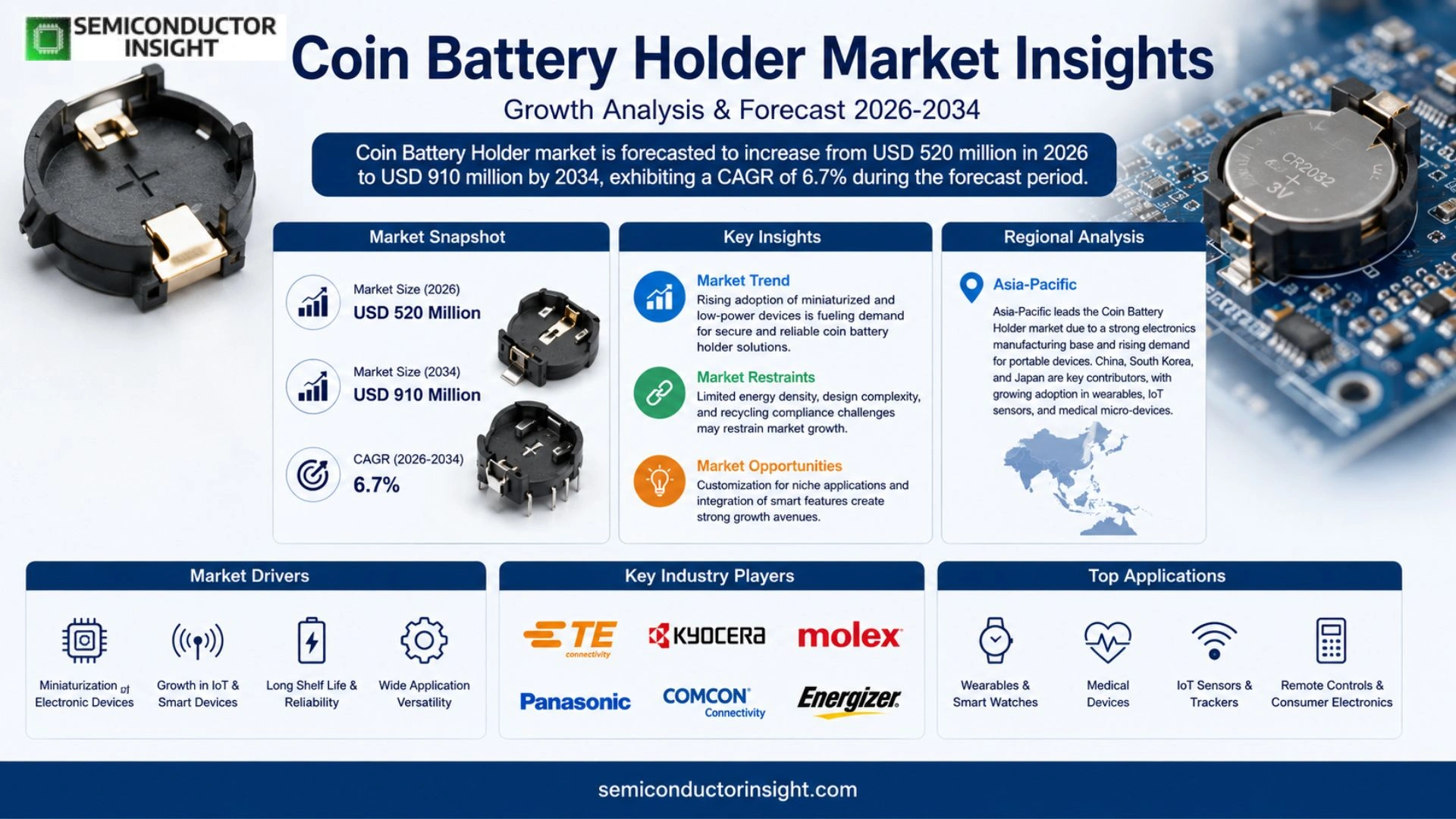
MARKET DRIVERS
Rising demand for compact power solutions
The surge in portable electronics,ranging from smart watches to miniature medical implants,creates a palpable need for space‑efficient power sources. Coin‑cell formats, paired with purpose‑built holders, satisfy the stringent size constraints while delivering reliable voltage. Manufacturers that integrate these holders into design cycles can shorten time‑to‑market, a competitive edge that resonates with OEMs seeking agility.
Expansion of wearable and IoT ecosystems
Wearable health monitors and low‑power IoT sensors are proliferating across consumer and industrial settings. Their reliance on long‑life, low‑maintenance power makes the coin‑battery holder an indispensable component. As device counts climb, procurement volumes for holders increase proportionally, prompting suppliers to scale production and achieve cost efficiencies.
➤ Design engineers prize the modularity of coin holders, which unlocks rapid prototyping and iterative testing.
Beyond product design, logistics teams benefit from the standardized dimensions of holders, simplifying inventory handling and reducing warehouse footprint. This operational simplicity feeds back into lower total cost of ownership for end users, reinforcing market momentum.
MARKET CHALLENGES
Stringent safety and compliance requirements
Regulatory bodies across regions impose rigorous standards for battery containment, especially in medical and aerospace applications. Meeting these criteria demands precise material selection and thorough testing, which can inflate development budgets and extend certification timelines.
Other Challenges
Supply chain volatility
Fluctuations in raw material prices,particularly copper and nickel used in contacts,create cost unpredictability. Manufacturers that lack diversified sourcing strategies may experience margin compression during price spikes.
MARKET RESTRAINTS
Limited energy density compared with alternative formats
While coin‑cell holders excel in size, their capacity lags behind pouch or cylindrical batteries. Applications that outgrow the modest mAh ratings are forced to adopt larger solutions, curbing broader adoption of the holder format.
Furthermore, the mechanical tolerance required for reliable contact pressure adds design complexity. Engineers must balance sufficient retention force against the risk of damaging delicate cells, a trade‑off that can deter some product teams.
Finally, end‑of‑life recycling regulations are tightening, and the composite materials often used in holders complicate compliant disposal, potentially imposing additional compliance costs on manufacturers.
MARKET OPPORTUNITIES
Customization for niche verticals
Emerging sectors such as precision agriculture sensors and low‑power edge AI modules require bespoke holder designs that accommodate unconventional cell geometries. Suppliers that invest in flexible tooling can capture premium pricing by addressing these specialized needs.
Another avenue lies in the integration of smart features,such as RFID tagging or embedded moisture sensors,directly into holders. This added data layer enables predictive maintenance and inventory tracking, a value proposition increasingly sought after by large‑scale distributors.
Lastly, the global push toward greener electronics fuels demand for recyclable holder constructs. Companies that pioneer biodegradable or fully recyclable polymer housings will likely differentiate themselves as sustainability standards tighten across supply chains.
Coin Battery Holder Market Trends
Miniaturization and Surface‑Mount Adoption
The push for ever‑smaller electronic modules has accelerated demand for surface‑mount coin battery holders. Designers of wearables, IoT sensors, and compact medical devices now favor surface‑mount footprints because they enable automated placement, reduce board real‑estate, and improve reliability under vibration. This technical shift is underpinned by the proliferation of 2025‑class wearable health monitors that require sub‑5 mm battery solutions. As manufacturers re‑engineer product lines to accommodate these footprints, procurement volumes for surface‑mount holders are rising faster than for traditional through‑hole variants, reshaping supplier production schedules.
Other Trends
Application Diversification in Healthcare
While watches and consumer electronics have long driven Coin Battery Holder market, medical equipment now represents a growing segment. Portable diagnostic tools, implantable monitoring units, and point‑of‑care testing devices increasingly embed coin cells because of their long shelf‑life and stable voltage. Regulatory approval cycles for such devices often span several years, prompting OEMs to lock‑in long‑term contracts with holder manufacturers. This creates a more predictable revenue stream for suppliers, but also raises the bar for quality‑control processes and traceability throughout the supply chain.
Competitive Consolidation Among Top Five Players
The latest competitive analysis shows that the five leading firms,Varta Microbattery, Panasonic, Murata, Energizer (Rayovac), and EVE Energy,jointly control roughly half of global supply. Their dominance stems from extensive component portfolios, global distribution networks, and strategic investments in advanced manufacturing. Smaller entrants are seeking niche differentiation through specialty formats (e.g., high‑temperature holders) or by targeting emerging markets where price sensitivity outweighs brand premium. This bifurcation forces the leading group to innovate continuously while defending market share against agile newcomers.
Regionally, Asia‑Pacific accounts for more than 45 % of total holder shipments, bolstered by domestic consumer‑electronics production and a burgeoning medical‑device ecosystem. North America and Europe together represent about 45 % of demand, with the former leaning heavily toward automotive and industrial IoT applications, and the latter emphasizing stringent safety standards in medical devices. Companies that can synchronize product roadmaps with these regional preferences,such as offering low‑lead‑time inventory in China while providing certified high‑reliability parts for Europe,will capture incremental growth. In practice, this translates into a need for flexible sourcing strategies, diversified material suppliers, and proactive engagement with regulatory bodies.
Overall, Coin Battery Holder market is being reshaped by technology‑driven design trends, the expanding role of healthcare applications, and a competitive landscape where scale and specialization coexist. Firms that align their manufacturing agility with the evolving requirements of surface‑mount adoption and regional nuances will be best positioned to translate these macro forces into sustainable profit expansion.
COMPETITIVE LANDSCAPE
Key Industry Players
Coin Battery Holder Market – Competitive Overview
The holder segment is heavily anchored by a handful of multinational manufacturers whose integrated supply chains and deep R&D budgets allow them to offer both surface‑mount and through‑hole solutions at scale. Panasonic, leveraging its extensive portfolio of miniaturized power modules, commands the largest share in the Asia‑Pacific corridor, where OEMs in consumer electronics and medical devices demand high‑reliability packaging. Varta Microbattery follows closely, differentiating through a focus on high‑energy‑density cells that pair with premium holder designs, enabling it to secure contracts with major wearable‑device brands. The concentration of the top five firms,Panasonic, Varta, Murata, Energizer (Rayovac) and EVE Energy,covers roughly half of global shipments, reinforcing a competitive environment where price elasticity is limited and differentiation hinges on material engineering and rapid design‑for‑manufacturing capabilities.
Beyond the dominant tier, a diverse set of specialist suppliers occupies niche corridors that are increasingly attractive to designers seeking bespoke form‑factors or stricter regulatory compliance. Memory Protection Devices, Wurth Elektronik and Renata SA have built reputations for ultra‑low‑profile holders used in aerospace and high‑precision instrumentation. Harwin and Keystone Electronics excel in ruggedized through‑hole packages for industrial controllers, while Linx Technologies, Adam Tech and TE Connectivity supply high‑volume connectors that integrate holder clips for streamlined assembly lines. Ming Chiang Precision, NTE Electronics and TAKACHI round out the field with regionally focused production that serves emerging markets in Southeast Asia and Latin America, offering competitive lead times and localized support that larger players struggle to match.
List of Key Coin Battery Holder Companies Profiled
- Panasonic
- Varta Microbattery
- Murata Manufacturing
- Energizer (Rayovac)
- EVE Energy
- Memory Protection Devices
- Würth Elektronik
- Renata SA
- Harwin
- Keystone Electronics
- Linx Technologies
- Adam Tech
- TE Connectivity
- Ming Chiang Precision Co.
- NTE Electronics
- TAKACHI
Segment Analysis:
| Segment Category | Sub-Segments | Key Insights |
| By Type |
|
Surface Mount is favored for its compact footprint and ease of automated assembly; it aligns with high‑density electronic designs and supports rapid production cycles; manufacturers emphasize robust solder reliability and compatible PCB layouts, making it the preferred choice for next‑generation portable devices. |
| By Application |
|
Wearable Device drives demand for ultra‑thin holders that fit ergonomic form factors; designers prioritize long‑term reliability under flexing conditions; the segment benefits from increasing consumer focus on health monitoring, prompting suppliers to enhance corrosion resistance and secure mechanical locking mechanisms. |
| By End User |
|
Consumer Electronics remains the dominant end‑user, seeking cost‑effective yet dependable holders for mass‑market gadgets; product development focuses on streamlined supply chains and low‑profile designs; the segment also values ease of integration with diverse PCB layouts, reinforcing its leadership position. |
| By Material |
|
Nickel‑plated is preferred for its balance of conductivity and corrosion resistance; it supports a broad temperature range, which is critical for devices operating in harsh environments; suppliers highlight consistent plating thickness to ensure reliable contact performance. |
| By Connectivity |
|
SMD connectors are gaining traction due to their compatibility with surface‑mount processes; they enable tighter component spacing, support fast production rates, and reduce assembly errors; industry players stress the importance of precise tolerance control to meet stringent quality standards. |
Regional Analysis: Coin Battery Holder Market
A considerable portion of coin‑battery housings originates from high‑volume factories in Guangdong and Taiwan, where automated extrusion lines pair with precision molding. These hubs leverage economies of scale to keep unit costs low, permitting OEMs to price devices competitively while preserving margins. The concentration also fosters rapid iteration cycles, so design tweaks can be rolled out in weeks rather than months.
Beyond conventional remote controls, developers are embedding coin‑battery holders in wearable health monitors and smart‑home sensors. These applications prioritize miniature form‑factors, driving demand for thinner walls and higher amp‑hour densities. Suppliers that can balance miniaturization with safety certifications are capturing early‑adopter contracts.
Regional authorities are tightening standards on lead‑free solder and flame‑retardant polymers. Compliance is becoming a market entry gate, especially for medical‑grade devices that must meet ISO 13485. Companies investing in compliant material streams avoid costly redesigns and can market their products as “globally certified.”
Digital twins of production lines are being piloted to predict tooling wear and optimize resin flow. This data‑driven approach cuts scrap rates and shortens time‑to‑market, giving manufacturers a tactical edge when OEMs request rapid product launches.
North America
North America maintains a sizable share of Coin Battery Holder market, driven largely by demand from high‑end consumer electronics and defense contracts. U.S. manufacturers emphasize strict quality‑control protocols, often integrating advanced analytics into their manufacturing footprints to assure consistency for aerospace and medical equipment. The region’s emphasis on sustainability pushes suppliers toward recyclable polymer blends, influencing procurement decisions for OEMs that tout green credentials. While labor costs are higher than in Asia‑Pacific, the premium placed on reliability and regulatory compliance sustains a niche that commands higher margins.
Europe
European players distinguish themselves through rigorous environmental standards and a strong focus on circular economy principles. Countries such as Germany and Sweden champion reusable battery‑holder designs that align with EU directives on waste reduction. This regulatory backdrop stimulates innovation in modular housings that can be detached and recycled without compromising device integrity. The market here leans toward premium applications,medical diagnostics and automotive key‑fobs,where durability and compliance outweigh pure cost considerations, prompting manufacturers to invest in high‑precision tooling.
South America
In South America, Coin Battery Holder market is shaped by expanding mobile‑device penetration and a growing appetite for low‑cost consumer gadgets. Local assemblers often source components from neighboring Brazil, benefiting from regional trade agreements that lower tariffs. However, infrastructural constraints sometimes limit the adoption of cutting‑edge polymer technologies, leading firms to rely on legacy materials. Companies that can bridge the gap between cost efficiency and incremental quality improvements are poised to secure market share as consumer expectations evolve.
Middle East & Africa
The Middle East & Africa region displays a heterogeneous profile, with affluent Gulf markets adopting sophisticated wearable technologies while sub‑Saharan economies focus on basic portable electronics. Investment in renewable‑energy projects drives demand for rugged, temperature‑resistant battery carriers, especially for off‑grid sensor networks. Meanwhile, distributors in North Africa are aligning with European standards to serve cross‑border trade, encouraging a gradual uplift in product specifications across the continent.
Report Scope
This market research report provides a comprehensive analysis of the Coin Battery Holder Market , covering the forecast period 2026–2034. It offers detailed insights into market dynamics, technological advancements, competitive landscape, and key trends shaping the industry.
Key focus areas of the report include:
- Market Overview: The report begins with an overview outlining its current market scenario, key growth indicators, and industry transformation drivers. It discusses macroeconomic factors, demand–supply balance, regulatory landscape, and the strategic role of semiconductors in powering advancements across industries such as automotive, telecommunications, consumer electronics, and industrial automation.
- Market Size & Forecast: Historical data and future projections for revenue, unit shipments, and market value across major regions and segments.
- Segmentation Analysis: Detailed breakdown by product type, technology, application, and end-user industry to identify high-growth segments and investment opportunities.
- Regional Insights: Insights into market performance across North America, Europe, Asia-Pacific, Latin America, and the Middle East & Africa, including country-level analysis where relevant.
- Competitive Landscape: Profiles of leading market participants, including their product offerings, R&D focus, manufacturing capacity, pricing strategies, and recent developments such as mergers, acquisitions, and partnerships.
- Technology Trends & Innovation: Assessment of emerging technologies, integration of AI/IoT, semiconductor design trends, fabrication techniques, and evolving industry standards.
- Market Drivers & Restraints: Evaluation of factors driving market growth along with challenges, supply chain constraints, regulatory issues, and market-entry barriers.
- Stakeholder Insights: Insights for component suppliers, OEMs, system integrators, investors, and policymakers regarding the evolving ecosystem and strategic opportunities.
Primary and secondary research methods are employed, including interviews with industry experts, data from verified sources, and real-time market intelligence to ensure the accuracy and reliability of the insights presented.
FREQUENTLY ASKED QUESTIONS:
What is the current market size of Coin Battery Holder Market?
-> Coin Battery Holder market is forecasted to increase from USD 520 million in 2026 to USD 910 million by 2034, exhibiting a CAGR of 6.7 %
Which key companies operate in Coin Battery Holder Market?
-> Key players include Varta Microbattery, Panasonic, Murata, Energizer (Rayovac), and EVE Energy, among others.
What are the key growth drivers?
-> Key growth drivers include rising demand for compact power solutions in watches, wearable devices, and medical equipment, as well as the expansion of IoT applications that require reliable miniature energy sources.
Which region dominates the market?
-> Asia-Pacific holds the largest share with more than 45% of global revenue, followed by North America (≈25%) and Europe (≈20%).
What are the emerging trends?
-> Emerging trends include greater adoption of surface‑mount coin battery holders for miniaturized electronics, increased use in medical and wearable applications, and the development of higher‑capacity, safer chemistries to meet stringent regulatory standards.

Get Sample Report PDF for Exclusive Insights
Report Sample Includes
- Table of Contents
- List of Tables & Figures
- Charts, Research Methodology, and more...
 Download Sample Report PDF