CMOS Image Sensor (CIS) for Consumer Market Insights
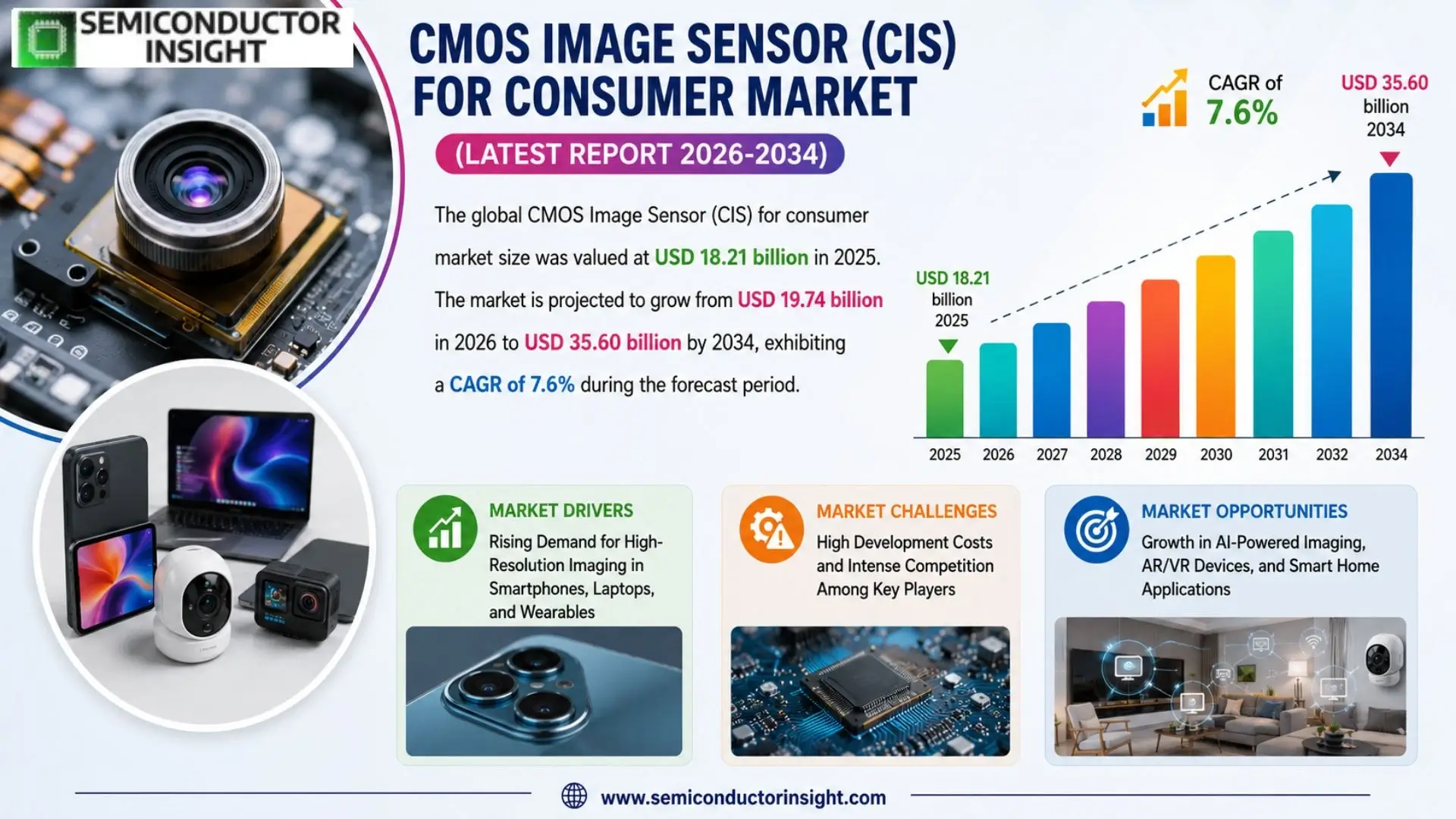
Global CMOS Image Sensor (CIS) for Consumer Market size was valued at USD 18.21 billion in 2025. The market is projected to grow from USD 19.74 billion in 2026 to USD 35.60 billion by 2034, exhibiting a CAGR of 7.6% during the forecast period.
CMOS image sensors are semiconductor devices that convert light into electronic signals, widely integrated into consumer electronics such as smartphones, tablets, digital cameras, laptops, and wearable devices. These sensors operate on complementary metal-oxide-semiconductor technology, offering key advantages including low power consumption, compact form factor, high integration capability, and cost-effective mass production. The consumer segment encompasses a broad range of sensor types, including front-illuminated (FSI), back-illuminated (BSI), and stacked CMOS sensors, each catering to distinct imaging performance requirements across device categories.
The market is witnessing robust expansion driven by the surging demand for multi-camera smartphone configurations, growing adoption of high-resolution imaging in entry-level to premium consumer devices, and rapid advancements in computational photography. Furthermore, the proliferation of AI-enhanced imaging capabilities and the increasing integration of CIS in augmented reality (AR) and virtual reality (VR) devices are opening new growth avenues. Industry leaders such as Sony Semiconductor Solutions Corporation, Samsung Electronics Co., Ltd., OmniVision Technologies, and SK Hynix continue to dominate the competitive landscape with expansive sensor portfolios tailored for diverse consumer applications.
MARKET DRIVERS
Surging Smartphone Adoption and Multi-Camera Integration Accelerating CIS Demand
The proliferation of smartphones equipped with multi-camera systems has emerged as one of the most significant growth catalysts for CMOS Image Sensor (CIS) for Consumer Market. Leading original equipment manufacturers (OEMs) are increasingly integrating three to five camera modules per device, encompassing wide-angle, telephoto, ultrawide, and depth-sensing lenses. This architectural shift has multiplied per-device CIS unit consumption considerably, sustaining robust demand across mid-range and premium smartphone segments. As mobile photography continues to be a primary purchase driver among consumers globally, the appetite for high-resolution, low-light-capable CMOS image sensors remains firmly entrenched.
Rising Consumer Electronics Penetration and the Expansion of Imaging-Enabled Devices
Beyond smartphones, CMOS Image Sensor (CIS) for Consumer Market is benefiting from the rapid expansion of imaging capabilities across a broader consumer electronics ecosystem. Wearables such as smartwatches, action cameras, tablets, laptops with enhanced front-facing cameras, and smart home devices including video doorbells and indoor security cameras are all increasingly reliant on advanced CIS technology. The integration of image sensing into augmented reality (AR) headsets and next-generation gaming peripherals further expands the addressable consumer base. This diversification of end-use applications provides the market with multiple simultaneous demand streams, insulating it from cyclical downturns in any single product category.
➤ The convergence of artificial intelligence-driven computational photography with advanced CMOS Image Sensor architecture is redefining consumer imaging standards, compelling manufacturers to invest in next-generation stacked sensor designs and back-illuminated (BSI) technology to meet evolving end-user expectations.
The adoption of AI-enhanced imaging pipelines, including scene recognition, noise reduction, and real-time bokeh simulation, has elevated performance benchmarks for CMOS image sensors in the consumer market. Sensor manufacturers are responding by delivering higher pixel counts, improved dynamic range, and faster readout speeds. The ongoing transition toward stacked BSI-CMOS architectures, which separate pixel and logic layers for superior light capture and processing efficiency, is enabling a new generation of consumer imaging products that were previously confined to professional-grade equipment.
MARKET CHALLENGES
Intensifying Price Competition and Margin Compression Among CIS Suppliers
CMOS Image Sensor (CIS) for Consumer Market faces persistent pricing pressure driven by fierce competition among a concentrated group of dominant suppliers. As leading manufacturers scale production capacity and mid-tier suppliers from Asia increasingly enter the market with cost-competitive offerings, average selling prices for mainstream consumer-grade sensors have trended downward. While volume growth partially offsets revenue erosion, smaller specialized suppliers find it increasingly difficult to sustain profitability without differentiated technology portfolios. This pricing dynamic also incentivizes OEMs to optimize sensor selection toward lower-cost alternatives, particularly in mass-market smartphone and consumer electronics segments where bill-of-material discipline is critical.
Other Challenges
Supply Chain Concentration and Semiconductor Fab Dependency
CMOS Image Sensor (CIS) for Consumer Market is highly dependent on a limited number of advanced semiconductor fabrication facilities capable of producing leading-edge stacked and BSI sensor designs. Geopolitical tensions, trade restrictions, and periodic capacity constraints at foundry partners introduce supply continuity risks that can disrupt consumer electronics production schedules. The capital-intensive nature of CIS fabrication further limits the speed at which new entrants can scale manufacturing, concentrating supply chain risk around a handful of global players.
Rapid Technology Obsolescence and Shortened Product Lifecycles
Consumer expectations for camera performance in smartphones and imaging devices evolve at an accelerating pace, driven by competitive benchmarking and social media culture. This compresses product lifecycles for CMOS image sensors in the consumer market, requiring manufacturers to sustain elevated research and development expenditures to remain competitive. Sensors that represent leading-edge performance in one product generation may be perceived as commoditized within 18 to 24 months, challenging manufacturers to continuously innovate while managing legacy product portfolios cost-effectively.
MARKET RESTRAINTS
High Capital Investment Requirements Limiting New Entrant Participation
One of the foremost restraints affecting CMOS Image Sensor (CIS) for Consumer Market is the extraordinary level of capital expenditure required to develop and manufacture advanced sensor products. The fabrication of cutting-edge stacked CIS designs demands access to sub-10nm process nodes and specialized wafer-level packaging technologies, investments that run into several billion dollars for state-of-the-art facilities. This creates formidable barriers to entry, effectively consolidating the high-performance consumer CIS segment among a small number of vertically integrated players. Emerging competitors without legacy fabrication assets or foundry relationships face structural disadvantages that limit competitive disruption, potentially slowing the pace of innovation over the longer term.
Smartphone Market Saturation in Mature Economies Tempering Volume Growth
Saturation of smartphone penetration in developed markets across North America, Western Europe, and parts of East Asia represents a structural volume constraint for CMOS Image Sensor (CIS) for Consumer Market. Replacement cycles have lengthened as incremental hardware improvements generate diminishing consumer upgrade motivation. While emerging markets continue to offer volume expansion opportunities, average selling prices in these geographies are typically lower, limiting revenue upside. The reduced frequency of flagship device launches by major OEMs and inventory correction cycles further introduces periodic demand volatility that can weigh on near-term CIS shipment volumes and capacity utilization rates at sensor manufacturers.
MARKET OPPORTUNITIES
Expansion of AR/VR Consumer Devices Creating New High-Value CIS Application Segments
The emergence of consumer-grade augmented reality and virtual reality devices represents a compelling high-growth opportunity for CMOS Image Sensor (CIS) for Consumer Market. Next-generation mixed reality headsets require multiple specialized sensors for environment mapping, eye tracking, hand gesture recognition, and pass-through video, each demanding unique CIS specifications distinct from conventional smartphone applications. As major consumer technology platforms advance their spatial computing hardware roadmaps, demand for purpose-built image sensors optimized for low-latency, high-frame-rate, and compact form-factor requirements is expected to grow substantially, offering CIS manufacturers the opportunity to establish premium-priced product lines beyond the fiercely contested smartphone segment.
Growth of Smart Home and IoT Imaging Devices Broadening the Consumer CIS Addressable Market
The accelerating deployment of smart home ecosystems presents a structurally expanding opportunity for CMOS Image Sensor (CIS) for Consumer Market. Video doorbells, indoor security cameras, smart displays, robotic vacuum cleaners with navigation cameras, and connected appliances with integrated imaging functions collectively represent a large and growing installed base of CIS-enabled consumer devices. Unlike smartphones, many of these product categories are still in relatively early adoption phases, particularly in developing economies, providing sustained incremental volume growth. Furthermore, the integration of on-device AI capabilities for person detection, facial recognition, and anomaly identification is driving consumer willingness to pay for higher-quality sensors in these applications, improving average selling price dynamics for CIS suppliers addressing the smart home segment.
Trends
Rising Demand for Multi-Camera Smartphone Configurations Driving CIS Adoption
CMOS Image Sensor (CIS) for Consumer Market is experiencing a significant upswing, largely propelled by the widespread integration of multi-camera systems in smartphones. Modern consumer devices increasingly feature two, three, or even four rear-facing camera modules, each requiring a dedicated image sensor. This trend has expanded the total addressable sensor count per device considerably. Smartphone manufacturers across premium and mid-range segments are incorporating wide-angle, ultra-wide, telephoto, and depth-sensing lenses, all relying on advanced CMOS image sensors to deliver superior imaging quality. As consumer expectations for mobile photography continue to rise, original equipment manufacturers are investing in higher-resolution, back-illuminated (BSI) and stacked CMOS sensor architectures to meet performance benchmarks while maintaining compact device form factors.
Other Trends
AI-Enhanced Computational Photography
Artificial intelligence is reshaping CMOS Image Sensor (CIS) for Consumer Market by enabling sophisticated on-device computational photography capabilities. AI-powered image signal processors are being tightly integrated with CMOS sensors to deliver real-time scene recognition, noise reduction, dynamic range optimization, and portrait enhancement. This convergence of AI and imaging hardware is elevating the overall user experience in consumer electronics, encouraging faster upgrade cycles and sustained sensor demand across device categories.
Integration in AR/VR and Wearable Devices
The growing proliferation of augmented reality (AR) and virtual reality (VR) platforms is emerging as a notable growth avenue for CMOS Image Sensor (CIS) for Consumer Market. Wearable devices, smart glasses, and immersive headsets require compact, high-sensitivity sensors capable of operating under varied lighting conditions. Leading sensor manufacturers, including Sony Semiconductor Solutions Corporation, Samsung Electronics Co., Ltd., and OmniVision Technologies, are developing specialized sensor solutions tailored for these next-generation consumer applications.
Advancement in Stacked CMOS Sensor Technology
Stacked CMOS sensor architecture represents one of the most impactful technological trends shaping the consumer imaging landscape. By separating the pixel layer from the logic circuit layer, stacked sensors enable faster readout speeds, reduced noise levels, and enhanced dynamic range compared to conventional front-illuminated (FSI) designs. These performance advantages are making stacked sensors increasingly prevalent in flagship smartphones, digital cameras, and tablets, reinforcing their adoption across the broader consumer segment.
Shift Toward High-Resolution Imaging Across Device Tiers
Another defining trend CMOS Image Sensor (CIS) for Consumer Market is the democratization of high-resolution imaging technology. Sensors delivering resolutions of 50 megapixels and above, once exclusive to premium-tier devices, are now being integrated into mid-range smartphones and consumer cameras. This shift is being driven by competitive pricing pressures and advancements in semiconductor fabrication processes, enabling mass production of high-performance sensors at reduced cost. As imaging capabilities become a primary purchase driver for consumers, the demand for advanced CIS solutions across all device price points is expected to remain robust.
COMPETITIVE LANDSCAPE
Key Industry Players
CMOS Image Sensor (CIS) for Consumer Market: Competitive Dynamics and Leading Manufacturers
Global CMOS Image Sensor (CIS) for Consumer Market is characterized by a concentrated competitive structure dominated by a handful of technologically advanced semiconductor manufacturers. Sony Semiconductor Solutions Corporation commands the largest share of the consumer CIS market, leveraging its proprietary Exmor and Exmor RS back-illuminated and stacked sensor technologies that are widely adopted across premium smartphone brands globally. Samsung Electronics Co., Ltd. closely follows as the second-largest player, utilizing its in-house foundry capabilities to develop advanced stacked CMOS sensors integrated into its flagship Galaxy device lineup while also supplying sensors to third-party OEMs. OmniVision Technologies, now operating under the Will Semiconductor umbrella, has carved a strong position in the mid-range and entry-level consumer segment, offering a broad portfolio spanning smartphone front cameras, laptop webcams, and wearable imaging modules. SK Hynix, traditionally a memory chipmaker, has expanded its CIS capabilities and is increasingly gaining traction in the consumer electronics supply chain.
Beyond the dominant players, several specialized and emerging manufacturers are actively competing for market share across niche consumer imaging segments. STMicroelectronics and ON Semiconductor (onsemi) maintain notable positions supplying CIS solutions for digital cameras, automotive-adjacent consumer devices, and IoT-enabled imaging products. Galaxycore Inc. and SmartSens Technology have emerged as competitive Chinese suppliers targeting cost-sensitive consumer applications, including budget smartphones and surveillance-integrated consumer electronics. GalaxyCore’s strong domestic distribution network in China has enabled rapid volume ramp-ups in entry-level device categories. Meanwhile, companies such as Canon Inc. and Nikon Corporation develop proprietary CMOS sensors primarily for their own interchangeable-lens and compact digital camera ecosystems, maintaining differentiation through sensor size, dynamic range, and color science optimizations. The competitive intensity across the market is further amplified by continuous R&D investment in AI-enhanced imaging pipelines, multi-camera integration, and miniaturized sensor architectures suited for AR and VR consumer platforms.
List of Key CMOS Image Sensor (CIS) for Consumer Market Companies Profiled
- Sony Semiconductor Solutions Corporation
- Samsung Electronics Co., Ltd.
- OmniVision Technologies, Inc.
- SK Hynix Inc.
- STMicroelectronics N.V.
- onsemi (ON Semiconductor)
- Galaxycore Inc.
- SmartSens Technology Co., Ltd.
- Canon Inc.
- Nikon Corporation
- Will Semiconductor Co., Ltd.
- Teledyne Technologies Incorporated
- GPixel Inc.
- Pixart Imaging Inc.
Segment Analysis:
| Segment Category | Sub-Segments | Key Insights |
| By Type |
|
Back-Illuminated Sensors (BSI) represent the leading segment in the CMOS Image Sensor consumer market, owing to their superior light-gathering architecture that significantly enhances image quality in low-light environments.
|
| By Application |
|
Smartphones & Tablets dominate the application landscape, serving as the single largest end-use category for CMOS image sensors in the consumer market globally.
|
| By End User |
|
Individual Consumers constitute the predominant end-user segment, underpinned by the mass-market adoption of smartphones and personal consumer electronics that embed CMOS image sensors as a core functional component.
|
| By Resolution |
|
Mid Resolution (8 MP – 48 MP) sensors lead the consumer CIS market by volume, serving as the dominant specification tier across the broadest range of consumer devices and use cases.
|
| By Technology Integration |
|
AI-Integrated CMOS Sensors are rapidly emerging as the most strategically significant technology segment, reshaping the competitive dynamics of the consumer CIS market through the convergence of hardware and intelligent processing capabilities.
|
Regional Analysis: CMOS Image Sensor (CIS) for Consumer Market
Asia-Pacific hosts the world’s most vertically integrated CIS manufacturing ecosystems. From wafer fabrication and photolithography to packaging and final assembly, the region’s end-to-end capability gives it a structural cost and speed advantage. This dense industrial clustering enables rapid prototyping and scale-up of new CMOS Image Sensor (CIS) for Consumer Market innovations, reducing time-to-market for consumer device manufacturers globally.
The region’s massive smartphone penetration rates and the relentless upgrade cycles driven by camera-centric consumer preferences fuel continuous demand for higher-performance CIS solutions. Multi-camera smartphone configurations and the integration of AI-enhanced imaging capabilities are particularly prominent trends shaping consumer expectations and purchase decisions across Asia-Pacific markets.
Asia-Pacific leads in advancing back-side illuminated and stacked CMOS Image Sensor (CIS) for Consumer Market architectures. Japanese sensor pioneers continue to refine pixel-level engineering, while Chinese and Korean firms invest heavily in computational imaging integration. The convergence of sensor hardware with on-chip AI processing is emerging as a defining competitive frontier within the region’s consumer market landscape.
Government-backed semiconductor strategies across China, South Korea, Japan, and Taiwan are channeling significant investment into expanding domestic CIS capabilities. Subsidies, tax incentives, and state-funded research programs are accelerating the development of next-generation sensor technologies, reinforcing Asia-Pacific’s long-term dominance in Global CMOS Image Sensor (CIS) for Consumer Market through the forecast period.
North America
North America represents a strategically critical region withCMOS Image Sensor (CIS) for Consumer Market, distinguished by its strength in fabless semiconductor design, software-driven imaging innovation, and premium consumer device ecosystems. Leading technology companies headquartered in the United States are among the world’s largest consumers of advanced CIS solutions, integrating cutting-edge image sensors into flagship smartphones, laptops, augmented reality devices, and wearables. The region’s consumer market is characterized by a high willingness to adopt premium imaging technology, driven by strong brand loyalty and a culture of early technology adoption. While North America relies heavily on Asia-Pacific for physical sensor fabrication, its influence over sensor specification, performance benchmarking, and ecosystem integration remains substantial. Ongoing investments in domestic semiconductor manufacturing capacity, supported by federal policy initiatives, are gradually reshaping the regional supply landscape. North America’s robust intellectual property environment and deep venture capital ecosystem continue to nurture emerging CIS startups focused on specialized consumer imaging applications through 2034.
Europe
Europe occupies a notable position in Global CMOS Image Sensor (CIS) for Consumer Market, particularly through its leadership in automotive-grade imaging, industrial vision systems, and high-end consumer camera technology. European semiconductor firms and research institutions contribute meaningfully to sensor design innovation, with particular expertise in low-light performance, color accuracy, and specialized pixel architectures. Consumer demand across Western Europe is shaped by a preference for quality-over-quantity, supporting sustained interest in premium imaging devices including mirrorless cameras, high-resolution webcams, and advanced smartphone systems. Regulatory emphasis on data privacy and ethical AI is influencing how image sensors are integrated into consumer products marketed within the region. Eastern European markets present growing consumer demand as smartphone penetration deepens and mid-range device adoption accelerates. Europe’s well-established electronics retail infrastructure and strong brand presence of international consumer device manufacturers ensure continued healthy demand for advanced CMOS Image Sensor (CIS) for Consumer Market solutions across diverse product categories through the forecast horizon.
South America
South America represents an emerging growth frontier for CMOS Image Sensor (CIS) for Consumer Market, underpinned by expanding smartphone adoption, a youthful and digitally engaged consumer population, and improving economic conditions across key markets such as Brazil, Colombia, and Argentina. Consumer demand in the region is primarily concentrated in the mid-range smartphone segment, where CIS-equipped multi-camera systems have become a decisive purchasing factor for value-conscious buyers. While South America does not yet host significant indigenous CIS manufacturing capacity, the region serves as an important consumption market for globally manufactured sensor-integrated consumer devices. Local electronic assembly operations in Brazil benefit from established trade incentives that support regional device manufacturing. Social media culture and the growing creator economy are meaningfully elevating consumer expectations for camera performance in affordable devices. As regional incomes rise and digital infrastructure matures, South America’s role in Global CMOS Image Sensor (CIS) for Consumer Market is expected to expand progressively through 2034.
Middle East & Africa
The Middle East and Africa region presents a diverse and evolving landscape for CMOS Image Sensor (CIS) for Consumer Market, shaped by contrasting levels of economic development, digital infrastructure, and consumer purchasing power. Gulf Cooperation Council countries, particularly the UAE and Saudi Arabia, exhibit robust demand for premium consumer electronics, with tech-forward urban populations readily adopting flagship smartphones and smart home devices equipped with advanced CIS solutions. Africa’s expansive and youthful population represents a significant long-term growth opportunity, with smartphone adoption accelerating rapidly as affordable mid-range devices equipped with capable image sensors penetrate markets previously dominated by feature phones. Regional digital transformation initiatives and expanding mobile broadband coverage are key enablers of consumer device adoption. While local sensor manufacturing remains negligible, the region’s growing import volumes of CIS-integrated consumer electronics signal its increasing relevance as a demand market. Strategic partnerships between global device brands and regional distributors are intensifying, reflecting confidence in the long-term growth trajectory of CMOS Image Sensor (CIS) for Consumer Market across Middle East and Africa through the forecast period.
Report Scope
This market research report provides a comprehensive analysis of the CMOS Image Sensor (CIS) for Consumer Market , covering the forecast period 2026–2034. It offers detailed insights into market dynamics, technological advancements, competitive landscape, and key trends shaping the industry.
Key focus areas of the report include:
- Market Overview: The report begins with an overview outlining its current market scenario, key growth indicators, and industry transformation drivers. It discusses macroeconomic factors, demand–supply balance, regulatory landscape, and the strategic role of semiconductors in powering advancements across industries such as automotive, telecommunications, consumer electronics, and industrial automation.
- Market Size & Forecast: Historical data and future projections for revenue, unit shipments, and market value across major regions and segments.
- Segmentation Analysis: Detailed breakdown by product type, technology, application, and end-user industry to identify high-growth segments and investment opportunities.
- Regional Insights: Insights into market performance across North America, Europe, Asia-Pacific, Latin America, and the Middle East & Africa, including country-level analysis where relevant.
- Competitive Landscape: Profiles of leading market participants, including their product offerings, R&D focus, manufacturing capacity, pricing strategies, and recent developments such as mergers, acquisitions, and partnerships.
- Technology Trends & Innovation: Assessment of emerging technologies, integration of AI/IoT, semiconductor design trends, fabrication techniques, and evolving industry standards.
- Market Drivers & Restraints: Evaluation of factors driving market growth along with challenges, supply chain constraints, regulatory issues, and market-entry barriers.
- Stakeholder Insights: Insights for component suppliers, OEMs, system integrators, investors, and policymakers regarding the evolving ecosystem and strategic opportunities.
Primary and secondary research methods are employed, including interviews with industry experts, data from verified sources, and real-time market intelligence to ensure the accuracy and reliability of the insights presented.
FREQUENTLY ASKED QUESTIONS:
What is the current market size of CMOS Image Sensor (CIS) for Consumer Market?
-> Global CMOS Image Sensor (CIS) for Consumer Market was valued at USD 18.21 billion in 2025 and is projected to grow from USD 19.74 billion in 2026 to USD 35.60 billion by 2034, exhibiting a CAGR of 7.6% during the forecast period.
Which key companies operate CMOS Image Sensor (CIS) for Consumer Market?
-> Key players include Sony Semiconductor Solutions Corporation, Samsung Electronics Co., Ltd., OmniVision Technologies, and SK Hynix, among others.
What are the key growth drivers?
-> Key growth drivers include the surging demand for multi-camera smartphone configurations, growing adoption of high-resolution imaging in entry-level to premium consumer devices, rapid advancements in computational photography, and the proliferation of AI-enhanced imaging capabilities and integration of CIS in augmented reality (AR) and virtual reality (VR) devices.
Which region dominates the market?
-> Asia-Pacific is the fastest-growing region, driven by high consumer electronics manufacturing activity, while North America and Europe remain significant markets owing to strong demand for premium imaging devices and technological innovation.
What are the emerging trends?
-> Emerging trends include AI-enhanced imaging capabilities, integration of CMOS image sensors in augmented reality (AR) and virtual reality (VR) devices, advancement of stacked CMOS sensor architectures, and the growing adoption of back-illuminated (BSI) sensors across consumer electronics categories such as smartphones, tablets, laptops, and wearable devices.

Get Sample Report PDF for Exclusive Insights
Report Sample Includes
- Table of Contents
- List of Tables & Figures
- Charts, Research Methodology, and more...
 Download Sample Report PDF