CMOS Digital Isolators Market Insights
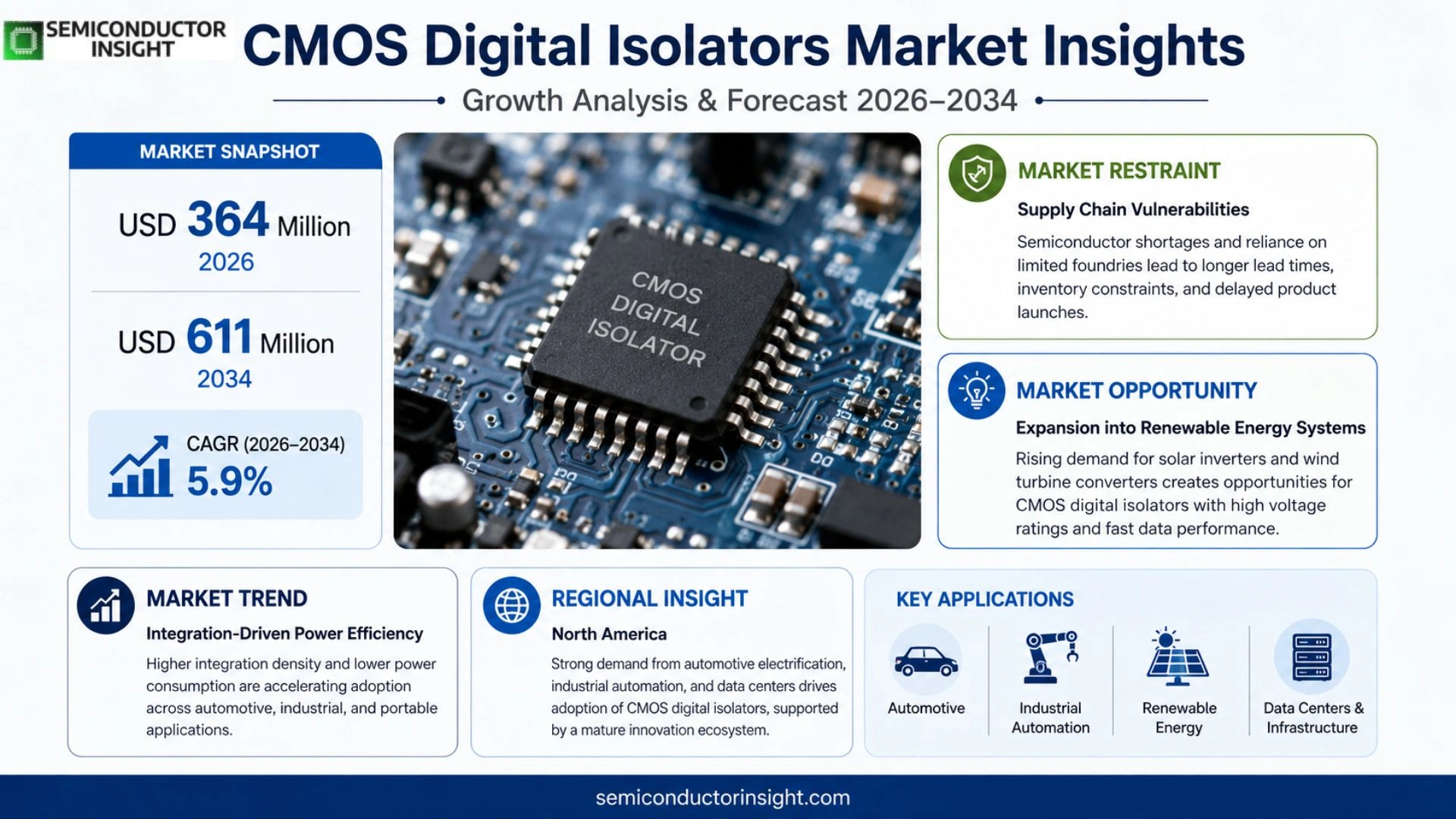
Global CMOS Digital Isolators market size is projected to grow from USD 364 million in 2026 to USD 611 million by 2034, exhibiting a CAGR of 5.9% during the forecast period.
CMOS digital isolators are integrated devices that provide galvanic isolation for digital signals while enabling high‑speed data transfer across an isolation barrier. Their architecture allows compact footprints, low power consumption and performance levels that rival traditional optocouplers, making them suitable for industrial automation, automotive electronics, power conversion and medical equipment.
These isolators find extensive use in industrial automation systems, power‑electronics converters, automotive safety networks and medical monitoring devices where reliable data isolation reduces noise susceptibility and enhances system safety.
As Industry 4.0 expands and electric‑vehicle architectures demand tighter integration with lower energy budgets, designers increasingly prefer CMOS isolators over legacy solutions.
MARKET DRIVERS
Rising Demand for Energy‑Efficient Interfaces
The push for lower power consumption in automotive and industrial equipment has elevated the appeal of CMOS digital isolators. Their low static power draw enables designers to meet stringent efficiency targets without sacrificing signal integrity, which directly fuels adoption across new product lines.
Integration of High‑Speed Data Buses
Modern control architectures increasingly rely on SPI, UART, and CAN‑FD interfaces operating at megahertz rates. CMOS digital isolators provide the bandwidth needed to bridge these buses while maintaining galvanic isolation, a combination that is prompting original equipment manufacturers to replace legacy optocouplers.
➤ Customers value the reduced bill of materials that results from consolidating isolation functions into a single silicon platform.
As regulatory bodies tighten electromagnetic compatibility standards, the inherent immunity of CMOS solutions to noise becomes a competitive advantage, prompting more design houses to specify these components in upcoming releases of CMOS Digital Isolators market.
MARKET CHALLENGES
Complexity of Multi‑Protocol Support
Designers often need a single isolator to handle several communication protocols simultaneously. Engineering trade‑offs between data rate, voltage tolerance, and pin count can extend development cycles, discouraging some manufacturers from adopting newer CMOS devices.
Other Challenges
Cost Sensitivity
While the total cost of ownership improves, the upfront price of high‑performance CMOS digital isolators remains higher than that of traditional counterparts, creating resistance in price‑pressured segments such as consumer electronics.
MARKET RESTRAINTS
Supply Chain Vulnerabilities
Global semiconductor shortages have exposed the fragility of the supply chain for silicon‑based isolators. Lead times have stretched, and inventory buffers are being depleted, limiting the ability of OEMs to ramp production quickly.
Additionally, reliance on a limited number of foundries for advanced CMOS processes heightens exposure to capacity constraints, which can delay new product introductions and erode confidence in the market’s growth trajectory.
MARKET OPPORTUNITIES
Expansion into Renewable Energy Systems
Solar inverters and wind‑turbine converters require robust isolation to protect control electronics from high‑voltage transients. CMOS digital isolators offer the combination of high voltage rating and fast data rates that can improve fault detection and system reliability, opening a sizable niche for market participants.
Furthermore, the ongoing shift toward modular, plug‑and‑play architectures in smart grid equipment encourages the integration of compact, low‑power isolators, positioning CMOS Digital Isolators market to capture demand from utility‑scale deployments.
CMOS Digital Isolators Market Trends
Integration‑Driven Power Efficiency Gains
The market recorded a valuation of roughly $344 million in 2024 and a forecast to reach $515 million by 2031, reflecting a 6.1 % compound annual growth rate. The principal catalyst is the relentless push for smaller, lower‑power circuitry across multiple end‑markets. CMOS digital isolators deliver higher integration density than traditional optocouplers while consuming markedly less energy, enabling designers to meet the stringent thermal budgets of portable and automotive platforms. As manufacturers trim board space and power budgets, the demand for these isolators accelerates, creating a feedback loop where higher volume drives cost efficiencies, further encouraging adoption.
Other Trends
Automotive Electrification
Electrified power‑train architectures rely on reliable data exchange between high‑voltage and low‑voltage domains. CMOS isolators, with their fast propagation delay and robust noise rejection, are becoming the preferred interface for battery‑management systems, inverters, and advanced driver‑assistance sensors. The shift toward electric vehicles therefore raises the bar for isolation solutions that can operate safely under higher voltage stresses while preserving signal fidelity, prompting original equipment manufacturers to incorporate these devices early in vehicle architecture design cycles.
Industry 4.0 and IoT Expand Isolation Requirements
Factories adopting Industry 4.0 principles interconnect thousands of sensors, actuators, and controllers via Ethernet‑based fieldbuses. Each node generates digital traffic that must traverse isolation barriers without degrading timing or accuracy. The proliferation of IoT devices in industrial, medical, and consumer environments amplifies this need, as even modest power savings aggregate into measurable operational cost reductions at scale. Consequently, system integrators are prioritizing CMOS digital isolators to secure data pathways while meeting stringent EMC standards, a trend that is reshaping component sourcing strategies across the supply chain.
COMPETITIVE LANDSCAPE
Key Industry Players
CMOS Digital Isolators: Competitive Dynamics and Emerging Leaders
Texas Instruments continues to dominate the CMOS digital isolator segment, leveraging its extensive analog‑mixed‑signal portfolio and deep relationships in automotive and industrial automation. By embedding isolation functionality within broader power‑management IC families, TI offers customers a consolidated bill of materials, which translates into higher design win rates and recurring revenue streams. Broadcom and Skyworks Solutions follow closely, each capitalising on niche strengths,Broadcom in high‑frequency data‑center interconnects, Skyworks in compact, low‑power solutions for consumer electronics. Analog Devices’ focus on precision measurement and signal integrity further diversifies the competitive set, creating a three‑tier hierarchy where scale, application breadth, and performance differentiation shape market share. The overall structure resembles a concentration at the top, with mid‑tier players defending specific verticals through targeted product roadmaps and strategic partnerships.
Beyond the headline names, a cadre of specialised firms injects innovation into the market. Renesas Electronics and NVE Corporation concentrate on automotive‑grade reliability, targeting electric‑vehicle power‑train communication where thermal robustness is critical. Mornsun Power, Novosense Microelectronics, and 2Pai Semiconductor differentiate by delivering ultra‑low‑power, bidirectional isolators for IoT gateways and edge devices. Asian manufacturers such as Shanghai Chipanalog Microelectronics, Hangzhou Vango Technologies, and Beijing Zhongke Gree Micro Technology exploit cost‑effective silicon‑on‑insulator processes to serve high‑volume consumer appliances in China and Southeast Asia. SKYRELAY and Microchip Technology round out the ecosystem, offering niche modules and development kits that accelerate time‑to‑market for system integrators. These players collectively broaden the value chain, pressuring incumbents to enhance feature sets and price competitiveness.
List of Key CMOS Digital Isolators Companies Profiled
- Texas Instruments
- Skyworks Solutions
- Analog Devices
- Broadcom
- Renesas Electronics
- NVE Corporation
- Mornsun Power
- Novosense Microelectronics
- 2Pai Semiconductor
- Shanghai Chipanalog Microelectronics
- Hangzhou Vango Technologies
- SKYRELAY
- Beijing Zhongke Gree Micro Technology
- Infineon Technologies
- Microchip Technology
Segment Analysis:
| Segment Category | Sub-Segments | Key Insights |
| By Type |
|
Unidirectional Digital Isolators are prized for their straightforward architecture, delivering reliable one‑way signal isolation that simplifies board layout – they excel in sensor and data‑acquisition paths where data flow is directional – their lower component count often translates to reduced cost and power consumption, making them a go‑to choice for many industrial automation designs. |
| By Application |
|
Industrial Automation drives adoption through the need for robust, noise‑immune communication between PLCs and field devices – the high‑speed data exchange requirements of modern factories favor CMOS isolators that combine low latency with strong isolation – their compact footprint supports dense controller designs required by Industry 4.0 deployments. |
| By End User |
|
Automotive leverages CMOS digital isolators for in‑vehicle networks where reliability under temperature extremes is critical – their low power draw supports electric‑vehicle architectures seeking to maximize overall vehicle efficiency – they also enable secure isolation for advanced driver‑assistance systems that require high‑integrity signal transmission. |
| By Data‑Rate Capability |
|
High‑Speed Digital Isolators meet the growing demand for rapid data exchange in power‑electronics converters and smart grid interfaces – they provide minimal propagation delay while preserving isolation strength – designers appreciate the ability to support high‑frequency PWM signals without compromising system safety. |
| By Power‑Efficiency Class |
|
Ultra‑Low Power Isolators are increasingly important for battery‑operated IoT devices and wearables where energy budget is tight – their sub‑microwatt quiescent currents extend device runtime – the low‑power profile also reduces thermal load, supporting compact system designs in constrained enclosures. |
Regional Analysis: CMOS Digital Isolators Market
Vehicle architectures are integrating higher voltage domains to support electric drivetrains and advanced driver‑assist functions. CMOS isolators provide the low‑power, high‑speed barrier needed to protect micro‑controllers and sensors without adding bulk, making them a preferred choice for next‑gen power‑train designs.
Factories adopting modular robotics and smart‑factory concepts rely on distributed control networks. The need for isolated communication links that can survive harsh electrical environments fuels demand for CMOS solutions with robust tolerance to voltage spikes.
The migration to higher density compute racks intensifies power‑distribution challenges. Engineers turn to CMOS isolators to secure low‑latency data paths while preserving efficiency, a combination that directly influences overall data‑center energy footprints.
A handful of legacy players dominate, yet niche innovators are leveraging advanced process nodes to deliver tighter integration and lower leakage, reshaping supplier competition and prompting strategic alliances.
Europe
European manufacturers are navigating a complex regulatory matrix that emphasizes safety and environmental compliance. The trend toward electric mobility across the continent amplifies the requirement for compact isolation in charging infrastructure and on‑board power modules. Moreover, Industry 4.0 initiatives across Germany, France, and the Nordics encourage modular, isolated I/O to safeguard sensor arrays and edge‑computing nodes. Suppliers that can align product roadmaps with the EU’s sustainability directives stand to capture design‑win opportunities, particularly where lifecycle cost and recyclability are scrutinized alongside performance.
Asia‑Pacific
In Asia‑Pacific, rising consumer electronics production and burgeoning renewable‑energy installations are reshaping demand patterns. Nations such as China, South Korea, and Japan are accelerating the adoption of smart‑grid components that rely on isolated digital control loops. Concurrently, the region’s cost‑sensitive OEM base looks for CMOS isolators that can be fabricated at scale without sacrificing signal integrity. Partnerships between local fabs and global IP holders are fostering a supply chain that can respond quickly to volume spikes, especially in emerging markets where power‑electronics penetration is still accelerating.
South America
South American economies are gradually modernizing their manufacturing bases, with Brazil leading the shift toward more automated production lines. While overall market size remains modest, the region’s focus on localized sourcing drives interest in CMOS isolators that can meet both performance and price expectations. Energy‑infrastructure projects, particularly in hydro‑electric and solar sectors, create niche opportunities for isolated control modules that must endure fluctuating environmental conditions.
Middle East & Africa
The Middle East and Africa present a distinctive blend of high‑value oil‑and‑gas installations and fast‑growing renewable‑energy portfolios. In oil‑field automation, reliable isolation is critical for protecting control systems from harsh electromagnetic environments. Meanwhile, solar‑farm developers in the Gulf and South Africa are integrating smart‑inverters that benefit from low‑loss CMOS isolation. Market participants that can navigate disparate procurement standards and demonstrate robust field performance are positioned to establish footholds in these emerging segments.
Report Scope
This market research report provides a comprehensive analysis of the CMOS Digital Isolators Market , covering the forecast period 2026–2034. It offers detailed insights into market dynamics, technological advancements, competitive landscape, and key trends shaping the industry.
Key focus areas of the report include:
- Market Overview: The report begins with an overview outlining its current market scenario, key growth indicators, and industry transformation drivers. It discusses macroeconomic factors, demand–supply balance, regulatory landscape, and the strategic role of semiconductors in powering advancements across industries such as automotive, telecommunications, consumer electronics, and industrial automation.
- Market Size & Forecast: Historical data and future projections for revenue, unit shipments, and market value across major regions and segments.
- Segmentation Analysis: Detailed breakdown by product type, technology, application, and end-user industry to identify high-growth segments and investment opportunities.
- Regional Insights: Insights into market performance across North America, Europe, Asia-Pacific, Latin America, and the Middle East & Africa, including country-level analysis where relevant.
- Competitive Landscape: Profiles of leading market participants, including their product offerings, R&D focus, manufacturing capacity, pricing strategies, and recent developments such as mergers, acquisitions, and partnerships.
- Technology Trends & Innovation: Assessment of emerging technologies, integration of AI/IoT, semiconductor design trends, fabrication techniques, and evolving industry standards.
- Market Drivers & Restraints: Evaluation of factors driving market growth along with challenges, supply chain constraints, regulatory issues, and market-entry barriers.
- Stakeholder Insights: Insights for component suppliers, OEMs, system integrators, investors, and policymakers regarding the evolving ecosystem and strategic opportunities.
Primary and secondary research methods are employed, including interviews with industry experts, data from verified sources, and real-time market intelligence to ensure the accuracy and reliability of the insights presented.
FREQUENTLY ASKED QUESTIONS:
What is the current market size of CMOS Digital Isolators Market?
-> CMOS Digital Isolators market size is projected to grow from USD 364 million in 2026 to USD 611 million by 2034, at a CAGR of 6.1% during the forecast period.
Which key companies operate in CMOS Digital Isolators Market?
-> Key players include Skyworks Solutions, Broadcom, Texas Instruments, Analog Devices, Mornsun Power, Renesas Electronics, NVE Corporation, NOVOSENSE Microelectronics, 2Pai Semiconductor, Shanghai Chipanalog Microelectronics, Hangzhou Vango Technologies, SKYRELAY, Beijing Zhongke Gree Micro Technology.
What are the key growth drivers?
-> Key growth drivers include industrial automation, power electronics, medical devices, automotive electronics, electric vehicle adoption, renewable energy systems, Industry 4.0 and Internet of Things expansion, and the demand for low‑power, high‑performance isolation solutions.
Which region dominates the market?
-> Asia‑Pacific is the dominant region, driven by strong demand in China, Japan, South Korea and emerging markets, while North America and Europe also show significant growth.
What are the emerging trends?
-> Emerging trends include integration of CMOS isolators in electric vehicles and renewable energy converters, development of bidirectional isolators, ultra‑low‑power designs for IoT devices, and increased adoption driven by Industry 4.0 and AI‑enabled edge computing.

Get Sample Report PDF for Exclusive Insights
Report Sample Includes
- Table of Contents
- List of Tables & Figures
- Charts, Research Methodology, and more...