Cleaning Chemistry (SC1, SC2, Ozonated DI) Market Insights
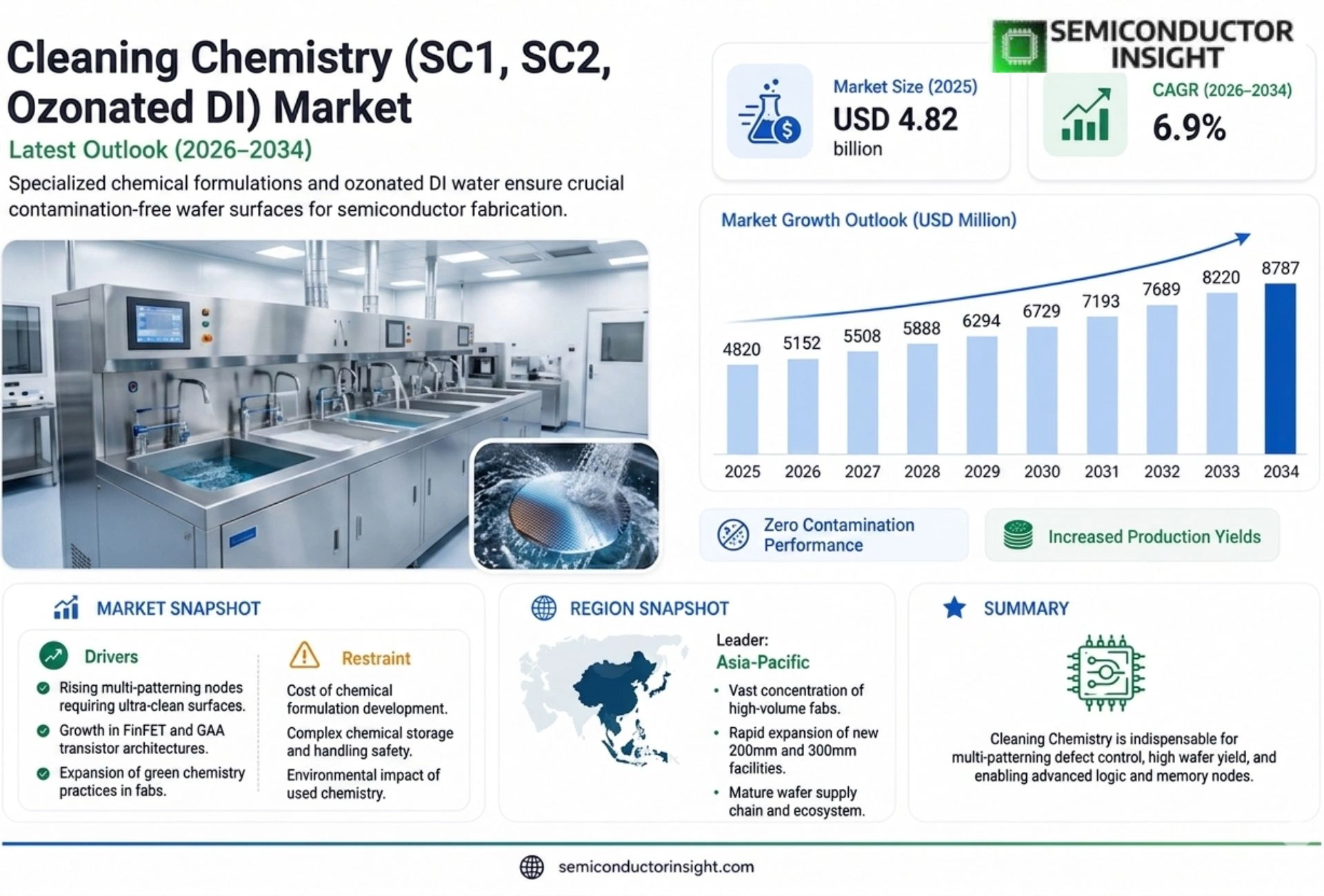
Global Cleaning Chemistry (SC1, SC2, Ozonated DI) Market size was valued at USD 4.82 billion in 2025. The market is projected to grow from USD 5.14 billion in 2026 to USD 8.76 billion by 2034, exhibiting a CAGR of 6.9% during the forecast period.
Cleaning Chemistry (SC1, SC2, Ozonated DI) encompasses specialized chemical formulations and processes critical for semiconductor wafer cleaning and surface preparation in advanced manufacturing. SC1, or Standard Clean 1, consists of ammonium hydroxide and hydrogen peroxide mixtures designed to remove organic contaminants and particles. SC2, or Standard Clean 2, utilizes hydrochloric acid and hydrogen peroxide to eliminate metallic impurities from silicon surfaces. Ozonated DI (Deionized Water) employs ozone dissolved in ultra-pure water as an environmentally friendly oxidizing agent for organic removal and surface conditioning. These chemistries form the backbone of front-end-of-line (FEOL) cleaning protocols in integrated circuit fabrication.
The market is experiencing steady growth driven by several interconnected factors. While semiconductor device miniaturization demands ever-cleaner surfaces, environmental regulations are simultaneously pushing manufacturers toward greener alternatives like ozonated DI solutions. Furthermore, the proliferation of advanced packaging technologies and 3D NAND architectures has intensified cleaning step requirements per wafer. The global semiconductor capital expenditure reached approximately USD 97 billion in 2024 according to SEMI industry data, with wet processing equipment and consumables representing substantial portions of this investment. Additionally, regional initiatives such as the CHIPS Act in the United States and similar programs across Europe and Asia-Pacific are accelerating fab construction activities because domestic supply chain security has become paramount. Key industry participants including Entegris Inc., DuPont de Nemours Inc., BASF SE, Mitsubishi Chemical Corporation, and Fujifilm Holdings Corporation continue expanding their high-purity chemical portfolios to address evolving customer specifications for sub-7nm node manufacturing.
MARKET DRIVERS
Growing Demand for High-Purity Cleaning Solutions
Cleaning Chemistry (SC1, SC2, Ozonated DI) Market is primarily driven by the increasing need for ultrapure cleaning agents in semiconductor and electronics manufacturing. These industries demand stringent cleanliness to ensure defect-free production, which significantly boosts the demand for specialized cleaning chemistries such as SC1 and SC2 formulations, along with ozonated deionized water.
Technological Advancements in Ozonated DI Cleaning
Innovations in ozonated DI technology are enhancing cleaning efficiency while reducing chemical usage and environmental Impact. The adoption of ozone as a powerful oxidizing agent offers better particle removal and sterilization without harmful residues, making it attractive for advanced semiconductor cleaning processes.
➤ The integration of SC1, SC2, and ozonated DI cleaning solutions provides a synergistic effect, improving yield and reducing defects in high-precision manufacturing.
With increasing semiconductor wafer production and the transition to smaller node technologies, the precision and efficacy of cleaning chemistry are paramount, further stimulating market growth.
MARKET CHALLENGES
Complexity in Formulation and Process Integration
Developing and optimizing Cleaning Chemistry (SC1, SC2, Ozonated DI) formulations that meet varying material compatibility and stringent contamination standards poses significant challenges. Process integration requires balancing chemical reactivity and substrate safety, which can limit universal application and increase development time.
Other Challenges
Environmental Compliance Pressure
Meeting increasingly strict environmental regulations on chemical discharge and ozone safety standards requires ongoing investment in waste treatment and monitoring technology, raising operational complexities and costs.
MARKET RESTRAINTS
High Cost of Advanced Cleaning Chemistry Solutions
The cost associated with producing and deploying highly specialized cleaning chemicals such as SC1, SC2 solutions, and ozonated DI systems can be prohibitive, especially for small to medium manufacturers. The requirement for precision dosing systems and maintenance of ozonation equipment further add to operational expenses, potentially restraining broader adoption despite efficacy.
MARKET OPPORTUNITIES
Expansion into Emerging Semiconductor Manufacturing Hubs
As semiconductor fabrication plants expand across regions such as Southeast Asia and Eastern Europe, there is substantial potential to supply advanced cleaning chemistries tailored to new market entrants. Localized production and customized formulations adapted for regional substrates can facilitate rapid market penetration.
Innovative Sustainable Cleaning Technologies
Developing eco-friendly and reduced chemical consumption cleaning processes incorporating ozonated DI water presents an opportunity to meet environmental targets while maintaining cleaning performance. This aligns well with global moves toward sustainability and circular economy models in high-tech manufacturing.
Trends
Emerging Demand for Advanced Semiconductor Cleaning Solutions
Cleaning Chemistry (SC1, SC2, Ozonated DI) Market is witnessing consistent advancement driven by the semiconductor industry’s push for cleaner surfaces as device geometries shrink. SC1 and SC2 chemistries remain the foundational technology for removing organic and metallic contaminants respectively, playing a pivotal role in front-end wafer preparation. Concurrently, ozonated DI water is gaining traction due to its environmentally sustainable profile and efficiency in organic contaminant removal, aligning well with increasing regulatory emphasis on green manufacturing processes.
Other Trends
Impact of Semiconductor Miniaturization and Packaging Innovations
The intensification of cleaning protocols has been spurred by the rise of advanced packaging methods and the integration of 3D NAND technologies. These complex architectures demand enhanced chemical formulations that ensure contaminant-free surfaces essential for defect-free lithography and device performance. Consequently, manufacturers are prioritizing optimized cleaning chemistries that maintain compatibility with sub-7nm technology nodes while improving throughput.
Regulatory Influence and Supply Chain Dynamics
Environmental legislation globally is encouraging adoption of less hazardous chemicals like ozonated DI water, as it reduces chemical waste and exposure risks. Regional initiatives, notably the CHIPS Act in the U.S. and similar programs in Europe and Asia-Pacific, are stimulating semiconductor fabrication capacity expansions. This growth bolsters demand for high-purity cleaning consumables, directly impacting Cleaning Chemistry (SC1, SC2, Ozonated DI) Market’s evolution.
Industry Players and Portfolio Expansion
Key companies such as Entegris Inc., DuPont de Nemours Inc., BASF SE, Mitsubishi Chemical Corporation, and Fujifilm Holdings Corporation are continuously refining and broadening their cleaning chemistry offerings. Their focus is on accommodating increasingly stringent specifications arising from advanced process nodes and integrating sustainable practices.
Market Direction with Sustainable Innovation
Cleaning Chemistry (SC1, SC2, Ozonated DI) Market is progressively aligning towards innovative chemistries that balance efficacy with environmental responsibility. The fusion of traditional SC1 and SC2 formulations with emerging ozonated DI solutions reflects the industry’s commitment to sustainable production. As semiconductor capital expenditure remains robust and fabrication technologies evolve, these cleaning chemistries will remain integral to achieving high yield and reliability in next-generation semiconductor manufacturing.
COMPETITIVE LANDSCAPE
Key Industry Players
Leading companies shaping Cleaning Chemistry (SC1, SC2, Ozonated DI) Market dynamics
Cleaning Chemistry (SC1, SC2, Ozonated DI) Market is characterized by a competitive landscape dominated by established chemical and semiconductor materials manufacturers who leverage deep expertise in high-purity chemical formulations. Entegris Inc. stands out as a key player with comprehensive offerings in advanced cleaning chemistries aligned to sub-7nm semiconductor manufacturing nodes, reinforcing its strong market position. The market structure demonstrates moderate concentration with significant investments from global conglomerates focusing on innovation in environmentally compliant chemistries such as ozonated DI solutions.
Other significant competitors include multinational corporations that have developed specialized product lines targeting front-end wafer cleaning and surface preparation. Companies such as DuPont de Nemours Inc., BASF SE, and Mitsubishi Chemical Corporation hold strategic importance due to their broad portfolio and global manufacturing footprint. Additionally, Fujifilm Holdings Corporation and Clariant AG contribute with focused R&D initiatives on green chemistry alternatives, reflecting the industry’s push towards sustainability. The competitive landscape also features niche players specializing in custom wet process chemicals and regional suppliers addressing localized fab demands across Asia-Pacific, Europe, and North America.
List of Key Cleaning Chemistry (SC1, SC2, Ozonated DI) Companies Profiled
- Entegris Inc.
- DuPont de Nemours Inc.
- BASF SE
- Mitsubishi Chemical Corporation
- Fujifilm Holdings Corporation
- Clariant AG
- Honeywell International Inc.
- Air Liquide
- Wacker Chemie AG
- Sigma-Aldrich Corporation
- Azota Chemicals
- Avantor Inc.
- Showa Denko K.K.
- Tosoh Corporation
- Kanto Chemical Co., Inc.
Segment Analysis:
| Segment Category | Sub-Segments | Key Insights |
| By Type |
|
SC1 (Standard Clean 1) remains a foundational cleaning chemistry, widely favored for effectively removing organic residues and particles, critical in maintaining wafer surface integrity.
SC2 (Standard Clean 2) is essential where metallic impurity removal is a priority, sustaining high purity standards crucial for advanced semiconductor nodes. Ozonated DI is increasingly recognized for its environmentally friendly profile, leveraging oxidative properties of ozone in ultra-pure water to meet stricter environmental regulations while maintaining effective surface conditioning. This type segmentation highlights the industry’s transition toward greener technologies alongside maintaining traditional processes indispensable for precision cleaning. |
| By Application |
|
Front-End Wafer Cleaning leads key applications, driven by the necessity to eliminate contaminants before subsequent fabrication steps ensuring device reliability.
Surface Preparation is pivotal in enhancing adhesion and electrical performance, reflecting increased complexity in packaging and device architectures. Post-Etch Cleaning demands advanced chemistries like ozone-based cleaning to safely remove residuals without damaging delicate structures. The application segmentation underscores the increasing sophistication of cleaning steps aligning with semiconductor manufacturing advances and tighter process controls. |
| By End User |
|
Semiconductor Manufacturers demand stringent cleaning chemistries to support high-volume fabrication with consistent quality necessary for sub-7nm manufacturing nodes.
Foundry Services apply versatile cleaning solutions tailored to diverse customer requirements and specialty process flows, emphasizing adaptability. Research & Development Labs drive innovation in cleaning chemistries, focusing on next-generation materials and cost-effective green alternatives. End user segmentation reflects varied cleaning chemistry needs across operational scales, fostering continuous innovation and customization. |
| By Technology Node |
|
Sub-7nm technology nodes require ultra-pure and highly specialized cleaning chemistries to meet the stringent contamination control and surface accuracy demands.
7nm-14nm nodes balance advanced cleaning performance with cost-efficiency, witnessing incremental improvements in chemical formulations. Above 14nm nodes maintain established cleaning protocols, focusing on reliability and process stability. Technology Node segmentation emphasizes continuous enhancement of cleaning solutions aligned to the evolution of semiconductor device scaling. |
| By Environmental Compliance |
|
Green Cleaning Solutions such as ozonated DI are gaining precedence as environmental regulations tighten globally and manufacturers seek sustainable practices.
Traditional Chemistries continue to serve critical roles in cleaning processes where specific contaminant removal is required. Hybrid Approaches integrate conventional and green chemistries to optimize cleaning efficacy while minimizing ecological impact. Environmental Compliance segmentation highlights the market’s strategic focus on ecological sustainability alongside performance demands. |
Regional Analysis: Global Cleaning Chemistry (SC1, SC2, Ozonated DI) Market
Asia-Pacific leads in R&D efforts focusing on tailoring SC1 and SC2 formulations alongside ozonated DI water systems to optimize wafer surface cleanliness while reducing chemical waste. Local partnerships between manufacturers and research institutes drive continuous innovations.
The region’s semiconductor fabrication plants operate at large scale, demanding consistent supply of specialized cleaning chemistries that maintain yield quality, creating sustained growth opportunities for chemical suppliers and service providers.
Governments across Asia-Pacific increasingly advocate for green manufacturing processes, encouraging the adoption of ozonated DI water to reduce harmful effluents, thus shaping market trends toward more sustainable chemistry solutions.
The collaboration between chemical producers, semiconductor companies, and equipment manufacturers fosters integrated cleaning chemistry solutions that align with evolving wafer production techniques and contamination control standards.
North America
North America represents a mature and innovation-driven market for Cleaning Chemistry (SC1, SC2, Ozonated DI) with strong emphasis on precision and quality control in semiconductor cleaning processes. The U.S. leads activities in developing next-generation chemical formulations that enhance wafer yield while complying with strict environmental rules. Market players invest heavily in R&D to improve ozonated DI water applications that reduce the use of traditional chemicals, aligning with sustainability goals. The presence of prominent semiconductor manufacturers and technology giants accelerates the adoption of cutting-edge cleaning chemistries, supported by a well-established supply chain and regulatory framework. However, market expansion is cautiously strategized due to stringent regulatory oversight and higher operational costs compared to emerging regions.
Europe
Europe’s Cleaning Chemistry market is characterized by its focus on sustainability and regulatory compliance, driven by stringent environmental policies. Companies in the region prioritize reducing hazardous chemical footprints by integrating ozonated DI water solutions and exploring bio-based cleaning agents. The semiconductor industry in countries like Germany and France is expanding cautiously, emphasizing quality and process integration over volume growth. Collaborative efforts between industry and academia are fostering innovations in SC1 and SC2 chemistries that meet ecological standards without compromising cleaning efficacy. The European market’s strategic approach revolves around balancing environmental concerns with advancing technology requirements, leading to incremental yet impactful advancements in the cleaning chemistry domain.
South America
South America’s Cleaning Chemistry sector is in the nascent stage, with gradual growth prospects tied to the slow but steady rise of semiconductor assembly and packaging activities. The regional market focuses on adopting proven cleaning technologies from leading regions while customizing solutions to local manufacturing conditions. Investments tend to prioritize cost-effective and environmentally safer chemistries such as ozonated DI treatments, responding to growing environmental awareness. The region faces challenges from limited infrastructure and lower industrial scale, yet offers opportunities for niche applications and potential future expansions driven by increasing local electronics manufacturing demands.
Middle East & Africa
The Middle East & Africa region is emerging as a promising market for Cleaning Chemistry due to increasing investments in electronics manufacturing hubs and technology parks. Economic diversification strategies encourage the establishment of semiconductor fabrication units, thereby stimulating demand for advanced cleaning chemistries. Regional players show growing interest in SC1 and SC2 solutions adapted for local environmental conditions and water scarcity challenges, promoting use of ozonated DI water to optimize resource utilization. Market growth is expected to accelerate as infrastructure improves and regional policies increasingly support high-tech industry development.
Report Scope
This market research report provides a comprehensive analysis of the Cleaning Chemistry (SC1, SC2, Ozonated DI) Market , covering the forecast period 2026–2034. It offers detailed insights into market dynamics, technological advancements, competitive landscape, and key trends shaping the industry.
Key focus areas of the report include:
- Market Overview: The report begins with an overview outlining its current market scenario, key growth indicators, and industry transformation drivers. It discusses macroeconomic factors, demand–supply balance, regulatory landscape, and the strategic role of semiconductors in powering advancements across industries such as automotive, telecommunications, consumer electronics, and industrial automation.
- Market Size & Forecast: Historical data and future projections for revenue, unit shipments, and market value across major regions and segments.
- Segmentation Analysis: Detailed breakdown by product type, technology, application, and end-user industry to identify high-growth segments and investment opportunities.
- Regional Insights: Insights into market performance across North America, Europe, Asia-Pacific, Latin America, and the Middle East & Africa, including country-level analysis where relevant.
- Competitive Landscape: Profiles of leading market participants, including their product offerings, R&D focus, manufacturing capacity, pricing strategies, and recent developments such as mergers, acquisitions, and partnerships.
- Technology Trends & Innovation: Assessment of emerging technologies, integration of AI/IoT, semiconductor design trends, fabrication techniques, and evolving industry standards.
- Market Drivers & Restraints: Evaluation of factors driving market growth along with challenges, supply chain constraints, regulatory issues, and market-entry barriers.
- Stakeholder Insights: Insights for component suppliers, OEMs, system integrators, investors, and policymakers regarding the evolving ecosystem and strategic opportunities.
Primary and secondary research methods are employed, including interviews with industry experts, data from verified sources, and real-time market intelligence to ensure the accuracy and reliability of the insights presented.
FREQUENTLY ASKED QUESTIONS:
What is the current market size of Cleaning Chemistry (SC1, SC2, Ozonated DI) Market?
-> Cleaning Chemistry (SC1, SC2, Ozonated DI) Market size was valued at USD 4.82 billion in 2025. The market is projected to grow from USD 5.14 billion in 2026 to USD 8.76 billion by 2034, exhibiting a CAGR of 6.9% during the forecast period.
Which key companies operate Cleaning Chemistry (SC1, SC2, Ozonated DI) Market?
-> Key players include Entegris Inc., DuPont de Nemours Inc., BASF SE, Mitsubishi Chemical Corporation, and Fujifilm Holdings Corporation, among others.
What are the key growth drivers?
-> Key growth drivers include semiconductor device miniaturization demanding cleaner surfaces, environmental regulations favoring greener alternatives like ozonated DI solutions, proliferation of advanced packaging and 3D NAND architectures, and increased semiconductor capital expenditure supported by regional initiatives such as the CHIPS Act.
Which region dominates the market?
-> Asia-Pacific is the fastest-growing region, driven by expanding semiconductor fab activities and supply chain security efforts, while North America and Europe remain important markets due to established semiconductor manufacturing ecosystems and supportive government policies.
What are the emerging trends?
-> Emerging trends include the shift towards environmentally friendly cleaning chemistries such as ozonated DI water, development of high-purity formulations tailored for sub-7nm node manufacturing, and intensification of cleaning protocols driven by advanced packaging technologies.

Get Sample Report PDF for Exclusive Insights
Report Sample Includes
- Table of Contents
- List of Tables & Figures
- Charts, Research Methodology, and more...
 Download Sample Report PDF