Chiplet Ecosystem & Standardization (UCIe, BoW) Market Insights
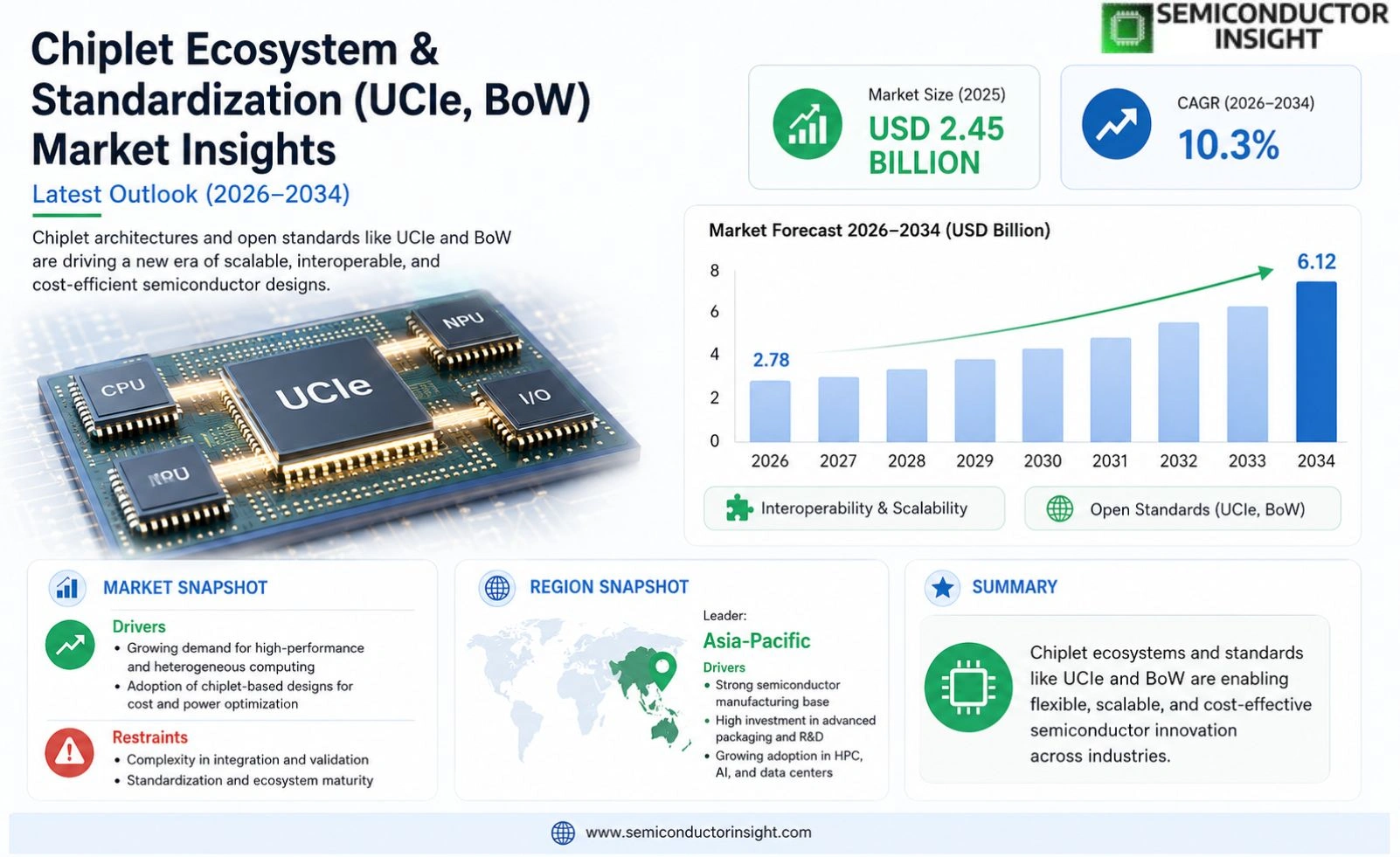
Global Chiplet Ecosystem & Standardization (UCIe, BoW) Market size was valued at USD 2.45 billion in 2025. The market is projected to grow from USD 2.78 billion in 2026 to USD 6.12 billion by 2034, exhibiting a CAGR of 10.3% during the forecast period.
The Chiplet Ecosystem & Standardization (UCIe, BoW) represents a transformative approach in semiconductor design, enabling disaggregation of monolithic system-on-chips (SoCs) into smaller, modular components called chiplets. These chiplets communicate via standardized interfaces such as Universal Chiplet Interconnect Express (UCIe) and Bunch of Wires (BoW), ensuring interoperability across different vendors and process nodes. This architecture enhances scalability, reduces development costs, and accelerates time-to-market for advanced computing solutions,particularly in high-performance computing (HPC), artificial intelligence (AI), data centers, and automotive applications.
The rapid adoption of chiplet-based designs is driven by the escalating demand for higher performance and energy efficiency in next-generation processors. While traditional monolithic SoCs face physical limitations due to reticle size constraints and yield challenges at advanced nodes like 3nm and beyond, the chiplet model allows manufacturers to mix and match optimized dies from various foundries. Furthermore, industry-wide standardization efforts,led by consortia including the UCIe Consortium,are fostering ecosystem collaboration among semiconductor giants such as Intel, AMD, TSMC, Samsung Foundry, Qualcomm, Arm Holdings plc., and Synopsys Inc., thereby accelerating technology maturation and commercial deployment.
MARKET DRIVERS
Accelerated HPC and AI Workloads
The rapid proliferation of artificial intelligence and high-performance computing is fundamentally transforming the landscape of Chiplet Ecosystem & Standardization (UCIe, BoW) Market. As enterprises demand higher compute throughput at lower costs, the industry is shifting toward modular architectures that allow for incremental performance gains without replacing entire systems. This operational efficiency is driving significant capital expenditure on advanced packaging technologies.
Universal Chiplet Interconnect Express (UCIe) Standard
Global adoption of the UCIe standard has created a necessary interoperability framework that streamlines the integration of diverse silicon components, thereby solidifying the growth trajectory of Chiplet Ecosystem & Standardization (UCIe, BoW) Market. This standardization reduces fragmentation, allowing foundries and OSATs to scale production volumes while maintaining high performance expectations.
➤ Strategic partnerships across the value chain are critical to establishing a unified manufacturing infrastructure.
Additionally, the need to optimize manufacturing yields is driving interest in the BoW (Bridge-on-Wafer) approach, which further empowers the robust expansion of Chiplet Ecosystem & Standardization (UCIe, BoW) Market by facilitating mixed-technology node implementations.
MARKET CHALLENGES
Complexity in Heterogeneous System Integration
Successfully merging disparate chiplets with varying fabrication processes and thermal profiles presents a significant hurdle for developers withChiplet Ecosystem & Standardization (UCIe, BoW) Market. The physical interconnect requirements demand precise alignment and bonding, which complicates the design-to-silicon lifecycle.
Other Challenges
Thermal Management Solutions
Dissipating heat generated in densely packed 3D stacks remains a technical hurdle for large-scale adoption Chiplet Ecosystem & Standardization (UCIe, BoW) Market.
MARKET RESTRAINTS
High Verification and IP Licensing Costs
Ensuring functional correctness across interconnected dies requires extensive simulation and verification, driving up R&D expenses and acting as a barrier for smaller competitors Chiplet Ecosystem & Standardization (UCIe, BoW) Market. The financial investment required to validate interconnect performance remains a primary factor slowing down widespread deployment.
MARKET OPPORTUNITIES
Customized Automotive and Edge Computing Solutions
Automotive electrification and edge computing require highly specialized silicon, creating a lucrative opportunity for specialized chiplet providers Chiplet Ecosystem & Standardization (UCIe, BoW) Market. The ability to tailor specific functions, such as radar or AI processing, offers a competitive advantage that drives innovation and revenue growth.
Trends
Transition to Modular Architecture
The global Chiplet Ecosystem & Standardization (UCIe, BoW) market is witnessing a transformative shift as semiconductor manufacturers seek to overcome the significant physical and economic challenges associated with legacy monolithic system-on-chip designs. This evolution towards disaggregation allows for the creation of more flexible, scalable architectures that utilize standardized interfaces such as Universal Chiplet Interconnect Express (UCIe). By breaking down complex integrated circuits into smaller, reusable components known as chiplets, the industry is better positioned to address the increasingly complex demands of modern data centers and artificial intelligence workloads.
Other Trends
Enhanced Scalability and Design Innovation
The widespread adoption of chiplet-based designs directly addresses critical limitations found in traditional monolithic systems, particularly regarding yield and reticle size constraints at advanced manufacturing nodes. This modular approach enables manufacturers to mix and match optimized dies from various foundries, which serves to significantly reduce overall development costs and accelerate the time-to-market for next-generation processors. This innovation is critical for maintaining a competitive edge in a rapidly evolving technological landscape where performance efficiency and cost-effectiveness are paramount.
Expansion of Ecosystem Collaboration
Major industry players, including leaders in semiconductor design and manufacturing, are actively accelerating the maturation of interoperability technologies through the UCIe Consortium. This widespread collaboration fosters a robust ecosystem that supports diverse vendor contributions and minimizes the risks associated with potential vendor lock-in. As the deployment of standardization protocols becomes more widespread, the market continues to evolve to support the rigorous reliability standards required in automotive and enterprise infrastructure.
COMPETITIVE LANDSCAPE
Key Industry Players
Global Chiplet Ecosystem Standardization Analysis
Global Chiplet Ecosystem & Standardization Market represents a transformative approach in semiconductor design, enabling the disaggregation of monolithic systems-on-chips into modular components called chiplets. This architecture enhances scalability and reduces development costs, driven by rising demand for higher performance and energy efficiency in next-generation computing solutions. Standardized interfaces such as UCIe and BoW ensure interoperability across vendors, facilitating the integration of HPC and AI technologies.
Rapid adoption of chiplet-based designs addresses physical limitations of traditional monolithic SoCs at advanced process nodes like 3nm. Industry-wide standardization efforts, led by the UCIe Consortium, foster collaboration among semiconductor giants and niche ecosystem players. This maturation accelerates commercial deployment, allowing manufacturers to mix and match optimized dies to overcome reticle size constraints and yield challenges.
List of Key Chiplet Ecosystem Companies
- Intel Corporation
- Intel Corporation
- AMD
- Qualcomm Technologies Inc.
- Qualcomm Technologies Inc.
- TSMC
- Samsung Foundry
- Samsung Foundry
- Arm Holdings plc.
- Arm Holdings plc.
- NVIDIA
- Synopsys Inc.
- Synopsys Inc.
- Siemens EDA
- Cadence Design Systems
Segment Analysis:
| Segment Category | Sub-Segments | Key Insights |
| By Type |
|
Leading Segment: Modular Architecture driven by the strategic shift from monolithic System-on-Chip to disaggregated designs. This transition aims to mitigate risks associated with high node yield challenges and reticle size limitations. By enabling the mixing and matching of dies from different vendors like Intel, AMD, and TSMC, manufacturers can optimize performance and cost, offering greater flexibility in supply chain management and innovation cycles. |
| By Application |
|
Leading Segment: HPC and AI Applications. The relentless demand for computational power and energy efficiency in deep learning and cloud computing is propelling the adoption of specialized chiplets. These segments benefit significantly from heterogeneous integration techniques, where distinct dies for compute, memory, and connectivity are combined to handle complex workloads with superior throughput and lower latency compared to unified architectures. |
| By End User |
|
Leading Segment: Cloud Computing Providers. Enterprise and data center operators are prioritizing chiplet-based solutions to enhance energy conservation and system scalability. The economic advantage of upgrading specific modules to accommodate evolving workload demands, rather than scrapping entire legacy infrastructure, provides a compelling case for market penetration in this sector. |
| By Standard |
|
Leading Segment: UCIe Standard. The Universal Chiplet Interconnect Express is solidifying its role as the enabler for a truly interoperable ecosystem. Collaborative efforts led by the UCIe Consortium are dismantling compatibility barriers between competing foundries, fostering a robust marketplace where competitors can coexist as partners, thereby accelerating the commercial deployment of advanced semiconductor technologies globally. |
| By Architecture |
|
Leading Segment: 3D Heterogeneous Architecture. This approach represents the frontier of semiconductor engineering, allowing for vertical stacking of dies on a single package. By reducing interconnect lengths between components, 3D architectures dramatically enhance signal integrity and power efficiency, unlocking performance gains that are otherwise unattainable with traditional planar designs. |
Regional Analysis: Chiplet Ecosystem & Standardization (UCIe, BoW) Market
The area boasts cutting-edge Fab 3.0 facilities that can produce heterogeneous chips at volume, essential for the mass market and ensuring tight integration for major OEMs.
Local universities and research institutes work closely with industry giants to refine UCIe and Back of Package thermal management techniques directly on the production floor.
High volume manufacturing significantly reduces the per-unit cost of chiplets, making them more attractive to mainstream OEMs beyond just high-performance computing centers.
The push for edge AI is spurring demand for modular chiplet architectures that can be customized rapidly for specific sensor and compute tasks without redesigning the entire package.
North America
The North American region remains a critical center for innovation, IP development, and standard setting with Chiplet Ecosystem & Standardization (UCIe, BoW) Market. With major players like Intel, AMD, and NVIDIA heavily investing in proprietary and open-standard technologies, the area is characterized by high R&D expenditure and a strong regulatory focus on data sovereignty and security. Companies in this region prioritize the development of foundational specifications and interoperability frameworks that ensure the longevity of the UCIe standard. The business strategy here often involves leveraging advanced packaging technologies like 2.5D and 3D ICs to maintain competitive advantages in high-performance computing and autonomous vehicles. While manufacturing capabilities have shifted partially to Asia, the region retains a robust IP ecosystem and a keen focus on the business strategies required to launch these complex systems into global markets.
Europe
Europe presents a unique landscape for Chiplet Ecosystem & Standardization (UCIe, BoW) Market, focusing heavily on industrial applications, automotive, and aerospace sectors driven by innovation. The region is increasingly focusing on the adoption of chiplet architectures to enhance the reliability and redundancy required for critical automotive systems and defense infrastructure. European policymakers are encouraging a collaborative approach to standardization that balances open-source flexibility with strict security and compliance certifications. Companies in this region are pursuing business strategies that emphasize the long-term durability of semiconductor components and the ability to upgrade system functionality via modular redesigns rather than complete component replacement. The market dynamics here are influenced by regulatory initiatives, aiming to boost local production and reduce dependency on external sources.
South America
The South American market for Chiplet Ecosystem & Standardization (UCIe, BoW) Market is currently in a nascent but emergent stage, driven by the rising demand for affordable computing solutions and the expansion of local IT infrastructures. Regional players are starting to explore the potential of chiplet-based solutions to bridge the gap between expensive monolithic solutions and budget-friendly alternatives. The focus is primarily on consumer electronics and basic enterprise computing, where the ability to use different generations of chiplets within a single system offers significant cost advantages. Business strategies in the region are still forming, with a strong emphasis on partnerships with international technology providers to bring advanced packaging know-how to local design firms.
Middle East & Africa
The Middle East and Africa region are gradually recognizing the potential of Chiplet Ecosystem & Standardization (UCIe, BoW) Market as a means to enhance digital infrastructure and support ambitious government initiatives. Countries in the region are investing in massive computing centers and data hubs, where the modularity and scalability offered by chiplet architectures can optimize energy consumption and performance per watt. Business strategies in this region are currently concentrated on large-scale system integrators who utilize chiplets to customize high-performance computing clusters tailored for finance, healthcare, and energy sectors. As the region seeks to diversify its economies beyond traditional industries, the strategic integration of advanced semiconductor architectures is becoming a priority to support digital transformation.
Report Scope
This market research report provides a comprehensive analysis of the Chiplet Ecosystem & Standardization (UCIe, BoW) Market , covering the forecast period 2026–2034. It offers detailed insights into market dynamics, technological advancements, competitive landscape, and key trends shaping the industry.
Key focus areas of the report include:
- Market Overview: The report begins with an overview outlining its current market scenario, key growth indicators, and industry transformation drivers. It discusses macroeconomic factors, demand–supply balance, regulatory landscape, and the strategic role of semiconductors in powering advancements across industries such as automotive, data centers, HPC, and AI.
- Market Size & Forecast: Historical data and future projections for revenue, unit shipments, and market value across major regions and segments.
- Segmentation Analysis: Detailed breakdown by product type, technology, application, and end-user industry to identify high-growth segments and investment opportunities.
- Regional Insights: Insights into market performance across North America, Europe, Asia-Pacific, Latin America, and the Middle East & Africa, including country-level analysis where relevant.
- Competitive Landscape: Profiles of leading market participants, including their product offerings, R&D focus, manufacturing capacity, pricing strategies, and recent developments such as mergers, acquisitions, and partnerships.
- Technology Trends & Innovation: Assessment of emerging technologies, integration of AI/IoT, semiconductor design trends, fabrication techniques, and evolving industry standards.
- Market Drivers & Restraints: Evaluation of factors driving market growth along with challenges, supply chain constraints, regulatory issues, and market-entry barriers.
- Stakeholder Insights: Insights for component suppliers, OEMs, system integrators, investors, and policymakers regarding the evolving ecosystem and strategic opportunities.
Primary and secondary research methods are employed, including interviews with industry experts, data from verified sources, and real-time market intelligence to ensure the accuracy and reliability of the insights presented.
FREQUENTLY ASKED QUESTIONS:
What is the current market size of Chiplet Ecosystem & Standardization (UCIe, BoW) Market?
-> Chiplet Ecosystem & Standardization (UCIe, BoW) Market size was valued at USD 2.45 billion in 2025. The market is projected to grow from USD 2.78 billion in 2026 to USD 6.12 billion by 2034, exhibiting a CAGR of 10.3% during the forecast period..
Which key companies operate Chiplet Ecosystem & Standardization (UCIe, BoW) Market?
-> Key players include Intel, AMD, TSMC, Samsung Foundry, Qualcomm, Arm Holdings plc., and Synopsys Inc., among others.
What are the key growth drivers?
-> Key growth drivers include reticle size constraints, yield limitations at advanced nodes (3nm+), and demand for higher performance/energy efficiency.
Which region dominates the market?
-> Asia-Pacific is the fastest-growing region, driven by foundry capabilities and major semiconductor manufacturing partners, while North America remains a dominant market for design and innovation.
What are the emerging trends?
-> Emerging trends include chiplet disaggregation, UCIe/BoW standardization, and ecosystem collaboration.

Get Sample Report PDF for Exclusive Insights
Report Sample Includes
- Table of Contents
- List of Tables & Figures
- Charts, Research Methodology, and more...
 Download Sample Report PDF