Chip Type Three-Terminal Capacitors Market Insights
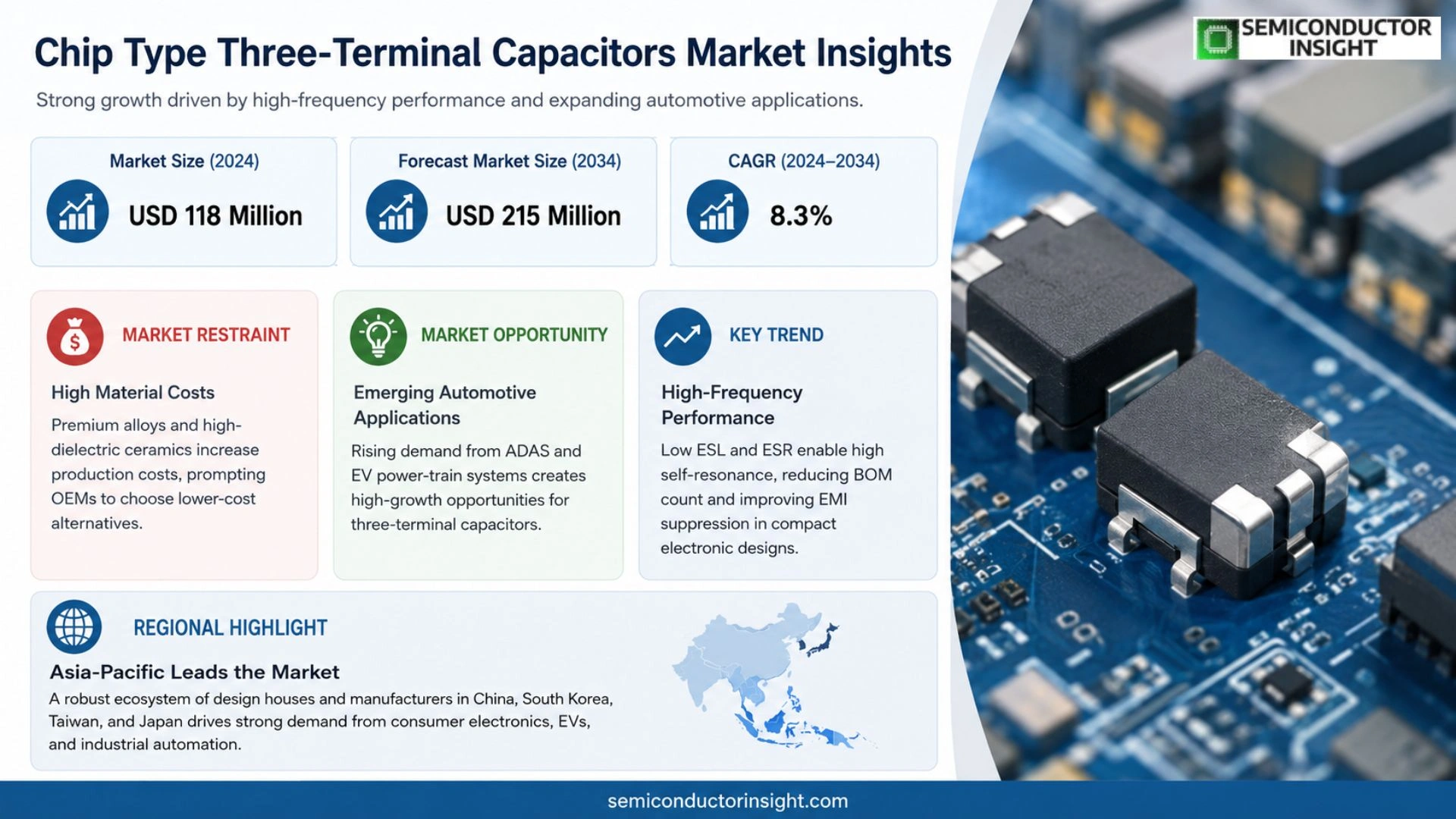
Global Chip Type Three-Terminal Capacitors market was valued at USD 118 million in 2024 and is forecasted to reach USD 215 million by 2034, exhibiting a CAGR of 8.3 % during the forecast period.
Because ESL (residual inductance) and ESR (equivalent series resistance) are extremely low, the self‑resonance frequency of these components is high, delivering deep insertion‑loss performance in the high‑frequency range. Compared with conventional two‑terminal capacitors, a single three‑terminal chip can replace several discrete parts, suppressing both low‑frequency ripple and high‑frequency EMI in digital appliances, computers, automotive electronics and other modern devices. Their compact footprint, lightweight construction and stable electrical characteristics make them well suited for mobile communications, consumer electronics and industrial control applications where space efficiency and reliable performance are paramount.
MARKET DRIVERS
Increasing Demand in Consumer Electronics
Chip Type Three-Terminal Capacitors Market is benefitting from the surge in handheld devices that require high‑frequency filtering in a compact footprint. Manufacturers are opting for three‑terminal architectures because they deliver lower equivalent series resistance, which translates directly into longer battery life for smartphones and wearables. This technical advantage has become a decisive factor in component selection, prompting suppliers to scale production capacity.
Miniaturization and System‑in‑Package Trends
Designers of system‑in‑package (SiP) modules are integrating three‑terminal capacitors to shrink board area while meeting stringent impedance specifications. The ability to place capacitors directly on silicon reduces interconnect parasitics, a benefit that is especially valuable in 5G radios and IoT gateways. Consequently, demand for such components is rising across tier‑1 OEMs.
➤ Component engineers cite the superior frequency response of three‑terminal capacitors as the primary reason for their adoption in high‑performance RF chains.
Beyond pure technical merit, the cost of ownership is improving as manufacturers achieve higher yields with automated chip‑on‑board processes. This efficiency gain narrows the price gap with traditional two‑terminal parts, making the three‑terminal option economically viable for volume production.
MARKET CHALLENGES
Supply Chain Volatility
Global shortages of high‑purity ceramic powders have introduced lead times that exceed six months for certain capacitance values. End‑users face scheduling uncertainty, forcing many to hold higher inventory buffers,a practice that inflates working capital and erodes profitability.
Other Challenges
Regulatory Compliance
Stringent RoHS and REACH regulations limit the use of certain dopants in capacitor formulations. Suppliers must invest in alternative chemistries, which can delay new product introductions and increase R&D expenditures.
MARKET RESTRAINTS
High Material Costs
The premium alloys and high‑dielectric‑constant ceramics required for three‑terminal designs command a price premium over conventional parts. When raw‑material prices climb, OEMs often revert to lower‑cost alternatives, throttling market momentum.
MARKET OPPORTUNITIES
Emerging Automotive Applications
Advanced driver‑assistance systems (ADAS) and electric‑vehicle power‑train controllers demand capacitors that can operate reliably across wide temperature ranges while preserving signal integrity. Three‑terminal capacitors meet these criteria, positioning them as a preferred choice for next‑generation automotive electronics. Companies that adapt their product lines to automotive qualification standards stand to capture a growing share of this high‑margin segment.
Chip Type Three-Terminal Capacitors Market Trends
High‑Frequency Performance Drives Broader Adoption
The exceptionally low residual inductance (ESL) and equivalent series resistance (ESR) of Chip Type Three-Terminal Capacitors translate into a self‑resonance frequency that comfortably exceeds the limits of conventional two‑terminal parts. This characteristic yields a deep insertion‑loss profile in the high‑frequency band, allowing designers to replace several discrete capacitors with a single chip. The resulting reduction in bill‑of‑materials not only trims board space but also simplifies thermal management. In digital appliances, computer motherboards, and emerging automotive electronic modules, the ability to suppress both low‑frequency ripple and high‑frequency electromagnetic interference (EMI) with one component has become a decisive factor for cost‑sensitive engineering teams.
Other Trends
Miniaturization Paired with System‑Level Integration
Device manufacturers are continuously pursuing lighter, smaller platforms without sacrificing reliability. Chip Type Three-Terminal Capacitors answer this call by offering a compact footprint, lightweight profile, and stable capacitance across temperature ranges. Their suitability for mobile communications, consumer wearables, and industrial control panels has accelerated their inclusion in system‑on‑chip (SoC)‑adjacent designs, where board real‑estate is at a premium. As smart‑device ecosystems evolve, the pressure to consolidate functions onto fewer components intensifies, prompting suppliers to expand their product portfolios with tighter tolerances and enhanced voltage ratings. Companies that align their R&D pipelines with these integration demands are positioning themselves to capture incremental market share.
Automotive and Industrial Segments Expand Usage
Electrification of vehicles and the rise of advanced driver‑assistance systems have created a fertile environment for high‑performance filtering solutions. Chip Type Three-Terminal Capacitors meet the stringent qualification standards required for infotainment units, power‑train control modules, and sensor interfaces, where both low‑frequency noise suppression and high‑frequency stability are critical. Parallel growth in factory automation,driven by predictive maintenance and real‑time monitoring,has amplified the need for robust EMI mitigation on industrial PCBs. These sectoral shifts compel manufacturers to scale production capacities, invest in automotive‑grade quality controls, and diversify distribution networks to serve a broader customer base.
COMPETITIVE LANDSCAPE
Key Industry Players
Global Competitive Overview of Chip Type Three-Terminal Capacitors
The market is dominated by a small cohort of Tier‑1 manufacturers that command the bulk of global capacity. Murata Manufacturing leads with a portfolio that blends high‑frequency performance and robust supply‑chain reach, allowing it to serve automotive infotainment, consumer mobile, and industrial control segments simultaneously. Kyocera’s ceramic expertise gives it a decisive edge in low‑ESR designs, while TDK leverages its scale in SMD/SMT formats to secure long‑term contracts with major OEMs. These incumbents benefit from vertically integrated production lines, which shorten lead times and enable tighter control over dielectric consistency. Regional presence is heavily weighted toward East Asia, where proximity to semiconductor fabs reduces logistics friction and supports rapid iteration of product specifications. The concentration of revenue among these three firms forces smaller players to specialize either in niche capacitance ranges or in cost‑sensitive applications. Recent acquisitions of ceramic foundries by Murata and TDK illustrate a strategic move to lock in raw‑material supply, reducing exposure to price volatility in the global ceramic market. Such consolidation raises entry barriers for newcomers lacking comparable capital resources.
Beyond the three powerhouses, a cluster of midsize and specialized firms sustains competitive pressure through differentiated technologies or targeted market segments. Fenghua Advanced Technology has carved a niche in high‑capacitance three‑terminal devices for power‑train modules, leveraging a proprietary dielectric that tolerates elevated ripple currents. Walsin Technology focuses on ultra‑compact packages for handheld electronics, where board‑space savings translate directly into higher bill‑of‑materials efficiency. Taiyo Yuden’s strength lies in its low‑loss ceramic formulations, making it a preferred supplier for precision timing and RF front‑ends. Samsung Electro‑Mechanics, while better known for chip capacitors, has entered the three‑terminal space with a line optimized for automotive transmission equipment, reflecting its broader strategy to diversify across vehicle electrification trends. European contenders such as AVX and Vishay maintain a foothold in the general‑use segment by offering extensive temperature‑range parts that satisfy stringent industrial standards. In the North‑American market, ROHM and Panasonic deliver customized solutions for smart‑home and IoT devices, underscoring the importance of application‑specific engineering support.
List of Key Chip Type Three-Terminal Capacitors Companies Profiled
- Murata Manufacturing
- Kyocera Corporation
- TDK Corporation
- Samsung Electro‑Mechanics
- Fenghua Advanced Technology
- Walsin Technology Corporation
- Taiyo Yuden Co., Ltd.
- AVX Corporation
- Vishay Intertechnology
- ROHM Semiconductor
- Panasonic Corporation
- NXP Semiconductors
Segment Analysis:
| Segment Category | Sub-Segments | Key Insights |
| By Type |
|
SMD/SMT
|
| By Application |
|
Automotive (Infotainment)
|
| By End User |
|
Consumer Electronics
|
| By Integration Level |
|
Integrated
|
| By Functionality |
|
Decoupling
|
Regional Analysis: Chip Type Three-Terminal Capacitors Market
Leading fabs in Taiwan and South Korea have refined high‑throughput plasma‑enhanced processes that squeeze capacitance values onto ever‑smaller footprints, enabling tier‑one smartphone makers to meet aggressive bill‑of‑material targets without compromising reliability.
Automotive power‑train modules and data‑center server boards represent the fastest‑growing demand pockets, as designers seek tighter voltage regulation and lower thermal footprints in compact form factors.
Regional standards for electromagnetic compatibility and safety certifications influence material choices, prompting suppliers to adopt low‑loss dielectric formulations that satisfy both performance and compliance criteria.
Collaborative R&D programmes between universities and industry players are accelerating the introduction of hybrid silicon‑graphene electrodes, a step that could redefine the power‑density ceiling for three‑terminal devices.
North America
North America retains a strong design‑centric position in Chip Type Three-Terminal Capacitors Market, with Silicon Valley and Detroit engineering clusters steering specification trends. While most volume manufacturing occurs abroad, U.S. firms focus on high‑performance variants for aerospace and defense platforms, where reliability under extreme temperature cycles is paramount. Partnerships between semiconductor houses and defense contractors translate into niche product lines that emphasize low leakage and extended lifetime, allowing domestic players to command premium pricing despite higher production costs. The convergence of 5G infrastructure rollout and renewable‑energy grid stabilisation projects further fuels demand for compact, high‑efficiency capacitors in the region.
Europe
European activity in the three‑terminal capacitor arena is characterised by stringent environmental directives and a preference for circular‑economy practices. Companies based in Germany and France are integrating eco‑friendly materials and adopting wafer‑recycling protocols, aligning product development with EU sustainability goals. Automotive manufacturers, especially those pursuing aggressive electrification targets, push suppliers to deliver components that balance high power density with minimal carbon footprint. In addition, the region’s strong intellectual‑property framework encourages investment in proprietary dielectric chemistries that promise lower dielectric loss and enhanced thermal stability.
South America
In South America, market momentum is modest but increasingly tied to regional telecom upgrades and mining equipment upgrades. Brazil’s expanding broadband initiatives create pockets of demand for compact power‑management modules, while Chile’s copper‑processing industry seeks robust capacitors capable of handling high surge currents. Local distributors often act as intermediaries, aggregating smaller orders from diverse end‑users and enabling access to imported technology. Strategic alliances with Asian manufacturers are gradually reducing lead times, allowing South American OEMs to integrate newer three‑terminal solutions into their product cycles.
Middle East & Africa
The Middle East & Africa region watches Chip Type Three-Terminal Capacitors Market with cautious optimism, driven largely by infrastructure projects and renewable‑energy installations. Saudi Arabia’s Vision 2030 agenda and the United Arab Emirates’ smart‑city initiatives demand reliable, space‑efficient power components for data‑centre back‑bones and solar‑inverter arrays. Meanwhile, African nations are beginning to adopt more sophisticated telecommunications equipment, prompting a slow but steady uptake of advanced capacitor technologies. Collaborative ventures with European design houses are providing a pathway for local firms to acquire design expertise while relying on imported manufacturing capacity.
Report Scope
This market research report provides a comprehensive analysis of the Chip Type Three-Terminal Capacitors Market , covering the forecast period 2026–2034. It offers detailed insights into market dynamics, technological advancements, competitive landscape, and key trends shaping the industry.
Key focus areas of the report include:
- Market Overview: The report begins with an overview outlining its current market scenario, key growth indicators, and industry transformation drivers. It discusses macroeconomic factors, demand–supply balance, regulatory landscape, and the strategic role of semiconductors in powering advancements across industries such as automotive, telecommunications, consumer electronics, and industrial automation.
- Market Size & Forecast: Historical data and future projections for revenue, unit shipments, and market value across major regions and segments.
- Segmentation Analysis: Detailed breakdown by product type, technology, application, and end-user industry to identify high-growth segments and investment opportunities.
- Regional Insights: Insights into market performance across North America, Europe, Asia-Pacific, Latin America, and the Middle East & Africa, including country-level analysis where relevant.
- Competitive Landscape: Profiles of leading market participants, including their product offerings, R&D focus, manufacturing capacity, pricing strategies, and recent developments such as mergers, acquisitions, and partnerships.
- Technology Trends & Innovation: Assessment of emerging technologies, integration of AI/IoT, semiconductor design trends, fabrication techniques, and evolving industry standards.
- Market Drivers & Restraints: Evaluation of factors driving market growth along with challenges, supply chain constraints, regulatory issues, and market-entry barriers.
- Stakeholder Insights: Insights for component suppliers, OEMs, system integrators, investors, and policymakers regarding the evolving ecosystem and strategic opportunities.
Primary and secondary research methods are employed, including interviews with industry experts, data from verified sources, and real-time market intelligence to ensure the accuracy and reliability of the insights presented.
FREQUENTLY ASKED QUESTIONS:
What is the current market size of Chip Type Three-Terminal Capacitors Market?
-> Chip Type Three-Terminal Capacitors market is forecasted to reach USD 215 million by 2034, exhibiting a CAGR of 8.3 % during the forecast period.
Which key companies operate in Chip Type Three-Terminal Capacitors Market?
-> Key players include Murata, Kyocera, Samsung, Fenghua Advanced Technology, TDK, Walsin, Maruwa, Taiyo Yuden.
What are the key growth drivers?
-> Key growth drivers include miniaturization of electronic devices, increasing demand for high‑frequency performance, EMI suppression requirements, growth in automotive electronics, and expansion of IoT and 5G applications.
Which region dominates the market?
-> Asia‑Pacific is the largest and fastest‑growing region, driven by major manufacturing hubs and strong demand in consumer electronics and automotive sectors.
What are the emerging trends?
-> Emerging trends include integration of advanced dielectric materials, higher self‑resonant frequency designs, adoption in AI‑enabled devices, and increased focus on eco‑friendly manufacturing processes.

Get Sample Report PDF for Exclusive Insights
Report Sample Includes
- Table of Contents
- List of Tables & Figures
- Charts, Research Methodology, and more...
 Download Sample Report PDF