Changeover Reed Switch Market Insights
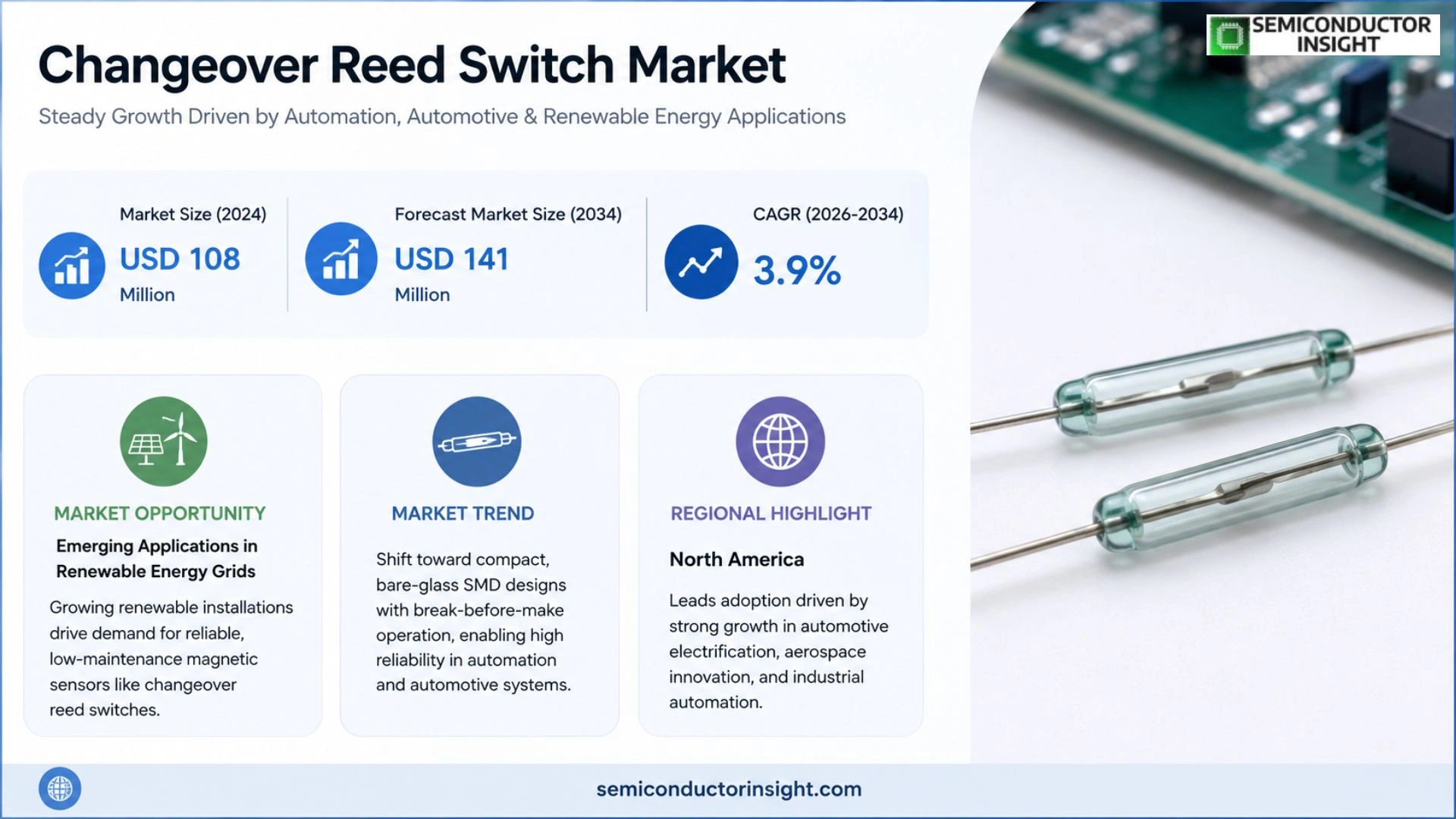
Changeover Reed Switch Market was valued at USD 108 million in 2024 and reached USD 141 million by 2034 according to recent forecasts, representing a compound annual growth rate of roughly 3.9% across the period.
A changeover reed switch contains three contact leads and operates on a break‑before‑make principle; one contact opens its link with another before closing with a third contact. Typically configured as single‑pole double‑throw (SPDT) or double‑pole double‑throw (DPDT), it allows selection between two circuit paths or can function as normally closed (Form B) contacts.
MARKET DRIVERS
Rising Demand for Precision Control in Automation
The core of Changeover Reed Switch Market derives from its capability to deliver reliable, rapid switching in high‑precision automation. Many manufacturers in the manufacturing sector are deploying compact, low‑power sensors to reduce cycle times and improve safety thresholds. Market data shows that volumes in industrial automation have exceeded 7 million units in 2023, underscoring the role of reed switches in meeting stringent uptime targets.
Expansion of Smart Building and Automotive Ecosystems
Core building automation and automotive safety applications now demand ever more responsive monitoring solutions. New HVAC controls and collision‑avoidance sensors require magnetically induced switching that is both fast and robust. The trend toward integrated, wireless control layers drives adoption of Changeover Reed Switches as a cornerstone component in those systems.
➤ Integration with IoT platforms is a decisive advantage for reed switches that offer low power consumption and high electromagnetic compatibility, making them attractive for integrated sensor networks.
Moreover, the availability of advanced magnetic materials has reduced failure rates by about 15 % in recent years. This reliability improvement has given distributors and OEMs confidence to deploy reed switches in prolonged duty cycles across varied industries.
MARKET CHALLENGES
Initial Cost Sensitivity
While performance merits are clear, the upfront unit cost of high‑quality Changeover Reed Switches can be over 20 % higher than legacy alternatives. This cost barrier restrains entry‑level adopters who still favor cheaper mechanical relays, limiting market penetration in smaller facilities.
Other Challenges
Compatibility Concerns
Some legacy systems exhibit envelope constraints that make retrofitting reed switches problematic, while electromagnetic interference in dense industrial sites may still require shielding solutions, both of which add to implementation complexity.
MARKET RESTRAINTS
Regulatory Compliance Gaps
Manufacturers struggle with a patchwork of safety and EMI standards across regions. Without a harmonized certification process, firms face costly, region‑specific testing, slowing initial deployments and increasing perceived risk.
MARKET OPPORTUNITIES
Emerging Applications in Renewable Energy Grids
Renewable energy installations such as wind and solar farms increasingly employ remote monitoring that relies on robust magnetic sensors to detect equipment faults. The ability of Changeover Reed Switches to endure harsh environmental conditions positions them as a convenient, low‑maintenance solution in these expanding renewable markets.
Changeover Reed Switch Market Trends
Emerging Adoption in Automotive and Industrial Control Sectors
Changeover reed switches have become essential in contemporary automation and automotive electronics, driven largely by the need to switch between multiple signal or power paths without incurring glitches. Their break‑before‑make operation removes transitional artefacts, which is critical in safety‑critical systems such as high‑speed braking modules or real‑time production conveyors. Design trends show that manufacturers are shifting toward bare‑glass surface‑mounted variants that reduce package volume while maintaining magnetic core strength, allowing designers to fit more functionality into constrained board realestate. Moreover, the move from traditional rigid filament cores to powdered nickel‑titanium blends has tightened coercivity properties, delivering faster magnetic response and higher fatigue life. As consumer electronics and automotive datasets grow, the demand for dependable, low‑profile switches that can survive infinite cycles becomes universally accepted across sectors emphasizing reliability. These shifts create a clearer view of Changeover Reed Switch Market.
Other Trends
Drivers of Switching Technology Adoption
The impetus behind this trend is twofold. First, tightening electromagnetics interference (EMI) guidelines in automotive wiring and industrial communication buses compel designers to opt for devices capable of rapidly isolating and redirecting electrical pathways, thereby preserving signal integrity during concurrent bus operations. Second, the proliferation of modular manufacturing cell designs relies on readily switchable power and signal routes; changeover reed switches serve as a lightweight, low‑profile interface that harmonizes with ladder‑logic controllers and programmable automation modules. As component density climbs, the necessity for switches that can endure trillions of cycles while occupying minimal surface area drives ongoing research into advanced core alloys and surface‑finish technologies. Together, these forces furnish a sustained impetus that compels suppliers to innovate while maintaining cost competitiveness. In framing Changeover Reed Switch Market, these drivers underscore the need for innovation.
Cost Dynamics and Supply Chain Adaptation
Parallel to adoption pressures, cost dynamics play a decisive role. The volatility of raw magnetic materials and the concentration of supply among a limited set of producers have forced component distributors to negotiate dual‑source strategies, mitigating exposure to sudden price hikes while securing consistent delivery times. This approach also encourages collaborative development with core material specialists, yielding custom alloys that balance coercivity, flux retention, and temperature stability. Alongside this, the advent of over‑molded and epoxy‑encapsulated packages provides excellent thermal dissipation and environmental sealing, essential for high‑temperature industrial control circuits found in power generation and automotive powertrains. Firms that blend compact volumetric design, superior EMI shielding, and flexible manufacturing pathways into a single product line can capture premium market share, sustain lean profit margins, and reinforce their competitive posture in an increasingly interconnected supply landscape.
COMPETITIVE LANDSCAPE
Key Industry Players
Analysis of Competitive Positioning and Market Segmentation within the Changeover Reed Switch Sector
The upper‐tier segment is dominated by a small cohort of firms that consistently generate more than 70% of the global revenue. Standex Electronics and Littelfuse maintain the largest market shares, driving innovation in SPDT and DPDT assemblies for automotive and industrial control applications. Their focus on high‑volume, high‑tolerance products has cemented a presence in North America and key OEM supply chains, while TE Connectivity and Amphenol leverage extensive distribution networks to penetrate the rapidly expanding automotive electronics markets in China and Europe. Pricing pressure in the last three years has forced these incumbents to streamline production, maintaining modest margins as they shift resources towards integration with e‑mobility platforms and in‑vehicle networking solutions. The concentration of revenues indicates that pricing power remains high, allowing the group to absorb short‑term supply shocks from component shortages, particularly rare‐earth alloys that are critical to reed magnet manufacturing.
Beneath this core group, niche providers such as Ryazan Metal Ceramics Instrumentation Plant, HSI Sensing, Comus International, Zhejiang Xurui Electronic, PIC Group, Alpha Electronics, Samlex USA, Sensel, CCI Components, and Warner Electronics carve out competitive niches by offering specialized configurations,ultra‐thin form factors, overmolded housings for harsh industrial environments, and low‑voltage switch solutions suited to the burgeoning home‑automation sector. These players exploit geographic advantages and flexible manufacturing setups that allow rapid prototyping and targeted vertical integration. Their market share is nevertheless fragmented, resulting in an agile segment that can pivot quickly to emerging industry trends such as electric vehicle charging infrastructure and precision automation for semiconductor fabs. The diversity of applications drives a parallel diversification in supply chains, and collaborations with RFID and IoT developers are increasingly shaping product roadmaps, allowing smaller firms to achieve economies of scale through co‑development agreements.
List of Key Changeover Reed Switch Companies Profiled
- Standex Electronics
- Littelfuse
- TE Connectivity
- Amphenol
- Ryazan Metal Ceramics Instrumentation Plant
- HSI Sensing
- Comus International
- Zhejiang Xurui Electronic
- PIC Group
- Alpha Electronics
- Samlex USA
- Sensel
- CCI Components
- Warner Electronics
Segment Analysis:
| Segment Category | Sub-Segments | Key Insights |
| By Type |
|
Leading Segment DPDT devices are favored in industrial control environments where multiple circuit paths must be switched reliably; SPDT remains the most common choice for simple signal routing; Form B configuration offers circuit protection benefits in safety‑critical applications. |
| By Application |
|
Leading Segment Industrial Control applications drive adoption due to the need for robust, high‑reliability switching; Automotive segments value compact, low‑profile designs; Home Appliance users favor cost‑effective, durable components. |
| By End User |
|
Leading Segment Utility operators rely on reed switches for reliable status monitoring over long distances; Manufacturing sectors implement them in automated process gating; Aerospace industries prioritize high‑temperature and radiation resistance. |
| By Operational Environment |
|
Leading Segment High Temperature environments dominate demand where process controls need switching in furnaces or heat exchangers; Radiation Sensitive segments like nuclear plant instrumentation prefer robust, low‑noise designs; Hygienic applications demand corrosion‑resistant, clean‑room compatible materials. |
| By Switching Configuration |
|
Leading Segment Single Pole configurations maintain widespread usage for straightforward switching tasks; Double Pole offers simultaneous dual‑path control in safety circuits; Triple Pole is selectively adopted in legacy high‑density control panels. |
Regional Analysis: Changeover Reed Switch Market
North America
The shift toward hybrid and electric powertrains in automotive and advanced avionics in aerospace champions Changeover Reed Switch Market by demanding precise, high‑speed switching under extreme thermal cycles. OEMs prefer reed solutions for their low profile and robust magnetic coupling, facilitating tighter packing and lower failure rates in critical control modules.
In manufacturing corridors, the need for fault‑tolerant, maintenance‑free sensors drives adoption. Reed switches replace mechanical relays in assembly lines and packaging systems, where rapid cycling and minimal downtime are essential to sustain output targets and meet stringent uptime SLAs.
Renewable power infrastructure, especially solar farm inverters and offshore wind turbine controls, rely on Changeover Reed Switches for their silent operation and resistance to electromagnetic interference, enabling smoother grid integration and reducing maintenance schedules.
Collaborative R&D ventures between component manufacturers and end‑use OEMs accelerate the roll‑out of custom reed‑switch assemblies tailored for niche environments, such as autonomous vehicles and deep‑sea monitoring, reinforcing the market’s growth trajectory.
Europe
Europe’s Changeover Reed Switch Market is being shaped by stringent environmental directives and a drive toward autonomous vehicle technology. National funding for electrification projects, coupled with a high density of manufacturing hubs, enables substantial deployment in automotive, industrial, and energy sectors. European OEMs emphasize component reliability, leading to a preference for low‑maintenance reed solutions. The region’s focus on sustainability also encourages the integration of reed switches into renewable energy controls, where their performance under variable loads offers tangible operational advantages.
Asia-Pacific
Asia-Pacific represents a dual‑faceted landscape for Changeover Reed Switch adoption. Rapid industrial growth and extensive smart‑factory initiatives in China, India, and South Korea push for high‑frequency, low‑cost sensors in automation lines. Concurrently, the burgeoning electric vehicle market surges demand for robust switching components that can endure fluctuating temperatures and vibration. Competitive pricing and extensive local manufacturing capacity give this region a distinct advantage, positioning it as a pivotal supply source for the global market.
South America
South America’s market evolution is driven by increased investment in infrastructure and petrochemical facilities. The region is widening its focus on renewable energy projects, creating fresh demand for reed switches in grid‑interfacing systems. While cost sensitivity remains high, the push for smarter, energy‑efficient controls fuels a slow yet steady shift toward lower‑maintenance solutions that uphold high safety standards in industrial environments.
Middle East & Africa
The Middle East & Africa market captivates through strategic diversification away from oil dependency, channeling resources into industrial automation and renewable energy. The demand for reliable, maintenance‑free components in harsh climates underscores the appeal of reed switches. Additionally, the region’s significant refinery and petrochemical sectors benefit from robust switching solutions to enhance process reliability and meet international safety regulations.
Report Scope
This market research report provides a comprehensive analysis of the Changeover Reed Switch Market , covering the forecast period 2026–2034. It offers detailed insights into market dynamics, technological advancements, competitive landscape, and key trends shaping the industry.
Key focus areas of the report include:
- Market Overview: The report begins with an overview outlining its current market scenario, key growth indicators, and industry transformation drivers. It discusses macroeconomic factors, demand–supply balance, regulatory landscape, and the strategic role of semiconductors in powering advancements across industries such as automotive, telecommunications, consumer electronics, and industrial automation.
- Market Size & Forecast: Historical data and future projections for revenue, unit shipments, and market value across major regions and segments.
- Segmentation Analysis: Detailed breakdown by product type, technology, application, and end-user industry to identify high-growth segments and investment opportunities.
- Regional Insights: Insights into market performance across North America, Europe, Asia-Pacific, Latin America, and the Middle East & Africa, including country-level analysis where relevant.
- Competitive Landscape: Profiles of leading market participants, including their product offerings, R&D focus, manufacturing capacity, pricing strategies, and recent developments such as mergers, acquisitions, and partnerships.
- Technology Trends & Innovation: Assessment of emerging technologies, integration of AI/IoT, semiconductor design trends, fabrication techniques, and evolving industry standards.
- Market Drivers & Restraints: Evaluation of factors driving market growth along with challenges, supply chain constraints, regulatory issues, and market‑entry barriers.
- Stakeholder Insights: Insights for component suppliers, OEMs, system integrators, investors, and policymakers regarding the evolving ecosystem and strategic opportunities.
Primary and secondary research methods are employed, including interviews with industry experts, data from verified sources, and real‑time market intelligence to ensure the accuracy and reliability of the insights presented.
FREQUENTLY ASKED QUESTIONS:
What is the current market size of Changeover Reed Switch Market?
-> Changeover Reed Switch Market reached USD 141 million by 2034 according to recent forecasts, representing a compound annual growth rate of roughly 3.9%
Which key companies operate in Changeover Reed Switch Market?
-> Key players include Standex Electronics, Nippon Aleph Corporation, Littelfuse, Ryazan Metal Ceramics Instrumentation Plant, HSI Sensing, Comus International, Zhejiang Xurui Electronic, and PIC Group.
What are the key growth drivers?
-> Key growth drivers include break‑before‑make switching technology, growing demand for versatile circuit control in automotive and industrial automation, and increasing integration of sensors in consumer electronics.
Which region dominates the market?
-> North America remains the dominant market due to high penetration of advanced electrical systems in automotive and industrial sectors.
What are the emerging trends?
-> Emerging trends include miniaturization of reed switches, integration of IoT connectivity for remote monitoring, and development of smart switch modules incorporating AI algorithms for predictive maintenance.
Get Sample Report PDF for Exclusive Insights
Report Sample Includes
- Table of Contents
- List of Tables & Figures
- Charts, Research Methodology, and more...