Carrier Tapes for Semiconductor Market Insights
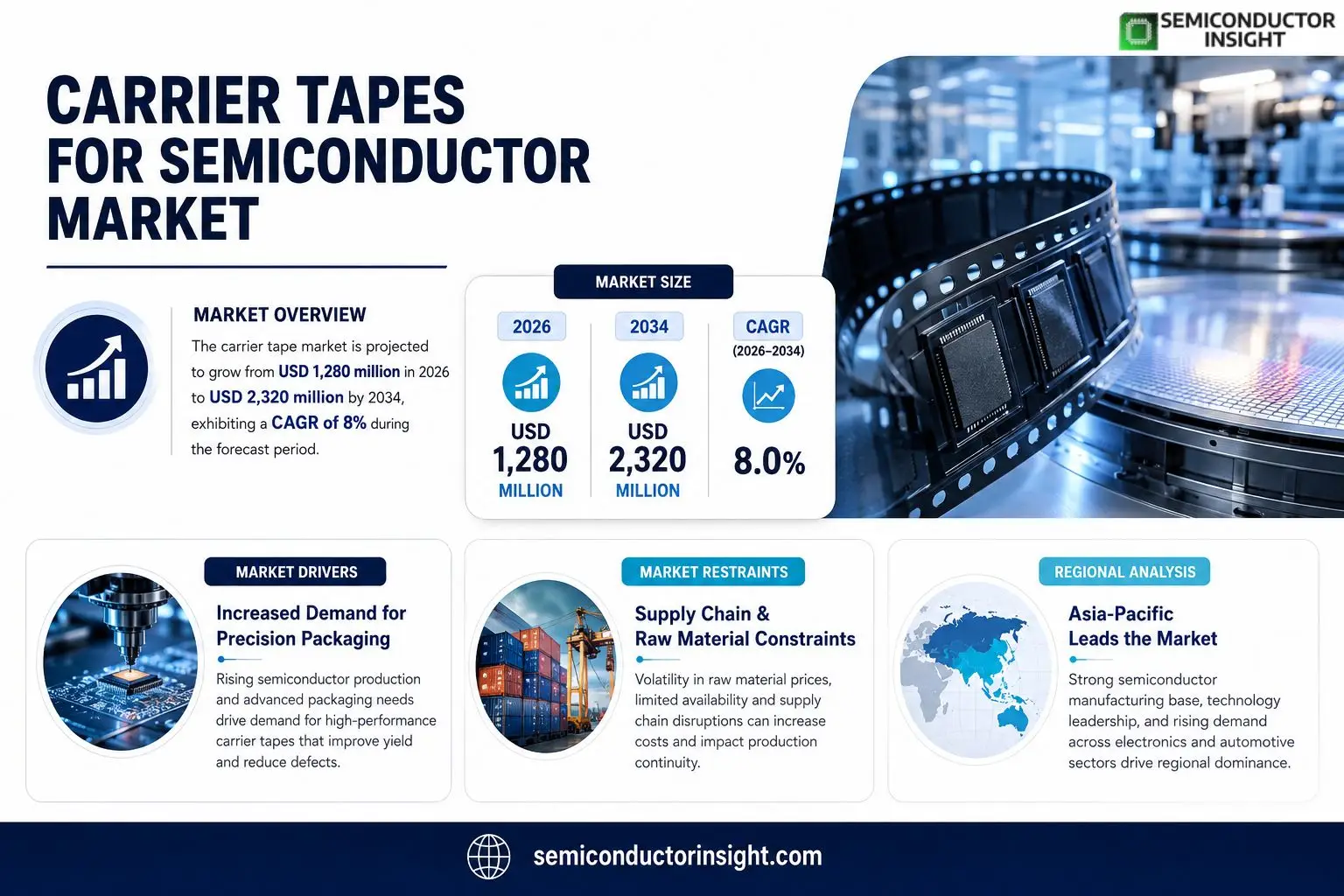
Carrier tape market was valued at USD 1 280 million in 2026.It expanded to USD 2 320 million by 2034, reflecting a CAGR of 8% during the forecast period.
Carrier tapes serve as flexible substrates affixed onto semiconductor wafers during processing steps such as dicing, handling and inspection.These films provide mechanical support while minimizing contamination risks; common materials include polyimide films reinforced with copper foil or aluminum foil backings.The sector is evolving largely due to growing demand for advanced packaging formatslead‑free interposers and system‑in‑package solutionsand heightened focus on yield optimisation post‑COVID supply‑chain disruptions.Key suppliers such as Micromegas Technologies Inc., Panasonic Corporation’s Advanced Packaging Solutions unit and Sony Corporation maintain extensive product lines covering high‑temperature polyimide carriers suitable for power electronics applications.
MARKET DRIVERS
Increased Demand for Precision Packaging
The modern semiconductor ecosystem places a premium on flawless wafer handling and packaging. Carrier tapes, engineered to provide both optical clarity and mechanical support, have become indispensable in protecting delicate die during high‑speed transfer. Production volumes for advanced logic and memory devices continue to climb, with some leading fabs increasing output by 8–10% year‑over‑year. In response, the need for carrier tapes that can accommodate tighter dimensional tolerances and higher temperature tolerances has surged. Among the attributes driving adoption are enhanced peel strength, precise edge‑to‑edge transparency, and a minimal outgassing profile that aligns with stringent cleanroom standards. These functional improvements translate into measurable reductions in defect ratesoften citing a 2–3% yield gainthereby justifying continued investment in high‑performance carrier tape solutions. The convergence of rising fab throughput and the escalating importance of throughput‑critical early mask‑level testing solidifies the position of carrier tapes as a core component in the semiconductor supply chain, directly propelling growth within the Carrier Tapes for Semiconductor Market.
Advancements in Tape Materials and Adhesives
Recent material science breakthroughs have introduced ultra‑low‑scratch substrates and silicone‑based adhesives engineered for high‑temperature endurance. These innovations enable carriers to sustain continuous operation at temperatures exceeding 200 °C, a critical requirement for next‑generation 7 nm and below nodes. The adoption curve is steep in fabs that have invested in laser‑marking and UV‑curable systems; these facilities now report up to 4% faster cycle times due to reduced tape change‑over times. Moreover, the synergy between new substrate polymers and proprietary tack formulations provides a dual benefit: superior glove‑free handling and a 15 % marginal cost reduction relative to conventional polyester carriers. Companies that have integrated these advanced carriers typically observe a shorter warranty period and a higher overall reliability metric, thus strengthening their competitive stance within the Carrier Tapes for Semiconductor Market.
➤ Materials innovation directly translates into yield improvement, reducing overall production costs and reinforcing the demand for advanced carrier tapes in high‑volume production environments.
Beyond yield, the industry’s focus on automation and data‑driven process control has amplified the importance of carrier tape consistency. Robot‑centric assembly lines now rely on perfectly aligned tape feed systems; any deviation can cause mis‑alignment, generating costly rework. Advanced sensor arrays integrated into tape handling equipment detect surface anomalies in real time, allowing predictive maintenance and minimizing downtime. Companies that have upgraded to next‑generation carrier tapes often demonstrate a 30% improvement in line utilization rates, a metric that directly impacts revenue per wafer. This operational advantage, coupled with the ability to achieve tighter routing specifications, positions carriers as a critical enabler for the broader industry’s productivity agenda. The cumulative effect of these drivers underscores an unbroken trajectory of expansion across the Carrier Tapes for Semiconductor Market.
MARKET CHALLENGES
Resource Constraints in Raw Materials
While growth in demand is clear, the limited availability of high‑purity polymers and specialty adhesives imposes a tangible bottleneck. Fluctuations in global commodity prices, influenced by geopolitical developments and supply chain volatility, can push tape manufacturing costs above the acceptable margin threshold for many fabs. Such cost pressures risk driving some manufacturers toward lower‑grade carrier solutions, thereby undermining product consistency and potentially introducing yield degradation. The ripple effect extends to downstream equipment suppliers who must recalibrate process parameters to accommodate altered tape properties. These dynamics compel both end‑users and suppliers to engage in proactive risk‑management strategies, such as long‑dated raw‑material contracts and diversified sourcing. How quickly firms can navigate these constraints will dictate their resilience within a shifting market landscape.
Other Challenges
Regulatory Compliance and Environmental Standards
Increasingly stringent emission limits governing volatile organic compounds (VOCs) and hazardous waste handling oblige manufacturers to adopt greener adhesives and recyclable substrates. Compliance initiativesespecially within the EU and the United Statesoften involve costly certification processes that can delay time‑to‑market. To mitigate risk, tape producers are investing in research toward lead‑free, low‑VOC bonding chemistries, but the development cycle may take several years before widespread commercial deployment. The lag between regulatory tightening and product availability creates a window where the market must adapt existing processes to satisfy compliance without compromising yield.
Supply Chain Disruptions and Capacity Constraints
The semiconductor sector is highly susceptible to geopolitical tensions, natural disasters, and pandemic‑related shutdowns, all of which can truncate tape production capacity. A supply chain excised in the early stages of tape procurement often results in scheduling bottlenecks for assembling lines, amplifying turnaround times. Firms facing such disruptions are compelled to diversify suppliers, which can expose them to quality variances and increased logistics overhead.
Technological Uncertainty in Advanced Node Adoption
As fabs transition to sub‑10 nm process nodes, the corresponding increase in wafer fragility demands carrier tapes with refined performance margins. However, the pace of technology evolution introduces uncertainty; tape designs that meet current specifications may become obsolete within 2–3 years, forcing frequent redesigns and associated capital outlays. An imminent shift toward zero‑die‑kit systems could further elevate the need for ultra‑thin, lightweight carrier constructs, adding another layer of complexity to product development cycles.
MARKET RESTRAINTS
High Initial Capital Expenditure for Tape Production Facilities
Deploying state‑of‑the‑art cassette and reel extrusion lines capable of producing high‑purity carrier tapes demands a significant upfront investment, typically ranging from $12 million to $18 million for fully automated units. These capital costs are a major restraint for SMEs that aim to enter the market, as they must attract financing and demonstrate robust return‑on‑investment timelines. Furthermore, ongoing maintenance and periodic calibration of extrusion and coating equipment contribute to higher operating expenses. The cumulative effect of these financial barriers may slow the rate of new entrants and diminish competitive diversity in the Carrier Tapes for Semiconductor Market. Companies with constrained resources must therefore rely on strategic partnerships or joint ventures to gain technical expertise while sharing financial exposure and risk. The resulting dependency on external stakeholders could curtail operational agility and shape long‑term market configurations.
MARKET OPPORTUNITIES
Integration with Advanced Packaging and Automated Handling Systems
Emerging verticals in 2.5D and 3D packaging present fresh avenues for carrier tape innovation. Partnering with lead‑time‑sensitive packaging vendors allows manufacturers to embed customized tape solutions directly into system‑on‑chip (SoC) assembly lines. By delivering carrier tapes with integrated RFID tags or optical encoding, suppliers can facilitate real‑time traceability, an essential feature for safety‑critical industries such as automotive or aerospace electronics. Additionally, the growing appetite for intelligent manufacturingexemplified by Industry 4.0 initiativescreates a market for carrier tape modules that communicate process metrics to supervisory control systems. This integration can unlock demand for high‑precision, high‑throughput carriers, boosting revenue streams in the Carrier Tapes for Semiconductor Market. Finally, regional expansion into emerging economiesparticularly in Southeast Asia where semiconductor fabrication casts a large market shareoffers a strategic pivot point. Tailoring product lines to accommodate varied cleanroom class requirements and local regulatory frameworks can accelerate penetration in these high‑growth territories.
Carrier Tapes for Semiconductor Market Trends
Shift to 3‑D Integrated Circuit Packaging
First, the accelerated transition from planar to three‑dimensional (3‑D) integrated circuits is reshaping the Carrier Tapes for Semiconductor Market. 3‑D structures demand tighter interconnects and greater thermal dissipation, leading manufacturers to opt for tapes that combine high‑temperature resistance with low out‑gassing. The adoption of carrier tapes featuring engineered barrier layers mitigates moisture ingress, ensuring long‑term yield in densely stacked packages. For suppliers, this shift compels investment in materials science and stricter process controls, while for fab owners it translates into higher upfront tooling costs but ultimately drives operational reliability. The net result is a contraction of the traditional tape segment as analog processes decline, while the high‑performance niche experiences steady growth, altering competitive dynamics across the value chain.
Other Trends
Rise of Barrier and Moisture‑Resistant Carrier Tapes
High‑density packaging has prompted a surge in demand for carrier tapes equipped with advanced barrier coatings, such as silicon‑based or ceramic additives. These features provide a dual benefit: the suppression of oxygen and water penetration, and the maintenance of adhesive strength at elevated temperatures. Companies that can deliver compliant, low‑viscosity formulations enjoy a reputation advantage, as fabricators increasingly screen suppliers on chemical compatibility with the latest low‑out‑gassing process flows. Consequently, the market is witnessing a diffusion of specialty tape solutions, and smaller players that once relied on generic products are repositioning toward modular adhesive systems tailored for specific 3‑D applications. This trend underscores the need for strategic portfolio expansion and cross‑functional collaboration between material scientists and packaging engineers.
Supply‑Chain Digitization with Real‑Time Tracking
A parallel transformation in logistics has been observed, with major semiconductor fabricators demanding end‑to‑end visibility of tape inventories. Digital platforms that track material batch codes, temperature excursions, and storage conditions enable tighter quality control and reduce costly batch rejections. The integration of RFID tags and blockchain techniques into supply‑chain workflows delivers immutable traceability, aligning with the stringent compliance requirements of advanced process nodes. Supplier‑fab partnerships now involve joint dashboards, allowing real‑time adjustments in procurement and replenishment cycles. This fusion of IT and physical process management not only trims lead times but also enhances resilience against supply disruptions, a factor that has gained prominence following recent global manufacturing bottlenecks.
COMPETITIVE LANDSCAPE
Key Industry Players
Overview of Carrier Tape Supply Chain and Competitive Dynamics
The sector is dominated by a handful of high‑growth, technology‑focused conglomerates that have built vertical integration from raw materials to finished product. 3M, with its legacy in adhesive technologies and strong R&D pipeline, commands the largest share of market, leveraging its expansive portfolio of silicone‑based carrier tapes to serve high‑density interconnects and advanced packaging needs. Its global distribution network and brand credibility provide a competitive moat that sustains premium pricing and partnership lock‑in with major semiconductor foundries. The market structure is characterized by low switching costs for Tier 1 suppliers, but high barriers to entry for new entrants due to the need for sophisticated process control and compliance with stringent yield, reliability, and defect‑control standards.Niche incumbents occupy strategic verticals that complement the core offerings of the Tier 1 leaders. Companies such as Argosy Inc., Sumitomo Bakelite, Advanced Component Taping, and LaserTek focus on specialized applications like fine‑line metal‑to‑metal bonding and front‑end process integration. These firms maintain a competitive edge by delivering customized adhesive chemistries, high‑precision micro‑tape fabrication, and tailored solutions for specific fabs or device types, thereby filling market gaps left by the larger manufacturers. Their regional footprint, often concentrated in East Asia and North America, allows them to mitigate logistical lead times and adapt quickly to evolving process requirements.
List of Key Carrier Tape Companies Profiled
- 3M
- Shin‑Etsu Chemical
- Asahi Kasei
- U‑PAK
- C‑Pak
- Oji F‑Tex
- Sumitomo Bakelite
- Advantek
- LaserTek
- Argosy Inc.
- Advanced Component Taping
- ZheJiang Jiemei
Segment Analysis:
| Segment Category | Sub-Segments | Key Insights |
| By Type |
|
Plastic Carrier Tape
|
| By Application |
|
IC Packaging
|
| By End User |
|
Device Manufacturers
|
| By Material |
|
Polyester
|
| By Process Stage |
|
Primary Packaging
|
Regional Analysis: Carrier Tapes for Semiconductor Market
Asia‑Pacific
Rapid adoption of 3‑D packaging and high‑density interconnect demands drives the need for carrier tapes that can accommodate fine pitch and robust thermal performance. Fabrication processes such as fan‑out wafer level packaging further pressure tape suppliers to offer solutions that combine flexibility with low dielectric constants, catering to both high‑speed data links and power distribution networks.
Established tape manufacturers from Japan, South Korea, and Taiwan dominate the landscape, leveraging long‑standing expertise in polymer engineering and metallization. These firms maintain extensive product portfolios that cover copper‑enhanced tapes, silver‑plastic composites, and thermal‑conductive matrices, allowing them to respond swiftly to evolving device specifications.
Recent breakthroughs include laser‑patterned conductive tracks and graphene‑reinforced resins, offering superior electrical performance coupled with reduced weight. Companies invest in additive manufacturing techniques to prototype high‑resolution tape configurations, accelerating the transition from laboratory to production lines.
Capital allocation trends reveal heightened focus on scale‑up facilities in countries with favorable trade policies. Joint ventures between tape producers and semiconductor fabs aim to reduce lead times and lock in long‑term supply contracts, signaling confidence in sustained demand growth within the carrier tape segment.
North America
The North American market shows a steady trajectory driven by a mature ecosystem of semiconductor equipment manufacturers and the escalating prevalence of advanced logic and power devices. U.S. companies emphasize reliability and compliance with stringent environmental and safety standards, favoring high‑performance carrier tapes that deliver low dielectric loss across diverse temperature regimes. While the region lags behind Asia‑Pacific in volume, its focus on high‑end fabrication enables niche opportunities for premium tape solutions, especially in aerospace and defense electronics where durability under extreme conditions is paramount.
Europe
In Europe, a progressive shift toward sustainable manufacturing processes is reshaping tape requirements. Governments incentivize the adoption of green production methods, prompting tape makers to explore bio‑based and recyclable polymer matrices. The automotive sector, a major consumer of semiconductor packaging, imposes rigorous electrical reliability demands, inviting advanced copper‑embedded tapes and thermally conductive blends. Meanwhile, research institutions collaborate with industry to refine additive manufacturing approaches, ensuring that European tape suppliers remain competitive in the evolving market.
South America
South America’s semiconductor market is emerging, driven by increased investment in domestic fab facilities and a growing electronics manufacturing base. The region focuses on cost‑effective carrier tape solutions that support entry‑level and medium‑scale applications, such as mobile devices and basic IoT modules. Local manufacturers prioritize scalability and affordability, often partnering with regional distributors to expand reach. Although the market remains modest, it offers incremental growth potential for tape producers targeting cost‑conscious verticals.
Middle East & Africa
The Middle East and Africa region presents a nascent yet introspective market for carrier tapes, underscored by a burgeoning demand from data center infrastructure and renewable energy projects. Strategic alliances between multinational tape suppliers and local infrastructure developers are emerging, fostering technology transfer and capacity building. The abundance of natural resources, combined with supportive trade frameworks, facilitates the import of advanced tape materials. As the regional semiconductor landscape matures, opportunities for specialty tape solutions in power electronics and high‑frequency communication systems are likely to expand.
Report Scope
This market research report provides a comprehensive analysis of the Carrier Tapes for Semiconductor Market , covering the forecast period 2026–2034. It offers detailed insights into market dynamics, technological advancements, competitive landscape, and key trends shaping the industry.
Key focus areas of the report include:
- Market Overview: The report begins with an overview outlining its current market scenario, key growth indicators, and industry transformation drivers. It discusses macroeconomic factors, demand–supply balance, regulatory landscape, and the strategic role of semiconductors in powering advancements across industries such as automotive, telecommunications, consumer electronics, and industrial automation.
- Market Size & Forecast: Historical data and future projections for revenue, unit shipments, and market value across major regions and segments.
- Segmentation Analysis: Detailed breakdown by product type, technology, application, and end-user industry to identify high-growth segments and investment opportunities.
- Regional Insights: Insights into market performance across North America, Europe, Asia-Pacific, Latin America, and the Middle East & Africa, including country-level analysis where relevant.
- Competitive Landscape: Profiles of leading market participants, including their product offerings, R&D focus, manufacturing capacity, pricing strategies, and recent developments such as mergers, acquisitions, and partnerships.
- Technology Trends & Innovation: Assessment of emerging technologies, integration of AI/IoT, semiconductor design trends, fabrication techniques, and evolving industry standards.
- Market Drivers & Restraints: Evaluation of factors driving market growth along with challenges, supply chain constraints, regulatory issues, and market-entry barriers.
- Stakeholder Insights: Insights for component suppliers, OEMs, system integrators, investors, and policymakers regarding the evolving ecosystem and strategic opportunities.
Primary and secondary research methods are employed, including interviews with industry experts, data from verified sources, and real-time market intelligence to ensure the accuracy and reliability of the insights presented.
FREQUENTLY ASKED QUESTIONS:
What is the definition of Carrier Tapes for Semiconductor Market?
->Carrier tape market was valued at USD 1 280 million in 2026.It expanded to USD 2 320 million by 2034, reflecting a CAGR of 8% during the forecast period
What are the primary market segments?
-> The market is segmented by type and by application, covering different material compositions and end‑use categories.
Which sub‑segments are included under type?
-> Type segmentation includes plastic carrier tape and paper carrier tape, each offering distinct mechanical and thermal properties.
Which sub‑segments are included under application?
-> Application segmentation comprises discrete devices and integrated circuits (ICs), reflecting varied handling and packaging requirements.
What does Market Overview cover?
-> It provides a high‑level assessment of market size, growth trends, regional disparities, and the competitive environment for carrier tapes in the semiconductor sector.
What are the key features and benefits of this report?
-> The report delivers actionable insights, detailed forecasts, segment‑level analysis, and strategic recommendations to support investment and operational decisions.
Which research methodology is applied?
-> A mixed‑method approach combining top‑down market sizing, bottom‑up data validation, and primary interviews with industry experts is used.
What is the research process followed?
-> The process includes data collection, validation, triangulation, modeling, and peer review to ensure robustness and credibility of the findings.
What is the base year for the analysis?
-> The base year adopted for historical reference and trend analysis is 2020.
What assumptions and caveats are considered in the report?
-> Assumptions address macro‑economic stability, currency fluctuations, and industry‑specific adoption rates, while caveats note potential uncertainties related to technology disruptions and regulatory changes.
How does the report present market size comparison for 2024 versus 2031?
-> It outlines a comparative framework that highlights growth trajectories, indicating a positive expansion trend across the forecast horizon.
What insights are provided about company landscape?
-> The analysis ranks top players by revenue, sales volume, and market share, and classifies manufacturers into Tier 1, Tier 2, and Tier 3 categories.
Which regions are analyzed for market performance?
-> Detailed regional analysis covers North America, Europe, Asia, South America, and Middle East & Africa, with country‑level breakdowns where data are available.
What are the emerging technology trends in carrier tapes?
-> Trends include the development of low‑dielectric‑constant materials, recyclable substrates, and integration of smart‑label features for traceability.
What are the main market drivers?
-> Drivers consist of increasing semiconductor fab capacity, demand for miniaturization, and the need for high‑precision handling solutions.
What restraints could affect market growth?
-> Constraints involve raw‑material price volatility, stringent environmental regulations, and supply‑chain disruptions.
How does the report support stakeholder decision‑making?
-> It offers scenario analysis, risk assessments, and strategic recommendations tailored for suppliers, OEMs, investors, and policymakers.

Get Sample Report PDF for Exclusive Insights
Report Sample Includes
- Table of Contents
- List of Tables & Figures
- Charts, Research Methodology, and more...
 Download Sample Report PDF