Camera Voice Coil Motor (VCM) Market Insights
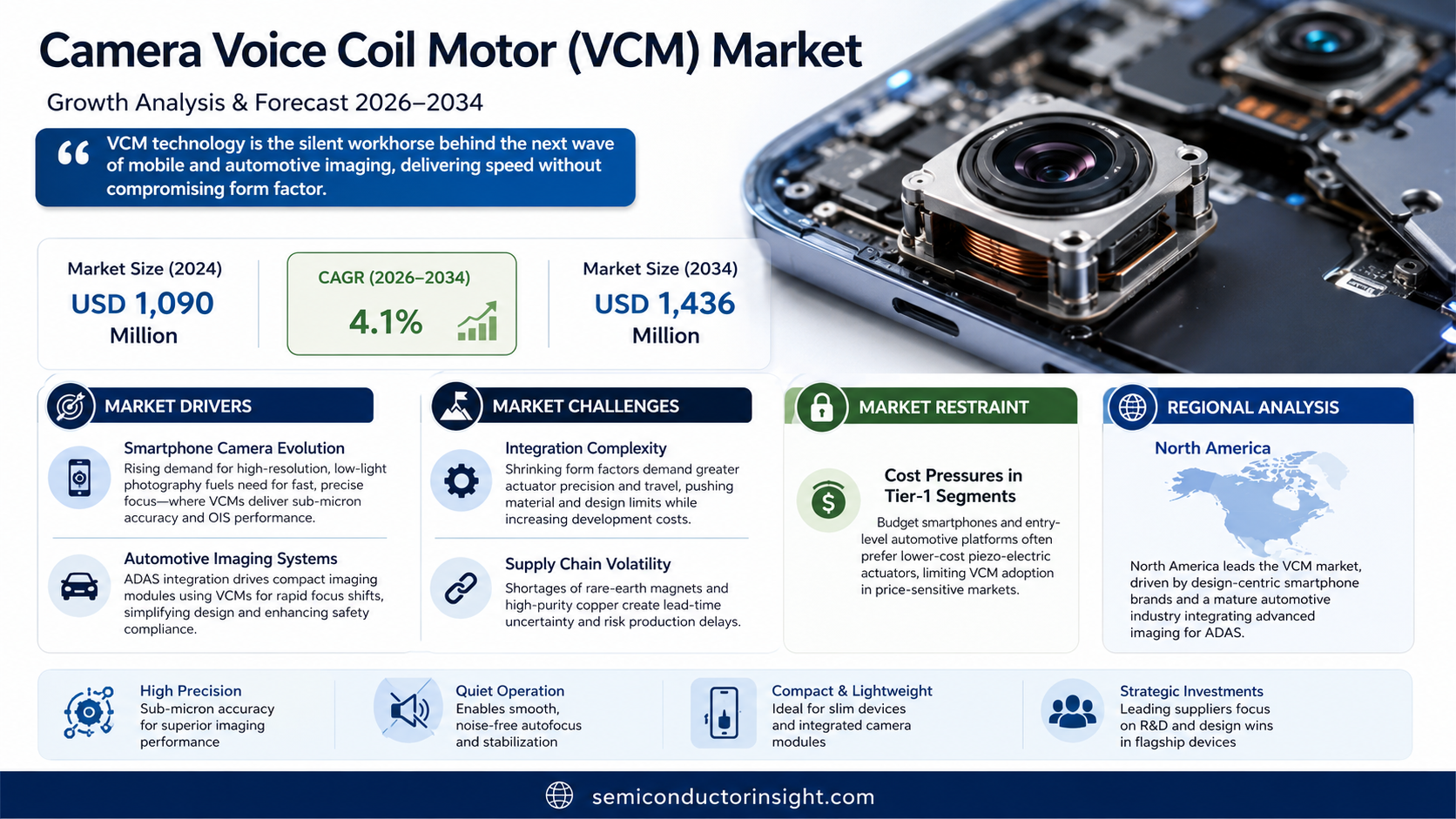
Global Camera Voice Coil Motor (VCM) market size was valued at USD 1,090 million in 2024 and is projected to reach USD 1,436 million by 2034, exhibiting a CAGR of 4.1% during the forecast period.
A VCM autofocus lens achieves focus by mechanically shifting the lens element relative to the image sensor; each adjustment changes focal length so that images remain sharp across varying distances.
The market benefits from expanding smartphone camera modules, growing demand for high‑resolution webcams, and continued semiconductor investment despite modest macro‑economic headwinds; leading suppliers such as ALPS, Mitsumi and TDK are advancing shrapnel‑type designs to meet miniaturisation trends.
MARKET DRIVERS
Smartphone Camera Evolution
Camera Voice Coil Motor (VCM) Market is being fanned by relentless consumer appetite for higher‑resolution, low‑light photography. As manufacturers embed multi‑lens arrays into thin‑form‑factor handsets, the need for fast, precise focus adjustment escalates. VCMs deliver the quiet operation and sub‑micron accuracy that optical‑image‑stabilization modules demand, translating into better user experiences and higher device premiums.
Automotive Imaging Systems
Advanced driver‑assistance systems (ADAS) are integrating compact imaging modules that rely on VCMs for rapid focus shifts at varying distances. The shift from isolated camera units to fully integrated sensor‑actuator packages reduces wiring complexity, a benefit that OEMs are capitalising on to meet safety regulations while keeping weight low.
➤ “VCM technology is the silent workhorse behind the next wave of mobile and automotive imaging, delivering speed without compromising form factor.”
Strategic investments from leading component suppliers underscore the long‑term confidence in this segment. By aligning R&D pipelines with emerging lens architectures, these firms aim to lock‑in design wins across flagship smartphones and premium vehicle models.
MARKET CHALLENGES
Integration Complexity
Engineers face a tightening margin between lens size and actuator travel, especially as devices shrink below 5 mm. Achieving the required focus range without sacrificing torque pushes the material science limits of coil windings and magnetic circuits, inflating development costs.
Other Challenges
Supply Chain Volatility
Component shortages for rare‑earth magnets and high‑purity copper have introduced lead‑time uncertainty. OEMs that cannot diversify their supplier base risk production bottlenecks that may delay product launches.
MARKET RESTRAINTS
Cost Pressures in Tier‑1 Segments
Budget‑oriented smartphones and entry‑level automotive platforms favour cheaper piezo‑electric alternatives to VCMs. The marginal cost advantage of non‑magnetic actuators narrows the price elasticity for VCM adoption, especially in markets where unit cost dominates bill‑of‑materials considerations.
MARKET OPPORTUNITIES
Augmented Reality and Wearable Optics
AR glasses and compact wearables demand ultra‑light, silent focusing mechanisms to maintain user comfort. VCMs, with their low inertia and fine‑step control, are uniquely positioned to satisfy these requirements, opening a niche yet rapidly expanding revenue stream.
Emerging 5G‑enabled cameras that stream high‑definition video in real time also call for actuators capable of sustaining high‑frequency focus cycles without overheating. Suppliers that can demonstrate thermal‑stable designs stand to capture contracts from telecom‑linked imaging solutions.
Camera Voice Coil Motor (VCM) Market Trends
Rising Demand for Compact Autofocus Solutions
Camera Voice Coil Motor (VCM) Market recorded revenue of about $1.09 billion in 2024. Forecasts indicate the segment will reach roughly $1.44 billion by 2031, reflecting a steady compound annual increase of 4.1 percent. This trajectory is anchored in the proliferation of ultra‑thin consumer electronics,smartphones, ultrabooks, and high‑resolution webcams,where space‑constrained lens assemblies rely on VCM‑driven autofocus to maintain image quality without enlarging device profiles. Manufacturers are therefore prioritising designs that integrate the motor directly into lens stacks, reducing overall bill of materials while preserving rapid focusing performance. The trend creates a clear incentive for component suppliers to shorten development cycles and scale volume production, as OEMs seek predictable lead‑times for next‑generation devices.
Other Trends
Shift Toward Shrapnel and Ball Structures
Segment analysis shows the shrapnel and ball‑type VCMs together accounting for over 60 percent of unit shipments in 2024. Shrapnel designs, with their lightweight diaphragms, meet the weight‑sensitive demands of smartphone cameras, while ball structures deliver higher torque suitable for interchangeable‑lens systems in premium mirrorless cameras. Suppliers that can offer flexible material options,such as high‑modulus polymers for shrapnel and low‑friction ceramics for ball configurations,are positioning themselves to capture market share in both mass‑market and professional segments. Consequently, R&D expenditures are increasingly directed toward hybrid manufacturing processes that blend micro‑machining with additive techniques.
Regional Realignment of Supply Chains
Geographically, the Americas recorded a 17 percent year‑on‑year revenue uplift in 2022, whereas Asia‑Pacific experienced a modest 2 percent decline, reflecting shifting consumer spending patterns and tariff pressures. Companies are rebalancing production footprints by expanding foundry capacity in North America and Eastern Europe, while maintaining strategic component sourcing from Japan and South Korea where sensor integration expertise remains strong. This reallocation mitigates exposure to regional demand volatility and shortens the logistics loop for high‑mix, low‑volume orders typical of emerging AR/VR devices that increasingly embed VCMs for eye‑tracking applications. The realignment also prompts distributors to develop region‑specific inventory models, enhancing responsiveness to localized OEM forecasts.
COMPETITIVE LANDSCAPE
Key Industry Players
Camera VCM Market: Competitive Assessment 2024‑2031
The market is anchored by a handful of vertically integrated manufacturers that command both design expertise and high‑volume production capacity. ALPS Alpine and Sony Semiconductor Solutions lead the segment with extensive portfolios covering shrapnel‑type and ball‑type motors for premium smartphones, leveraging deep relationships with OEMs that demand tight tolerance and fast focus response. Their scale creates pricing pressure for mid‑tier suppliers, while also establishing a benchmark for reliability that shapes procurement strategies across the supply chain. Samsung Electro‑Mechanics and TDK complement the top tier by focusing on cost‑efficient ball‑structure units for mainstream devices, using economies of scale in semiconductor fabs to keep unit costs attractive. This concentration of capability forces smaller entrants to specialize or partner with larger fab houses to gain market access.
Beyond the dominant quartet, a diverse set of niche players enriches the competitive fabric. Companies such as Mitsui‑Mitsumi, SEMCO, and Jahwa concentrate on friction‑type motors that serve niche applications like webcams and industrial scanners where torque over speed is prized. Regional specialists,Hysonic in Taiwan, YOVA in South Korea, and Shanghai B.L. Electronics in China,exploit localized customer bases and rapid customization cycles to capture orders from emerging camera modules. New Shicoh and ZET have recently announced development programs aimed at lightweight, low‑power VCMs for wearables, indicating a strategic pivot toward expanding the application envelope beyond traditional cell‑phone lenses. LG and Panasonic, while better known for broader display and imaging components, are gradually increasing their VCM footprint through joint ventures that blend electro‑mechanical expertise with existing supply‑chain relationships.
List of Key Camera Voice Coil Motor (VCM) Companies Profiled
- ALPS Alpine
- Sony Semiconductor Solutions
- Samsung Electro‑Mechanics
- TDK
- Mitsumi
- SEMCO
- Jahwa
- Hozel
- ZET
- New Shicoh
- Hysonic
- LG
- YOVA
- Shanghai B.L. Electronics
- Panasonic
Segment Analysis:
| Segment Category | Sub-Segments | Key Insights |
| By Type |
|
Ball Structure is emerging as the preferred type for high‑precision autofocus mechanisms.
|
| By Application |
|
Cell Phone drives the most innovative VCM implementations.
|
| By End User |
|
Consumer Electronics remains the core driver of VCM adoption.
|
| By Device Integration |
|
Dual‑camera modules are gaining traction as the leading integration approach.
|
| By Actuation Mechanism |
|
Linear VCM is recognized as the dominant actuation mechanism for most camera modules.
|
Regional Analysis: Camera Voice Coil Motor (VCM) Market
North America
Flagship handsets released in the United States and Canada often introduce the latest VCM designs to enable faster autofocus. Manufacturers leverage the region’s high consumer spending power to justify premium pricing for lenses that deliver superior low‑light performance, reinforcing a feedback loop between demand and technological refinement.
North American automakers are embedding VCM‑driven camera modules in advanced driver‑assistance systems. The regulatory environment encourages early adoption of safety features, prompting suppliers to align actuator specifications with rigorous automotive reliability standards.
Factories that rely on machine vision for quality control source VCM components from regional distributors that can offer quick technical support, minimizing equipment downtime and fostering loyalty among industrial clients.
Proximity to major silicon foundries and precision machining hubs shortens the logistics chain, allowing original equipment manufacturers to respond swiftly to design changes without sacrificing inventory efficiency.
Europe
European firms exhibit a disciplined approach to VCM integration, particularly within premium camera modules for compact devices. The region’s stringent environmental directives shape material choices, encouraging the adoption of recyclable actuator components. Collaborative projects between German engineering firms and French optical specialists have yielded highly synchronized focus mechanisms, positioning Europe as a hub for bespoke solutions that command higher margins. Demand is further supported by a strong presence of automotive manufacturers that prioritize safety‑grade imaging systems, prompting local suppliers to meet exacting functional specifications.
Asia‑Pacific
Asia‑Pacific remains the most diverse market for Camera Voice Coil Motor (VCM) Market, ranging from high‑volume smartphone assemblers in China to emerging automotive players in India. Cost‑sensitive production environments drive intense competition among contract manufacturers, fostering rapid iteration of actuator designs that balance performance with affordability. Simultaneously, regional governments invest in smart‑city initiatives that embed cameras across public infrastructure, creating ancillary demand for compact, reliable VCMs. The breadth of applications leads to a multifaceted supply network that can scale quickly when new product cycles commence.
South America
In South America, growth is anchored by gradual adoption of advanced imaging in both consumer electronics and agricultural machinery. Local OEMs increasingly source VCM components from nearby Latin‑American distributors to reduce import reliance and mitigate currency volatility. While overall volumes are modest, the market shows a clear trajectory toward higher‑end devices, especially as middle‑class consumers upgrade to smartphones with sophisticated camera capabilities. Companies that can offer localized after‑sales support gain a competitive edge in this evolving landscape.
Middle East & Africa
The Middle East & Africa region presents a niche yet expanding arena for VCM technology. In the Gulf states, premium automotive brands integrate VCM‑driven cameras within luxury vehicle line‑ups, reflecting consumer expectations for cutting‑edge safety features. Meanwhile, African telecom operators are rolling out 5G networks that enable richer mobile photography experiences, indirectly stimulating demand for more capable camera modules. Suppliers that tailor their value propositions to address both high‑end automotive needs and emerging mobile trends stand to capture the limited but growing opportunities across this varied territory.
Report Scope
This market research report provides a comprehensive analysis of the Camera Voice Coil Motor (VCM) Market , covering the forecast period 2026–2034. It offers detailed insights into market dynamics, technological advancements, competitive landscape, and key trends shaping the industry.
Key focus areas of the report include:
- Market Overview: The report begins with an overview outlining its current market scenario, key growth indicators, and industry transformation drivers. It discusses macroeconomic factors, demand–supply balance, regulatory landscape, and the strategic role of semiconductors in powering advancements across industries such as automotive, telecommunications, consumer electronics, and industrial automation.
- Market Size & Forecast: Historical data and future projections for revenue, unit shipments, and market value across major regions and segments.
- Segmentation Analysis: Detailed breakdown by product type, technology, application, and end-user industry to identify high-growth segments and investment opportunities.
- Regional Insights: Insights into market performance across North America, Europe, Asia-Pacific, Latin America, and the Middle East & Africa, including country-level analysis where relevant.
- Competitive Landscape: Profiles of leading market participants, including their product offerings, R&D focus, manufacturing capacity, pricing strategies, and recent developments such as mergers, acquisitions, and partnerships.
- Technology Trends & Innovation: Assessment of emerging technologies, integration of AI/IoT, semiconductor design trends, fabrication techniques, and evolving industry standards.
- Market Drivers & Restraints: Evaluation of factors driving market growth along with challenges, supply chain constraints, regulatory issues, and market-entry barriers.
- Stakeholder Insights: Insights for component suppliers, OEMs, system integrators, investors, and policymakers regarding the evolving ecosystem and strategic opportunities.
Primary and secondary research methods are employed, including interviews with industry experts, data from verified sources, and real-time market intelligence to ensure the accuracy and reliability of the insights presented.
FREQUENTLY ASKED QUESTIONS:
What is the current market size of Camera Voice Coil Motor (VCM) Market?
-> Camera Voice Coil Motor (VCM) Market is expected to reach USD 1436 million by 2034, growing at a CAGR of 4.1%
Which key companies operate in Camera Voice Coil Motor (VCM) Market?
-> Key players include ALPS, Mitsumi, SEMCO, Jahwa, TDK, Hozel, ZET, New Shicoh, Hysonic, LG, YOVA, Shanghai B.L Electronics.
What are the key growth drivers?
-> Key growth drivers include rising demand for high‑resolution smartphone cameras, increased adoption of automotive driver‑assistance systems, growth of IoT and wearable devices, and continuous improvements in autofocus technology that rely on VCM mechanisms.
Which region dominates the market?
-> Asia‑Pacific remains the largest market due to strong smartphone manufacturing bases and expanding automotive electronics production, while North America and Europe also show robust growth.
What are the emerging trends?
-> Emerging trends include integration of AI‑enabled autofocus, miniaturization of VCM structures such as shrapnel and ball types, and the development of low‑power VCM solutions for wearable and AR/VR applications.

Get Sample Report PDF for Exclusive Insights
Report Sample Includes
- Table of Contents
- List of Tables & Figures
- Charts, Research Methodology, and more...
 Download Sample Report PDF