Cable-Extension Transducer Market Insights
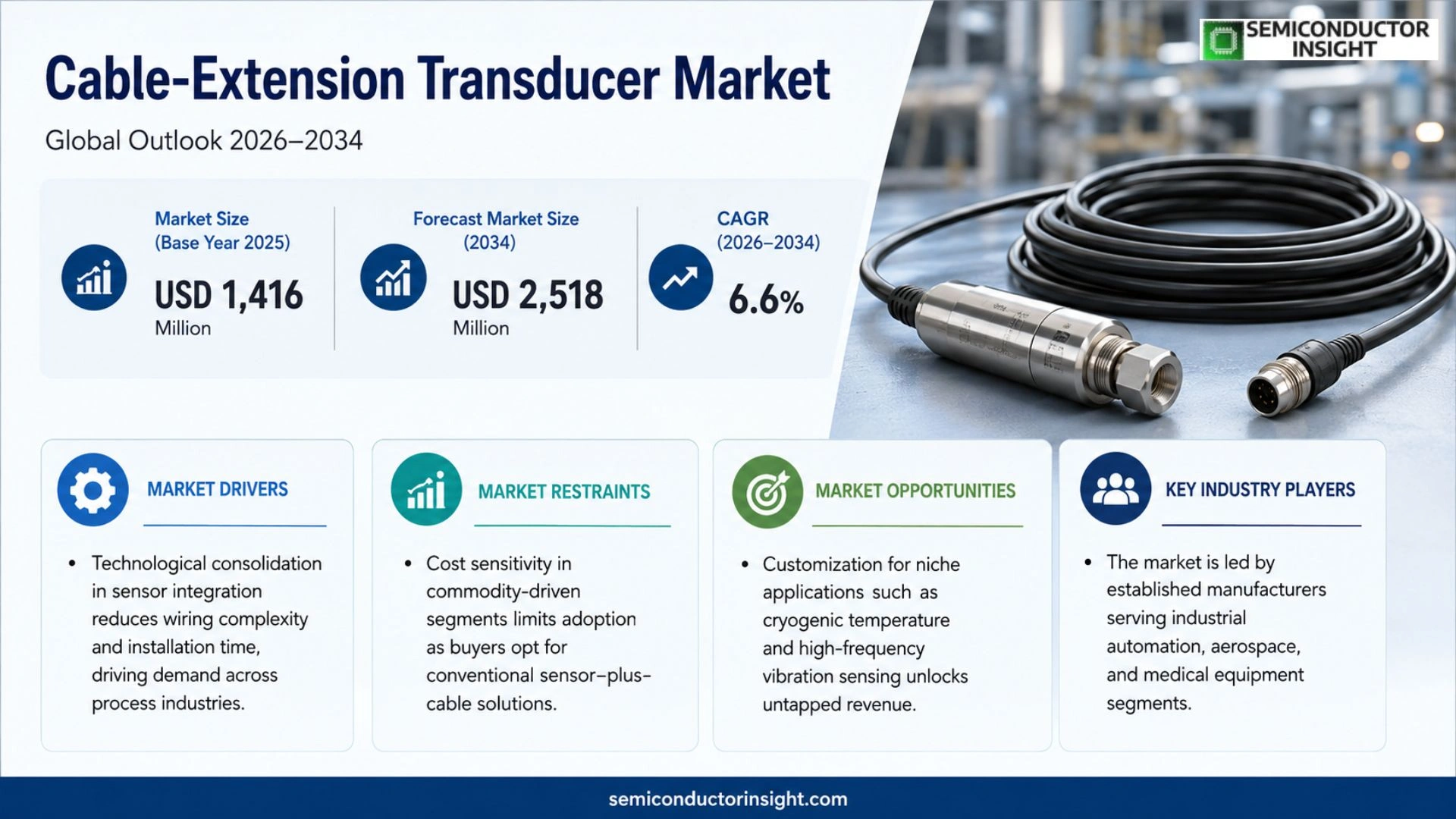
Global Cable-Extension Transducer market size was valued at USD 1,416 million in 2025 and is projected to reach USD 2,518 million by 2034, exhibiting a CAGR of approximately 6.6 % during the forecast period.
A cable‑extension transducer,also known as a draw‑wire sensor, string pot or yo‑yo pot,measures linear displacement by winding a spring‑loaded cable around a spool while converting motion into an electrical signal through a sensing element attached to the cable’s end. This architecture enables large travel distances within compact installations, offering high resolution, durability and flexibility for industrial automation, robotics, aerospace, automotive and medical equipment.
MARKET DRIVERS
Technological Consolidation in Sensor Integration
Manufacturers are merging signal conditioning, power delivery, and data acquisition within a single cable‑extension transducer package. This convergence reduces wiring complexity, shortens installation time, and lowers total cost of ownership. End‑users appreciate the streamlined architecture, prompting a noticeable uptick in procurement cycles across process industries.
Demand from Emerging Automation Hubs
Regions that are scaling smart‑factory initiatives,particularly in Southeast Asia and Central Europe,are specifying cable‑extension transducers for high‑precision flow and pressure monitoring. The localized push for tighter quality controls translates directly into higher unit volumes as OEMs adapt their product lines to meet stricter compliance regimes.
➤ “Integrating the sensor and the extension cable into a single unit cuts assembly labor by roughly 30 % while maintaining signal fidelity.”
The operational advantage of reduced connector count is resonating with maintenance teams. Reliability gains are especially valuable in hazardous environments where each additional connector represents a potential failure point. Consequently, Cable-Extension Transducer Market is witnessing a shift from legacy discrete assemblies toward integrated solutions.
MARKET CHALLENGES
Regulatory Hurdles in Hazardous Zones
Certification processes for explosive‑proof equipment remain lengthy and costly. Companies must navigate multiple standards (e.g., ATEX, IECEx) before a cable‑extension transducer can be deployed in volatile locations. This regulatory pathway slows time‑to‑market and adds a premium to the final product price.
Other Challenges
Supply‑Chain Volatility
Global shortages of specialty alloys and high‑purity polymers are affecting the ability to meet design specifications. When critical raw materials become scarce, lead times extend, and manufacturers are forced to redesign components, eroding margins.
MARKET RESTRAINTS
Cost Sensitivity in Commodity‑Driven Segments
Industries that treat transducers as interchangeable parts,such as bulk water treatment,remain hesitant to absorb the higher upfront investment associated with integrated cable‑extension designs. The prevailing pricing pressure forces many buyers to opt for conventional sensor‑plus‑cable setups, limiting broader market penetration.
MARKET OPPORTUNITIES
Customization for Niche Process Applications
Tailoring cable‑extension transducers to niche requirements,such as cryogenic temperature measurement or ultra‑high‑frequency vibration sensing,creates a differentiated value proposition. Companies that invest in modular design platforms can address these specialist needs without extensive re‑engineering, unlocking revenue streams that remain largely untapped.
Cable-Extension Transducer Market Trends
Compact Linear Sensing Gains Traction in Automated Equipment
The surge in high‑mix, low‑volume production lines has pushed equipment designers toward sensors that deliver millimetric accuracy while occupying minimal envelope. Cable‑Extension Transducers, with their spring‑loaded spool architecture, satisfy that requirement by translating cable travel into a robust electrical signal. Their ability to cover long strokes without sacrificing resolution makes them suitable for robotic arms, CNC tools, and pick‑and‑place machines that operate within confined cabinets. Because the cable itself can be routed through tight bends, system integrators achieve tighter mechanical tolerances and reduce the need for auxiliary alignment mechanisms. The practical outcome is a shorter time‑to‑market for bespoke automation projects and a measurable reduction in maintenance overhead, as the mechanical simplicity of the spool‑cable assembly translates into longer service intervals.
Other Trends
Sensor Fusion and IoT Integration
Manufacturers are embedding miniature communication modules directly onto the transducer housing, enabling real‑time telemetry without external conditioning hardware. This convergence supports predictive‑maintenance platforms that analyse displacement patterns to flag wear before failure occurs. In addition, the digital output formats align with Industry 4.0 gateways, allowing seamless ingestion into cloud‑based analytics pipelines. By offering both analog and digital interfaces, vendors cater to legacy equipment upgrades while positioning the technology as a native component of smart factories. The strategic implication for OEMs is the ability to monetize equipment uptime through service contracts that rely on continuous condition monitoring.
Geographic Realignment of Demand
Asia‑Pacific manufacturers are scaling up production of electric vehicles and collaborative robots, driving a pronounced uptick in orders for heavyweight sensor models that endure harsher operating cycles. European medical‑device firms, meanwhile, favor light‑duty transducers for patient‑centric imaging platforms, where sterilization protocols demand compact, easily serviceable designs. North America maintains a steady baseline, largely sustained by aerospace suppliers that value the proven reliability of cable‑extension solutions in vibration‑intense environments. This geographic diversification translates into a more resilient supply chain, as regional production hubs can buffer localized material shortages while meeting the nuanced specifications of each market segment.
COMPETITIVE LANDSCAPE
Key Industry Players
Cable‑Extension Transducer Market Competitive Landscape
The segment is dominated by a handful of mature manufacturers that have built extensive OEM relationships in industrial automation, aerospace and medical equipment. Micro‑Epsilon, for example, leverages its precision metrology heritage to offer high‑resolution string potentiometers that are favored in robotics and machine‑tool applications, allowing it to command a premium price tier and capture a sizable share of the $1.3 billion market recorded in 2024. SICK AG and Firstmark Controls complement the top tier by supplying integrated sensor solutions that pair cable‑extension technology with advanced digital interfaces, enabling system integrators to reduce wiring complexity while maintaining the linear accuracy demanded by modern smart factories. This concentration of capability creates a barrier to entry for newcomers, as the leading firms benefit from both deep engineering expertise and entrenched service networks across North America, Europe and Asia‑Pac.
Beyond the core group, a vibrant cohort of specialist firms injects differentiation through niche product portfolios and regional focus. Companies such as WayCon Positionsmesstechnik GmbH and Althen Sensors target heavy‑duty sectors like automotive assembly lines, where ruggedness and long‑stroke capability are decisive factors. Meanwhile, emerging players,including Changchun Rongde Optical, TR Electronic and Baumer USA,exploit growth in IoT‑enabled equipment by embedding telemetry functions directly into the transducer housing. This diversification of value propositions expands the addressable market, prompting larger incumbents to pursue strategic partnerships or acquisitions to retain competitive momentum in an environment where demand for precise linear displacement measurement is accelerating across a broad spectrum of end‑use cases.
List of Key Cable‑Extension Transducer Companies Profiled
- Micro‑Epsilon
- Firstmark Controls
- WayCon Positionsmesstechnik GmbH
- Althen Sensors
- BEI Sensors
- POSITAL
- SICK AG
- UniMeasure
- Bestech
- Messotron
- Kubler Group
- Changchun Rongde Optical
- TR Electronic
- Phoenix Sensors LLC
- RDP Electrosense, Inc.
- AMETEK Solartron Metrology
- West Coast Research Corp.
- TSM Sensors
- Baumer USA
Segment Analysis:
| Segment Category | Sub-Segments | Key Insights |
| By Type |
|
Light Duty Sensor is emerging as the preferred choice for most deployment scenarios.
|
| By Application |
|
Industrial Equipment drives the majority of adoption.
|
| By End User |
|
Robotics stands out as the most dynamic end‑user segment.
|
| By Connectivity |
|
Smart IoT‑Enabled is reshaping how position data is consumed.
|
| By Innovation |
|
Integrated Sensor Systems are gaining momentum among forward‑looking manufacturers.
|
Regional Analysis: Cable-Extension Transducer Market
North America
Venture capital flows favor firms that demonstrate scalable transducer platforms, while established players allocate capital to upgrade manufacturing footprints. The financing environment encourages both incremental upgrades and breakthrough projects.
Federal safety standards mandate continuous monitoring of high‑voltage cable networks, prompting utilities to adopt cable‑extension transducers as compliance tools rather than optional upgrades.
Utilities and data‑center operators prioritize real‑time diagnostics, leading to early‑stage contracts that embed transducer technology into new build and retrofit projects alike.
A dense supplier ecosystem in the United States and Canada provides rapid access to precision components, minimizing lead times and supporting just‑in‑time deployment models.
Europe
European markets exhibit a cautious but steady embrace of cable‑extension transducers, driven by stringent environmental directives that require proactive asset monitoring. Energy firms are integrating transducers to meet performance guarantees tied to renewable integration, while telecom regulators incentivize network resilience through targeted subsidies. Regional standards bodies are converging on interoperability protocols, which lowers entry barriers for smaller vendors and stimulates niche innovation, particularly in offshore wind connectivity.
Asia‑Pacific
In Asia‑Pacific, rapid urbanization and expanding broadband footprints create fertile ground for transducer adoption. Nations such as China, India, and Japan are upgrading legacy cable infrastructure to accommodate higher data rates, and transducers provide a cost‑effective means of extending service life. Local manufacturers benefit from economies of scale, yet face pressure to align with global quality benchmarks, prompting collaborative R&D efforts that blend cost efficiency with advanced sensing capabilities.
South America
South American operators are navigating legacy grid challenges while pursuing digital transformation agendas. Cable-Extension Transducer Market aids utilities in detecting insulation degradation before failures occur, a capability that aligns with public‑private partnership models aimed at reducing outage penalties. Emerging market entrants are leveraging partnerships with North American firms to acquire technology transfer, accelerating regional competence and fostering a competitive supplier landscape.
Middle East & Africa
The Middle East & Africa region presents a mixed picture; oil‑rich economies invest heavily in offshore cable networks where transducers enhance safety monitoring, whereas Sub‑Saharan nations focus on expanding basic telecommunication connectivity. International donors support pilot projects that demonstrate the reliability benefits of transducer‑enabled monitoring, gradually building a business case for broader rollout in both power and telecom sectors.
Report Scope
This market research report provides a comprehensive analysis of the Cable-Extension Transducer Market , covering the forecast period 2026–2034. It offers detailed insights into market dynamics, technological advancements, competitive landscape, and key trends shaping the industry.
Key focus areas of the report include:
- Market Overview: The report begins with an overview outlining its current market scenario, key growth indicators, and industry transformation drivers. It discusses macroeconomic factors, demand–supply balance, regulatory landscape, and the strategic role of semiconductors in powering advancements across industries such as automotive, telecommunications, consumer electronics, and industrial automation.
- Market Size & Forecast: Historical data and future projections for revenue, unit shipments, and market value across major regions and segments.
- Segmentation Analysis: Detailed breakdown by product type, technology, application, and end-user industry to identify high-growth segments and investment opportunities.
- Regional Insights: Insights into market performance across North America, Europe, Asia-Pacific, Latin America, and the Middle East & Africa, including country-level analysis where relevant.
- Competitive Landscape: Profiles of leading market participants, including their product offerings, R&D focus, manufacturing capacity, pricing strategies, and recent developments such as mergers, acquisitions, and partnerships.
- Technology Trends & Innovation: Assessment of emerging technologies, integration of AI/IoT, semiconductor design trends, fabrication techniques, and evolving industry standards.
- Market Drivers & Restraints: Evaluation of factors driving market growth along with challenges, supply chain constraints, regulatory issues, and market-entry barriers.
- Stakeholder Insights: Insights for component suppliers, OEMs, system integrators, investors, and policymakers regarding the evolving ecosystem and strategic opportunities.
Primary and secondary research methods are employed, including interviews with industry experts, data from verified sources, and real-time market intelligence to ensure the accuracy and reliability of the insights presented.
FREQUENTLY ASKED QUESTIONS:
What is the current market size of Cable-Extension Transducer Market?
-> Cable-Extension Transducer market is projected to reach USD 2,518 million by 2034, exhibiting a CAGR of approximately 6.6 % during the forecast period.
Which key companies operate in Cable-Extension Transducer Market?
-> Key players include Micro-Epsilon, Firstmark Controls, WayCon Positionsmesstechnik GmbH, Althen Sensors, BEI Sensors, POSITAL, SICK AG, UniMeasure, Bestech, Messotron, Kubler Group, Changchun Rongde Optical, TR Electronic, Phoenix Sensors LLC, RDP Electrosense, Inc., AMETEK Solartron Metrology, West Coast Research Corp., TSM Sensors, Baumer USA.
What are the key growth drivers?
-> Key growth drivers include rising automation in manufacturing, increasing demand for high‑resolution position sensing in robotics and aerospace, integration of sensors into IoT‑enabled smart systems, and the need for reliable displacement measurement in medical devices.
Which region dominates the market?
-> Asia‑Pacific leads the market due to rapid industrialization, strong automotive and electronics manufacturing bases, and extensive adoption of advanced automation technologies, while North America and Europe remain significant contributors.
What are the emerging trends?
-> Emerging trends include miniaturized cable‑extension transducers for compact robotic arms, AI‑enhanced sensor data analytics, wireless integration for predictive maintenance, and the development of high‑temperature resistant materials for aerospace applications.

Get Sample Report PDF for Exclusive Insights
Report Sample Includes
- Table of Contents
- List of Tables & Figures
- Charts, Research Methodology, and more...
 Download Sample Report PDF