Button Cell Battery Holder Market Insights
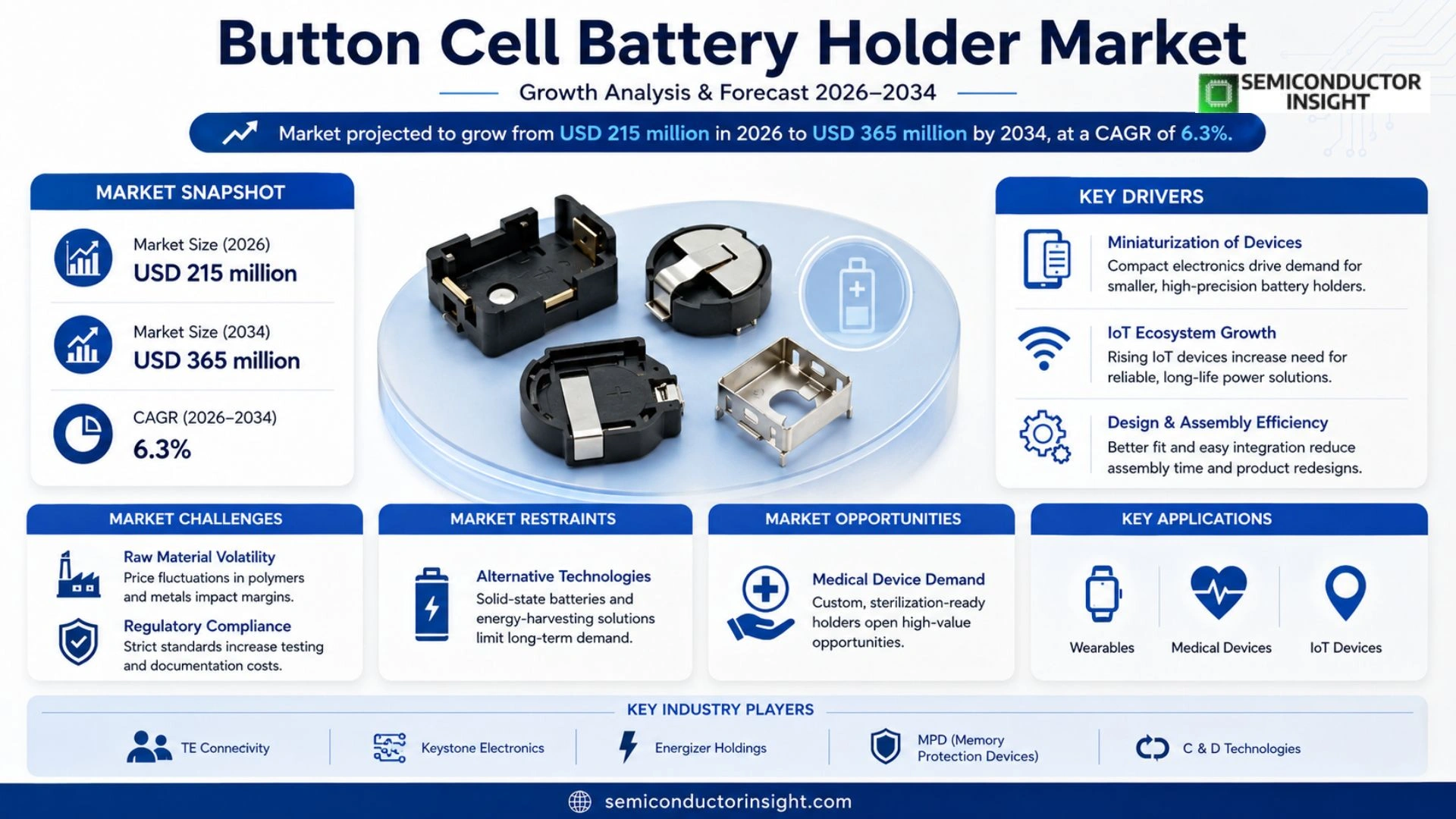
Global Button Cell Battery Holder market size was valued at USD 210 million in 2025. The market is projected to grow from USD 215 million in 2026 to USD 365 million by 2034, exhibiting a CAGR of approximately 6.3% during the forecast period.
A button cell battery holder is a miniature mechanical fixture designed to secure coin‑shaped electrochemical cells within electronic assemblies while providing reliable electrical contact through spring‑loaded or fixed terminals. These holders are offered in surface‑mount and through‑hole configurations, enabling integration into compact devices such as watches, medical implants, and wearable sensors.
The expansion of the holder segment mirrors wider adoption of ultra‑low‑power electronics and rising demand for replaceable power sources in IoT wearables and point‑of‑care medical equipment. Manufacturers including Memory Protection Devices, Wurth Elektronik, Renata SA and TE Connectivity have introduced higher‑density designs and lead‑free compliant variants to satisfy stricter environmental standards while preserving performance reliability.
MARKET DRIVERS
Miniaturization of Portable Electronics
Manufacturers of wearables, medical implants and remote sensors continuously shrink product footprints. This engineering imperative fuels demand for compact, reliable Button Cell Battery Holder solutions that can be integrated without compromising structural integrity. As device chassis become thinner, the holder’s material composition and mounting architecture evolve to meet tighter tolerances, directly propelling market activity.
Growth of the Internet of Things (IoT) Ecosystem
IoT deployments increasingly rely on low‑power, long‑life power sources. Button cells, paired with purpose‑built holders, deliver the predictable discharge curves required for autonomous operation. Industry observers note that the proliferation of smart home devices, asset‑tracking tags and environmental monitors creates a steady pipeline of orders for specialized holders.
➤ “Design engineers now specify battery holders at the concept stage, because a mis‑fit can force costly redesigns later in the product lifecycle.”
Because a well‑engineered holder reduces vibration‑induced wear and simplifies assembly, OEMs achieve faster time‑to‑market. The resulting efficiency gains reinforce the upward trajectory of Button Cell Battery Holder Market.
MARKET CHALLENGES
Supply‑Chain Volatility for Raw Materials
Fluctuations in the availability of high‑performance polymers and metal alloys complicate cost forecasting for holder manufacturers. When feedstock prices spike, the incremental expense is often transferred to end‑users, compressing margins for device makers that already operate under tight pricing constraints.
Other Challenges
Regulatory Compliance Burden
Stringent restrictions on hazardous substances in electronic components compel suppliers to certify each holder variant. The documentation effort, coupled with periodic audit cycles, drains resources that could otherwise be allocated to innovation.
MARKET RESTRAINTS
Alternative Power‑Delivery Architectures
Emerging solid‑state micro‑batteries and energy‑harvesting modules present viable substitutes for traditional button cells. As these technologies mature, some OEMs reevaluate the necessity of conventional holders, curbing long‑term demand growth for Button Cell Battery Holder Market.
MARKET OPPORTUNITIES
Customization for Niche Medical Devices
Regulated medical applications require holders that meet sterilization standards and possess biocompatible coatings. Suppliers that can deliver validated, custom‑engineered solutions stand to capture premium pricing, unlocking a lucrative segment within Button Cell Battery Holder Market.
Integration of Smart Features
Embedding RFID tags or conductive traces into holders enables real‑time inventory tracking and predictive maintenance for IoT deployments. Companies that pioneer such intelligent holders can differentiate themselves, creating new revenue streams while enhancing product value for end‑users.
Button Cell Battery Holder Market Trends
Integration of Wearables Fuels Holder Demand
The adoption of wearable electronics,smart watches, fitness trackers, and health‑monitoring patches,has accelerated the demand for compact power‑solution components. Manufacturers of miniature devices prioritize designs that conserve space while ensuring reliable electrical contact, a combination that elevates the relevance of button cell battery holders. This shift is spurred by consumer expectations for longer battery life and slimmer form factors, prompting OEMs to favor surface‑mount holders that integrate directly onto printed circuit boards. The ripple effect extends to supply chains, where component distributors report heightened inquiries for packages that meet tighter mechanical tolerances. Companies that adapt their product portfolios toward these specifications are likely to capture incremental revenue from the expanding wearable segment. Furthermore, the shift encourages design engineers to incorporate modular holder configurations that can be easily swapped during product revisions, thereby reducing time‑to‑market for successive device generations.
Other Trends
Shift Toward Surface‑Mount Technology
Surface‑mount holders have begun to supplant through‑hole variants in high‑volume production lines. The primary advantage lies in the reduction of assembly time; automated pick‑and‑place equipment can place surface‑mount components at rates exceeding 200 pcs per minute, a speed unattainable with traditional insertion methods. Additionally, the lower profile of these holders aligns with the trend of multi‑layer board architectures, where vertical space is at a premium. Suppliers responding to this demand are introducing variants with reinforced leads to address reliability concerns in vibration‑intensive environments such as automotive telematics. The market implication is a gradual reallocation of inventory from through‑hole to surface‑mount SKUs, compelling distributors to adjust pricing structures to reflect the higher throughput capabilities.
Regional Realignment Towards Asia‑Pacific
Asia‑Pacific continues to dominate the holder ecosystem, buoyed by a dense concentration of consumer‑electronics manufacturers in China, Japan, and South Korea. The region’s share of global button cell production exceeds 45 percent, a statistic that naturally translates into heightened demand for compatible mounting hardware. Recent investments in advanced packaging facilities have shortened lead times, allowing local OEMs to adopt just‑in‑time inventory models. Meanwhile, North American and European markets are experiencing a modest shift toward specialized medical‑device applications, where regulatory scrutiny drives the preference for holders with enhanced sealing properties. This geographic divergence suggests that suppliers will need to maintain distinct product portfolios: high‑volume, cost‑optimized lines for Asia‑Pacific and premium, compliance‑focused offerings for mature Western markets. In addition, the rising prevalence of IoT edge nodes in industrial settings is prompting a secondary wave of demand for ruggedized holders that can endure temperature fluctuations and harsh mechanical stress.
COMPETITIVE LANDSCAPE
Key Industry Players
Competitive Dynamics in the Global Button Cell Battery Holder Market
The holder segment is dominated by a handful of firms whose product breadth and vertical integration grant them leverage over pricing and supply‑chain resilience. Varta Microbattery, Panasonic, Murata, Energizer (Rayovac) and EVE Energy collectively command roughly half of worldwide shipments, a concentration that mirrors the coin‑cell market’s oligopolistic pattern. These companies have expanded their portfolio beyond traditional CR‑type holders into surface‑mount variants that cater to wearable‑device OEMs, using scale economies to undercut smaller rivals on cost per unit. Recent joint‑venture activity in Southeast Asia and strategic acquisitions of niche plating specialists reflect a deliberate push to secure raw‑material sources and to tighten tolerances for medical‑grade modules. For customers, the implication is a predictable supply window but reduced bargaining power, prompting many manufacturers to diversify their bill‑of‑materials across second‑tier sources.
Beyond the top tier, a diverse set of specialists is carving out lucrative niches by focusing on application‑specific performance attributes. Memory Protection Devices, Wurth Elektronik and Renata SA excel in high‑reliability holders for aerospace and defense, where stringent vibration and temperature ratings offset higher price points. Harwin, Keystone Electronics and Linx Technologies differentiate through compact through‑hole designs that fit legacy equipment, while Adam Tech and TE Connectivity leverage extensive distribution networks to serve the fast‑growing wearable and IoT segments. Ming Chiang Precision Co, NTE Electronics and Takachi sustain relevance through regional manufacturing footprints in China, India and Taiwan, enabling rapid response to localized demand spikes. Collectively, these firms add depth to the ecosystem, forcing the leaders to innovate continuously and offering end‑users a spectrum of cost‑ versus performance choices.
List of Key Button Cell Battery Holder Companies Profiled
- Varta Microbattery
- Panasonic
- Murata
- Energizer (Rayovac)
- EVE Energy
- Memory Protection Devices
- Wurth Elektronik
- Renata SA
- Harwin
- Keystone Electronics
- Linx Technologies
- Adam Tech
- TE Connectivity
- Ming Chiang Precision Co
- NTE Electronics
- Takachi
Segment Analysis:
| Segment Category | Sub-Segments | Key Insights |
| By Type |
|
Surface Mount
|
| By Application |
|
Wearable Device
|
| By End User |
|
Consumer Electronics
|
| By Material |
|
Plastic Housing
|
| By Design |
|
Low Profile
|
Regional Analysis: Button Cell Battery Holder Market
North America
The United States and Canada enforce rigorous certification processes for battery holders, emphasizing fire‑resistance and lead‑free construction. Manufacturers that streamline compliance can accelerate time‑to‑market, while those lagging face costly redesign cycles.
Proximity to major semiconductor and polymer producers enables tight coordination between component suppliers and assemblers, reducing lead times and supporting rapid iteration of holder designs.
Health‑tech firms in the region continually push for miniaturized power solutions, prompting holder manufacturers to explore thinner profiles and higher dimensional tolerances to accommodate emerging device form factors.
Environmental regulations and corporate ESG agendas drive the adoption of recyclable polymers and reduced‑metal content, reshaping material sourcing strategies across the market.
Europe
European markets exhibit a nuanced demand pattern for button cell holders, anchored by stringent RoHS directives and a strong preference for modular designs in automotive electronics and smart‑metering devices. German and French OEMs prioritize holders that can withstand temperature swings typical of vehicle cabins, prompting suppliers to emphasize robust sealing technologies. Moreover, the EU’s circular‑economy initiatives are nudging manufacturers toward recyclable composite materials, creating a niche for firms that can certify their products against the new waste‑reduction standards. The confluence of regulatory pressure and a fragmented but technologically adept customer base sustains Europe’s relevance in the broader market landscape.
Asia‑Pacific
In Asia‑Pacific, Button Cell Battery Holder Market is shaped by a surge in low‑cost consumer gadgets and a burgeoning smart‑city rollout across China, India, and Southeast Asian economies. Manufacturers exploit economies of scale to deliver volume‑driven pricing, yet they face escalating scrutiny over product safety after several high‑profile recall incidents. This tension between cost efficiency and compliance has spurred a wave of investment in automated testing facilities. Concurrently, the region’s massive manufacturing footprint provides an advantageous platform for rapid product diversification, enabling suppliers to address varied application segments from wearable health monitors to RFID tags.
South America
South America’s market growth is underpinned by expanding renewable‑energy projects and increased penetration of portable medical devices in Brazil and Chile. Local distributors value holders that combine affordability with reliable performance under humid conditions, leading to a modest preference for polymer‑based designs with enhanced moisture barriers. Trade agreements within Mercosur have eased cross‑border component flow, allowing regional assemblers to tap into broader supplier networks while still catering to localized device specifications.
Middle East & Africa
The Middle East & Africa region reflects a mixed outlook, where high‑value aerospace and defense contracts in the Gulf states drive demand for premium‑grade button cell holders, while African markets remain focused on cost‑effective solutions for off‑grid lighting and water‑purification systems. Energy‑efficiency mandates in the UAE encourage the adoption of holders with low self‑discharge characteristics, whereas emerging economies in Sub‑Saharan Africa prioritize durability to extend device lifecycles in rugged environments. This divergence creates opportunities for tiered product strategies that align with distinct purchasing power tiers across the region.
Report Scope
This market research report provides a comprehensive analysis of the Button Cell Battery Holder Market , covering the forecast period 2026–2034. It offers detailed insights into market dynamics, technological advancements, competitive landscape, and key trends shaping the industry.
Key focus areas of the report include:
- Market Overview: The report begins with an overview outlining its current market scenario, key growth indicators, and industry transformation drivers. It discusses macroeconomic factors, demand–supply balance, regulatory landscape, and the strategic role of semiconductors in powering advancements across industries such as automotive, telecommunications, consumer electronics, and industrial automation.
- Market Size & Forecast: Historical data and future projections for revenue, unit shipments, and market value across major regions and segments.
- Segmentation Analysis: Detailed breakdown by product type, technology, application, and end-user industry to identify high-growth segments and investment opportunities.
- Regional Insights: Insights into market performance across North America, Europe, Asia-Pacific, Latin America, and the Middle East & Africa, including country-level analysis where relevant.
- Competitive Landscape: Profiles of leading market participants, including their product offerings, R&D focus, manufacturing capacity, pricing strategies, and recent developments such as mergers, acquisitions, and partnerships.
- Technology Trends & Innovation: Assessment of emerging technologies, integration of AI/IoT, semiconductor design trends, fabrication techniques, and evolving industry standards.
- Market Drivers & Restraints: Evaluation of factors driving market growth along with challenges, supply chain constraints, regulatory issues, and market-entry barriers.
- Stakeholder Insights: Insights for component suppliers, OEMs, system integrators, investors, and policymakers regarding the evolving ecosystem and strategic opportunities.
Primary and secondary research methods are employed, including interviews with industry experts, data from verified sources, and real-time market intelligence to ensure the accuracy and reliability of the insights presented.
FREQUENTLY ASKED QUESTIONS:
What is the current market size of Button Cell Battery Holder Market?
-> Button Cell Battery Holder market is projected to grow from USD 215 million in 2026 to USD 365 million by 2034
Which key companies operate in Button Cell Battery Holder Market?
-> Key players include Memory Protection Devices, Wurth Elektronik, Renata SA, Harwin, Keystone Electronics, Linx Technologies, Adam Tech, TE Connectivity, Ming Chiang Precision Co, NTE Electronics, TAKACHI.
What are the key growth drivers?
-> Key growth drivers include rising demand for compact power solutions in wearables, medical equipment, and IoT devices; increasing miniaturization trends; and the expansion of smart consumer electronics.
Which region dominates the market?
-> Asia-Pacific holds the largest share, accounting for more than 45% of the market, followed by North America (≈25%) and Europe (≈20%).
What are the emerging trends?
-> Emerging trends include development of higher‑capacity button cell holders, integration with flexible printed circuits, and increased focus on sustainability through eco‑friendly materials.

Get Sample Report PDF for Exclusive Insights
Report Sample Includes
- Table of Contents
- List of Tables & Figures
- Charts, Research Methodology, and more...
 Download Sample Report PDF