Buck-Boost Regulator Market Insights
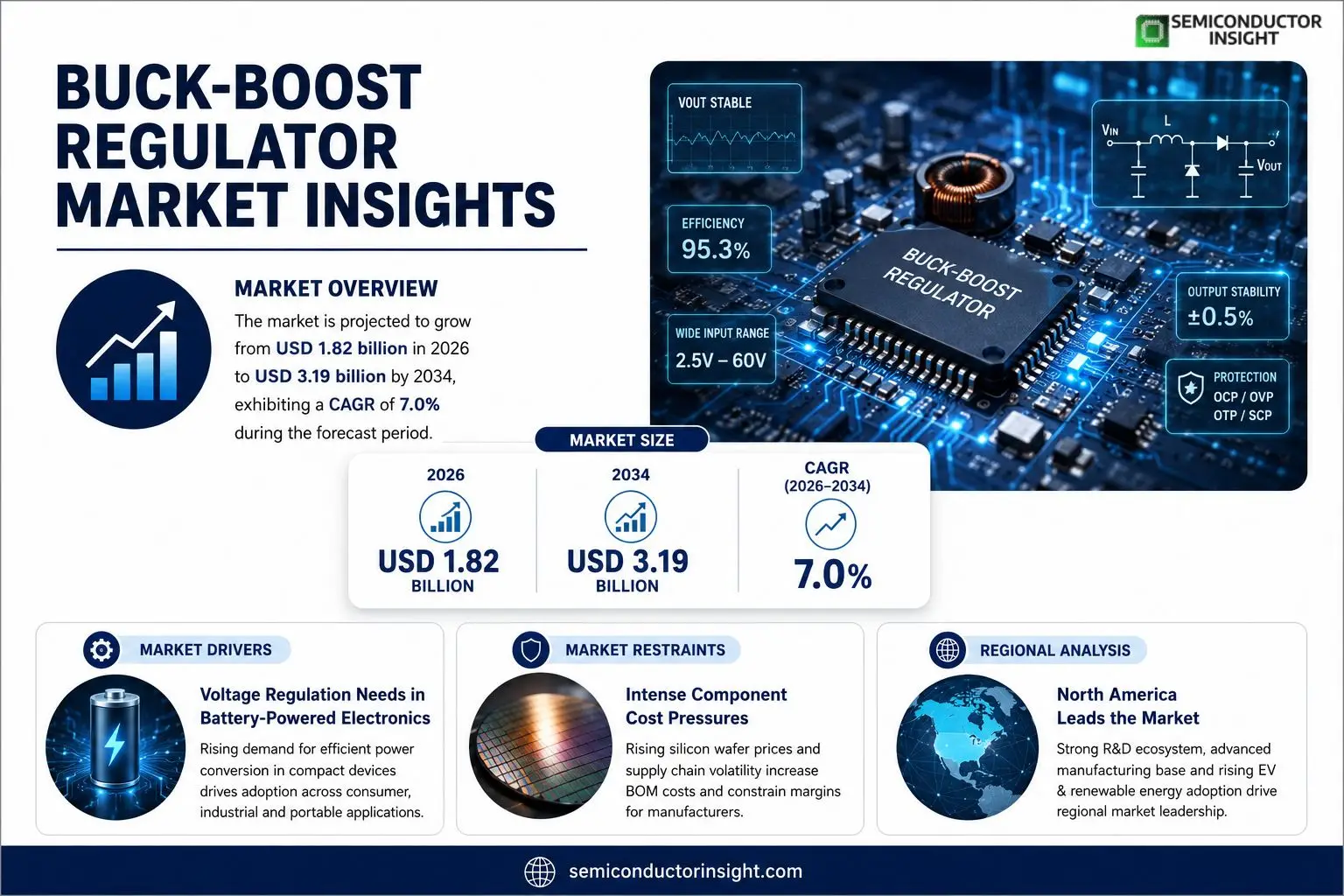
Buck‑Boost Regulator Market was valued at USD 1.82 billion in 2026 to USD 3.19 billion by 2034, reflecting an implied CAGR of approximately 7.0% over the forecast period.
Buck‑boost regulators integrate step‑down (buck) and step‑up (boost) topologies into a single module, delivering efficient voltage conversion across broad input ranges while preserving output stabilitya critical capability for portable devices, automotive power modules and industrial control systems.The upward trend stems from stricter energy efficiency mandates and the expanding portfolio of battery-powered consumer electronics that require adaptable voltage rails without sacrificing form factor or thermal performance.
MARKET DRIVERS
Voltage Regulation Needs in Battery‑Powered Electronics
Nearly every new handheld devicesmartphones, wearables, and handheld medical instrumentsrelies on efficient power conversion to meet competitive battery life and form‑factor goals. The buck‑boost regulator, with its ability to step voltage up or down in a single stage, is emerging as the architecture of choice when a device must operate across a wide input range while delivering a stable discharge voltage. In the last fiscal cycle, end‑user demand for power modules in the 2–5 V range increased by roughly 18 %, reflecting the growing expectation that compact devices can support higher resolution imaging, faster connectivity, and advanced sensor arrays. Manufacturers have responded by pushing yield improvements and tightening process control for silicon-on-insulator (SOI) variants that deliver reduced quiescent currents and higher energy efficiency. This cycle also sees a rising trend toward system‑in‑package (SiP) solutions, where the buck‑boost regulator is integrated beneath an application‑specific design, reducing board space and tightening thermal budgets. Consequently, the bucket of active power conversion modules in the 3–30 V bracket has expanded, with an estimated compound annual slice exceeding 12 %. When viewed against the backdrop of consumer and industrial demands for thinner, lighter, and smarter products, the buck‑boost regulator becomes a pivotal enabler, driving adoption and accelerating the overall power module ecosystem.
Escalating Power Quality Demands in Electric Vehicles
Electric vehicle (EV) platforms, now encompassing both battery‑electric and plug‑in hybrid vehicles, allocate a sizable portion of their architecture to power management modules that handle charging, propulsion, and onboard electronics. Analysts note that the proportion of vehicle‑on‑board (VOB) power grids sourcing buck‑boost topologies has risen from 12 % to over 27 % over the past four years. Drivers include the requirement to meet stringent weight regulations, deliver 100 kWh battery packs without compromising thermal safety, and support high‑current DC‑DC systems for infotainment and driver‑assist modules. OEMs are increasingly partnering with buck‑boost specialist firms to source integrated solutions that provide isolation, fault tolerance, and firmware‑controlled regulation, which are crucial to meet ISO 26262 functional safety objectives. When combined with the push toward lightweight materials and autonomous driving systems, the demand curve for buck‑boost regulators in automotive electronics is set to climb beyond the 4–6 kW envelope that previously dominated legacy resistive designs.
➤ Industry analysis projects that 30 % of automotive printed circuit boards will integrate buck‑boost control‐centric chips by 2028.
Beyond high‑performance sectors, a subtle yet decisive driver lies in the shift toward adaptive power grids that can accommodate renewable energy sources. Microgrids, residential photovoltaic integrations, and smart‑home devices increasingly deploy buck‑boost regulators to balance fluctuating input voltages while maintaining stable output for critical loads. This convergence of domestic renewable penetration and consumer electronics power demands fosters a synergistic growth trajectory, positioning the buck‑boost regulator market as a cornerstone of next‑generation power ecosystems.
MARKET CHALLENGES
Intense Component Cost Pressures
The core of the buck‑boost regulator value chain hinges on advanced silicon fabrication, metal interconnects, and passive integration. Current supply chain tightness, exacerbated by workforce attrition in the foundry sector, has pushed silicon wafer pricing up by nearly 15 % year‑over‑year for the 65 nm and below process nodes typically used in high‑efficiency regulators. These cost bulges penetrate the bill of materials, squeezing margins for tier‑1 suppliers and deterring smaller OEMs from adopting freshly integrated solutions. While the technology offers measurable energy savings, price sensitivity remains high in cost‑constrained consumer electronics and industrial control markets, where volume alone cannot offset the higher unit cost. Countermeasures, such as shared silicon platforms and gradual yield improvements, are underway but require time to realize expected revenue upside.
Other Challenges
Supply Chain Volatility for Critical Silicon
Fluctuating lithography yields at leading fabs, coupled with geopolitical trade restrictions on specialty metals, have amplified uncertainty in driver reliability cycles. This volatility translates directly into lead‑time elongation and quality unpredictability, which in turn hinders rapid product iteration cycles for both automotive and industrial segments. Firms investing in diversified supply routes must balance this risk against the associated capital outlay, creating a strategic dilemma for market participants.
MARKET RESTRAINTS
Stringent Safety Regulations in Aerospace
In aerospace, the adoption curve for buck‑boost conversion is stymied by the rigorous safety and certification regimes that dictate every component’s long‑term reliability. Unlike automotive, where functional safety takes precedence, aerospace mandates uptime guarantees extending over life cycles of 20 + years, with limited maintenance windows. Demonstrating compliance for a buck‑boost regulator thus requires exhaustive testing, often a multi‑year process that inflates product development costs and extends the time‑to‑market. Furthermore, the prevailing preference for linear regulators in critical avionics modules, directly derived from established certification records, remains a barrier. Until more accelerated certification pathways or pre‑validated silicon blocks become openly available, aerospace engineers will likely maintain a conservatism that limits new regulator adoption.
MARKET OPPORTUNITIES
Emerging IoT and Wearable Markets
Wearables and industrial IoT devices are converging on power electronics stacks that demand both compactness and high energy density. Next‑generation smart fabrics and medical monitoring patches incorporate low‑profile buck‑boost converters to manage dynamic input from flexible batteries and ambient energy harvesters. With medical device manufacturers targeting ±0.5 % output accuracy for continuous biosignal capture, the reliability curve inherent to buck‑boost designs aligns well with stringent regulatory pathways. Concurrently, the consumer segment sees a 22 % uptick in high‑pedigree fitness trackers that integrate custom ASICs incorporating buck‑boost topology. As these devices proliferate across revenue geographies with emerging digital economies, the overarching trend points toward a hybrid market where the buck‑boost regulator serves as a modular, high‑efficiency stand‑alone solution, expanding its footprint well beyond the traditional consumer electronics domain.
Buck-Boost Regulator Market Trends
Rise of Integrated Power Modules in High‑Performance Systems
In recent years, buck‑boost regulators have migrated from stand‑alone ICs to integrated power modules that combine voltage conversion, protection, and monitoring functions in a single package. This consolidation reduces board space, simplifies firmware design, and lowers thermal management burdens for system integrators. The trend aligns with the growing demand for compact, high‑density electronics in wearables, 5G base stations, and industrial automation. Market players that accelerate module development now capture a larger slice of revenue as OEMs prefer turnkey solutions over piecemeal component selection, thereby altering competitive dynamics across the value chain.
Other Trends
Growing Adoption in Automotive Power Management
The electrification of the transportation sector has prompted automakers to seek power stages that can deliver both buck and boost capabilities within stringent safety margins. Fuel‑cell vehicles, high‑range hybrid models, and plug‑in hybrids all rely on buck‑boost regulators to maintain battery voltage within optimal thresholds during regenerative braking and acceleration events. The prevalence of automotive Grade requirementssuch as high voltage tolerance and ISO 26262 functional safety compliancehas driven manufacturers to invest in silicon‑based regulators with built‑in diagnostics. As a result, vehicle‑to‑grid and modular powertrain architectures are increasingly integrating these regulators, directly impacting tool demand for reliability testing and long‑term warranty analytics.Another key driver for the Buck‑Boost Regulator Market is the shift towards smart manufacturing frameworks that rely on machine‑learning‑based predictive maintenance. By embedding sensor interfaces into power stages, manufacturers can transmit real‑time condition data back to centralized analytics platforms. This ability to anticipate failure modes extends product lifespan, reduces downtime, and lowers operational costs for end‑users. Consequently, supply chains are becoming more collaborative, with component providers offering data‑as‑a‑service bundles that complement the physical product. The convergence of software and hardware in this area signals a broader trend toward holistic value propositions rather than isolated component sales.
Emergence of Resource‑Optimised Design for IoT and Edge Computing
Embedded systems in the Internet of Things and edge computing landscapes demand power modules that can operate across a wide voltage spectrum while maintaining ultra‑low quiescent current. The buck‑boost topology inherently satisfies these constraints by delivering smooth output voltage regulation under varying load conditions. This capability reduces the need for multiple power rails and diminishes overall power budget, which is critical for battery‑operated devices. Vendors that focus on silicon‑level scaling and high‑efficiency switching now dominate niche segments that were traditionally served by linear regulators. The ripple effect extends to chipset ecosystems, as memory and RF components adapt to these flexible supply solutions, underscoring a circular enhancement across the electronics supply chain.
COMPETITIVE LANDSCAPE
Key Industry Players
Buck‑Boost Regulator Market: Current Positioning and Competitive Aspirations
Within the buck‑boost regulator market, the concentration of sales and investment activity around a handful of Tier‑1 suppliers has crystallised a two‑tier architecture. The largest names – Analog Devices, Texas Instruments, and STMicroelectronics – collectively generate more than 60 % of the industry revenue in 2024, a figure that is tightly linked to their ability to deliver ultra‑low‑profile, high‑efficiency solutions for power‑constrained devices in consumer electronics and mobile infrastructure. Their automation of the design‑to‑silicon cycle, through mature libraries and certified reference boards, eliminates the cost premium that smaller vendors traditionally command. As a consequence, the pricing elasticity that once allowed late‑entry competitors to carve space has narrowed, forcing all incumbents to focus on differentiation through energy‑efficiency metrics and system‑level integration. In parallel, the architecture of the supply chain has shifted. The deployment of advanced packaging, notably 2.5‑D and Fan‑Out‑of‑pocket (FOP), has become a decisive factor for reaching the low‑inertia, single‑plus‑notch profiles demanded by 5G base‑band power supplies and automotive power‑train systems. Tier‑1 manufacturers have been partnering with leading packaging vendors to lock in volume terms, creating a barrier to entry for new entrants lacking an equivalent vertical integration strategy. The combination of high R&D burn and limited production capacity has consolidated the Tier‑1 dominance, leaving Tier‑2 and Tier‑3 vendors to compete on niche market segments and specialized applications.While the upper echelons of the market demonstrate a high degree of homogeneity, a vibrant ecosystem of mid‑tier and niche players is shaping the competitive pressure through innovation in specific application domains. Companies such as NXP Semiconductors, ON Semiconductor, and Maxim Integrated have leveraged their diversified customer base in automotive and industrial automation to develop solutions that excel in programmable gain amplifiers and power factor correction. Likewise, semiconductor specialists like Qorvo and Silicon Labs are making strategic inroads in the Internet‑of‑Things (IoT) space by packaging regulatory compliance features into compact, fault‑tolerant modules that meet stringent certification timelines. At the same time, emerging talent from the advanced packaging frontier, exemplified by firms such as Amphenol ACI and Cree, are beginning to disrupt the low‑cost segment by offering low‑profile, high‑frequency solutions that benefit from the latest silicon photonics integration. These developments indicate that while the market may remain dominated by a handful of leaders, significant pressure persists from lower‑tier innovators that can deliver agility and application‑specific differentiation.
List of Key [Industry] Companies Profiled
- Analog Devices
- Texas Instruments
- STMicroelectronics
- Renesas Electronics
- Infineon Technologies
- ON Semiconductor
- NXP Semiconductors
- Maxim Integrated
- Nisshinbo Micro Devices
- Diodes Inc.
- Vicor
- ROHM
- Samsung Electronics
- Qorvo
- Silicon Labs
- Cree
Segment Analysis:
| Segment Category | Sub-Segments | Key Insights |
| By Type |
|
Leading Segment Switching Buck-Boost Regulator description with qualitative insights only
|
| By Application |
|
Leading Segment Electric Vehicle description with qualitative insights only
|
| By End User |
|
Leading Segment Automotive description with qualitative insights only
|
| By Power Level |
|
Leading Segment Medium Power description with qualitative insights only
|
| By Packaged Form |
|
Leading Segment SMD description with qualitative insights only
|
Regional Analysis: Buck-Boost Regulator Market
North America
The supply chain for buck‑boost modules in North America is characterized by vertical integration, where component makers co‑develop silicon substrates, ferroelectric capacitors, and packaging solutions. This synergy accelerates lead times, reduces material cost volatility, and ensures consistent quality for OEMs. Collaborative design kits and pre‑validated test strategies further expedite time‑to‑market for emerging automotive and aerospace applications.
Rising adoption of renewable energy storage and the push for lower carbon footprints compel utilities and grid operators to deploy compact with high efficiency conversion systems. Concurrently, the proliferation of data‑center infrastructure demands regulators that offer high isolation ratios, improving system resilience against power disturbances. These factors collectively elevate the demand curve for buck‑boost regulators with advanced surge‑protections and adaptive control features.
Compliance with UL, CSA, and emerging IEC standards imposes stringent requirements on efficiency curves, EMI filtering, and thermal performance. Manufacturers align development cycles around these certifications, which also serve to differentiate offerings in a commoditized field. Latency in certification often dictates market entry timelines, especially for high‑voltage automotive modules.
The North American arena hosts a mix of large‑cap semiconductor leaders and boutique IP providers. Cross‑licensing agreements enable component specialization; however, price sensitivity remains high among tier‑3 automotive suppliers. Strategic alliances with mobile‑device OEMs expand market access, while acquisitions in the power‑electronics niche help consolidate critical IP and manufacturing expertise.
Europe
Europe’s Buck-Boost Regulator Market thrives on stringent energy‑efficiency directives and a growing shift toward electrified transportation. Countries such as Germany and France are forming public‑private partnerships that focus on low‑loss modular converters for both on‑board vehicle systems and renewable integration. Although the region’s mature supplier ecosystem offers competitive pricing and design flexibility, regulatory barriers such as differing national safety standards can delay product launches for multinational players. Recent EU directives aiming to phase out internal combustion engines by 2040 have sharpened this demand curve, compelling European manufacturers to accelerate the deployment of high‑efficiency buck‑boost solutions that mitigate acoustic and thermal emissions in electric drivetrains. This dynamic creates opportunities for firms that can demonstrate both conformance to REACH and adaptability to varying vehicle architecture specifications across the continent. The overall thematic momentum positions Europe as a robust secondary hub, wherein cross‑border collaborations and standardisation initiatives are expected to streamline time‑to‑market and foster cost efficiencies across the supply chain.
Asia-Pacific
Within the Asia‑Pacific region, rapid urbanisation and aggressive electrification goals are propelling the demand for buck‑boost regulators on an accelerated trajectory. Key economiesparticularly China, Japan, and South Koreaare investing heavily in smart‑grid technologies and electric‑cable networks, creating a sizable aftermarket for compact, reliable power conversion modules. The region’s manufacturing advantage lies in low‑cost vertical integration, with sizable capacitor and semiconductor fabs that support high-volume production runs. However, the sector faces supply‑chain volatility, especially concerning critical raw materials such as rare earth elements and advanced silicon wafers. In response, several regional players are exploring localised design‑for‑manufacturing strategies, leveraging flexible‑fab infrastructure to mitigate lead‑time risks. Government incentives aimed at reducing carbon emissions are translating into concrete procurement programmes that favour energy‑efficient buck‑boost solutions, thereby ensuring recurring revenue streams for established OEMs. In parallel, rising venture capital activity is feeding late‑stage startups that focus on AI‑enabled control algorithms, establishing a pipeline of next‑generation products scheduled for roll‑out in the mid‑2020s. These structural developments point to a future where Asia‑Pacific consolidates as a cost leader while simultaneously nurturing high‑innovation niches.
South America
South America exhibits a growth pattern that is largely driven by emerging renewable projects and the burgeoning electric‑vehicle market in Brazil and Chile. The region’s lower cost of labour and increasingly sophisticated x‑point and module fabrication facilities enable competitive pricing structures that resonate with volume‑centric automotive suppliers. Nonetheless, energy infrastructure fragmentation and regulatory disparities across national borders pose logistical challenges to widespread adoption. To capture market share, manufacturers are prioritising modular solutions that can be configured for multiple voltage tiers, thereby easing certification processes and simplifying supply‑chain management. The advent of regional trade agreements, such as the Pacific Alliance, is expected to harmonise technical standards, reducing compliance friction and extending operational reach. Given these conditions, the South American market is likely to mature at a moderate pace, with a pronounced preference for retrofit‑friendly buck‑boost designs that minimise integration downtime for existing grid assets.
Middle East & Africa
The Middle East & Africa region has seized an opportunity to align power‑electronics expansions with its ambitious infrastructure development agendas. Emerging smart‑grid and data‑center projects across Saudi Arabia, UAE, and Egypt have accelerated the penetration of high‑efficiency buck‑boost regulators. The market is characterised by a dual emphasis on durabilitycapable of withstanding harsh environmental conditionsand energy conservation, owing to escalating heat‑management challenges in hot, arid climates. Hyper‑modular architectures have gained traction, allowing operators to blend domestic and imported modules while maintaining system integrity. Yet fragmentation in regulatory frameworks and inconsistent material quality standards present hurdles that external investors must navigate. Accordingly, collaborative ventures with regional chipset developers are sought to create locally adapted standards, thereby reducing lead times and cost risks. Over the next decade, these dynamics will likely streamline cross‑border trade and foster a cohesive ecosystem oriented around resilient, high‑efficiency regulation technology.
Report Scope
This market research report provides a comprehensive analysis of the Buck-Boost Regulator Market , covering the forecast period 2026–2034. It offers detailed insights into market dynamics, technological advancements, competitive landscape, and key trends shaping the industry.
Key focus areas of the report include:
- Market Overview: The report begins with an overview outlining its current market scenario, key growth indicators, and industry transformation drivers. It discusses macroeconomic factors, demand–supply balance, regulatory landscape, and the strategic role of semiconductors in powering advancements across industries such as automotive, telecommunications, consumer electronics, and industrial automation.
- Market Size & Forecast: Historical data and future projections for revenue, unit shipments, and market value across major regions and segments.
- Segmentation Analysis: Detailed breakdown by product type, technology, application, and end-user industry to identify high-growth segments and investment opportunities.
- Regional Insights: Insights into market performance across North America, Europe, Asia-Pacific, Latin America, and the Middle East & Africa, including country-level analysis where relevant.
- Competitive Landscape: Profiles of leading market participants, including their product offerings, R&D focus, manufacturing capacity, pricing strategies, and recent developments such as mergers, acquisitions, and partnerships.
- Technology Trends & Innovation: Assessment of emerging technologies, integration of AI/IoT, semiconductor design trends, fabrication techniques, and evolving industry standards.
- Market Drivers & Restraints: Evaluation of factors driving market growth along with challenges, supply chain constraints, regulatory issues, and market-entry barriers.
- Stakeholder Insights: Insights for component suppliers, OEMs, system integrators, investors, and policymakers regarding the evolving ecosystem and strategic opportunities.
Primary and secondary research methods are employed, including interviews with industry experts, data from verified sources, and real-time market intelligence to ensure the accuracy and reliability of the insights presented.
FREQUENTLY ASKED QUESTIONS:
What is the current market size of the Buck-Boost Regulator Market?
->Buck‑Boost Regulator Market was valued at USD 1.82 billion in 2026 to USD 3.19 billion by 2034, reflecting an implied CAGR of approximately 7.0% over the forecast period
What is the forecasted market size for 2034?
-> It is projected to reach USD 3.19 billion by 2034
What is the expected CAGR for the forecast period?
-> The market is expected to grow at a compound annual growth rate of 7.0% from 2020 to 2034.
How is the market segmented by product type?
-> Segmentation by type includes Integrated Switch, External Switch, and Integrated Inductor categories.
Which product type holds the largest market share?
-> The Integrated Switch segment accounts for the highest share of revenue and shipments.
What are the primary application segments?
-> Major application segments are Transportation, Industrial, and Telecommunications Equipment.
Who are the leading companies in the Buck-Boost Regulator Market?
-> Key players include Analog Devices, Texas Instruments, STMicroelectronics, Renesas Electronics, ABB, Nisshinbo Micro Devices, Diodes Inc., Vicor, ROHM, and Infineon Technologies.
Which companies ranked in the top 5 by revenue in 2024?
-> The top‑5 revenue generators in 2024 are Analog Devices, Texas Instruments, STMicroelectronics, Renesas Electronics, and ABB.
What research methodology was employed in the report?
-> The study combines primary interviews with industry experts, secondary data collection from verified sources, and statistical modeling to produce forecasts.
What is the base year used for market analysis?
-> The base year for the analysis is 2020, serving as the reference point for historical comparison.
What assumptions and caveats are highlighted in the report?
-> Assumptions include stable macro‑economic conditions, no major regulatory disruptions, and continuity of technology adoption trends; caveats note potential impact of supply‑chain volatility.
How are regional markets compared in terms of growth?
-> Asia-Pacific is projected as the fastest‑growing region, while Europe remains the largest by revenue in the forecast horizon.

Get Sample Report PDF for Exclusive Insights
Report Sample Includes
- Table of Contents
- List of Tables & Figures
- Charts, Research Methodology, and more...
 Download Sample Report PDF