Bragg Fiber Market Insights
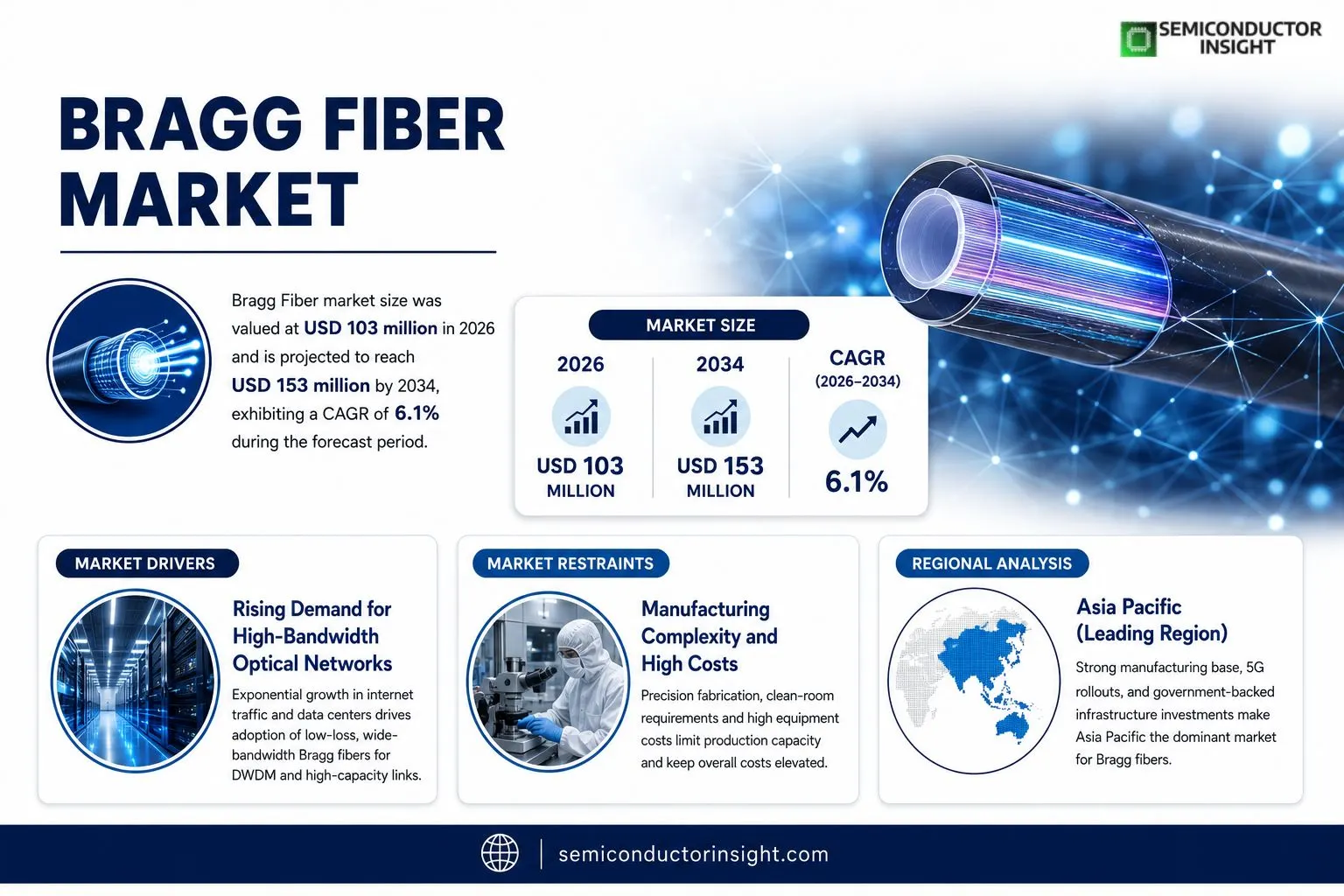
Bragg Fiber market size was valued at USD 103 million in 2026 and is projected to reach USD 153 million by 2034, exhibiting a CAGR of 6.1% during the forecast period.
Bragg fibers are a specialized class of photonic‑bandgap optical fibres that feature either a solid or hollow core surrounded by concentric layers of alternating high‑and low‑index dielectrics. The resulting interference pattern produces vivid colours under ambient illumination without the need for dyes or pigments, eliminating colour fading concerns that affect conventional light‑emitting fibres. Light is guided within the lower‑index core and leaks out through the surrounding structure as controlled side emission; by varying layer count or applying mechanical strain one can modulate intensity or shift reflected wavelengths, enabling passive colour change in textiles and adaptable sensing applications.
MARKET DRIVERS
Rising Demand for High‑Bandwidth Optical Networks
Internet traffic is expected to exceed 80 exabytes per month by 2027, pressuring data‑center operators to deploy optical links that can sustain terabit‑scale throughput. Bragg fiber’s intrinsic low‑loss and wide‑bandwidth characteristics give it a measurable advantage in dense wavelength‑division multiplexing (DWDM) systems, driving adoption in telecommunication backbones and high‑performance computing clusters.
Technological Progress in Bragg Fiber Fabrication
Advances in dual‑material deposition and nanopatterning have reduced insertion loss below 0.5 dB/km and enabled precise control of the stop‑band position. These fabrication breakthroughs translate into more reliable and cost‑effective production pathways, encouraging manufacturers to expand output capacity to meet the new market demand.
➤ Innovative layer‑by‑layer growth techniques are the linchpin that will shape the next wave of Bragg fiber deployment across critical infrastructure.
Consequently, the synergy between escalating bandwidth needs and improved manufacturing is priming Bragg Fiber Market for accelerated penetration in both telecom and data‑center segments.
MARKET CHALLENGES
Limited Production Capacity and Elevated Costs
Manufacturing Bragg fibers requires clean‑room environments, high‑precision deposition tools, and stringent quality control, all of which raise unit costs. These capital‑intensive processes currently constrain output, limiting the market’s ability to scale in a cost‑competitive manner.
Other Challenges
Supply Chain Disruptions
Fluctuations in the availability of specialty glass precursors and the concentration of key suppliers have introduced production bottlenecks, delaying new‑product rollouts.
MARKET RESTRAINTS
Manufacturing Complexity
The need for sub‑micron feature placement and defect‑free interfaces makes the Bragg fiber fabrication process highly sensitive to process variations. Even minor deviations can compromise optical performance, increasing reject rates and driving up overall production costs.
Environmental regulations governing the use of certain rare‑earth dopants and high‑purity precursors also add compliance layers, further constraining cost‑effective scaling.
MARKET OPPORTUNITIES
Comparative Cost Reduction Through Bulk Production
Emerging roll‑to‑roll deposition technologies promise to slash per‑meter costs by up to 30 % once throughput scales. Bragg fiber manufacturers that secure early access to these scalable processes will position themselves to capture new customer bases in cost‑sensitive segments.Additionally, the fusion of Bragg fiber with silicon photonics paves the way for integrated sensor platforms in medical diagnostics and industrial metrology, expanding the application portfolio beyond traditional telecom roles.
Bragg Fiber Market Trends
Material‑Resilient, Colour‑Stable Bragg Fibres Drive Adoption
Material resilience and colour stability are now the main leverage points for Bragg Fiber Market. Unlike conventional dye‑based fiber optics, Bragg fibres maintain their chromatic integrity under prolonged exposure, as the structural colour emerges from periodic dielectric layers rather than pigments. This intrinsic resistance to fade translates into lower maintenance costs and extended lifecycle for end‑use solutions ranging from aesthetic textiles to high‑definition displays. Market observers note that the combination of low manufacturing complexityno need for hazardous colourantsand the ability to tunably control side emission through layer count make Bragg fibres attractive for manufacturers seeking scalability. With the market recorded at US$103 million in 2026 and a trajectory toward US$153 million by 2034, the growth is underpinned by a demand shift toward sustainable, self‑regulating photonic components. This trend signals a shift toward eco‑friendly fibre optics, aligning regulations with market demand.
Other Trends
Sensing and Imaging Applications
Bragg fibres have proven efficacy in sensing and imaging, capitalising on their photonic bandgap to deliver precise wavelength‑selective responses. In industrial process monitoring, the fibres’ ability to transmit a narrow spectral band while emitting a controlled colour allows real‑time temperature, strain, and refractive‑index measurements with minimal external calibration. Imaging systems benefit from the fibres’ low loss and absence of polarisation scrambling, enabling clearer wavefront capture in LIDAR and endoscopic diagnostics. Adoption in ultra‑short pulse applications further showcases their robustness, as the hollow‑core designs can sustain higher peak powers without nonlinear distortion. Early case studies in automotive LiDAR and biomedical imaging illustrate the market’s readiness to integrate these components into next‑generation sensor suites.
Integrating Bragg Fibers Into Emerging Communications and Optofluidics
Strategic integration of Bragg fibres into the evolving communications fabric remains a priority for both corporate and start‑up actors. The ubiquity of 5G nodes, the expansion of edge‑cloud infrastructures, and the nascent meta‑universe concept create a surge in demand for compact, self‑regulated optical transmitters. Bragg fibres’ low insertion loss, mechanical resilience, and wavelength‑control capabilities make them a natural fit for LiDAR arrays, secure key distribution, and optical interconnects within data centres. For capitalised players, the fusion of material innovation with advanced manufacturingadditive layering, nano‑imprint techniques, and automated quality controlwill dictate competitive advantage. Firms that can scale production while preserving spectral fidelity are positioned to capture the most profitable niches, particularly in North America and Asia‑Pacific regions where the technology roadmap remains heavily concentrated.
COMPETITIVE LANDSCAPEKey Industry Players
Bragg Fiber Market Competitive Landscape
In 2026 Bragg Fiber Market was valued at US$103 million and is on trajectory to reach roughly US$153 million by 2034, driven by high‑performance telecom, sensing and advanced textiles applications. NKT Photonics commands the largest share of this value chain, with revenues approaching US$35 million and a sales volume that represents roughly 40 % of the market. The company sustains its leader position through a vertically integrated model that combines research‑heavy design studios, state‑of‑the‑art fabrication facilities, and a sales office network spanning North America, Europe, and Asia. NKT’s catalog of hollow‑core and solid‑core Bragg fibers delivers low‑loss propagation for both conventional and quantum communication systems, enabling it to negotiate premium pricing while maintaining competitive manufacturing margins. Strategic acquisitions of niche specialty fiber makers in the last two years have expanded NKT’s material science footprint, ensuring preferential access to novel low‑index nanolayer materials and proprietary coating technologies that reinforce its market dominance and create barriers to entry for competitors. The concentration of powerful R&D investment and a robust service engine positions NKT to convert emerging application demands into scalable commercial offerings, thereby sustaining its high revenue growth trajectory across the forecast horizon.Other notable players, though smaller in billing, shape the competitive landscape through targeted innovation, flexible supply chains, and strategic alliances. iXblue has carved a niche with ultra‑low loss Bragg fibers tailored for ultra‑short pulse laser systems and high‑resolution imaging, serving a growing customer base of research laboratories and defense contractors. Thorlabs, with its extensive part catalog, embeds Bragg fibers in a broad suite of optical modules, appealing to prototyping and educational markets. Fibercity Materials, PolyOptics Co., Chaoyuan Optics, LarkOptics, and SinoPhoton each focus on vertical markets such as environmental sensing, flexible mobile‑device illumination, and smart textile integration, enabling them to capture roles that demand low cost, high reliability, and rapid time‑to‑market. Collaborations with university research groups and joint ventures with textile manufacturers have accelerated the adoption of Bragg fibers in passive color‑changing fabrics, expanding the application footprint beyond traditional photonics. This mosaic of niche players mitigates market concentration risks and fuels incremental implementation across emerging segments, compelling the leaders to refine their product portfolios and maintain agility in response to evolving customer requirements.
List of Key Bragg Fiber Companies Profiled
- NKT Photonics
- iXblue
- Thorlabs
- Fibercity Materials
- PolyOptics Co.
- Chaoyuan Optics
- LarkOptics
- SinoPhoton
- Nanoptics
- OptiTech Systems
- Conexio
- Zhuhai Zhongshan Photonics
- Fangzhou Advanced Optics
Segment Analysis:
| Segment Category | Sub-Segments | Key Insights |
| By Type |
|
Solid Core Provides lower attenuation and superior mechanical reliability, making them preferred in high‑intensity optical communication and sensing applications. Their uniform core composition facilitates scalable manufacturing and precision coatings, enabling consistent spectral properties and ease of integration with existing fiber systems. |
| By Application |
|
Sensing Capitalizes on the inherent bandgap stability of Bragg fibers, allowing robust detection of environmental changes such as temperature, strain, and chemical composition. The fibers’ coloration under ambient light delivers real‑time visual cues, reducing the need for electronic readouts. This combination is attractive for wearable monitoring, structural health, and biomedical diagnostics. |
| By End User |
|
Telecommunications Institutions adopt Bragg fibers for ultra‑stable, low‑loss routing in data centers and 5G backhaul. The fibers’ resilience to color fading and mechanical stress extends service life, essential in challenging campus or offshore deployments. Their bandgap filtering simplifies wavelength‑division multiplexing, easing integration with photonic chips. |
| By Material |
|
Glass Offers high thermal stability and chemical inertness, essential for harsh industrial environments. Its dense lattice permits precise refractive‑index engineering, enabling sharp bandgap boundaries and efficient side‑emission control. Glass fibers resist contamination, sustaining optical clarity over long periods and high‑temperature processing. |
| By Usage |
|
Passive Color Changing Exploits the interplay of guided and ambient light to deliver dynamic visual effects without electronic power. Valuable for aesthetic textile designs, responsive signage, and protective coatings that signal stress or exposure. The absence of dyes ensures longevity and regulatory compliance for consumer products. |
Regional Analysis: Bragg Fiber Market
North America
The surge in high‑capacity data centers and edge computing deployments creates a direct demand for efficient signal routing, positioning Bragg fibers as an attractive replacement for conventional waveguides. Pipeline upgrades in metropolitan fiber networks reinforce this need, while utility companies seek cost‑effective solutions to extend reach without extensive trenching. The resulting demand mix pushes suppliers to prioritize both performance and reliability, fostering a competitive environment focused on incremental performance gains. Commercial pressures converge with defensive needs, ensuring market momentum remains steady.
Researchers have introduced multi‑layer field‑modulated designs that effectively broaden operational bandwidth, supporting a wider spectrum of signal modalities. This technological shift opens new segments such as lidar and quantum communication, prompting collaborations between academia and industry to expedite prototype validation. The focus on miniaturized manufacturing techniques, such as femtosecond laser inscription, further reduces entry barriers for mid‑scale electronics firms, creating a ripple effect in the supply chain. The result is a rapid diffusion of advanced Bragg fiber variants across diverse market verticals.
Federal agencies have begun adopting guidelines that specify quality thresholds for integrated photonics in defense systems, which indirectly raise baseline requirements for commercial offerings. These standards simplify procurement cycles for contractors, reducing evaluation time and encouraging smaller manufacturers to enter the space. The incremental tightening of certification processes ultimately signals a market trajectory where engineering precision becomes a key differentiator.
Consolidation continues as larger optics conglomerates acquire boutique fiber developers to secure proprietary designs. Cooperative ventures between telecom operators and manufacturing entities aim to lock in supply chains and mitigate pricing volatility. Flow‑through pilot projects are being tested in national data centers to validate performance claims under real‑world stress. The competitive landscape is thereby skewed toward entities capable of executing cross‑functional, rapid‑turnover strategies.
Europe
A balanced mix of traditional optical infrastructure and emerging high‑capacity networks defines Bragg Fiber Market in Europe. Established cable carriers are partnering with research institutions to validate new fiber architectures, thereby shortening the time to deployment. Demand from the defense sector for low‑profile optical components is bolstering niche opportunities, especially in compliance‑heavy environments. The region’s digital sovereignty agenda encourages domestic production, hinting at a shift toward localized value chains that place European manufacturers at the forefront of innovation.
Asia‑Pacific
The Asia‑Pacific market presents a unique combination of high network density and rapid urban expansion. Large‑scale spectrum licensing initiatives give telecom operators the capital to adopt next‑generation fiber solutions, including Bragg variants that deliver sharper attenuation curves. Meanwhile, government‑backed smart city projects are nudging municipal deployments toward fiber‑based sensor networks, creating new application corridors for advanced Bragg fibers. Competitive pressure from cost‑effective but lower‑performance alternatives is driving a trend where vendors refine materials to meet stringent efficiency benchmarks. The confluence of these forces supports a sustained growth trajectory for the region.
South America
In South America, the Bragg Fiber segment remains a relatively nascent but rapidly catching segment of the broader optics landscape. Nations investing in high‑speed rail and telecommunication infrastructure are gradually integrating fiber‑based spectrometry solutions for monitoring. Public‑private partnerships are emerging, aimed at reducing maintenance costs on aging networks through targeted deployment of Bragg fibers in critical junctures. Although capital allocation remains tight, the low‑silicon content of modern fibers offers a compelling value proposition for developers looking to balance performance with affordability. The sector is poised to see incremental gains as technology diffuses across emerging economies.
Middle East & Africa
The Middle East & Africa region features a dynamic blend of legacy data distribution frameworks and ambitious digital transition initiatives. Bragg fiber adoption is accelerating in high‑end applications such as satellite backhaul and secure military communications, driven by regional investment in advanced infrastructure. The scarcity of skilled optical technicians and the need for modular, low‑maintenance solutions are spurring demand for fibers that can be installed with minimal on‑site intervention. As a consequence, regional players are focusing on design simplicity and cost resilience, positioning Bragg fibers as a strategic component for long‑term resilience in fluctuating network conditions.
Report Scope
This market research report provides a comprehensive analysis of the Bragg Fiber Market , covering the forecast period 2026–2034. It offers detailed insights into market dynamics, technological advancements, competitive landscape, and key trends shaping the industry.
Key focus areas of the report include:
- Market Overview: The report begins with an overview outlining its current market scenario, key growth indicators, and industry transformation drivers. It discusses macroeconomic factors, demand–supply balance, regulatory landscape, and the strategic role of semiconductors in powering advancements across industries such as automotive, telecommunications, consumer electronics, and industrial automation.
- Market Size & Forecast: Historical data and future projections for revenue, unit shipments, and market value across major regions and segments.
- Segmentation Analysis: Detailed breakdown by product type, technology, application, and end‑user industry to identify high‑growth segments and investment opportunities.
- Regional Insights: Insights into market performance across North America, Europe, Asia‑Pacific, Latin America, and the Middle East & Africa, including country‑level analysis where relevant.
- Competitive Landscape: Profiles of leading market participants, including their product offerings, R&D focus, manufacturing capacity, pricing strategies, and recent developments such as mergers, acquisitions, and partnerships.
- Technology Trends & Innovation: Assessment of emerging technologies, integration of AI/IoT, semiconductor design trends, fabrication techniques, and evolving industry standards.
- Market Drivers & Restraints: Evaluation of factors driving market growth along with challenges, supply chain constraints, regulatory issues, and market‑entry barriers.
- Stakeholder Insights: Insights for component suppliers, OEMs, system integrators, investors, and policymakers regarding the evolving ecosystem and strategic opportunities.
Primary and secondary research methods are employed, including interviews with industry experts, data from verified sources, and real‑time market intelligence to ensure the accuracy and reliability of the insights presented.
FREQUENTLY ASKED QUESTIONS:
What is the current market size of Bragg Fiber Market?
-> Bragg Fiber Market was valued at USD 103 million in 2026 and is projected to reach USD 153 million by 2034, at a CAGR of 6.1% during the forecast period.
Which key companies operate in Bragg Fiber Market?
-> Key players include NKT Photonics, iXblue, Thorlabs, among others.
What are the key growth drivers?
-> Key growth drivers include the advancement of 5G, cloud, AI, big data, and the expanding need for durable, color‑stable optical fibers in communication networks.
Which region dominates the market?
-> Asia‑Pacific, particularly China, dominates the market.
What are the emerging trends?
-> Emerging trends include passive color‑changing textiles, stretchable Bragg fibers for dynamic color shifts, and integration of Bragg fibers in 5G and AI‑driven communication networks.
Get Sample Report PDF for Exclusive Insights
Report Sample Includes
- Table of Contents
- List of Tables & Figures
- Charts, Research Methodology, and more...
 Download Sample Report PDF