Bonding Wire (Gold, Copper, Palladium-coated) Market Insights
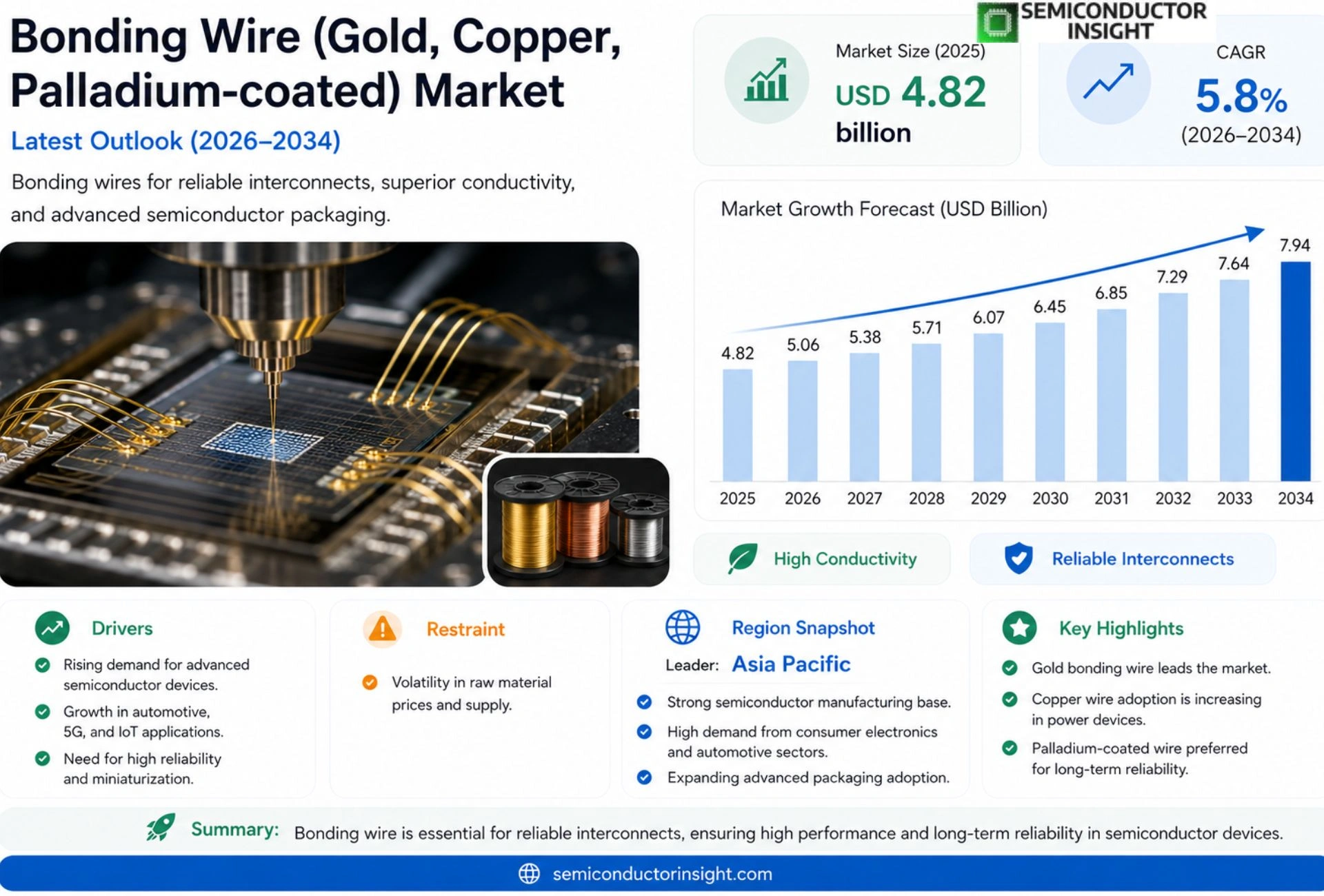
Global Bonding Wire (Gold, Copper, Palladium-coated) Market size was valued at USD 4.82 billion in 2025. The market is projected to grow from USD 5.06 billion in 2026 to USD 7.94 billion by 2034, exhibiting a CAGR of 5.8% during the forecast period.
Bonding wires are ultra-fine metallic conductors essential for establishing electrical interconnections between semiconductor chips packages and printed circuit boards. These wires include gold bonding wire, copper bonding wire, and palladium-coated copper bonding wire, each selected based on specific application requirements such as conductivity, reliability, and cost efficiency. Gold bonding wire remains dominant in high-reliability applications due to its excellent corrosion resistance and stable electrical properties. Copper bonding wire has gained substantial traction because of its superior electrical conductivity and lower material costs compared to gold. Palladium-coated copper bonding wire offers an optimal balance by combining copper’s cost advantages with enhanced oxidation resistance through palladium surface protection.
The market continues to expand driven by robust demand from consumer electronics, automotive electronics, and industrial semiconductor applications. While gold bonding wire maintains strong positioning in aerospace and medical device sectors where reliability is paramount, copper-based alternatives are capturing increasing market share in cost-sensitive consumer applications. Furthermore, the proliferation of electric vehicles and advanced driver-assistance systems has intensified demand for high-performance semiconductor packaging solutions. The shift toward smaller chip geometries and multi-chip module configurations necessitates finer diameter bonding wires with enhanced mechanical properties. Industry participants including Heraeus Holding GmbH, Tanaka Holdings Co., Ltd., Sumitomo Metal Mining Co., Ltd., and MK Electron Co., Ltd. continue to invest in advanced alloy development and coating technologies to address evolving performance requirements across diverse end-use segments.
MARKET DRIVERS
Increasing Demand from Semiconductor Industry
Bonding Wire (Gold, Copper, Palladium-coated) Market is primarily driven by the escalating demand for miniaturized and high-performance semiconductor devices. As integrated circuits (ICs) become increasingly complex, the need for reliable and efficient bonding wires to connect components within semiconductor packages is intensifying. Gold bonding wires continue to be preferred for their excellent conductivity and corrosion resistance, fueling market growth globally.
Technological Advancements and Material Innovations
Recent innovations in bonding wire materials such as copper and palladium-coated bonding wires offer enhanced performance characteristics at a reduced cost compared to traditional gold wires. These developments are driving adoption across diverse industries including automotive electronics and consumer devices. Improved wire drawing techniques and coating processes contribute to better wire strength and oxidation resistance, positively impacting market expansion.
➤ Rising adoption of copper and palladium-coated bonding wires is expected to enable cost-effective solutions in semiconductor packaging without compromising electrical performance.
Furthermore, increased investments in research and development by key industry players are expected to support continuous innovation in bonding wire technology, thus propelling the overall market forward.
MARKET CHALLENGES
Stringent Quality and Reliability Requirements
One of the primary challenges Bonding Wire (Gold, Copper, Palladium-coated) Market is meeting the rigorous quality and reliability standards necessary for advanced semiconductor applications. Variability in wire diameter, tensile strength, and bonding performance can lead to device failure, impacting customer trust and increasing warranty costs.
Other Challenges
Supply Chain Disruptions
Recent global supply chain constraints have affected the availability of high-purity raw materials such as gold and palladium, leading to fluctuations in bonding wire prices and supply delays.
Manufacturing Complexity
Copper bonding wire requires specialized oxidation control during manufacturing and packaging processes to prevent degradation, increasing production complexity and cost compared to gold wires.
MARKET RESTRAINTS
High Costs Associated with Precious Metals
The widespread use of gold in bonding wires is restrained by its high and volatile cost, which directly impacts the overall pricing of semiconductor devices. Fluctuations in global gold prices can limit the adoption of gold bonding wires in cost-sensitive applications, pushing manufacturers to explore alternative materials.
Environmental and Regulatory Constraints
Stringent environmental regulations related to the mining and refining of precious metals like gold and palladium restrain market growth. Additionally, regulatory requirements on waste management in semiconductor manufacturing compel producers to invest in cleaner, more sustainable bonding wire materials and processes, presenting cost and operational challenges.
MARKET OPPORTUNITIES
Rising Adoption of Copper and Palladium-coated Wires
The growing preference for copper and palladium-coated bonding wires presents significant opportunities for market players. Copper’s lower cost combined with comparable electrical performance to gold is attracting manufacturers aiming to optimize expenses. Palladium coatings enhance copper’s oxidation resistance, broadening its applicability in high-reliability sectors such as automotive and aerospace electronics.
Expansion of Automotive and Consumer Electronics Markets
Rapid technological developments in automotive electronics, including electric vehicles and advanced driver-assistance systems (ADAS), increase demand for high-quality bonding wires with superior conductivity and durability. Similarly, continuous growth of the consumer electronics segment offers lucrative opportunities for premium and cost-effective bonding wire solutions tailored to evolving device requirements.
Moreover, ongoing investments in advanced packaging technologies like system-in-package (SiP) and fan-out wafer-level packaging (FOWLP) create new avenues for bonding wire suppliers to innovate and expand their product portfolio in response to evolving semiconductor assembly trends.
Trends
Growth Dynamics in Bonding Wire Market
Bonding Wire (Gold, Copper, Palladium-coated) Market is witnessing a steady expansion fueled by advancements in semiconductor packaging and escalating demand from sectors such as consumer electronics, automotive, and industrial applications. Gold bonding wire continues to serve critical roles where reliability and corrosion resistance are imperative, notably in aerospace and medical devices. Simultaneously, copper bonding wire is gaining momentum due to its superior electrical conductivity and cost-effectiveness. The palladium-coated copper bonding wire segment bridges the gap by providing enhanced oxidation resistance paired with economical advantages. The increasing adoption of electric vehicles and driver-assistance technologies propels market demand for fine-diameter, mechanically robust bonding wires essential for modern semiconductor configurations.
Other Trends
Technological Innovations and Market Shifts
Recent trends highlight a market shift towards the development of advanced alloys and surface treatments to meet evolving performance standards. Industry leaders are investing significantly in research to produce bonding wires that accommodate smaller chip geometries and complex multi-chip modules. This innovation is pivotal to supporting higher density interconnections and improving overall semiconductor device reliability. The competitive landscape is also shaped by cost-sensitivity among consumer electronics manufacturers, encouraging wider adoption of copper-based solutions without compromising quality. Additionally, the environmental benefits associated with reduced gold usage are influencing procurement strategies across various industries.
Future Outlook and Strategic Directions
Looking forward, Bonding Wire (Gold, Copper, Palladium-coated) Market is expected to maintain its upward trajectory as technological demands intensify. Key players are poised to expand capabilities in coating technologies and alloy customization to capture emerging opportunities. Market emphasis on high-performance wire types tailored for electric vehicles and safety-critical applications will likely intensify. As industry standards evolve, the preference for finer bonding wires that integrate enhanced mechanical and electrical attributes will become more pronounced, underscoring the criticality of innovation-driven growth strategies.
COMPETITIVE LANDSCAPE
Key Industry Players
Competitive dynamics within the bonding wire market: leaders and strategic positioning
The bonding wire market, particularly for gold, copper, and palladium-coated variants, is characterized by a mix of established multinational corporations and specialized manufacturers. Heraeus Holding GmbH remains a preeminent player, leveraging its comprehensive portfolio and advanced alloy technologies to serve high-reliability sectors like aerospace and medical devices. Similarly, Tanaka Holdings Co., Ltd. and Sumitomo Metal Mining Co., Ltd. maintain strong market positions through continuous innovation in bonding wire materials, particularly focusing on palladium coatings to enhance oxidation resistance. The market structure is competitive, with firms investing heavily in R&D to meet the evolving requirements of semiconductor packaging, including finer wire diameters and multi-chip configurations.
Alongside these global leaders, several niche and regional players like JX Nippon Mining & Metals Corporation and MK Electron Co., Ltd. have carved out specialized roles focusing on copper bonding wires and cost-efficient solutions targeted at consumer electronics. The competitive landscape is further diversified with companies such as Superior Essex, Glin Semiconductor Inc., and Shinko Electric Industries Co., Ltd. contributing to technological advancements and expanding market reach. The growing adoption of electric vehicles and industrial electronics continues to fuel competition, driving companies to balance cost, conductivity, and reliability in their product offerings.
List of Key Bonding Wire Companies Profiled
- Heraeus Holding GmbH
- Tanaka Holdings Co., Ltd.
- Sumitomo Metal Mining Co., Ltd.
- MK Electron Co., Ltd.
- JX Nippon Mining & Metals Corporation
- Shinko Electric Industries Co., Ltd.
- Superior Essex
- Glin Semiconductor Inc.
- Elform USA Inc.
- Greene Tweed
- Hitachi Cable America
- Furukawa Electric Co., Ltd.
- Ushio Inc.
- Tokyo Ohka Kogyo Co., Ltd.
- BFIT Group
Segment Analysis:
| Segment Category | Sub-Segments | Key Insights |
| By Type |
|
Gold Bonding Wire remains the preferred choice for high-reliability applications due to its exceptional corrosion resistance and stable electrical properties, making it ideal for aerospace and medical devices. Copper Bonding Wire is gaining traction as a cost-effective solution with superior electrical conductivity, favored in consumer electronics where cost sensitivity is a significant factor. Palladium-coated Copper Wire offers a balanced option by combining copper’s conductivity and cost benefits with enhanced oxidation protection, appealing to industries requiring improved durability without high costs. |
| By Application |
|
Consumer Electronics dominate demand with a focus on cost-effective copper wiring solutions facilitating affordable yet reliable device manufacturing. Automotive Electronics requires bonding wires that support electric vehicle technologies and advanced driver-assistance systems, emphasizing performance and long-term reliability. Industrial Semiconductor Applications drive the need for precision bonding wires with fine diameters and enhanced mechanical properties to meet multi-chip module configurations and shrinking chip geometries. |
| By End User |
|
Aerospace systems demand gold bonding wires for their unmatched reliability and resistance to harsh environments. Medical Devices prioritize bonding wires that guarantee electrical stability and biocompatibility, reinforcing the position of gold wire in this segment. Consumer Electronics Manufacturers are increasingly adopting copper and palladium-coated wires to balance cost and performance, expanding their application scope across various devices. |
| By Product Advancement |
|
Alloy Development drives market evolution by enhancing wire strength and conductivity to meet advanced semiconductor packaging needs. Coating Technologies such as palladium coatings increase oxidation resistance, extending wire lifespan and application suitability. Fine Diameter Wire innovations respond to the miniaturization trend in chips, ensuring mechanical integrity while supporting complex multi-chip modules. |
| By Performance Requirement |
|
High Reliability segment relies heavily on gold wires for critical applications such as aerospace and medical sectors demanding consistent performance. Cost Efficiency drives adoption of copper bonding wires especially within consumer electronics where budget constraints dictate material choice. Enhanced Durability combines the need for oxidation resistance and mechanical strength, fulfilled by palladium-coated copper wires serving mid to high-end applications. |
Regional Analysis: Global Bonding Wire (Gold, Copper, Palladium-coated) Market
Manufacturers in Asia-Pacific lead in adopting cutting-edge bonding wire materials, focusing on palladium-coated wires that offer corrosion resistance and superior bonding strength, vital for next-generation semiconductor devices.
The growing electronics manufacturing sector and increased consumer demand for miniaturized products intensify the need for high-performance bonding wires, making Asia-Pacific a vital growth engine in the market.
Strong vertical integration within semiconductor supply chains in countries like Taiwan and South Korea enhances efficient sourcing and customization of bonding wires, providing competitive advantages to regional players.
Regional manufacturers increasingly focus on sustainable production techniques, reducing environmental impact and promoting the use of copper bonding wires as eco-friendly alternatives to gold.
North America
North America remains a sophisticated market for bonding wire materials, with a focus on research and development led by semiconductor and electronics firms in the United States. The preference for gold bonding wires continues due to their reliability and performance in high-end applications. However, growing cost pressures and material scarcity have accelerated the exploration of copper and palladium-coated alternatives. Collaborative efforts among industry stakeholders and government agencies aim to foster innovation while ensuring supply chain resilience. North America’s emphasis on quality control and advanced manufacturing techniques sustains its role as a key influencer in the global bonding wire landscape.
Europe
Europe’s bonding wire market is characterized by a strong focus on precision and quality, with Germany, France, and the UK leading in semiconductor and electronics production. The rising adoption of copper bonding wires aligns with regional initiatives to enhance cost efficiency and environmental sustainability. Innovation centers and specialized manufacturers contribute to incremental improvements in wire material properties and bonding technologies. Europe’s stringent regulatory environment also shapes market dynamics, prompting producers to prioritize compliance and sustainable operations in the bonding wire segment.
South America
South America showcases an emerging market for bonding wire materials, largely driven by expanding electronics manufacturing sectors in Brazil and Argentina. Although still developing compared to Asia-Pacific and North America, the region benefits from increasing investments in local semiconductor production capabilities. There is growing interest in cost-effective copper bonding wires to meet price-sensitive demands. Regional players focus on building supply chain linkages and adopting technologies that improve bonding reliability, laying the groundwork for gradual growth in the bonding wire market.
Middle East & Africa
The Middle East & Africa region presents nascent but promising opportunities in the bonding wire market with investments directed towards technology parks and electronic manufacturing hubs. The market emphasis lies on adopting advanced bonding wire solutions that support emerging semiconductor applications. Challenges related to infrastructure and supply chains persist, yet government initiatives to attract foreign investments and develop local capabilities are pivotal. The market is gradually evolving, with copper and palladium-coated wires gaining traction due to cost effectiveness and functional benefits.
Report Scope
This market research report provides a comprehensive analysis of the Bonding Wire (Gold, Copper, Palladium-coated) Market , covering the forecast period 2026–2034. It offers detailed insights into market dynamics, technological advancements, competitive landscape, and key trends shaping the industry.
Key focus areas of the report include:
- Market Overview: The report begins with an overview outlining its current market scenario, key growth indicators, and industry transformation drivers. It discusses macroeconomic factors, demand–supply balance, regulatory landscape, and the strategic role of semiconductors in powering advancements across industries such as automotive, telecommunications, consumer electronics, and industrial automation.
- Market Size & Forecast: Historical data and future projections for revenue, unit shipments, and market value across major regions and segments.
- Segmentation Analysis: Detailed breakdown by product type, technology, application, and end-user industry to identify high-growth segments and investment opportunities.
- Regional Insights: Insights into market performance across North America, Europe, Asia-Pacific, Latin America, and the Middle East & Africa, including country-level analysis where relevant.
- Competitive Landscape: Profiles of leading market participants, including their product offerings, R&D focus, manufacturing capacity, pricing strategies, and recent developments such as mergers, acquisitions, and partnerships.
- Technology Trends & Innovation: Assessment of emerging technologies, integration of AI/IoT, semiconductor design trends, fabrication techniques, and evolving industry standards.
- Market Drivers & Restraints: Evaluation of factors driving market growth along with challenges, supply chain constraints, regulatory issues, and market-entry barriers.
- Stakeholder Insights: Insights for component suppliers, OEMs, system integrators, investors, and policymakers regarding the evolving ecosystem and strategic opportunities.
Primary and secondary research methods are employed, including interviews with industry experts, data from verified sources, and real-time market intelligence to ensure the accuracy and reliability of the insights presented.
FREQUENTLY ASKED QUESTIONS:
What is the current market size of Bonding Wire (Gold, Copper, Palladium-coated) Market?
-> Bonding Wire (Gold, Copper, Palladium-coated) Market was valued at USD 4.82 billion in 2025 and is expected to reach USD 7.94 billion by 2034, exhibiting a CAGR of 5.8% during the forecast period.
Which key companies operate Bonding Wire (Gold, Copper, Palladium-coated) Market?
-> Key players include Heraeus Holding GmbH, Tanaka Holdings Co., Ltd., Sumitomo Metal Mining Co., Ltd., and MK Electron Co., Ltd.
What are the key growth drivers?
-> Key growth drivers include robust demand from consumer electronics, automotive electronics, industrial semiconductor applications, and the proliferation of electric vehicles and advanced driver-assistance systems.
Which region dominates the market?
-> The market is driven by strong demand in Asia-Pacific regions particularly for cost-sensitive consumer applications, while Europe and North America maintain significant positions in aerospace, medical devices, and high-reliability sectors.
What are the emerging trends?
-> Emerging trends include the shift toward smaller chip geometries requiring finer diameter bonding wires, multi-chip module configurations, enhanced alloy development, and advanced coating technologies to meet evolving performance requirements.

Get Sample Report PDF for Exclusive Insights
Report Sample Includes
- Table of Contents
- List of Tables & Figures
- Charts, Research Methodology, and more...
 Download Sample Report PDF