Body Area Network (BAN) Low Power Controller Market Insights
Global Body Area Network (BAN) Low Power Controller Market size was valued at USD 2.85 billion in 2025. The market is projected to grow from USD 3.12 billion in 2026 to USD 6.45 billion by 2034, exhibiting a CAGR of 9.5% during the forecast period.
Body Area Network (BAN) Low Power Controllers are specialized microcontrollers and power management integrated circuits designed to enable efficient, ultra-low energy operation of wireless sensor networks deployed on or around the human body. These controllers coordinate data collection from biosensors, manage communication protocols such as Bluetooth Low Energy or Zigbee, and optimize power consumption to extend battery life in wearable and implantable devices while maintaining reliable performance in dynamic environments.
The market is experiencing robust growth due to several factors, including the rapid expansion of wearable health monitoring technologies, increasing demand for remote patient monitoring solutions, and advancements in semiconductor miniaturization that support energy-efficient designs. Furthermore, the rising prevalence of chronic diseases has accelerated adoption of continuous health tracking systems, where low power controllers play a critical role in ensuring long-term device operation without frequent recharging. While challenges such as stringent regulatory requirements for medical-grade devices persist, ongoing innovations in energy harvesting and on-device processing are helping to address power constraints effectively.
Additionally, the integration of advanced wireless standards and AI-driven signal processing capabilities is contributing to market expansion by enabling more sophisticated applications in fitness, sports performance, and clinical diagnostics. Key players continue to invest in research and development to enhance controller efficiency and interoperability. For instance, leading semiconductor manufacturers have introduced new generations of ultra-low power MCUs tailored specifically for BAN applications, supporting seamless connectivity with multiple sensors while consuming minimal energy. Prominent companies operating in this space include those with extensive portfolios in wireless communication and power management technologies, driving competitive innovation across consumer and medical segments.
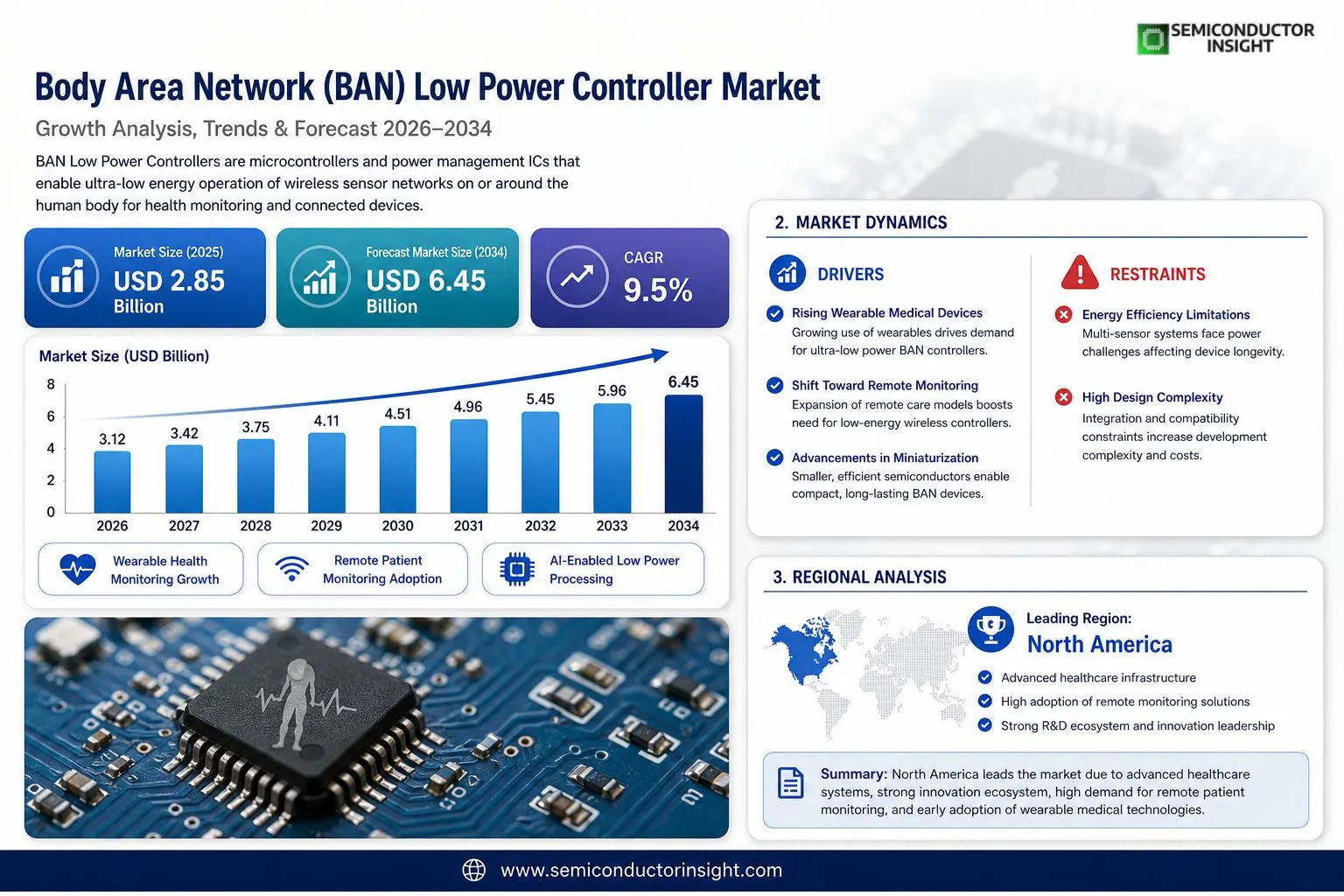
MARKET DRIVERS
Rising Adoption of Wearable Medical Devices
The expanding use of wearable health monitors, fitness trackers, and clinical-grade sensors is a key driver supporting advancements in Body Area Network (BAN) Low Power Controller Market. Growing demand for continuous physiological monitoring is pushing manufacturers to design ultra‑low‑power controllers capable of long operational cycles with minimal battery consumption. Healthcare systems increasingly rely on real-time biometric data to improve diagnostics and remote patient management.
Shift Toward Remote Patient Monitoring
Remote monitoring platforms are expanding with greater adoption of home-based healthcare models. This drives the need for reliable low-energy wireless communication modules within BAN architectures. The market benefits from rising demand in chronic disease management where sensors must maintain consistent data transmission without frequent recharging.
➤ Low-power microcontrollers are becoming central to ensuring continuous data capture, secure transmission, and long-term device operation.
Additionally, the proliferation of interoperable IoT medical ecosystems encourages innovation in compact BAN controllers optimized for sensor integration, connectivity, and energy efficiency. These factors collectively enhance market momentum across consumer health and clinical-grade applications.
MARKET CHALLENGES
Energy Efficiency Limitations in Multi-Sensor Systems
As BAN devices incorporate multiple sensing units, ensuring consistent low-power performance becomes increasingly complex. Designers must balance processing capabilities with stringent energy requirements. Thermal constraints, firmware inefficiencies, and power leakage remain persistent challenges that limit system longevity in wearable environments.
Other Challenges
Cybersecurity Constraints
The need to secure sensitive biometric data increases processing demands, which can conflict with low-power operating conditions. Achieving secure, encrypted communication channels without degrading battery life remains a technical obstacle for developers and manufacturers in Body Area Network (BAN) Low Power Controller Market.
MARKET RESTRAINTS
High Design Complexity and Integration Barriers
The integration of low-power controllers within compact wearable systems requires sophisticated design approaches. Constraints related to form factor, heat dissipation, and multi-protocol wireless compatibility can limit device performance. These limitations slow development cycles and may increase production costs for manufacturers targeting advanced body area network solutions.
MARKET OPPORTUNITIES
Growing Demand for Smart Healthcare Ecosystems
The shift toward connected healthcare ecosystems presents substantial opportunities for manufacturers of BAN low-power controllers. As hospitals and digital health platforms expand sensor-based monitoring capabilities, demand increases for energy-efficient controllers that support seamless connectivity and long-duration operation. Innovations in on-chip AI accelerators, advanced power management techniques, and secure wireless modules will help shape the next generation of body area network devices and provide strong commercial potential across emerging medical and consumer health applications.
Trends
Rising Adoption of Low‑Power Architectures in Wearable Health Systems
Body Area Network (BAN) Low Power Controller Market is experiencing steady transformation as wearable and implantable health technologies continue to evolve. Increasing reliance on biosensor networks for continuous monitoring is driving demand for ultra-efficient controllers capable of operating in constrained power environments. Low power architectures optimized for wireless standards such as Bluetooth Low Energy and Zigbee are becoming central to next‑generation device designs, allowing manufacturers to balance performance with long-term operational stability. As remote patient monitoring gains wider clinical and consumer use, controller efficiency has become a critical differentiator, particularly in devices requiring uninterrupted multi-sensor data acquisition.
Advancements in semiconductor miniaturization are improving controller integration capabilities, enabling compact system designs that enhance device comfort and usability. Many BAN solutions now incorporate power management mechanisms that adjust consumption dynamically based on sensor activity and communication intervals. This trend aligns with the increasing need for devices capable of providing continuous health insights without compromising battery endurance. Adoption is further supported by technological enhancements that strengthen device interoperability, allowing sensors and controllers to coordinate data exchange with greater reliability even in complex, movement-heavy environments.
Other Trends
AI-Enabled Signal Processing Integration
Integration of AI-driven on-device processing is emerging as a significant trend in Body Area Network (BAN) Low Power Controller Market. By enabling preliminary data filtering and event detection directly on the controller, these technologies help reduce unnecessary transmissions and improve overall energy efficiency. This shift is enhancing the capabilities of wearables used for chronic disease tracking, sports performance analysis, and personalized health insights. Manufacturers are prioritizing designs that support lightweight machine learning operations while maintaining stringent power constraints required for long-duration wear.
Advancements in Energy Optimization Techniques
Ongoing innovation in power management continues to influence controller development. Techniques such as adaptive duty cycling, energy-aware scheduling, and integration with energy harvesting components are gaining traction. These improvements address key challenges associated with maintaining device longevity in real-world usage conditions. As BAN networks expand to include multiple sensor nodes operating simultaneously, such optimization strategies are becoming vital to maintaining system reliability without increasing battery size or weight.
Growing Focus on Multi-Sensor Interoperability
Interoperability across diverse biosensors is increasingly shaping product development in Body Area Network (BAN) Low Power Controller Market. New controller designs are supporting multiple communication protocols and improved synchronization mechanisms that enhance data transmission accuracy. This trend is especially important in clinical-grade systems requiring harmonized real-time readings across cardiovascular, metabolic, and motion-based sensors. Investment from leading semiconductor companies is accelerating these advancements, strengthening connectivity frameworks while ensuring devices remain energy efficient and comfortable for long-term use.
COMPETITIVE LANDSCAPE
Key Industry Players
Competitive Dynamics in the BAN Low Power Controller Ecosystem
Body Area Network (BAN) Low Power Controller Market is characterized by strong competition among semiconductor leaders specializing in ultra‑low power microcontrollers, wireless communication chipsets, and power management ICs. Companies such as Texas Instruments, Nordic Semiconductor, and STMicroelectronics maintain dominant positions due to their extensive portfolios supporting Bluetooth Low Energy, Zigbee, and proprietary low‑energy protocols essential for wearable and medical monitoring applications. These players benefit from long-standing expertise in energy-efficient architectures, integration of sensor interfaces, and reliable performance tailored for continuous physiological monitoring, enabling them to shape technological evolution and set performance benchmarks across the BAN ecosystem.
Beyond market leaders, a diverse set of niche innovators and health-tech semiconductor specialists contribute significantly to competitive differentiation. Firms such as Ambiq, Silicon Labs, and Renesas Electronics leverage advancements in sub‑threshold processing, edge AI, and integrated power optimization to serve emerging use cases in remote patient monitoring, implantable devices, and sports analytics. Meanwhile, companies including NXP Semiconductors, Infineon Technologies, and Qualcomm expand their presence by offering interoperable wireless solutions and scalable microcontroller platforms designed for medical-grade reliability. Collectively, these players drive continuous R&D investments, with competition increasingly focused on achieving longer battery life, enhanced security, multimodal sensor fusion, and seamless connectivity across body-worn sensor networks.
List of Key Body Area Network (BAN) Low Power Controller Market Companies Profiled
- Texas Instruments
- Nordic Semiconductor
- STMicroelectronics
- Silicon Labs
- Ambiq
- Renesas Electronics
- Infineon Technologies
- NXP Semiconductors
- Qualcomm
- Microchip Technology
- Dialog Semiconductor (Renesas)
- Maxim Integrated (Analog Devices)
- Arm Holdings
- ON Semiconductor (onsemi)
- Broadcom
Segment Analysis:
| Segment Category | Sub-Segments | Key Insights |
| By Type |
|
Microcontroller-Based BAN Controllers dominate due to their versatility and ability to manage complex biosensor networks efficiently.
|
| By Application |
|
Wearable Health Monitoring leads as continuous tracking devices increasingly rely on ultra-low power processing.
|
| By End User |
|
Healthcare Providers represent the most influential user base due to the growing integration of BAN-enabled monitoring systems in clinical settings.
|
| By Connectivity Technology] |
|
Bluetooth Low Energy (BLE) stands out due to its widespread compatibility and optimized low-power communication.
|
| By Device Form Factor] |
|
Wearable Devices form the leading segment as they represent the largest deployment environment for BAN controllers.
|
Regional Analysis: Body Area Network (BAN) Low Power Controller Market
North America
North America’s healthcare sector is among the most advanced globally, and its appetite for remote patient monitoring has accelerated demand for BAN low power controllers. Hospitals, clinics, and home care providers increasingly deploy wearable biosensors that require ultra-low power consumption, making high-efficiency controller chips central to product design strategies across the region’s medical device industry.
The United States hosts a world-class semiconductor ecosystem including established chip designers and fabless companies actively developing purpose-built BAN low power controllers. Silicon Valley and emerging tech corridors in Texas and Massachusetts are hotbeds of microcontroller innovation, ensuring a continuous pipeline of energy-optimized solutions tailored specifically for body area network applications in consumer and clinical settings.
Consumer-grade wearables such as smartwatches, fitness trackers, and hearables have seen widespread adoption across North America. This consumer electronics boom directly fuels demand within Body Area Network (BAN) Low Power Controller Market, as manufacturers prioritize extended battery life and seamless wireless connectivity , technical requirements that hinge on the performance of advanced low power controller architectures.
Supportive regulatory policies and active standardization efforts by organizations such as the IEEE and industry consortia have created a structured environment for BAN technology deployment. Clear compliance pathways for wearable medical devices reduce time-to-market friction and encourage sustained R&D investment, reinforcing North America’s leadership position across Body Area Network (BAN) Low Power Controller Market forecast horizon.
Europe
Europe represents a significant and rapidly maturing segment within Global Body Area Network (BAN) Low Power Controller Market, underpinned by the region’s strong emphasis on digital health transformation and patient-centric care delivery models. Countries such as Germany, the United Kingdom, France, and the Netherlands are at the forefront of integrating wearable health monitoring systems into their national healthcare frameworks, creating consistent downstream demand for BAN low power controllers. The European Union’s proactive stance on digital health policy, including strategic funding under programs like Horizon Europe, has catalyzed research into low-energy wireless body sensor networks. Additionally, strict data privacy regulations, particularly under GDPR, have prompted innovation in secure, on-device data processing , a trend that places greater functional demands on intelligent low power controllers embedded within BAN-enabled wearables. Europe’s well-established medical device manufacturing sector in Germany and Switzerland further supports regional market growth, ensuring that advanced BAN controller technologies are integrated into high-quality clinical and consumer products. The region is expected to maintain steady growth through 2034.
Asia-Pacific
Asia-Pacific is emerging as the fastest-growing regional market for Body Area Network (BAN) Low Power Controller solutions, propelled by rapid urbanization, expanding middle-class populations, and sweeping government digitalization programs across healthcare and consumer electronics sectors. China, Japan, South Korea, and India are the primary growth engines, each contributing unique demand drivers. China’s formidable semiconductor manufacturing base and aggressive national health tech agenda have positioned it as both a major producer and consumer of BAN-enabled devices. Japan’s aging population creates urgent demand for continuous, non-invasive health monitoring technologies, while South Korea’s leadership in consumer electronics ensures consistent integration of BAN low power controllers in next-generation wearables. India’s growing telemedicine ecosystem and increasing health awareness among younger demographics are also generating new demand pockets. Cost-competitive manufacturing and expanding domestic R&D capabilities make Asia-Pacific a critical region shaping Global competitive dynamics of Body Area Network (BAN) Low Power Controller Market through the forecast period.
South America
South America occupies a developing but increasingly noteworthy position within Body Area Network (BAN) Low Power Controller Market, as healthcare modernization efforts gain momentum across the region. Brazil and Argentina lead regional adoption, with growing investments in telemedicine infrastructure and preventive health initiatives driving demand for wearable monitoring devices that incorporate BAN low power controllers. The region faces certain structural challenges including inconsistent healthcare funding, limited semiconductor manufacturing capacity, and economic volatility that can slow technology adoption cycles. However, international partnerships, expanding digital health startups in urban centers such as São Paulo and Buenos Aires, and rising smartphone penetration are gradually creating conducive conditions for BAN technology deployment. Government programs aimed at expanding healthcare access to underserved rural populations are also expected to support long-term demand for energy-efficient wearable health solutions. South America is anticipated to register gradual but consistent growth in Body Area Network (BAN) Low Power Controller Market through 2034.
Middle East & Africa
The Middle East and Africa region presents a nascent yet strategically important frontier for Body Area Network (BAN) Low Power Controller Market. Gulf Cooperation Council (GCC) nations, led by the United Arab Emirates and Saudi Arabia, are making substantial investments in smart healthcare infrastructure as part of their broader economic diversification agendas, creating early adoption opportunities for BAN-enabled wearable health monitoring systems. Vision-driven national programs such as Saudi Vision 2030 and UAE’s health tech initiatives are actively encouraging deployment of digital health solutions, positioning these markets as early movers within the broader regional landscape. In Sub-Saharan Africa and North Africa, market growth remains nascent due to infrastructure gaps and budget constraints, though increasing mobile health (mHealth) initiatives and NGO-driven health monitoring programs are beginning to introduce BAN technologies in targeted healthcare settings. Over the 2026–2034 forecast window, the Middle East & Africa region is expected to witness rising interest in low-power wearable health solutions as digital health awareness and investment levels gradually improve across diverse national markets.
Report Scope
This market research report provides a comprehensive analysis of the Body Area Network (BAN) Low Power Controller Market , covering the forecast period 2026–2034. It offers detailed insights into market dynamics, technological advancements, competitive landscape, and key trends shaping the industry.
Key focus areas of the report include:
- Market Overview: The report begins with an overview outlining its current market scenario, key growth indicators, and industry transformation drivers. It discusses macroeconomic factors, demand–supply balance, regulatory landscape, and the strategic role of semiconductors in powering advancements across industries such as automotive, telecommunications, consumer electronics, and industrial automation.
- Market Size & Forecast: Historical data and future projections for revenue, unit shipments, and market value across major regions and segments.
- Segmentation Analysis: Detailed breakdown by product type, technology, application, and end-user industry to identify high-growth segments and investment opportunities.
- Regional Insights: Insights into market performance across North America, Europe, Asia-Pacific, Latin America, and the Middle East & Africa, including country-level analysis where relevant.
- Competitive Landscape: Profiles of leading market participants, including their product offerings, R&D focus, manufacturing capacity, pricing strategies, and recent developments such as mergers, acquisitions, and partnerships.
- Technology Trends & Innovation: Assessment of emerging technologies, integration of AI/IoT, semiconductor design trends, fabrication techniques, and evolving industry standards.
- Market Drivers & Restraints: Evaluation of factors driving market growth along with challenges, supply chain constraints, regulatory issues, and market-entry barriers.
- Stakeholder Insights: Insights for component suppliers, OEMs, system integrators, investors, and policymakers regarding the evolving ecosystem and strategic opportunities.
Primary and secondary research methods are employed, including interviews with industry experts, data from verified sources, and real-time market intelligence to ensure the accuracy and reliability of the insights presented.
FREQUENTLY ASKED QUESTIONS:
What is the current market size of Body Area Network (BAN) Low Power Controller Market?
-> Global Body Area Network (BAN) Low Power Controller Market size was valued at USD 2.85 billion in 2025 and is projected to grow from USD 3.12 billion in 2026 to USD 6.45 billion by 2034, exhibiting a CAGR of 9.5% during the forecast period.
Which key companies operate in Body Area Network (BAN) Low Power Controller Market?
-> Key players include prominent companies with extensive portfolios in wireless communication and power management technologies, including leading semiconductor manufacturers that have introduced new generations of ultra-low power MCUs tailored specifically for BAN applications, driving competitive innovation across consumer and medical segments.
What are the key growth drivers?
-> Key growth drivers include the rapid expansion of wearable health monitoring technologies, increasing demand for remote patient monitoring solutions, advancements in semiconductor miniaturization, rising prevalence of chronic diseases accelerating adoption of continuous health tracking systems, and integration of advanced wireless standards and AI-driven signal processing capabilities.
Which region dominates the market?
-> Asia-Pacific is the fastest-growing region, driven by expanding healthcare infrastructure and wearable technology adoption, while North America remains a dominant market due to advanced healthcare systems and high demand for remote patient monitoring solutions.
What are the emerging trends?
-> Emerging trends include energy harvesting innovations, on-device AI processing, integration of Bluetooth Low Energy and Zigbee communication protocols, development of ultra-low power MCUs for implantable and wearable devices, and growing applications in fitness, sports performance, and clinical diagnostics.

Get Sample Report PDF for Exclusive Insights
Report Sample Includes
- Table of Contents
- List of Tables & Figures
- Charts, Research Methodology, and more...
 Download Sample Report PDF