Bluetooth Low Energy Modules Market Insights
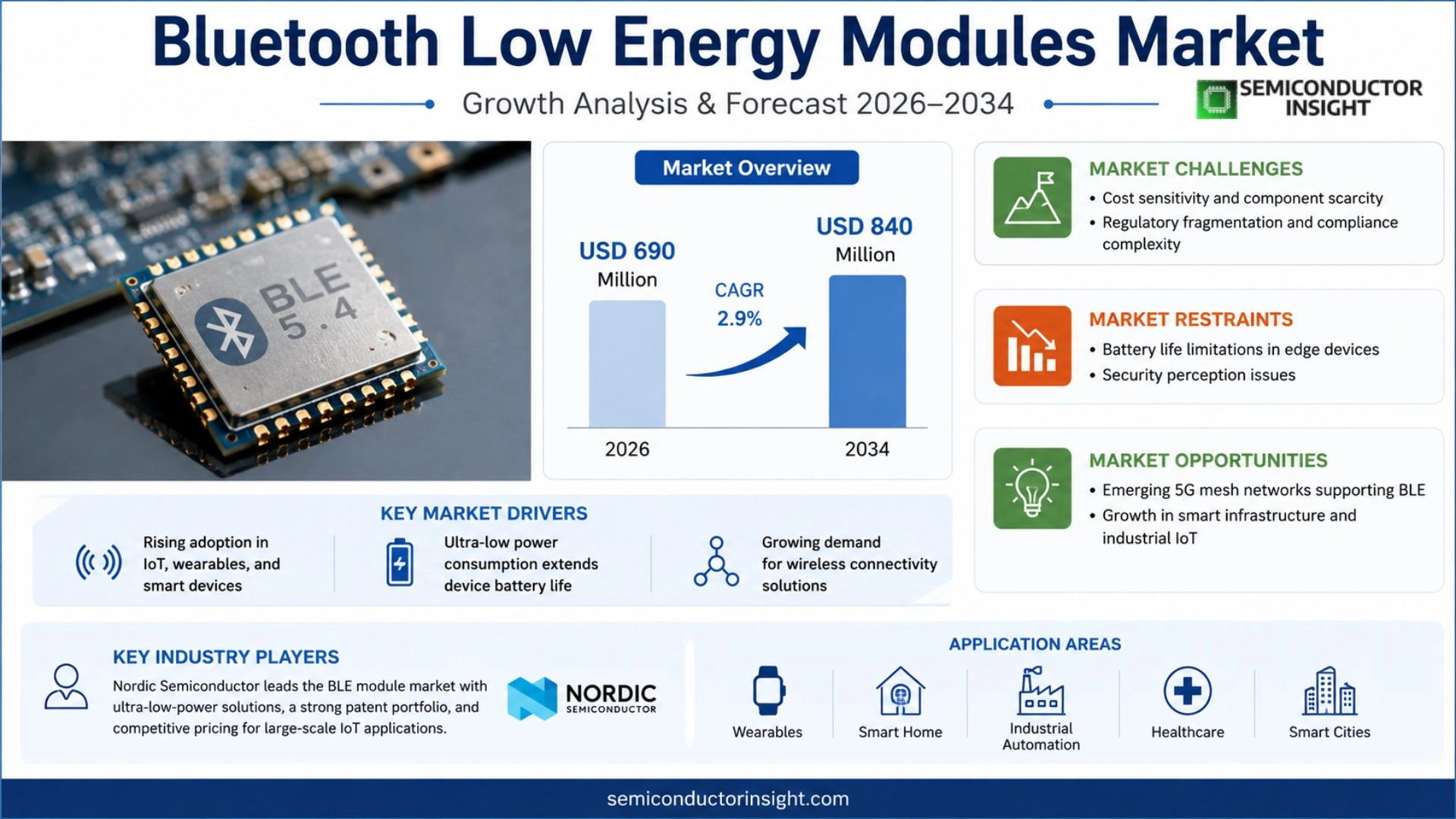
Bluetooth Low Energy Modules market is projected to grow from USD 690 million in 2026 to USD 840 million by 2034, exhibiting a CAGR of 2.9% during the forecast period.
Bluetooth Low Energy (BLE) modules are compact wireless transceivers that enable short‑range communication within personal area networks. They operate on the IEEE 802.15.1 standard and are optimized for low power consumption, making them ideal for IoT devices, wearables, medical sensors and M2M applications where battery life is critical.
The market is gaining momentum because IoT deployments continue expanding across industrial and consumer segments, while automotive manufacturers integrate BLE for key‑less entry and telematics functions. Moreover, advancements such as Bluetooth 5.x versions improve range and data throughput, prompting OEMs like Nordic Semiconductor, Texas Instruments, Qualcomm, STMicroelectronics and Toshiba to broaden their product portfolios.
MARKET DRIVERS
Rising Demand for Low‑Power Connectivity
The proliferation of battery‑operated sensors in smart‑city and industrial‑automation projects forces OEMs to select radios that consume milliwatts instead of watts. Bluetooth Low Energy Modules satisfy that requirement while offering a familiar stack, which shortens time‑to‑market for new products. As a result, manufacturers are redesigning legacy platforms to embed BLE, thereby creating a cascade of adoption across downstream supply chains.
Integration of BLE in Wearables and Health Tech
Wearable health monitors now rely on continuous data streaming to smartphones or gateways. The need for unobtrusive form factors pushes designers toward chips that occupy less than 1 mm² and operate under 1 mA during active transmission. This engineering pressure translates into a measurable uptick in orders for compact BLE modules, especially those that support extended advertising and secure pairing.
➤ BLE modules represent roughly 38 % of all new IoT radio shipments in 2024, underscoring their market penetration.
Suppliers that can guarantee consistent wafer yields and rapid customization are positioned to capture premium contracts, while system integrators benefit from a broader component pool that reduces lead times and inventory risk.
MARKET CHALLENGES
Cost Sensitivity and Component Scarcity
Mid‑tier device makers operate on razor‑thin margins; any increase in module price erodes profitability. Recent semiconductor fab constraints have pushed the average price of a BLE die upward by 12 % year‑over‑year, forcing customers to renegotiate contracts or seek alternative radio technologies.
Other Challenges
Regulatory Fragmentation
Different regional authorities impose divergent emission limits and certification timelines. A manufacturer targeting both the EU and North America must navigate CE and FCC processes simultaneously, adding engineering overhead that slows product launches.
Beyond compliance, developers grapple with firmware fragmentation as multiple BLE stack versions coexist, complicating over‑the‑air updates and raising support costs.
MARKET RESTRAINTS
Battery Life Limitations in Edge Devices
Even the most power‑efficient BLE radios cannot overcome the physical limits of small lithium‑polymer cells. In ultra‑low‑power nodes, a single burst of transmission can drain the battery by 15 % in a matter of hours, prompting designers to reconsider BLE for applications that demand multi‑year autonomy.
Security Perception Issues
High‑profile vulnerabilities disclosed in Bluetooth specifications have seeded doubt among enterprises that handle sensitive data. While newer modules incorporate hardware‑based encryption, the lingering perception of insecurity can deter adoption in sectors such as finance or defense.
MARKET OPPORTUNITIES
Emerging 5G Mesh Networks Supporting BLE
Convergence of 5G macro cells with localized BLE mesh topologies creates a hybrid connectivity layer ideal for large‑scale venues. Vendors that bundle BLE modules with edge‑compute software can tap into contracts for stadiums, airports, and smart‑factory floors where both ultra‑low latency and broad coverage are required.
Additionally, the rise of AI‑driven predictive maintenance opens a niche for BLE sensors that feed real‑time health metrics into cloud analytics. Companies that provide turnkey solutions,hardware, cloud integration, and analytics,stand to gain a disproportionate share of this nascent demand.
Bluetooth Low Energy Modules Market Trends
Expansion of Energy‑Efficient IoT Nodes
Manufacturers are increasingly integrating BLE modules into low‑power IoT nodes because the radios consume only a fraction of the energy required by classic Bluetooth. This efficiency permits battery‑free designs or multi‑year lifespans for sensors deployed in smart‑city infrastructure, agricultural monitoring, and building‑automation systems. The shift reduces maintenance costs, accelerates rollout schedules, and opens opportunities for service‑business models that charge per data point rather than per device. As utilities and municipalities demand greener solutions, procurement specifications now prioritize BLE‑enabled components, prompting semiconductor firms to expand capacity and streamline lead times to satisfy tighter project deadlines.
Other Trends
Migration Toward Bluetooth 5.x Standards
The industry is moving past the 4.0 generation as newer profiles deliver longer range, higher throughput, and improved coexistence with crowded ISM bands. Adoption of Bluetooth 5.2 and 5.3 is especially pronounced in wearables that demand simultaneous audio streaming and sensor data transmission. As device OEMs standardize on the latest specifications, module suppliers are consolidating product lines to streamline qualification processes and lower bill‑of‑materials costs. The broader bandwidth also enables firmware‑over‑the‑air updates, which reduces field service expenses and gives manufacturers a direct channel for feature roll‑outs, thereby increasing customer lock‑in and recurring revenue potential.
Automotive Connectivity and Safety Applications
Vehicle manufacturers are embedding BLE modules to support key‑less entry, tire‑pressure monitoring, and in‑cab Bluetooth audio links. The technology’s ability to maintain reliable links in metallic environments, combined with its low latency, makes it suitable for emerging V2X prototypes that exchange safety data over short distances. Suppliers that can certify modules to automotive quality standards are gaining preferential access to tier‑one contracts, reshaping the competitive landscape toward firms with robust validation capabilities. Moreover, the convergence of BLE with diagnostic software is prompting after‑market service providers to offer subscription‑based connectivity packages, turning a traditionally hardware‑centric market into a provider of ongoing data services.
COMPETITIVE LANDSCAPE
Key Industry Players
Bluetooth Low Energy Modules Market – Competitive Overview
Nordic Semiconductor dominates the BLE‑module arena, leveraging its early‑stage focus on ultra‑low‑power silicon and a robust ecosystem of development tools. The firm’s extensive patent portfolio and aggressive volume pricing have entrenched it as the preferred supplier for large‑scale IoT deployments, ranging from smart‑city sensors to industrial automation gateways. This concentration of market share forces rivals to distinguish themselves through either differentiated feature sets,such as advanced security blocks,or by targeting niche verticals where Nordic’s scale is less decisive. The result is a tiered structure: a few global leaders command the bulk of revenue, while a broader set of specialists chase fragmented opportunities.
Beyond the leader, the landscape features a mix of established semiconductor houses and agile newcomers. Renesas Electronics, Texas Instruments and Telink Semiconductor compete on integration density and cost‑effective solutions for wearables and consumer gadgets. STMicroelectronics and Qualcomm exploit their broader connectivity portfolios to bundle BLE modules with complementary radio technologies, appealing to automotive OEMs and edge‑computing platforms. Infineon, Microchip Technology and Silicon Labs emphasize security‑centric designs for medical and industrial use‑cases. Smaller yet innovative firms such as NXP Semiconductors, Realtek, AKM Semiconductor, BlueX Micro and Ingchips focus on regional markets or specialized form‑factors, ensuring the market retains enough diversity to meet varied customer requirements.
List of Key Bluetooth Low Energy Modules Companies Profiled
- Nordic Semiconductor
- Renesas Electronics
- Texas Instruments
- Telink Semiconductor
- STMicroelectronics
- Qualcomm
- Infineon Technologies
- Microchip Technology
- Silicon Labs
- Toshiba
- NXP Semiconductors
- Realtek Semiconductor
- AKM Semiconductor
- BlueX Micro
- Ingchips
Segment Analysis:
| Segment Category | Sub-Segments | Key Insights |
| By Type |
|
Bluetooth 5.0 is emerging as the preferred choice because:
|
| By Application |
|
IoT drives the market because:
|
| By End User |
|
Consumer Electronics remain dominant due to:
|
| By Ecosystem |
|
Smart Home is gaining traction because:
|
| By Integration Level |
|
Module‑Level integration is preferred because:
|
Regional Analysis: Bluetooth Low Energy Modules Market
North America
Designers of fitness trackers and smart watches favor BLE modules for their ability to maintain hour‑long battery life while delivering frequent heart‑rate and motion updates, a combination that shapes product differentiation in a crowded market.
Large‑scale sensor networks in warehouses and logistics centers rely on BLE’s low power draw to keep maintenance cycles minimal, enabling operators to focus on data analytics rather than battery replacement.
Automotive tiers incorporate BLE modules to create seamless hand‑off between smartphones and in‑vehicle systems, a capability that improves driver experience without adding complex wiring.
Medical device makers select BLE for its proven reliability in transmitting patient data from wearables to cloud platforms, supporting real‑time monitoring while respecting strict power constraints.
Europe
European manufacturers benefit from rigorous standardisation bodies that have codified BLE security layers, making it easier for medical and industrial firms to certify new devices. The region’s emphasis on sustainability encourages designers to opt for low‑energy components, aligning product roadmaps with EU energy‑efficiency directives. Meanwhile, strong automotive clusters in Germany and France are embedding BLE into next‑generation cockpit solutions, turning connectivity into a premium feature. These dynamics collectively nurture a market where qualitative improvements in module robustness drive cross‑sector adoption.
Asia‑Pacific
Asia‑Pacific’s rapid urbanisation fuels demand for smart‑city infrastructure, where BLE beacons guide navigation and enable contactless services. Manufacturers in China, South Korea, and Japan leverage large‑scale foundry capacities to produce cost‑effective modules, allowing smaller firms to embed connectivity without hefty price tags. In addition, consumer electronics brands are layering BLE into earbuds and AR headsets, a trend that deepens the region’s role as both a production hub and an innovation centre for pervasive connectivity.
South America
South American economies are witnessing a modest uptick in BLE utilisation within agritech, where low‑power sensors monitor soil moisture and livestock health across expansive farms. The adoption curve is reinforced by government programmes that subsidise digital tools for rural development, encouraging local startups to prototype BLE‑enabled solutions tailored to regional crops and climate patterns. As these initiatives mature, the market is likely to see a diversification of applications beyond agriculture, extending into retail and smart‑building projects.
Middle East & Africa
In the Middle East and Africa, BLE modules are gaining traction in hospitality and tourism, where venues deploy beacon‑based services to personalize guest experiences. Energy‑conscious building projects in the Gulf are also integrating BLE for lighting and HVAC controls, capitalising on its ability to operate for years on a single battery. African tech hubs are experimenting with BLE for off‑grid health diagnostics, a use‑case that underscores the protocol’s suitability for environments where power infrastructure is still evolving.
Report Scope
This market research report provides a comprehensive analysis of the Bluetooth Low Energy Modules Market , covering the forecast period 2026–2034. It offers detailed insights into market dynamics, technological advancements, competitive landscape, and key trends shaping the industry.
Key focus areas of the report include:
- Market Overview: The report begins with an overview outlining its current market scenario, key growth indicators, and industry transformation drivers. It discusses macroeconomic factors, demand–supply balance, regulatory landscape, and the strategic role of semiconductors in powering advancements across industries such as automotive, telecommunications, consumer electronics, and industrial automation.
- Market Size & Forecast: Historical data and future projections for revenue, unit shipments, and market value across major regions and segments.
- Segmentation Analysis: Detailed breakdown by product type, technology, application, and end-user industry to identify high-growth segments and investment opportunities.
- Regional Insights: Insights into market performance across North America, Europe, Asia-Pacific, Latin America, and the Middle East & Africa, including country-level analysis where relevant.
- Competitive Landscape: Profiles of leading market participants, including their product offerings, R&D focus, manufacturing capacity, pricing strategies, and recent developments such as mergers, acquisitions, and partnerships.
- Technology Trends & Innovation: Assessment of emerging technologies, integration of AI/IoT, semiconductor design trends, fabrication techniques, and evolving industry standards.
- Market Drivers & Restraints: Evaluation of factors driving market growth along with challenges, supply chain constraints, regulatory issues, and market-entry barriers.
- Stakeholder Insights: Insights for component suppliers, OEMs, system integrators, investors, and policymakers regarding the evolving ecosystem and strategic opportunities.
Primary and secondary research methods are employed, including interviews with industry experts, data from verified sources, and real-time market intelligence to ensure the accuracy and reliability of the insights presented.
FREQUENTLY ASKED QUESTIONS:
What is the current market size of Bluetooth Low Energy Modules Market?
-> Bluetooth Low Energy Modules Market is projected to reach USD 840 million by 2034, at a CAGR of 2.9% during the forecast period.
Which key companies operate in Bluetooth Low Energy Modules Market?
-> Key players include Nordic, Renesas, Texas Instruments, Telink, STMicroelectronics, Qualcomm, Infineon, Microchip, Silicon Labs, Toshiba, NXP, Realtek, AKM, BlueX Micro, Ingchips, among others.
What are the key growth drivers?
-> Key growth drivers include increasing adoption of IoT and M2M applications, demand for low‑power wireless connectivity, expansion of wearable and medical devices, and automotive connectivity requirements.
Which region dominates the market?
-> Asia-Pacific is the fastest‑growing and largest region, driven by strong demand in China, Japan, South Korea and Southeast Asian markets.
What are the emerging trends?
-> Emerging trends include adoption of Bluetooth 5.3 and higher versions, integration with AI‑enabled IoT platforms, and increased use in smart wearables, automotive and healthcare devices.
Get Sample Report PDF for Exclusive Insights
Report Sample Includes
- Table of Contents
- List of Tables & Figures
- Charts, Research Methodology, and more...
 Download Sample Report PDF