Bluetooth Audio SoC Chips Market Insights
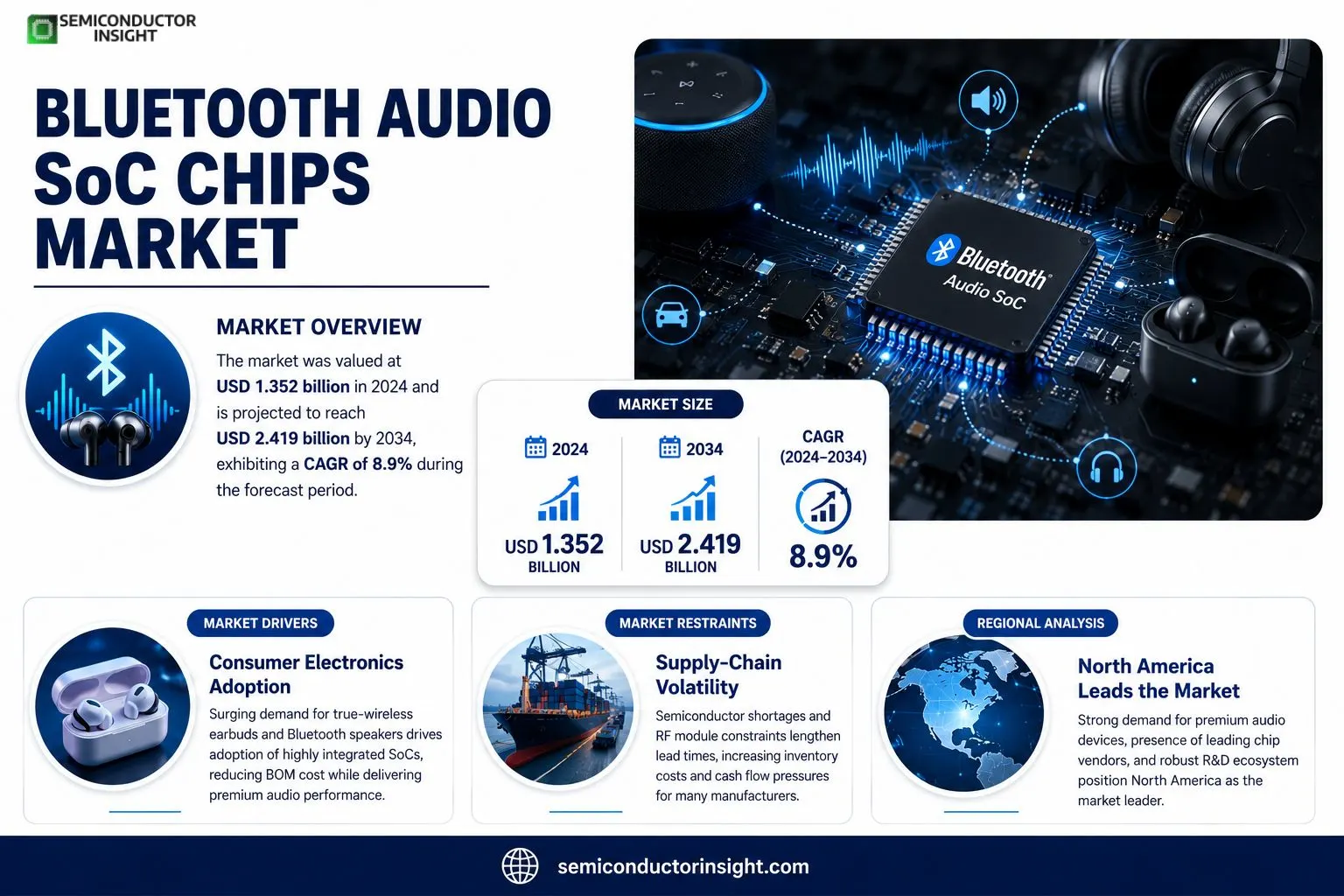
Bluetooth Audio SoC Chips market was valued at USD 1.352 billion in 2024 and is projected to reach USD 2.419 billion by 2034, exhibiting a CAGR of 8.9% during the forecast period.
Bluetooth Audio System‑on‑Chip (SoC) integrates radio transceiver, baseband processor, audio codec and power‑management functions into a single die, enabling premium wireless speakers and headphone applications with high‑fidelity sound reproduction.The market gains traction because consumer demand for true‑wireless earbuds and smart speakers remains strong, while semiconductor manufacturers benefit from scale efficiencies highlighted by analog segment growth exceeding 20 % in 2022. Additionally, the rollout of low‑power Bluetooth 5.x standards expands use cases into IoT voice assistants and automotive infotainment, further driving adoption.
MARKET DRIVERS
Consumer Electronics Adoption
The surge in true‑wireless earbuds and Bluetooth‑enabled speakers has forced OEMs to embed highly integrated audio SoCs. Manufacturers cite the ability to shave 10‑15 % off bill‑of‑materials while preserving premium sound as a decisive factor, especially in price‑sensitive segments.
Automotive Infotainment Evolution
Vehicle cabins are transitioning from analog radio to multi‑zone, Bluetooth‑linked audio architectures. Tier‑1 suppliers report that a single SoC now powers navigation prompts, passenger‑zone sound, and hands‑free calls, cutting board‑space by 30 % and simplifying firmware updates over‑the‑air.
➤ “Designers are choosing Bluetooth Audio SoC Chips because they reconcile performance, power, and integration in a single die, a combination that was unattainable a generation ago.”
Beyond devices, the proliferation of voice‑assistant ecosystems has pushed developers to prioritize low‑latency codecs and robust echo‑cancellation, capabilities that modern SoCs deliver out‑of‑the‑box, thereby accelerating time‑to‑market for new product lines.
MARKET CHALLENGES
Supply‑Chain Volatility
semiconductor shortages have lengthened lead times for high‑frequency RF modules, compelling many firms to maintain safety stocks that erode cash flow. The pressure is most acute for midsize audio brands lacking the bargaining power of large smartphone OEMs.
Other Challenges
Design Complexity
Integrating advanced DSP, Bluetooth 5.3, and proprietary codecs within a sub‑10 mm² footprint demands multidisciplinary expertise. Companies that cannot assemble such talent risk prolonged development cycles and higher NRE costs.
MARKET RESTRAINTS
Regulatory Certification Overheads
Each Bluetooth Audio SoC must pass regional radio‑frequency compliance tests, a process that can add 6‑12 months to product rollout. Smaller players, in particular, find these timelines and associated fees prohibitive, limiting their market participation.Moreover, the push for ultra‑low power consumption intensifies the need for silicon‑level power‑management features, which many legacy IP blocks lack, constraining the pool of viable candidates for cost‑conscious applications.
MARKET OPPORTUNITIES
Emerging Wearables and Health Devices
Smart watches, fitness trackers, and hearing‑aid platforms are incorporating high‑fidelity audio for notifications and guided workouts. The convergence of health monitoring and audio delivery creates a niche where ultra‑low‑power SoCs with integrated AI‑based noise suppression can command premium pricing.In parallel, AR/VR headsets are moving toward wireless audio to untether users from cables. Early adopters are seeking SoCs that support spatial audio rendering with sub‑10 ms latency, a requirement that opens a new design space for specialized Bluetooth chips.Geographically, regions with expanding middle classesparticularly Southeast Asia and Latin Americaare witnessing a rapid upgrade from basic Bluetooth speakers to feature‑rich audio ecosystems, signalling a sizeable addressable market for differentiated SoC solutions.
Bluetooth Audio SoC Chips Market Trends
Integration of Dual‑Mode Architecture in Premium Audio Devices
Manufacturers are converging on dual‑mode System‑on‑Chip solutions that combine classic Bluetooth Classic with Low Energy (LE) capabilities. This architectural shift stems from consumer expectations for seamless pairing across legacy speakers while retaining the power efficiency required for true‑wireless earbuds. Dual‑mode chips enable a single hardware platform to service both high‑fidelity streaming and battery‑friendly voice assistant activation, reducing bill‑of‑materials for OEMs. The move also simplifies firmware updates, allowing vendors to push enhancements without hardware redesigns. For brands focused on premium positioning, the ability to offer flawless multi‑device connectivity becomes a differentiator that directly influences product pricing and margin performance.
Other Trends
Shift Toward Ultra‑Low Power Designs
Power consumption has risen to the forefront of chipset engineering as portable audio devices compete for longer playback times. Designers are leveraging advanced process nodes and adaptive clocking techniques to cut active power draw by up to 30 percent compared with previous generations. The reduction in energy use not only satisfies end‑user demand for all‑day battery life but also eases thermal management in compact speaker enclosures. Consequently, component suppliers that can demonstrate measurable power savings are gaining preferential treatment in contract negotiations, prompting a reallocation of R&D budgets toward energy‑efficient architectures.
Regional Realignment of Production Capacity
While Asia‑Pacific historically provided the bulk of volume, recent tariff adjustments and supply‑chain diversification strategies have encouraged several tier‑one manufacturers to establish limited‑run assembly lines in North America and Europe. This geographic redistribution mitigates lead‑time volatility and aligns production closer to high‑margin markets such as the United States and Germany, where premium‑priced audio appliances dominate. The emerging regional footprint also spurs localized component sourcing, which can reduce logistics costs and enhance responsiveness to fast‑changing consumer trends. Companies that successfully balance scale with regional agility are poised to capture incremental share as OEMs prioritize resilience over pure cost advantage.
COMPETITIVE LANDSCAPE
Key Industry Players
Competitive Profile of Bluetooth Audio SoC Chip Vendors
Qualcomm dominates the Bluetooth audio SoC arena, leveraging its extensive RF‑IP portfolio and deep ties with OEMs of premium true‑wireless earbuds. Its Snapdragon Sound line integrates high‑resolution codecs, AI‑enhanced echo cancellation, and low‑power DSP cores, allowing manufacturers to compress multiple functions into a single die. This breadth of integration forces smaller rivals into niche segments or partnership roles, consolidating market power around a handful of large silicon houses. The overall structure mirrors a classic dual‑tier model: a few powerhouses control the bulk of volume shipments, while specialist firms compete on cost‑efficiency, custom analog front‑ends, or application‑specific features such as ultra‑low latency for gaming headsets.Beyond the giants, a vibrant cohort of regional players injects diversification into the supply chain. MediaTek’s recent audio‑focused SoC releases target cost‑sensitive mass‑market headphones, while Broadcom supplies high‑performance modules for automotive infotainment. Companies such as Zhuhai Jieli Technology, Bestechnic, and Zgmicro Wuxi exploit proprietary audio algorithms to win contracts with emerging Chinese brands. Amlogic and Telink focus on dual‑mode chips that can switch between classic Bluetooth and BLE, appealing to smart‑speaker manufacturers seeking regulatory flexibility. Shanghai ZCAN and Action Technology maintain strong footholds in industrial IoT audio nodes, where ruggedness outweighs raw performance. This patchwork of capabilities ensures that even as the market scales toward $2.4 billion by 2034, buyers retain bargaining leverage and opportunities for differentiation.
List of Key Bluetooth Audio SoC Chips Companies Profiled
- Qualcomm
- Qualcomm
- MediaTek
- MediaTek
- Broadcom
- Broadcom
- Realtek Semiconductor
- Realtek Semiconductor
- Zhuhai Jieli Technology
- Zgmicro Wuxi
- Bestechnic
- Amlogic
- Telink
- Shanghai ZCAN
- Action Technology
Segment Analysis:
| Segment Category | Sub-Segments | Key Insights |
| By Type |
|
Dual-mode is emerging as the preferred architecture because it supports both classic Bluetooth and low‑energy audio pathways, enabling richer sound experiences across premium speakers and headphones.
|
| By Application |
|
TWS Bluetooth Headphones dominate innovation cycles as consumer demand for truly wireless experiences grows.
|
| By End User |
|
Consumer Electronics remain the core growth engine, driven by rapid adoption of smart speakers and premium audio accessories.
|
| By Integration Level |
|
System‑in‑Package (SiP) Solutions are gaining traction as OEMs look to reduce board space and simplify supply chains.
|
| By Connectivity Feature |
|
Multi‑Protocol Support addresses the expanding ecosystem where devices must switch seamlessly between audio streaming and data‑centric functions.
|
Regional Analysis: Bluetooth Audio SoC Chips Market
North America
Premium headphones and smart wearables dominate purchase decisions, urging manufacturers to prioritize chipsets that deliver crystal‑clear sound while conserving battery life. This consumer bias nudges vendors toward solutions that seamlessly integrate active noise cancellation and voice assistant interfaces, augmenting the overall user experience.
Original equipment manufacturers experiment with modular architectures, embedding Bluetooth Audio SoCs that enable over‑the‑air updates. This flexibility permits continuous refinement of acoustic algorithms post‑sale, extending product relevance and reducing time‑to‑market for subsequent feature enhancements.
Recent disruptions have prompted firms to diversify component sourcing, fostering regional fabs and forging partnerships with foundries that guarantee steady throughput. Such maneuvers mitigate bottlenecks and safeguard the flow of critical audio SoC inventories.
Evolving wireless standards and spectrum allocations shape design parameters, compelling chipset designers to align with compliance frameworks that balance performance with electromagnetic compatibility across diverse device classes.
Europe
European markets exhibit a strong appetite for eco‑friendly audio solutions, influencing manufacturers to embed SoCs that support low‑power Bluetooth protocols and recyclable packaging. The region’s fragmented retail environment encourages niche players to differentiate through localized acoustic tuning, while collaborative research programs between universities and chipmakers drive incremental improvements in spatial audio rendering. Consequently, vendors that align product roadmaps with sustainability criteria and regional acoustic preferences gain a measurable advantage.
Asia‑Pacific
The Asia‑Pacific arena combines high volume production with rapid consumer adoption of affordable smart devices. Manufacturers leverage cost‑effective Bluetooth Audio SoCs that still meet essential latency and fidelity benchmarks, catering to price‑sensitive segments in emerging economies. Concurrently, the rise of local fab capacities shortens design cycles, enabling quicker response to shifting market tastes and fostering a competitive environment where incremental feature upgrades become decisive factors.
South America
In South America, urbanization and expanding broadband infrastructure stimulate demand for connected audio accessories that complement streaming services. Local distributors favor chipsets offering multilingual voice assistant compatibility and robust connection stability amid variable network conditions. Brands that tailor their Bluetooth Audio SoC portfolios to these practical considerations often secure stronger footholds in retail channels across the continent.
Middle East & Africa
The Middle East & Africa region reflects a blend of premium demand in affluent Gulf markets and burgeoning uptake in African urban centers. This dichotomy drives a dual strategy: high‑end SoCs with advanced codec support for luxury audio products, alongside economical variants that address price‑sensitive consumers. Partnerships with regional system integrators help navigate logistical complexities, ensuring that Bluetooth Audio SoC solutions align with both market segments effectively.
Report Scope
This market research report provides a comprehensive analysis of the Bluetooth Audio SoC Chips Market , covering the forecast period 2026–2034. It offers detailed insights into market dynamics, technological advancements, competitive landscape, and key trends shaping the industry.
Key focus areas of the report include:
- Market Overview: The report begins with an overview outlining its current market scenario, key growth indicators, and industry transformation drivers. It discusses macroeconomic factors, demand–supply balance, regulatory landscape, and the strategic role of semiconductors in powering advancements across industries such as automotive, telecommunications, consumer electronics, and industrial automation.
- Market Size & Forecast: Historical data and future projections for revenue, unit shipments, and market value across major regions and segments.
- Segmentation Analysis: Detailed breakdown by product type, technology, application, and end-user industry to identify high-growth segments and investment opportunities.
- Regional Insights: Insights into market performance across North America, Europe, Asia-Pacific, Latin America, and the Middle East & Africa, including country-level analysis where relevant.
- Competitive Landscape: Profiles of leading market participants, including their product offerings, R&D focus, manufacturing capacity, pricing strategies, and recent developments such as mergers, acquisitions, and partnerships.
- Technology Trends & Innovation: Assessment of emerging technologies, integration of AI/IoT, semiconductor design trends, fabrication techniques, and evolving industry standards.
- Market Drivers & Restraints: Evaluation of factors driving market growth along with challenges, supply chain constraints, regulatory issues, and market-entry barriers.
- Stakeholder Insights: Insights for component suppliers, OEMs, system integrators, investors, and policymakers regarding the evolving ecosystem and strategic opportunities.
Primary and secondary research methods are employed, including interviews with industry experts, data from verified sources, and real-time market intelligence to ensure the accuracy and reliability of the insights presented.
FREQUENTLY ASKED QUESTIONS:
What is the current market size of Bluetooth Audio SoC Chips Market?
-> Bluetooth Audio SoC Chips Market was valued at USD 1352 million in 2024 and is expected to reach USD 2419 million by 2034, at a CAGR of 8.9% during the forecast period.
Which key companies operate in Bluetooth Audio SoC Chips Market?
-> Key players include Qualcomm, MediaTek, Zhuhai Jieli Technology, Realtek Semiconductor, Actions Technology, Broadcom, Zgmicro Wuxi, Bestechnic, Amlogic, Telink, Shanghai ZCAN.
What are the key growth drivers?
-> Key growth drivers include the rise of premium wireless speakers and headphones, increasing consumer demand for wireless audio solutions, and advancements in Bluetooth Low Energy technology.
Which region dominates the market?
-> Asia-Pacific remains the largest market for Bluetooth Audio SoC Chips, driven by strong demand in consumer electronics, although it experienced a modest decline of 2.0% in 2022.
What are the emerging trends?
-> Emerging trends include dual‑mode SoC designs, integration of AI/IoT capabilities, growth of true‑wireless stereo (TWS) headphone applications, and increased focus on energy‑efficient architectures.
Get Sample Report PDF for Exclusive Insights
Report Sample Includes
- Table of Contents
- List of Tables & Figures
- Charts, Research Methodology, and more...
 Download Sample Report PDF