Market Insights
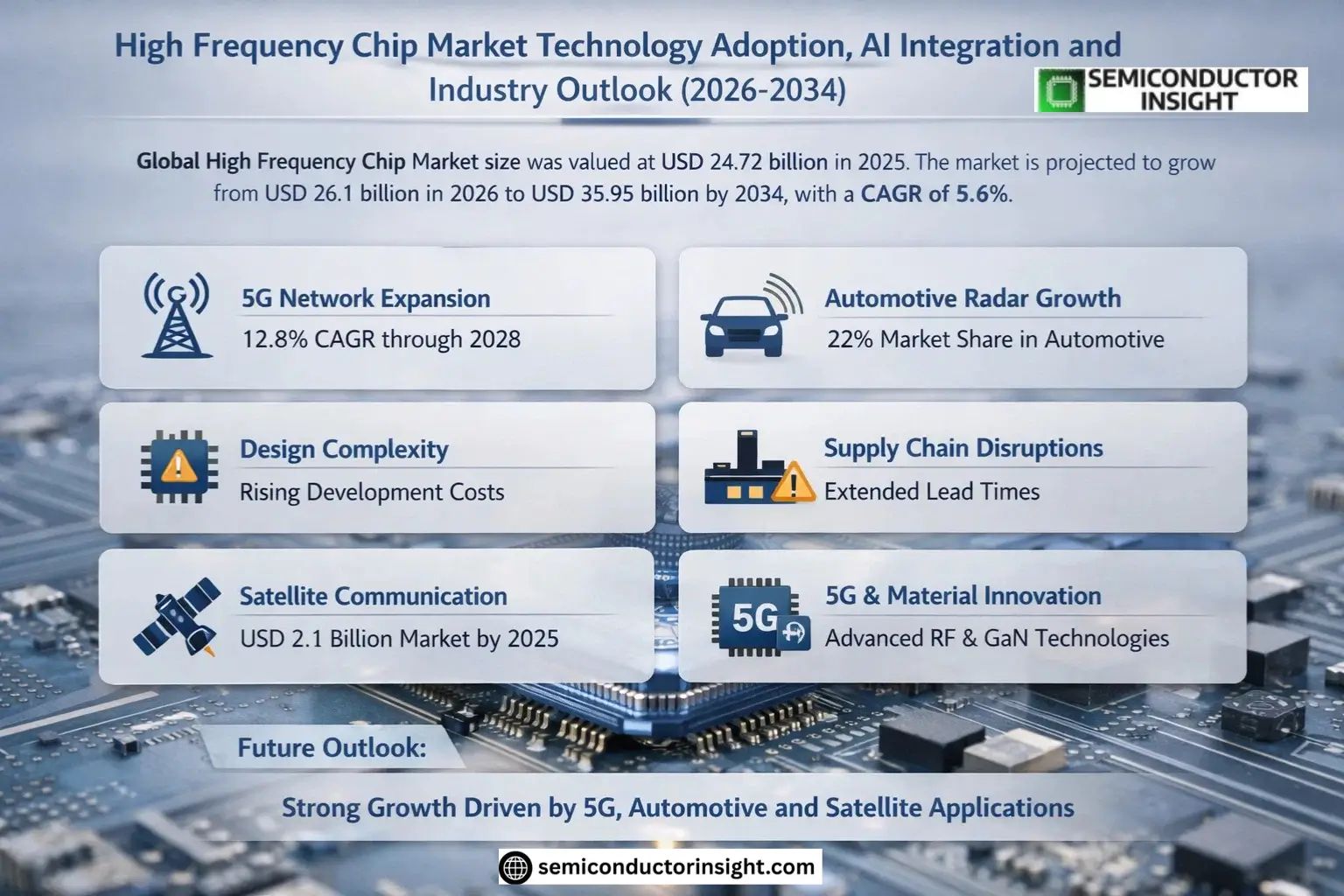
Global High Frequency Chip Market size was valued at USD 24.72 billion in 2025. The market is projected to grow from USD 26.1 billion in 2026 to USD 35.95 billion by 2034, exhibiting a CAGR of 5.6% during the forecast period.
High frequency chips are integrated circuits designed to process signals at radio or microwave frequencies, enabling faster data transmission with minimal interference. These components are critical for applications such as 5G networks, satellite communications, automotive radar systems, and IoT devices due to their ability to handle high bandwidth efficiently.
Market growth is driven by escalating demand for advanced wireless technologies and the rapid expansion of IoT ecosystems. However, challenges like complex manufacturing processes and high R&D costs may temper progress. Key players such as Qualcomm, Broadcom, and Skyworks Solutions dominate the sector with innovations in RF front-end chips and GaN-based solutions for next-generation connectivity.
MARKET DRIVERS
5G Network Expansion Boosts Demand
Global rollout of 5G infrastructure has significantly increased demand for high frequency chips, with the market projected to grow at 12.8% CAGR through 2028. These chips enable faster data transfer rates and lower latency in 5G base stations and devices. Leading smartphone manufacturers now integrate high frequency chips as standard components.
Automotive Radar Applications Accelerate Growth
Advanced driver assistance systems (ADAS) require high frequency radar chips operating at 77GHz-79GHz frequencies. The automotive segment now accounts for 22% of the High Frequency Chip Market revenue, with projections showing 18% annual growth as autonomous vehicle development advances.
Military and aerospace applications continue to drive premium segment growth, with defense budgets allocating USD 4.7 billion annually for RF and microwave component development.
MARKET CHALLENGES
Design Complexity Increases Development Costs
The miniaturization of high frequency chips while maintaining signal integrity presents significant engineering challenges. Development costs for millimeter-wave ICs have risen 35% over the past three years, creating barriers for smaller semiconductor firms.
Other Challenges
Material Limitations
Silicon-based technologies face performance constraints above 110GHz, forcing adoption of more expensive compound semiconductor materials like gallium arsenide and silicon germanium.
Thermal Management
Power dissipation in high frequency circuits requires advanced cooling solutions that add 15-20% to total system costs across applications.
MARKET RESTRAINTS
Supply Chain Disruptions Impact Production
High Frequency Chip Market continues facing constraints from semiconductor supply chain bottlenecks, particularly for specialized substrates and packaging materials. Lead times for gallium nitride wafers have extended to 26 weeks, affecting production schedules across the industry.
MARKET OPPORTUNITIES
Satellite Communication Presents New Frontier
Low Earth orbit satellite networks require high frequency chips for ground stations and user terminals, creating a USD 2.1 billion addressable market by 2025. Chipset manufacturers are developing specialized solutions for Ka-band and V-band satellite links.
High Frequency Chip Market Trends
5G Expansion Driving Demand for Advanced High Frequency Chips
The rapid global rollout of 5G networks continues to be the primary growth driver for the High Frequency Chip market. As telecom operators upgrade infrastructure to support higher bandwidth and lower latency requirements, demand for advanced RF front-end chips and transceiver solutions has surged. The transition towards millimeter-wave frequencies above 24GHz particularly benefits chip manufacturers specializing in GaN and advanced SiGe processes.
Other Trends
Material Innovation for Higher Frequency Bands
Semiconductor companies are investing heavily in GaN-on-SiC and advanced packaging technologies to address the challenges of signal integrity in the 3GHz-30GHz range. These material innovations enable higher power density and better thermal management, critical for 5G base stations and automotive radar applications.
Integration and Miniaturization in Consumer Electronics
The consumer electronics sector shows increasing demand for highly integrated High Frequency Chip solutions, particularly for smartphones and IoT devices. Manufacturers are developing System-in-Package (SiP) solutions that combine multiple functions while maintaining signal isolation at frequencies up to 6GHz. This trend aligns with the space constraints in modern smart devices.
Other Trends
Automotive Radar Adoption Accelerating
Advanced driver assistance systems (ADAS) and autonomous vehicle development are creating substantial demand for 77GHz-79GHz radar chips. Suppliers are focusing on improving phase noise performance and power efficiency in these high-frequency automotive applications, with specialized GaAs and CMOS processes gaining traction.
Supply Chain Localization and Security Concerns
Geopolitical factors are influencing procurement strategies, with regional supply chains emerging for defense and telecom applications. This has led to increased R&D investment in alternative semiconductor materials and domestic manufacturing capabilities for High Frequency Chips in major markets.
COMPETITIVE LANDSCAPE
Key Industry Players
Global High Frequency Chip Market Dominated by Semiconductor Giants and RF Specialists
High Frequency Chip Market is characterized by strong dominance from established semiconductor leaders and specialized RF component manufacturers. Qualcomm and Broadcom lead the market through their extensive portfolios in 5G RF front-end modules and wireless communication chips. Skyworks Solutions and Qorvo maintain significant market shares through their expertise in RF power amplifiers and filters, particularly for 5G infrastructure and smartphone applications. Murata Manufacturing and its subsidiary pSemi strengthen their position through advanced packaging technologies and high-frequency passive components.
Beyond these major players, several companies hold important niches in the high frequency chip ecosystem. Analog Devices and Texas Instruments excel in high-performance mixed-signal solutions for automotive radar and industrial applications. Infineon Technologies and NXP Semiconductors provide critical components for automotive V2X and industrial IoT markets. Emerging players like MACOM and Ampleon are gaining traction in GaN-based high frequency solutions for defense and telecom infrastructure applications.
List of Key High Frequency Chip Companies Profiled
- Qualcomm Technologies
- Broadcom Inc.
- Skyworks Solutions
- Qorvo, Inc.
- Murata Manufacturing
- pSemi (Murata)
- Analog Devices
- NXP Semiconductors
- Infineon Technologies
- MACOM Technology Solutions
- Texas Instruments
- onsemi
- Renesas Electronics
- Ampleon
Segment Analysis:
| Segment Category | Sub-Segments | Key Insights |
| By Type |
|
3GHz-30GHz segment dominates due to critical applications in 5G networks and satellite communications:
|
| By Application |
|
Wireless Communication segment drives market growth with strong technological adoption:
|
| By End User |
|
Telecom Operators show the highest adoption rate for high frequency chips:
|
| By Process Technology |
|
GaN Technology is gaining significant traction in high-power applications:
|
| By Function |
|
RF Front-End Chips maintain dominant position in the market:
|
Regional Analysis: High Frequency Chip Market
Taiwan and South Korea host the world’s most advanced semiconductor fabs specializing in high frequency chip production, with continuous capacity expansions to meet global demand for 5G and AI chipsets.
China’s national semiconductor strategy funds high frequency chip development programs, while Japan supports material innovation through public-private partnerships targeting mmWave applications in automotive radar systems.
Accelerated rollout of 5G networks across Southeast Asia drives demand for high frequency power amplifiers and RF filters, with telecom operators investing heavily in small cell deployments requiring specialized chips.
Leading smartphone brands integrate advanced high frequency chips to support faster data throughput and improved energy efficiency, particularly in flagship models designed for augmented reality and AI photography features.
North America
North America remains at the forefront of high frequency chip design innovation, with Silicon Valley companies pioneering AI-optimized architectures for data center and edge computing applications. The region benefits from strong defense sector demand for secure high frequency communication systems and substantial venture capital investments in quantum computing technologies. Collaborative research between academic institutions and semiconductor firms accelerates development of novel packaging techniques for terahertz-range chips, while automotive radar applications for autonomous vehicles create new market opportunities.
Europe
European markets demonstrate strong adoption of high frequency chips in industrial automation and automotive radar systems, supported by stringent safety regulations and 5G infrastructure mandates. Germany’s automotive OEMs lead in integrating high frequency radar chips for advanced driver assistance systems, while Nordic countries invest in low-power IoT chips for smart city applications. The EU Chips Act stimulates domestic high frequency chip production to reduce reliance on imports, particularly for aerospace and medical imaging equipment requirements.
Middle East & Africa
The Middle East is witnessing rapid adoption of high frequency chips in telecom infrastructure, driven by large-scale smart city projects and oil/gas industry automation. Gulf Cooperation Council nations invest heavily in 6G research initiatives incorporating high frequency technologies, while African mobile network operators upgrade base stations with energy-efficient RF chips to extend rural connectivity. Emerging applications include mmWave solutions for mining operations and agricultural monitoring systems.
South America
South American markets show growing high frequency chip demand for telecommunications equipment and industrial sensors, with Brazil leading in 5G infrastructure deployments. The region benefits from increasing foreign investment in semiconductor testing facilities, though local manufacturing capacity remains limited. Key applications include smart grid technologies and satellite communication systems supporting remote area connectivity, with particular focus on agricultural monitoring and resource extraction industries.
Report Scope
This market research report provides a comprehensive analysis of the High Frequency Chip Market , covering the forecast period 2025–2034. It offers detailed insights into market dynamics, technological advancements, competitive landscape, and key trends shaping the industry.
Key focus areas of the report include:
- Market Overview: The report begins with an overview outlining its current market scenario, key growth indicators, and industry transformation drivers. It discusses macroeconomic factors, demand–supply balance, regulatory landscape, and the strategic role of semiconductors in powering advancements across industries such as automotive, telecommunications, consumer electronics, and industrial automation.
- Market Size & Forecast: Historical data and future projections for revenue, unit shipments, and market value across major regions and segments.
- Segmentation Analysis: Detailed breakdown by product type, technology, application, and end-user industry to identify high-growth segments and investment opportunities.
- Regional Insights: Insights into market performance across North America, Europe, Asia-Pacific, Latin America, and the Middle East & Africa, including country-level analysis where relevant.
- Competitive Landscape: Profiles of leading market participants, including their product offerings, R&D focus, manufacturing capacity, pricing strategies, and recent developments such as mergers, acquisitions, and partnerships.
- Technology Trends & Innovation: Assessment of emerging technologies, integration of AI/IoT, semiconductor design trends, fabrication techniques, and evolving industry standards.
- Market Drivers & Restraints: Evaluation of factors driving market growth along with challenges, supply chain constraints, regulatory issues, and market-entry barriers.
- Stakeholder Insights: Insights for component suppliers, OEMs, system integrators, investors, and policymakers regarding the evolving ecosystem and strategic opportunities.
Primary and secondary research methods are employed, including interviews with industry experts, data from verified sources, and real-time market intelligence to ensure the accuracy and reliability of the insights presented.
FREQUENTLY ASKED QUESTIONS:
What is the current market size of High Frequency Chip Market?
-> High Frequency Chip Market size was valued at USD 24.72 billion in 2025. The market is projected to grow from USD 26.1 billion in 2026 to USD 35.95 billion by 2034, exhibiting a CAGR of 5.6% during the forecast period.
Which key companies operate in High Frequency Chip Market?
-> Key players include Qualcomm, Broadcom, Skyworks Solutions, Qorvo, Murata Manufacturing, pSemi (a Murata company), Analog Devices, NXP Semiconductors, Infineon Technologies, MACOM, Texas Instruments, onsemi, Renesas Electronics, and Ampleon, among others.
What are the key growth drivers?
-> Key growth drivers include 5G and next-generation network upgrades, expansion of IoT and smart vehicles, and rising demands for data rate and connection density.
Which region dominates the market?
-> Asia is the dominant market, with China, Japan, and South Korea leading in production and consumption.
What are the emerging trends?
-> Emerging trends include higher frequencies, greater integration, lower power consumption, and accelerated GaN adoption in high-power applications.
Get Sample Report PDF for Exclusive Insights
Report Sample Includes
- Table of Contents
- List of Tables & Figures
- Charts, Research Methodology, and more...
 Download Sample Report PDF