Market Insights
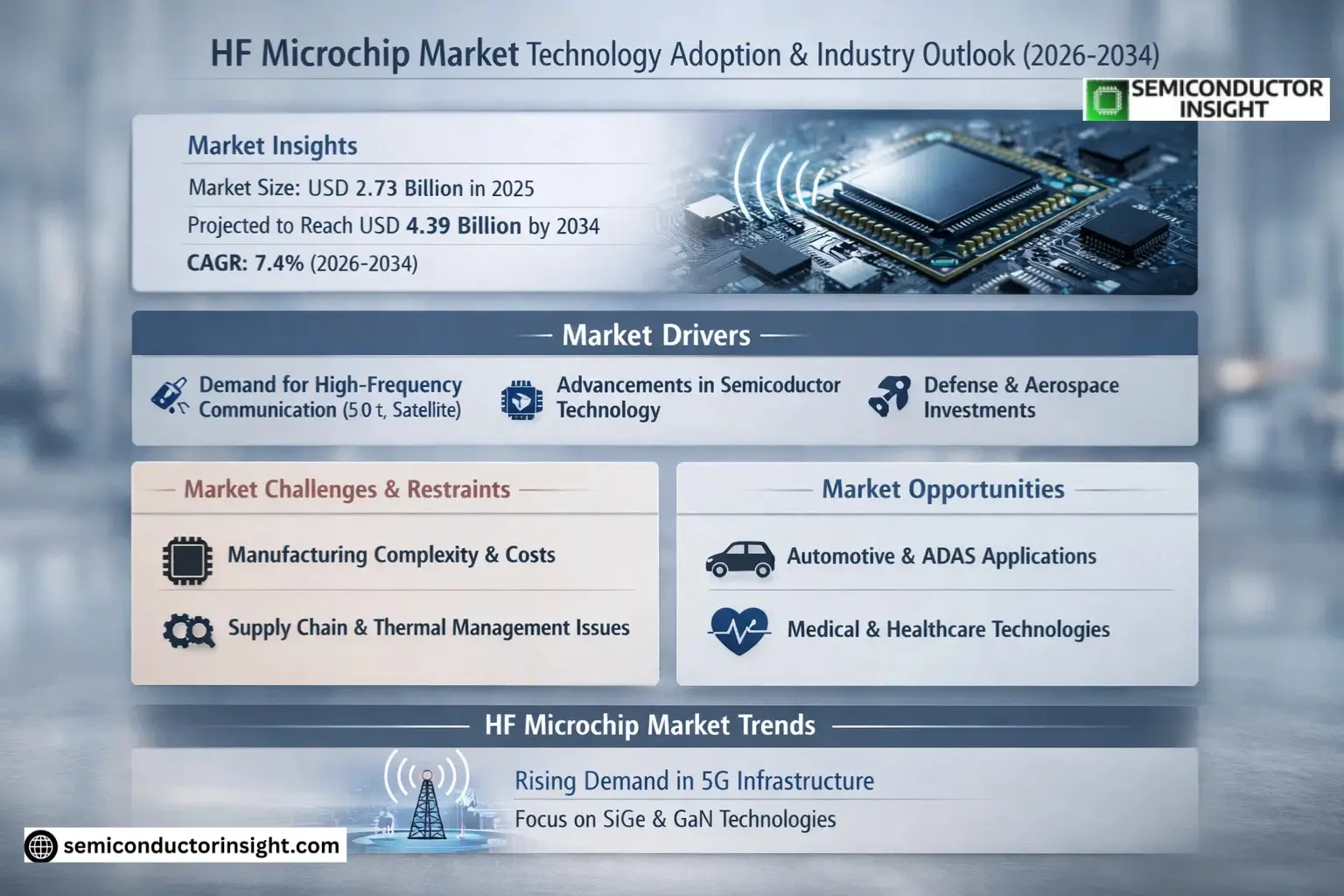
Global HF Microchip Market size was valued at USD 2.73 billion in 2025. The market is projected to grow from USD 2.93 billion in 2026 to USD 4.39 billion by 2034, exhibiting a CAGR of 7.4% during the forecast period.
High-frequency microchips (HF microchips) are specialized integrated circuits operating in radio frequency bands, designed for applications requiring short-range wireless communication. These chips integrate RF transceivers, modulation/demodulation circuits, and encryption modules to enable contactless data exchange through electromagnetic induction. Key characteristics include compact form factors, low power consumption, and robust interference resistance – making them essential for NFC payments, RFID systems, and secure identification solutions.
The market growth is primarily driven by expanding adoption of contactless payment systems worldwide, with global NFC transaction volumes exceeding 500 billion annually as of 2025. Additionally, accelerating deployment of industrial IoT solutions and smart manufacturing technologies has increased demand for reliable HF RFID tagging systems. Major industry players like NXP Semiconductors and Infineon Technologies continue to innovate, recently introducing chips with enhanced security features for payment cards and biometric passports – a critical development given rising cybersecurity concerns in financial transactions.
MARKET DRIVERS
Growing Demand for High-Frequency Communication
HF Microchip Market is experiencing significant growth due to rising demand for high-frequency communication in 5G networks, IoT devices, and satellite communication systems. The increasing need for faster data transmission and low-latency connectivity is driving adoption across industries.
Advancements in Semiconductor Technology
Technological innovations in semiconductor manufacturing, such as the development of 5nm and 3nm processes, are enabling more efficient HF microchip production. These advancements allow for higher performance while maintaining energy efficiency, making them ideal for next-generation applications.
Increasing defense and aerospace investments worldwide are further propelling demand for high-frequency microchips in radar systems, electronic warfare, and secure communication applications.
MARKET CHALLENGES
High Manufacturing Complexity
The production of HF microchips requires advanced fabrication facilities and stringent quality control measures, leading to higher production costs. This complexity presents barriers to entry for new market players.
Other Challenges
Supply Chain Constraints
HF Microchip Market faces ongoing challenges from semiconductor supply chain disruptions, affecting production timelines and component availability across industries.
Thermal Management Issues
High-frequency operations generate significant heat, requiring sophisticated cooling solutions that add to system complexity and cost.
MARKET RESTRAINTS
High Development Costs
The substantial R&D investments required for HF microchip development act as a significant market restraint. Smaller companies often struggle to compete with established semiconductor giants in this capital-intensive sector.
MARKET OPPORTUNITIES
Emerging Automotive Applications
The automotive industry presents substantial growth opportunities for the HF Microchip Market, particularly in autonomous vehicle systems and advanced driver-assistance systems (ADAS) that require high-frequency signal processing.
Medical Technology Integration
Healthcare applications such as medical imaging systems and implantable devices are creating new avenues for HF microchip adoption, driving innovation in biocompatible semiconductor solutions.
HF Microchip Market Trends
Increased Demand for HF Microchips in 5G Infrastructure
The rapid deployment of 5G networks worldwide is driving significant demand for HF microchips, particularly in RF front-end modules and baseband processors. These chips enable higher data throughput while maintaining power efficiency in next-generation communication systems. Market leaders are investing heavily in silicon-germanium (SiGe) and gallium nitride (GaN) technologies to meet the frequency and power requirements of 5G base stations.
Other Trends
Integration of HF Microchips in Automotive Radar Systems
Automotive manufacturers are incorporating HF microchips operating in the 24-77 GHz range for advanced driver assistance systems (ADAS) and autonomous driving applications. This trend is accelerating as vehicle electrification progresses, with chip designs emphasizing reliability in harsh automotive environments while maintaining high-frequency performance.
Expansion of Industrial IoT Applications
The industrial IoT sector is adopting HF microchips for wireless sensor networks and asset tracking solutions. These applications benefit from the chips’ ability to operate in the 300 MHz-3 GHz range while maintaining low power consumption. Manufacturers are developing specialized HF microchip variants with enhanced security features for industrial automation systems.
Emerging Medical Device Integration
Medical equipment manufacturers are implementing HF microchips in high-frequency imaging systems and wireless monitoring devices. The medical sector requires chips with exceptional signal integrity in the 3-300 GHz range, driving innovation in interference-resistant designs and miniaturized packaging solutions.
Advancements in Packaging Technologies
Industry players are transitioning toward wafer-level packaging and system-in-package (SiP) solutions for HF microchips to meet space constraints in mobile devices while improving thermal performance. This evolution supports the integration of RF, analog, and digital components in single packages for applications like NFC and contactless payment systems.
COMPETITIVE LANDSCAPE
Key Industry Players
Global HF Microchip Market Dominated by Semiconductor Giants and Specialized RF Players
HF Microchip Market is characterized by strong competition among established semiconductor leaders and specialized RF component manufacturers. NXP Semiconductors holds the dominant position with approximately 28% global market share in 2025, leveraging its comprehensive portfolio of NFC and RFID solutions. STMicroelectronics and Infineon Technologies follow closely with 19% and 15% market shares respectively, benefiting from their strong presence in automotive and industrial applications. These top three players collectively account for over 60% of the global HF microchip revenue, demonstrating a moderately consolidated market structure.
Beyond the market leaders, several specialty players maintain strong positions in niche segments. EM Microelectronic and ams OSRAM are key suppliers for ultra-low-power HF RFID applications, while Texas Instruments excels in mixed-signal solutions for communication equipment. Asian manufacturers like Shanghai Fudan Microelectronics and United Micro Technologies are gaining traction with cost-competitive alternatives, particularly in consumer electronics and IoT applications. The competitive intensity continues to increase as companies invest in advanced packaging technologies and higher-frequency solutions.
List of Key HF Microchip Companies Profiled
- NXP Semiconductors
- STMicroelectronics
- Infineon Technologies
- EM Microelectronic
- Texas Instruments
- ams OSRAM
- Sony
- Fujitsu
- Shanghai Fudan Microelectronics
- Microchip Technology
- United Micro Technologies
- Smiths Interconnect
- ON Semiconductor
- Renesas Electronics
- Mitsubishi Electric
Segment Analysis:
| Segment Category | Sub-Segments | Key Insights |
| By Type |
|
RF Front-End IC dominates due to critical role in signal processing:
|
| By Application |
|
5G Communication shows strongest growth potential:
|
| By End User |
|
Automotive OEMs exhibit fastest adoption rate:
|
| By Frequency Range |
|
300 MHz–3 GHz remains core operational band:
|
| By Manufacturing Process |
|
SiGe BiCMOS gains traction for high-performance applications:
|
Regional Analysis: Asia-Pacific HF Microchip Market
Asia-Pacific’s semiconductor foundries lead in HF microchip production with advanced nanometer-scale fabrication techniques. The region benefits from concentrated supply chains and government-supported technology hubs that enable rapid prototyping and mass production of high-frequency components.
Regional tech giants are pioneering AI-optimized HF chip architectures, integrating machine learning accelerators directly into high-frequency solutions. This convergence enables smarter signal processing capabilities for 5G networks, autonomous vehicles, and IoT applications across the Asia-Pacific markets.
Asia’s massive electronics manufacturing sector drives continuous innovation in HF microchips for smartphones, wearables, and smart home devices. Local brands require increasingly sophisticated chips to power next-generation features in compact form factors.
Strategic national programs across Asia-Pacific countries provide funding and policy support for domestic HF microchip development. Initiatives focus on reducing import dependence and fostering indigenous innovation in RF and millimeter-wave semiconductor technologies.
North America
The North American HF Microchip Market thrives on defense applications and telecommunications infrastructure. The region leads in specialized high-frequency solutions for aerospace, military systems, and satellite communications. Silicon Valley remains central to AI-optimized chip architecture innovation, with major tech firms developing proprietary HF designs. Growing investment in 6G research and quantum computing applications creates new opportunities for advanced microchip solutions in this high-value market segment.
Europe
Europe maintains strength in automotive and industrial HF microchip applications, with German and French manufacturers leading in precision RF components. The region emphasizes energy-efficient designs and reliability for industrial IoT applications. Strategic alliances between research institutions and semiconductor firms drive innovation in gallium nitride (GaN) and silicon-germanium (SiGe) technologies, particularly for aerospace and medical device applications requiring robust high-frequency performance.
South America
The South American HF Microchip Market shows growing potential in telecommunications infrastructure modernization. Brazil and Argentina lead regional demand as 5G rollouts accelerate across major cities. While manufacturing remains limited, the region benefits from strategic partnerships with global semiconductor firms establishing local design centers focused on cost-optimized HF solutions for emerging market applications.
Middle East & Africa
The Middle East demonstrates increasing HF microchip adoption in smart city infrastructures and telecommunications, while African markets show potential for growth in mobile network applications. Gulf nations invest heavily in semiconductor research facilities, partnering with Asian and European firms to develop high-frequency solutions optimized for harsh environmental conditions and specialized communication needs.
Report Scope
This market research report provides a comprehensive analysis of the HF Microchip Market, covering the forecast period 2025–2034. It offers detailed insights into market dynamics, technological advancements, competitive landscape, and key trends shaping the industry.
Key focus areas of the report include:
- Market Overview: The report begins with an overview outlining its current market scenario, key growth indicators, and industry transformation drivers. It discusses macroeconomic factors, demand-supply balance, regulatory landscape, and the strategic role of semiconductors in powering advancements across industries such as automotive, telecommunications, consumer electronics, and industrial automation.
- Market Size & Forecast: Historical data and future projections for revenue, unit shipments, and market value across major regions and segments.
- Segmentation Analysis: Detailed breakdown by product type, technology, application, and end-user industry to identify high-growth segments and investment opportunities.
- Regional Insights: Insights into market performance across North America, Europe, Asia-Pacific, Latin America, and the Middle East & Africa, including country-level analysis where relevant.
- Competitive Landscape: Profiles of leading market participants, including their product offerings, R&D focus, manufacturing capacity, pricing strategies, and recent developments such as mergers, acquisitions, and partnerships.
- Technology Trends & Innovation: Assessment of emerging technologies, integration of AI/IoT, semiconductor design trends, fabrication techniques, and evolving industry standards.
- Market Drivers & Restraints: Evaluation of factors driving market growth along with challenges, supply chain constraints, regulatory issues, and market-entry barriers.
- Stakeholder Insights: Insights for component suppliers, OEMs, system integrators, investors, and policymakers regarding the evolving ecosystem and strategic opportunities.
Primary and secondary research methods are employed, including interviews with industry experts, data from verified sources, and real-time market intelligence to ensure the accuracy and reliability of the insights presented.
FREQUENTLY ASKED QUESTIONS:
What is the current market size of HF Microchip Market?
-> HF Microchip Market size was valued at USD 2.73 billion in 2025. The market is projected to grow from USD 2.93 billion in 2026 to USD 4.39 billion by 2034, exhibiting a CAGR of 7.4% during the forecast period..
What is the growth rate of HF Microchip Market?
-> The market is expected to grow at a CAGR of 7.4% during 2025-2034.
Which key companies operate in HF Microchip Market?
-> Key players include NXP Semiconductors, STMicroelectronics, Infineon Technologies, EM Microelectronic, Texas Instruments, ams OSRAM, Sony, Fujitsu, Shanghai Fudan Microelectronics, Microchip Technology, United Micro Technologies, and Smiths Interconnect, among others.
What are the key growth drivers?
-> Key growth drivers include ongoing deployment of 5G and high-speed interconnects, rising penetration of automotive intelligence and radar, replacement of wired links by industrial wireless, and demand for thinner and lighter devices.
Which region dominates the market?
-> Asia currently holds the largest market share, with China, Japan, and South Korea being key markets.
What are the emerging trends?
-> Emerging trends include higher frequency bands, higher integration, lower power consumption, parallel development of silicon RF and compound semiconductors, accelerated adoption of SoC and SiP solutions, and stronger co-design with antenna and packaging.
Get Sample Report PDF for Exclusive Insights
Report Sample Includes
- Table of Contents
- List of Tables & Figures
- Charts, Research Methodology, and more...
 Download Sample Report PDF