Blu-ray Storage System Market Insights
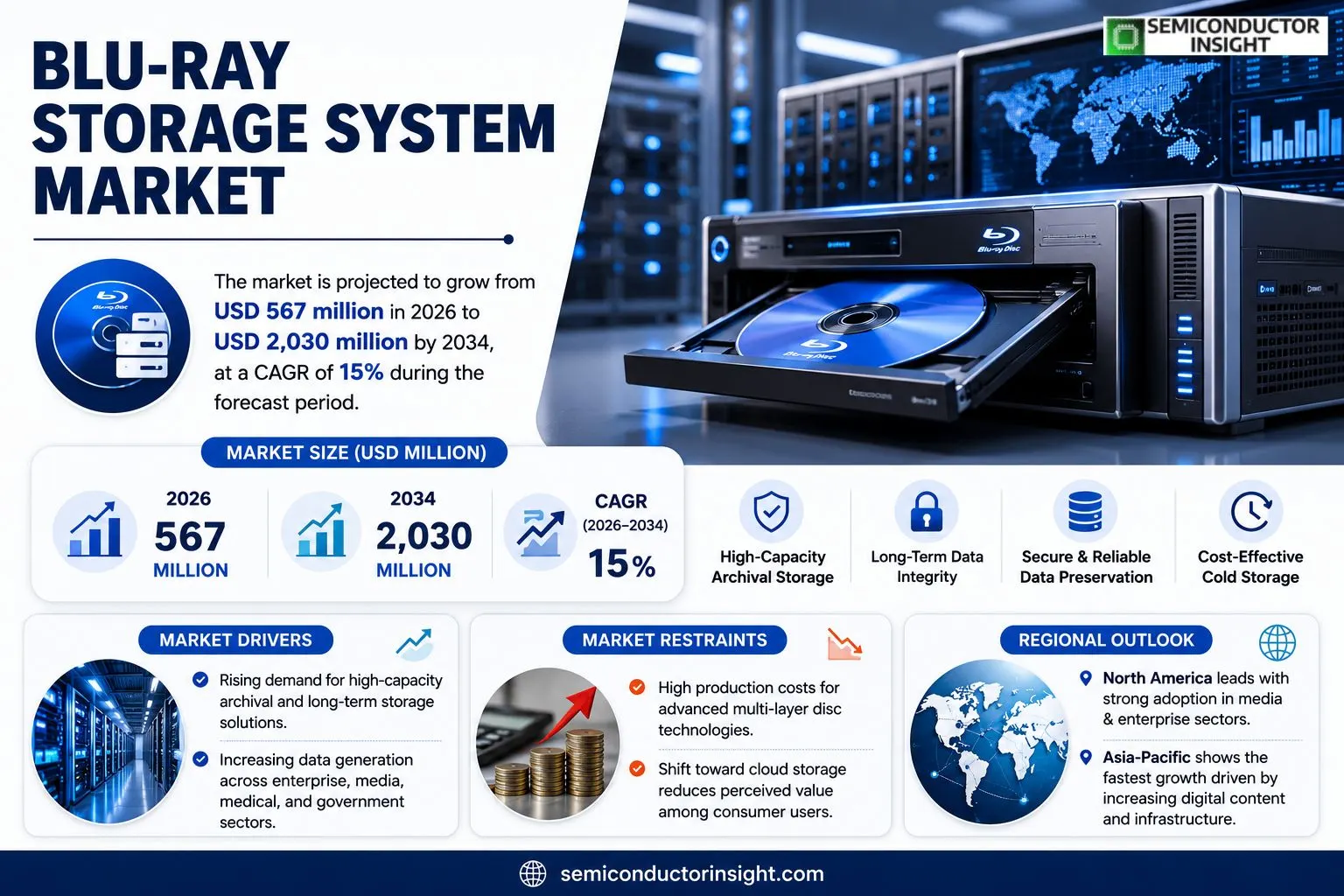
Blu-ray Storage System market size was valued at USD 567 million in 2025. The market is projected to grow from USD 567 million in 2026 to USD 2,030 million by 2034, exhibiting a CAGR of approximately 15 % during the forecast period.
Blu‑ray Storage Systems are high‑capacity optical media engineered for long‑term archival and rapid data retrieval. Leveraging multi‑layer disc technology they deliver capacities ranging from below 24 TB up to several hundred terabytes, positioning them as viable solutions for medical imaging archives, governmental record keeping, enterprise IT backups and other data‑intensive applications.The upward trajectory stems from mounting demand for dependable cold‑storage options as global data creation accelerates, coupled with stricter regulatory requirements on data retention. Recent industry movessuch as Panasonic’s joint development program with Sony on next‑generation dual‑layer formats announced early 2024are spurring technological advances that lower cost per terabyte while enhancing durability. Leading manufacturers including Panasonic, Sony, DISC Archiving System, China Hualu Group Co., Amethystum Storage Tech and others together command a substantial portion of worldwide revenue.
MARKET DRIVERS
Growing Demand for High‑Capacity Archival Solutions
The surge in data‑intensive applicationssuch as 8K video production, scientific imaging, and enterprise backuphas pushed organizations to seek media capable of holding multiple terabytes per cartridge. Blu‑ray Storage System Market players have responded with multi‑layer disc architectures that deliver up to 500 GB per disc, providing a cost‑effective alternative to solid‑state arrays for long‑term preservation. This shift is anchored in the lower total cost of ownership that physical media still offers when retention periods exceed a decade.
Shift Toward Physical Media in Premium Entertainment
Streaming platforms continue to negotiate licensing fees for ultra‑high‑definition titles, yet collectors and boutique distributors remain loyal to physical releases that guarantee uncompromised picture quality. Manufacturers have introduced limited‑edition Blu‑ray packages featuring dual‑layer discs and proprietary encryption, creating a niche where Blu-ray Storage System Market growth is driven by brand‑aware consumers willing to pay a premium for tangible assets.
➤ Industry analysts note that the 2023 shipment volume of Blu‑ray archival drives climbed to roughly 1.2 million units, reflecting a 7 % year‑over‑year uptick despite broader digital migration.
Regulatory frameworks governing data sovereignty in regions such as the EU and APAC have mandated on‑site storage for certain categories of information. Because Blu‑ray media can be sealed and stored offline, enterprises view it as a compliant repository, reinforcing demand across governmental and financial sectors.
MARKET CHALLENGES
Escalating Production Costs for Advanced Disc Technologies
Introducing additional recording layers and robust error‑correction algorithms raises material and equipment expenditures. Smaller OEMs find it increasingly difficult to amortize the capital outlay, leading to market consolidation that could limit competition and elevate prices for end‑users.
Other Challenges
Compatibility with Legacy Readers
Older Blu‑ray drives often lack firmware support for newer multi‑layer formats, forcing organizations to either upgrade entire fleets or accept reduced storage efficiency. This friction hampers seamless adoption in mixed‑generation environments.
MARKET RESTRAINTS
Limited Perceived Value in Consumer Segments
Casual users increasingly associate cloud services with convenience, overlooking the durability advantages of optical media. Marketing surveys indicate that less than 15 % of households consider Blu‑ray storage when planning data backups, curbing broader market penetration.Retail shelf space for Blu‑ray drives is shrinking as large‑format electronics chains prioritize smart‑home gadgets, further restricting visibility and impulse purchases.
MARKET OPPORTUNITIES
Emerging Use Cases in Edge Computing
Edge nodes deployed in remote locationssuch as oil rigs, autonomous vehicles, and disaster‑response unitsrequire storage that can withstand temperature extremes and power fluctuations. The ruggedized nature of Blu‑ray cartridges positions them as an attractive solution for storing critical logs and firmware updates where solid‑state devices may falter.Another promising avenue lies in the integration of Blu‑ray drives with AI‑enhanced data indexing software. By coupling high‑capacity optical media with intelligent retrieval algorithms, vendors can offer enterprises a hybrid archive that balances speed, cost, and security, thereby opening a new revenue stream beyond traditional hardware sales.
Blu-ray Storage System Market Trends
Shift Toward High‑Capacity Archival Solutions
The Blu‑ray Storage System Market is experiencing a pronounced movement toward larger capacity cartridges as enterprises grapple with exploding data volumes. Customers in media, scientific research, and government archives are prioritising media that can retain terabytes of information without frequent media swaps. This preference is reshaping vendor roadmaps; manufacturers are allocating R&D resources to extend the density of thin‑film layers and to refine error‑correction algorithms that sustain readability over decades. The operational advantage lies in reduced handling costs and a lower risk of data loss during migration cycles. For providers, the transition translates into a need to restructure pricing models, emphasizing long‑term value over unit cost, and to bolster service agreements that guarantee media longevity.
Other Trends
Geographic Realignment of Supply Chains
Recent trade uncertainties have prompted key players in the Blu‑ray Storage System Market to diversify their production footprints. While traditional hubs in East Asia retain a dominant share of output, firms are establishing assembly lines in North America and Europe to mitigate tariff exposure and to shorten delivery lead times for regional customers. This redistribution supports a more resilient supply network and enables quicker response to localized demand spikes, especially in sectors such as medical imaging and legal record keeping that require rapid fulfillment of archival media. The shift also encourages collaboration with regional component suppliers, fostering innovation in coating technologies and substrate materials tailored to specific climate conditions.
Emergence of Sustainable Media Initiatives
Environmental considerations are gaining traction within the Blu‑ray Storage System Market as corporations adopt green procurement policies. Manufacturers are experimenting with recyclable polymer substrates and low‑energy laser bonding processes to lower the carbon footprint of each cartridge. End‑users are increasingly evaluating vendors based on the lifecycle impact of their storage media, not merely on capacity or cost. This trend compels industry participants to disclose material composition, adopt circular‑economy frameworks, and invest in take‑back programs that recover used discs for remanufacturing. Companies that integrate sustainability into product design are likely to differentiate themselves, capture premium contracts, and align with the broader corporate responsibility agendas of their client base.
COMPETITIVE LANDSCAPE
Key Industry Players
Blu‑ray Storage System Market – Competitive Overview
Panasonic and Sony dominate the upper‑tier of the Blu‑ray storage ecosystem, combining cutting‑edge optical disc engineering with extensive distribution networks that cover North America, Europe and Asia‑Pacific. Their product portfolios span from 24 TB entry‑level cartridges to 840 TB enterprise‑grade modules, allowing them to capture the bulk of high‑value contracts in data‑center archiving and governmental records retention. Both firms have leveraged long‑standing relationships with OEMs and system integrators, channeling R&D spend into higher areal density and faster read/write cycles. Consequently, the market exhibits a clear tiered structure: a handful of global leaders own a sizable share of revenue, while a broader set of specialized manufacturers compete on niche capacities, price points, or regional service support.Beyond the headline players, a cohort of regionally focused firms adds depth to the competitive landscape. DISC Archiving System, based in Taiwan, excels in bespoke archival solutions for the media industry, whereas China Hualu Group Co. supplies cost‑effective 24‑48 TB units to domestic enterprises. Amethystum Storage Tech and Suzhou NETZON have introduced modular chassis that cater to rapid scaling demands in education and research institutions. Tsinghua Tongfang Co. and Beijing Xingzhen Tongyuan Digital System leverage state‑backed research to push capacity limits above 1 PB for strategic government projects. Beijing DMX, Beijing Ji Cheng Technology, Bctop and several emerging start‑ups concentrate on verticals such as medical imaging archives and public‑security footage, where compliance and long‑term data integrity are paramount. Their agility in customizing firmware and after‑sales service creates pockets of loyal clientele that offset the scale advantage of the market leaders.
List of Key Blu-ray Storage System Companies Profiled
- Panasonic
- Sony
- DISC Archiving System
- China Hualu Group Co.
- Amethystum Storage Tech
- Suzhou NETZON
- Tsinghua Tongfang Co.
- Beijing Xingzhen Tongyuan Digital System
- Beijing DMX
- Beijing Ji Cheng Technology
- Bctop
- IntelliDisk Solutions
Segment Analysis:
| Segment Category | Sub-Segments | Key Insights |
| By Type |
|
Below 24TB continues to dominate early‑stage adoption because:
|
| By Application |
|
Archival Industry remains the most compelling use case because:
|
| By End User |
|
Data Centers view Blu‑ray storage as a strategic tier for cold data because:
|
| By Integration Trend |
|
AI‑Enabled Retrieval is emerging as a differentiator because:
|
| By Value Driver |
|
Longevity drives purchasing decisions because:
|
Regional Analysis: Blu-ray Storage System Market
Sub-Segments
Large broadcasters and film studios in the United States have integrated Blu‑ray Storage Systems into their archival workflows, valuing the media’s resilience against bit‑rot. Their procurement cycles often prioritize vendors that can deliver turnkey solutions, reducing internal engineering overhead.
Federal data‑retention guidelines encourage the use of immutable storage media. Optical discs, with their read‑only nature, satisfy audit requirements, prompting compliance officers to recommend Blu‑ray technologies for critical records.
Recent launches of triple‑layer Blu‑ray discs push capacity beyond 250 GB, enabling archival of high‑resolution video assets on a single disc. Vendors are pairing these discs with robotic libraries that automate ingest and retrieval, raising operational efficiency.
The proximity of disc manufacturers to major media hubs reduces lead times, allowing rapid scaling of storage infrastructure in response to project spikes, a distinct advantage over overseas component sourcing.
Europe
European media enterprises exhibit a cautious yet growing interest in Blu‑ray Storage Systems, largely influenced by the region’s emphasis on sustainable data‑preservation practices. National archives across the EU have begun standardizing on optical media to meet long‑term cultural heritage mandates, appreciating the low energy footprint relative to active storage arrays. Vendor partnerships with local system integrators facilitate bespoke solutions that respect diverse language and regulatory requirements, reinforcing market confidence. While the cost premium of optical media remains a consideration, the guarantee of data integrity over decades continues to outweigh short‑term expense calculations for many European firms.
Asia-Pacific
In the Asia‑Pacific corridor, rapid digital media production has sparked a parallel need for reliable backup options, positioning Blu‑ray Storage Systems as a pragmatic choice for burgeoning studios in Japan, South Korea, and India. Cultural industries place high value on preserving original masters, and optical discs provide a tangible, tamper‑evident repository that aligns with these priorities. Government initiatives encouraging local content creation inadvertently boost demand for archival solutions, while regional manufacturers are investing in higher‑density disc production to serve domestic markets, reducing reliance on imports.
South America
South American broadcasters and educational institutions are exploring Blu‑ray Storage as a safeguard against frequent power interruptions that threaten hard‑disk longevity. The technology’s offline nature offers a resilient alternative for storing critical libraries of news footage and academic materials. Collaborative projects between regional universities and technology vendors aim to develop training programs that familiarize IT staff with optical media handling, gradually expanding the market’s skill base and fostering broader adoption.
Middle East & Africa
In the Middle East and Africa, strategic portfolios increasingly incorporate Blu‑ray Storage to meet the archival requirements of oil‑and‑gas records and governmental documentation. The region’s climatic challenges make the optical medium’s resistance to humidity and temperature fluctuations particularly appealing. Emerging data‑center hubs are beginning to allocate dedicated bays for optical libraries, signaling a shift toward diversified storage architectures that balance cloud, on‑premises, and archival layers.
Report Scope
This market research report provides a comprehensive analysis of the Blu-ray Storage System Market , covering the forecast period 2026–2034. It offers detailed insights into market dynamics, technological advancements, competitive landscape, and key trends shaping the industry.
Key focus areas of the report include:
- Market Overview: The report begins with an overview outlining its current market scenario, key growth indicators, and industry transformation drivers. It discusses macroeconomic factors, demand–supply balance, regulatory landscape, and the strategic role of semiconductors in powering advancements across industries such as automotive, telecommunications, consumer electronics, and industrial automation.
- Market Size & Forecast: Historical data and future projections for revenue, unit shipments, and market value across major regions and segments.
- Segmentation Analysis: Detailed breakdown by product type, technology, application, and end-user industry to identify high-growth segments and investment opportunities.
- Regional Insights: Insights into market performance across North America, Europe, Asia-Pacific, Latin America, and the Middle East & Africa, including country-level analysis where relevant.
- Competitive Landscape: Profiles of leading market participants, including their product offerings, R&D focus, manufacturing capacity, pricing strategies, and recent developments such as mergers, acquisitions, and partnerships.
- Technology Trends & Innovation: Assessment of emerging technologies, integration of AI/IoT, semiconductor design trends, fabrication techniques, and evolving industry standards.
- Market Drivers & Restraints: Evaluation of factors driving market growth along with challenges, supply chain constraints, regulatory issues, and market-entry barriers.
- Stakeholder Insights: Insights for component suppliers, OEMs, system integrators, investors, and policymakers regarding the evolving ecosystem and strategic opportunities.
Primary and secondary research methods are employed, including interviews with industry experts, data from verified sources, and real-time market intelligence to ensure the accuracy and reliability of the insights presented.
FREQUENTLY ASKED QUESTIONS:
What is the current market size of Blu-ray Storage System Market?
-> Blu-ray Storage System Market was valued at USD 491 million in 2024 and is expected to reach USD 1315 million by 2031, growing at a CAGR of 15.5% during the forecast period.
Which key companies operate in Blu-ray Storage System Market?
-> Key players include Panasonic, Sony, DISC Archiving System, China Hualu Group Co, Amethystum Storage Tech, Suzhou NETZON, Tsinghua Tongfang Co, Beijing Xingzhen Tongyuan Digital System, Beijing DMX, Beijing Ji Cheng Technology, among others.
What are the key growth drivers?
-> Key growth drivers include rising demand for high‑capacity archival storage, increasing data generation across enterprise and media sectors, and the need for reliable long‑term preservation solutions.
Which region dominates the market?
-> Asia, led by China, is projected to be a major market contributor, with significant growth opportunities across the region.
What are the emerging trends?
-> Emerging trends include development of higher‑capacity Blu‑ray formats such as the Below 24TB segment expansion and increasing adoption of Blu‑ray solutions for secure archival in medical, governmental, and financial applications.

Get Sample Report PDF for Exclusive Insights
Report Sample Includes
- Table of Contents
- List of Tables & Figures
- Charts, Research Methodology, and more...
 Download Sample Report PDF