Blu-ray Storage Libraries Market Insights
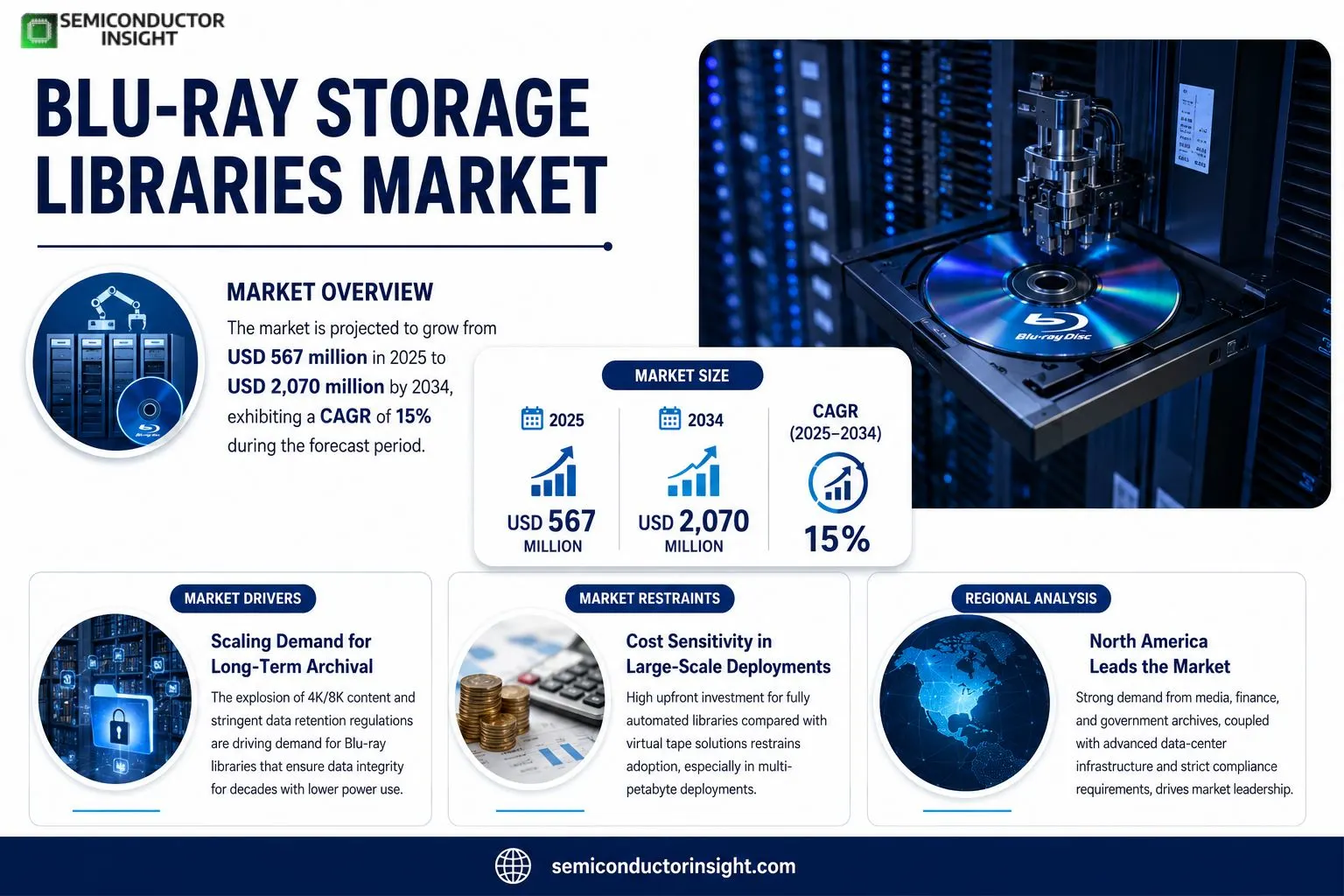
Blu-ray Storage Libraries market size was valued at USD 491 million in 2024 and is projected to grow from USD 567 million in 2025 to USD 2,070 million by 2034, exhibiting a CAGR of approximately 15% during the forecast period.
Blu‑ray Storage Libraries are high‑capacity optical‑disk archival systems that integrate robotic media handling with multi‑layer Blu‑ray discs whose capacities span from below 24 TB up to several hundred terabytes per library unit. Because the discs are immune to magnetic interference and offer a rated lifespan of up to fifty years, these libraries serve both enterprise cold‑storage and long‑term preservation needs while consuming less power than traditional tape solutions.
MARKET DRIVERS
Scaling Demand for Long‑Term Archival
The surge in high‑resolution media, especially 4K and 8K video, compels enterprises to seek storage solutions that guarantee data integrity for decades. Blu‑ray optical media, with its low bit‑error rate, positions itself as a reliable backbone for such archival needs. Companies that invest now can avoid costly migrations later, preserving both content value and compliance standing.
Regulatory Pressures on Data Retention
Stringent regulations across finance, healthcare, and media demand provable, tamper‑resistant storage for specified periods. Optical libraries meet these mandates without the power‑consumption concerns of spinning disks. As auditors tighten scrutiny, organizations are turning to the Blu‑ray Storage Libraries Market to demonstrate adherence and mitigate audit risk.
➤ Optical media’s inherent resistance to electromagnetic interference grants it a strategic advantage in environments where cyber‑physical threats are prevalent.
Beyond compliance, the economics of scale are improving. Larger cartridge capacities and faster robotic retrieval have narrowed the performance gap with traditional tape, making optical libraries a cost‑competitive choice for midsized data centers seeking predictable budgeting.
MARKET CHALLENGES
Technology Adoption Barriers
Many IT departments remain unfamiliar with the operational nuances of optical robotic systems, leading to hesitancy in replacing entrenched tape infrastructures. The learning curve associated with media handling, firmware updates, and library maintenance can deter early adopters.
Other Challenges
Integration Complexity
Legacy backup software often lacks native drivers for Blu‑ray libraries, forcing organizations to procure middleware or redesign workflows. This integration friction increases project timelines and can inflate total cost of ownership.
Supply Chain Constraints
While demand is rising, the production capacity for high‑density Blu‑ray discs is bounded by a limited number of manufacturers. Periodic shortages can delay deployment schedules, especially for enterprises with tight rollout windows.
MARKET RESTRAINTS
Cost Sensitivity in Large‑Scale Deployments
Although per‑terabyte pricing for optical media has fallen, the upfront capital outlay for fully automated libraries remains high compared with virtualized tape solutions. Organizations weighing multi‑petabyte expansions often prioritize short‑term cash flow considerations over long‑term durability, curbing broader market penetration.
MARKET OPPORTUNITIES
Emerging Use Cases in Media Preservation
The growing awareness of cultural heritage digitization has opened a niche for Blu‑ray Storage Libraries Market players. Archives, museums, and film studios require immutable, offline repositories that can survive decades without degradation. Tailored solutions that bundle metadata indexing with optical storage are poised to capture this specialized demand.
Cloud‑Hybrid Backup Architectures
Hybrid models that offload frequently accessed data to cloud while retaining cold archives on optical media are gaining traction. Service providers that embed Blu‑ray libraries into their tiered backup portfolios can differentiate themselves by offering a “cold‑storage‑plus” proposition, leveraging the market’s inherent resilience against ransomware.
Blu-ray Storage Libraries Market Trends
Increasing Preference for High‑Capacity Optical Archiving
The enterprise sector is gravitating toward optical solutions that can guarantee data integrity over decades without the power‑consumption penalties of spinning disks. Vendors that bundle 100‑TB and larger capacity modules with automated retrieval software are seeing procurement committees favor their offerings for regulatory‑driven record‑keeping. This shift is less about raw price competition and more about risk mitigation: optical media’s resistance to magnetic interference and its proven longevity address compliance mandates in finance, healthcare, and aerospace. Consequently, operators are re‑allocating capital from traditional tape silos to Blu‑ray Storage Libraries that promise a lower total cost of ownership over a 30‑year horizon.
Other Trends
Regional Tilt Toward Asian Manufacturing Hubs
While North America remains a mature market, production capacity is expanding rapidly in China and South Korea. The presence of firms such as China Hualu Group Co and Tsinghua Tongfang has lowered entry barriers for mid‑range customers seeking domestic sourcing. This geographic redistribution is prompting Western OEMs to pursue joint‑venture arrangements that blend established brand equity with localized supply chains, thereby preserving market share without sacrificing service quality.
Strategic Consolidation Among Legacy Players
Long‑standing manufacturers like Panasonic and Sony are navigating a landscape where new entrants leverage modular designs and cloud‑integrated management layers. To remain competitive, these incumbents are accelerating portfolio rationalization, shedding low‑margin legacy models while investing in next‑generation library chassis that support automated load‑unload cycles for multi‑petabyte archives. The strategic realignment is evident in partnership announcements aimed at embedding proprietary error‑correction algorithms, which enhance data reliability and differentiate product lines in a crowded field. For customers, the outcome is a clearer value proposition: higher throughput, reduced downtime, and enhanced scalabilityall critical factors when planning multi‑year data retention strategies.
COMPETITIVE LANDSCAPE
Key Industry Players
Blu‑ray Storage Libraries Market – Competitive Overview
Panasonic and Sony dominate the upper tier of the Blu‑ray storage library sector, leveraging extensive R&D budgets and global distribution networks to capture the majority of enterprise contracts. Their product portfolios span from sub‑24 TB tier‑1 shelves to high‑capacity 840 TB modules, allowing them to address both cost‑sensitive and performance‑driven customers. The duopoly benefits from long‑standing relationships with data‑center operators, which translates into higher recurring revenue and a defensible market share. Nevertheless, their pricing power is checked by a growing number of specialized vendors that focus on niche capacity blocks or vertical integrations, forcing the leaders to innovate around reliability, energy efficiency, and lifecycle supportBeyond the two giants, a cluster of regionally strong manufacturers such as DISC Archiving System, China Hualu Group Co., Amethystum Storage Tech, Suzhou NETZON, Tsinghua Tongfang Co., Beijing Xingzhen Tongyuan Digital System, Beijing DMX, Beijing Ji Cheng Technology, Bctop, and others, together constitute a vibrant competitive fringe. These firms often differentiate through aggressive pricing, customized firmware, or rapid rollout of emerging capacities like 100‑360 TB ranges. Their agility creates pressure on the incumbents, especially in fast‑growing Asian markets where local procurement preferences and government‑backed data‑preservation initiatives favor domestic suppliers. As a result, the landscape is characterized by a layered structure: global leaders hold strategic accounts, while a diverse set of mid‑size players chase niche segments and regional growth.
List of Key Blu-ray Storage Libraries Companies Profiled
- Panasonic
- Sony
- DISC Archiving System
- China Hualu Group Co.
- Amethystum Storage Tech
- Suzhou NETZON
- Tsinghua Tongfang Co.
- Beijing Xingzhen Tongyuan Digital System
- Beijing DMX
- Beijing Ji Cheng Technology
- Bctop
- Shenzhen OptiData Solutions
- Guangzhou Nova Storage
Segment Analysis:
| Segment Category | Sub-Segments | Key Insights |
| By Type |
|
Below 24TB
|
| By Application |
|
Enterprise Storage
|
| By End User |
|
Data Centers
|
| By Capacity |
|
Mid Capacity
|
| By Industry |
|
Finance
|
Regional Analysis: Blu-ray Storage Libraries Market
North America
Clients in the region are integrating Blu‑ray libraries with AI‑driven cataloging tools, allowing automated identification of content attributes and faster retrieval across massive archives.
Stringent data‑preservation mandates from agencies such as the Library of Congress push organizations toward optical solutions that guarantee longevity without frequent media refresh cycles.
Media conglomerates prioritize immutable storage for master copies, driving demand for Blu‑ray libraries that can securely house high‑resolution film assets for decades.
A handful of OEMs dominate the North American supply chain, yet niche integrators are emerging, offering customized solutions for scientific and governmental archives.
Europe
European firms exhibit a cautious yet progressive stance toward Blu‑ray storage, driven largely by the continent’s strong emphasis on cultural heritage preservation. National archives and broadcasting entities in countries such as Germany and France allocate budget for optical libraries to safeguard digitized historical recordings. The European Union’s data‑retention directives reinforce the need for reliable, long‑term media, positioning optical storage as a compliant alternative to magnetic tapes. Vendors respond with modular designs that align with the region’s preference for scalable, energy‑efficient infrastructure, allowing institutions to expand capacity without extensive capital outlay.
Asia‑Pacific
Asia‑Pacific presents a heterogeneous landscape where emerging economies are still consolidating basic data‑center capabilities, while advanced markets like Japan and South Korea push the envelope on high‑density optical archives. The region’s entertainment sector, especially the booming film and streaming industries, fuels demand for secure master storage. Concurrently, governmental initiatives to digitize archival holdings across India and Southeast Asia create new opportunities for Blu‑ray library deployments, although cost sensitivity remains a significant consideration in many markets.
South America
In South America, public broadcasters and university research centers are the primary adopters of Blu‑ray storage solutions. Economic constraints encourage a focus on cost‑effective, low‑maintenance hardware, making optical libraries attractive relative to more complex tape automation. Countries such as Brazil and Argentina are beginning to prioritize the preservation of indigenous audiovisual content, prompting modest but steady investment in optical archiving platforms that can operate in environments with limited climate control.
Middle East & Africa
The Middle East & Africa region shows nascent interest in Blu‑ray storage, largely driven by oil‑and‑gas firms that require immutable archival of seismic data and by cultural institutions safeguarding regional film heritage. While the overall market size is smaller, the strategic importance of long‑term data integrity in sectors such as defense and energy fosters a willingness to experiment with optical solutions, especially where power reliability is a concern.
Report Scope
This market research report provides a comprehensive analysis of the Blu-ray Storage Libraries Market , covering the forecast period 2026–2034. It offers detailed insights into market dynamics, technological advancements, competitive landscape, and key trends shaping the industry.
Key focus areas of the report include:
- Market Overview: The report begins with an overview outlining its current market scenario, key growth indicators, and industry transformation drivers. It discusses macroeconomic factors, demand–supply balance, regulatory landscape, and the strategic role of semiconductors in powering advancements across industries such as automotive, telecommunications, consumer electronics, and industrial automation.
- Market Size & Forecast: Historical data and future projections for revenue, unit shipments, and market value across major regions and segments.
- Segmentation Analysis: Detailed breakdown by product type, technology, application, and end-user industry to identify high-growth segments and investment opportunities.
- Regional Insights: Insights into market performance across North America, Europe, Asia-Pacific, Latin America, and the Middle East & Africa, including country-level analysis where relevant.
- Competitive Landscape: Profiles of leading market participants, including their product offerings, R&D focus, manufacturing capacity, pricing strategies, and recent developments such as mergers, acquisitions, and partnerships.
- Technology Trends & Innovation: Assessment of emerging technologies, integration of AI/IoT, semiconductor design trends, fabrication techniques, and evolving industry standards.
- Market Drivers & Restraints: Evaluation of factors driving market growth along with challenges, supply chain constraints, regulatory issues, and market-entry barriers.
- Stakeholder Insights: Insights for component suppliers, OEMs, system integrators, investors, and policymakers regarding the evolving ecosystem and strategic opportunities.
Primary and secondary research methods are employed, including interviews with industry experts, data from verified sources, and real-time market intelligence to ensure the accuracy and reliability of the insights presented.
FREQUENTLY ASKED QUESTIONS:
What is the current market size of Blu-ray Storage Libraries Market?
-> Blu-ray Storage Libraries Market was valued at USD 491 million in 2024 and is expected to reach USD 1,315 million by 2031, growing at a CAGR of 15.5% during the forecast period.
Which key companies operate in Blu-ray Storage Libraries Market?
-> Key players include Panasonic, Sony, DISC Archiving System, China Hualu Group Co, Amethystum Storage Tech, Suzhou NETZON, Tsinghua Tongfang Co, Beijing Xingzhen Tongyuan Digital System, Beijing DMX, Beijing Ji Cheng Technology, Bctop, among others.
What are the key growth drivers?
-> The source does not provide specific growth driver details.
Which region dominates the market?
-> The source lists regional segments but does not specify a dominant region.
What are the emerging trends?
-> The source does not outline emerging trends for this market.

Get Sample Report PDF for Exclusive Insights
Report Sample Includes
- Table of Contents
- List of Tables & Figures
- Charts, Research Methodology, and more...
 Download Sample Report PDF