Blood Oxygen (SpO₂) LED & Photodiode Sensor Market Insights
Global Blood Oxygen (SpO₂) LED & Photodiode Sensor Market size was valued at USD 1.87 billion in 2025. The market is projected to grow from USD 2.04 billion in 2026 to USD 4.12 billion by 2034, exhibiting a CAGR of 8.2% during the forecast period.
Blood oxygen (SpO₂) LED and photodiode sensors are precision optoelectronic components used to measure peripheral oxygen saturation non-invasively through photoplethysmography (PPG). These sensors typically employ red (660 nm) and infrared (940 nm) LEDs paired with photodiodes to detect the differential light absorption of oxygenated and deoxygenated hemoglobin in the bloodstream. They are integral to pulse oximeters, wearable health monitors, hospital-grade patient monitoring systems, and smartwatches.
The market is witnessing strong momentum driven by the rising global prevalence of respiratory and cardiovascular conditions, the rapid adoption of wearable health technology, and increasing clinical emphasis on continuous remote patient monitoring. Furthermore, the post-pandemic surge in consumer awareness around blood oxygen tracking has significantly accelerated demand for SpO₂-enabled devices across both medical and consumer electronics segments. Key industry participants such as Broadcom Inc., Maxim Integrated (now part of Analog Devices), Silicon Laboratories, and ams-OSRAM AG maintain prominent market positions with diversified sensor portfolios catering to medical-grade and consumer-grade applications.
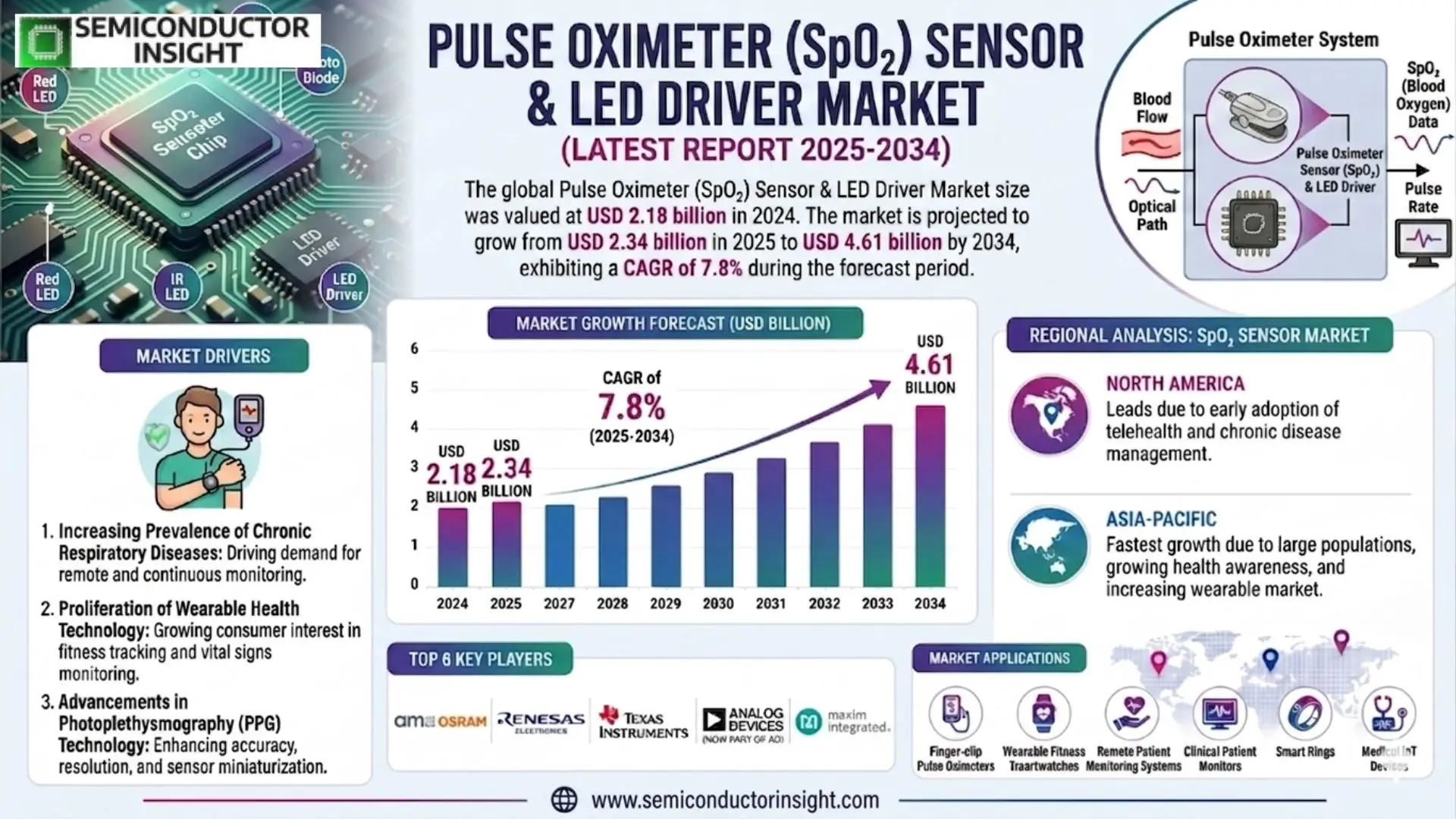
MARKET DRIVERS
Rising Prevalence of Respiratory and Cardiovascular Disorders Fueling Demand for SpO2 Monitoring Solutions
The global Blood Oxygen (SpO₂) LED & Photodiode Sensor Market is experiencing robust growth, driven primarily by the escalating burden of chronic respiratory diseases such as chronic obstructive pulmonary disease (COPD), asthma, and sleep apnea. As these conditions affect hundreds of millions of individuals worldwide, continuous and non-invasive blood oxygen monitoring has become a clinical necessity rather than a supplementary diagnostic tool. The integration of SpO2 LED and photodiode sensors into pulse oximeters, wearable fitness trackers, and hospital-grade patient monitoring systems has accelerated, reflecting the urgent need for real-time oxygen saturation data in both clinical and home care settings.
Post-Pandemic Expansion of Remote Patient Monitoring and Telehealth Infrastructure
The COVID-19 pandemic served as a significant inflection point for the Blood Oxygen SpO2 LED & Photodiode Sensor Market, as widespread oxygen desaturation among patients highlighted the critical importance of accessible SpO2 monitoring. Healthcare systems globally accelerated investments in remote patient monitoring (RPM) platforms and telehealth infrastructure, creating sustained demand for compact, energy-efficient SpO2 sensing components. Medical device manufacturers responded by scaling production of red and infrared LED-photodiode pairs optimized for high-accuracy photoplethysmography (PPG), embedding them into a new generation of connected health devices designed for outpatient and home-based care environments.
➤ The convergence of wearable technology and medical-grade SpO2 sensing is redefining patient monitoring paradigms, with miniaturized LED and photodiode assemblies now enabling continuous, ambulatory blood oxygen tracking beyond the traditional clinical setting.
Consumer electronics giants and dedicated medical sensor manufacturers are jointly driving innovation in the SpO2 LED and photodiode sensor segment, integrating these components into smartwatches, fitness bands, and continuous monitoring patches. Advances in optical sensor design, including multi-wavelength LED arrays and high-sensitivity silicon photodiodes, are improving measurement accuracy across diverse skin tones and physiological conditions, broadening the addressable market and reinforcing adoption across both developed and emerging healthcare economies.
MARKET CHALLENGES
Accuracy Limitations Across Diverse Skin Tones and Motion Artifacts Undermining Clinical Confidence in Consumer-Grade SpO2 Sensors
A persistent and well-documented challenge within the Blood Oxygen SpO2 LED & Photodiode Sensor Market is the variability in measurement accuracy attributed to physiological and environmental factors. Clinical studies and regulatory reviews have raised concerns about the reliability of consumer-grade SpO2 sensors in individuals with higher melanin concentrations, where certain wavelengths of light used in standard red and infrared LED configurations are absorbed differently, potentially skewing oxygen saturation readings. This has prompted regulatory bodies, including the U.S. Food and Drug Administration (FDA), to issue guidance urging device manufacturers to evaluate and improve sensor performance across a broader range of skin tones, adding complexity and cost to the product development cycle.
Other Challenges
Motion Artifact Interference and Signal Noise
Wearable SpO2 devices incorporating LED and photodiode sensor assemblies are particularly susceptible to motion artifacts generated during physical activity or patient movement. Signal noise introduced by motion can cause erroneous readings, reducing clinician confidence in continuous ambulatory monitoring data. While advanced signal processing algorithms and adaptive filtering techniques are being developed to mitigate these effects, their integration increases device complexity and power consumption, presenting ongoing engineering trade-offs for manufacturers operating in the competitive SpO2 sensor market.
Stringent Regulatory Requirements and Certification Timelines
Medical-grade Blood Oxygen SpO2 LED and photodiode sensors are subject to rigorous regulatory scrutiny under frameworks such as the FDA’s 510(k) clearance pathway in the United States and the CE marking process in the European Union. Extended certification timelines, evolving accuracy standards, and post-market surveillance obligations impose significant resource burdens on both established sensor manufacturers and emerging market entrants, potentially slowing the pace of product innovation and commercialization within this specialized sensing segment.
MARKET RESTRAINTS
High Development Costs and Component Miniaturization Constraints Limiting Broader Market Penetration
The development and manufacturing of precision SpO2 LED and photodiode sensors require specialized optical materials, tightly controlled fabrication processes, and rigorous calibration protocols that contribute to elevated per-unit production costs. For medical-grade applications, the tolerance thresholds for wavelength accuracy , particularly for the red (approximately 660 nm) and near-infrared (approximately 940 nm) LED emissions central to pulse oximetry , are extremely narrow, necessitating sophisticated quality assurance infrastructure. These cost structures present a meaningful barrier to entry for smaller manufacturers and constrain price competitiveness in cost-sensitive emerging markets where widespread adoption of Blood Oxygen SpO2 monitoring technology could deliver substantial public health benefits.
Supply Chain Vulnerabilities and Semiconductor Component Availability Risks
The Blood Oxygen SpO2 LED & Photodiode Sensor Market is exposed to supply chain disruptions affecting the broader semiconductor and optoelectronics industries. Dependence on a concentrated base of specialized LED epitaxial wafer suppliers and photodiode fabrication facilities introduces procurement risks, particularly during periods of global semiconductor supply imbalance. Geopolitical tensions affecting key manufacturing regions, combined with sustained demand pressures from consumer electronics and automotive optoelectronics sectors competing for similar component types, can lead to component allocation constraints, extended lead times, and input cost inflation that compress margins across the SpO2 sensor supply chain and delay product launch timelines for device manufacturers.
MARKET OPPORTUNITIES
Integration of Multi-Wavelength SpO2 Sensing into Next-Generation Wearable and Implantable Medical Devices
A compelling growth opportunity within the Blood Oxygen SpO2 LED & Photodiode Sensor Market lies in the rapid expansion of next-generation wearable health monitoring platforms that demand advanced multi-parameter sensing capabilities. The evolution from single-point pulse oximetry to continuous, multi-wavelength optical sensing , capable of measuring not only oxygen saturation but also hemoglobin variants, hydration status, and cardiovascular parameters , is creating demand for sophisticated LED and photodiode sensor arrays with broader spectral coverage. Device manufacturers investing in reflectance-mode SpO2 sensor architectures suitable for wrist-worn, ear-worn, and patch-based form factors are well-positioned to capture significant market share as the boundaries between consumer wellness technology and clinical-grade diagnostics continue to converge.
Expanding Healthcare Infrastructure in Emerging Economies Driving Volume Demand for Affordable SpO2 Sensing Components
Emerging markets across Asia-Pacific, Latin America, the Middle East, and Africa represent significant untapped opportunities for the Blood Oxygen SpO2 LED & Photodiode Sensor Market, as governments and healthcare organizations in these regions accelerate investments in primary care infrastructure, maternal health programs, and non-communicable disease management initiatives. The proliferation of low-cost, battery-powered pulse oximeters and portable diagnostic devices tailored for resource-limited healthcare settings is generating substantial volume demand for compact, reliable, and energy-efficient SpO2 LED and photodiode sensing components. Sensor manufacturers capable of delivering scalable, cost-optimized solutions without compromising measurement accuracy are poised to establish strong footholds in these high-growth markets, where increasing health awareness and expanding insurance coverage are progressively driving uptake of non-invasive monitoring technologies.
Trends
Rising Demand Driven by Wearable Health Technology and Remote Patient Monitoring
Blood oxygen (SpO₂) LED and photodiode sensors serve as essential optoelectronic components for non-invasive measurement of peripheral oxygen saturation through photoplethysmography (PPG). These sensors utilize red (660 nm) and infrared (940 nm) LEDs paired with photodiodes to detect differential light absorption by oxygenated and deoxygenated hemoglobin. Their integration spans pulse oximeters, wearable health monitors, hospital-grade patient monitoring systems, and smartwatches, supporting continuous health tracking across clinical and consumer applications.
Other Trends
Growing Clinical and Consumer Emphasis on Respiratory Health Monitoring
The market continues to expand as global prevalence of respiratory and cardiovascular conditions increases alongside rapid adoption of wearable health technology. Clinical focus on continuous remote patient monitoring has further propelled demand for these precision sensors. Post-pandemic awareness regarding blood oxygen tracking has accelerated integration of SpO₂ capabilities in both medical devices and consumer electronics, creating sustained momentum for advanced LED and photodiode sensor solutions.
Technological Advancements by Leading Sensor Manufacturers
Industry leaders including Broadcom Inc., Maxim Integrated (now part of Analog Devices), Silicon Laboratories, and ams-OSRAM AG maintain strong positions through diversified portfolios addressing both medical-grade accuracy requirements and consumer-grade applications. These companies drive innovation in sensor performance, power efficiency, and form factor optimization to meet evolving needs for reliable, compact SpO₂ monitoring solutions in next-generation health devices. The combination of established optoelectronic expertise and expanding application areas continues to shape competitive dynamics withBlood Oxygen (SpO₂) LED & Photodiode Sensor Market.
COMPETITIVE LANDSCAPE
Key Industry Players
The Competitive Landscape of Blood Oxygen (SpO₂) LED & Photodiode Sensor Market
Blood Oxygen (SpO₂) LED & Photodiode Sensor Market is moderately consolidated, led by specialized semiconductor and optoelectronics manufacturers with strong expertise in precision optical components. Broadcom Inc. and ams-OSRAM AG stand out as leading players, offering high-performance red and infrared LED-photodiode pairs optimized for medical-grade and consumer wearable applications. These companies benefit from vertical integration, extensive patent portfolios, and established supply chains serving both hospital-grade pulse oximeters and mass-market smart devices, enabling them to maintain significant market influence amid rising demand for accurate, low-power SpO₂ sensing solutions.
Other notable participants include Analog Devices (incorporating Maxim Integrated technology), Silicon Laboratories, and Vishay Intertechnology, alongside niche specialists such as OSI Optoelectronics and Excelitas Technologies. These firms differentiate through innovations in miniaturized packages, improved signal-to-noise ratios, and compatibility with photoplethysmography (PPG) platforms, targeting diverse segments from clinical monitoring to fitness wearables. The competitive dynamics are shaped by technological advancement in multi-wavelength sensing, strategic partnerships with device OEMs, and expansion into emerging markets driven by remote patient monitoring trends.
List of Key Blood Oxygen (SpO₂) LED & Photodiode Sensor Companies Profiled
- Broadcom Inc.
- ams-OSRAM AG
- Analog Devices, Inc. (Maxim Integrated)
- Silicon Laboratories
- Vishay Intertechnology, Inc.
- OSI Optoelectronics
- Excelitas Technologies Corp.
- TT Electronics Plc
- Everlight Electronics Co., Ltd.
- Hamamatsu Photonics K.K.
- ROHM Co., Ltd.
- Texas Instruments Incorporated
- KYOTO SEMICONDUCTOR Co., Ltd.
- Edmund Optics Inc.
- Thorlabs, Inc.
Segment Analysis:
| Segment Category | Sub-Segments | Key Insights |
| By Type |
|
Multi-Wavelength Sensors stand out as the leading segment due to their superior capability in delivering accurate oxygen saturation readings across diverse patient conditions. These sensors excel in minimizing motion artifacts and ambient light interference, making them highly reliable for continuous monitoring. Their advanced design supports better differentiation of hemoglobin variants, enhancing overall signal quality in dynamic environments. Integration flexibility further boosts adoption in sophisticated monitoring solutions. |
| By Application |
|
Wearable Health Monitors emerge as the dominant application segment owing to the seamless fusion of compact sensor technology with consumer lifestyle devices. These applications prioritize comfort, long battery life, and real-time data processing, driving innovation in low-power optoelectronics. The sensors enable proactive health management by providing continuous SpO₂ tracking during daily activities and sleep. Their integration enhances user engagement through intuitive feedback mechanisms and connectivity features. |
| By End User |
|
Home Healthcare Settings represent the leading end-user segment fueled by the growing preference for personalized and convenient monitoring solutions. Users benefit from non-invasive, easy-to-use devices that support independent health management without frequent clinical visits. These sensors facilitate early detection of respiratory fluctuations, empowering individuals with chronic conditions. Enhanced data sharing capabilities with healthcare providers further strengthen care continuity and patient confidence. |
| By Form Factor |
|
Wristband and Patch Sensors lead this category through exceptional wearability and continuous monitoring potential. Their flexible, skin-friendly designs ensure stable contact and reduced signal noise during movement. These form factors support extended usage periods critical for trend analysis in both wellness and clinical contexts. Miniaturization advancements allow discreet integration while maintaining high-fidelity optical performance essential for reliable SpO₂ measurements. |
| By Technology Integration |
|
Digital Output Modules dominate as the preferred technology integration due to streamlined data transmission and reduced external processing requirements. These modules deliver cleaner, more robust signals directly compatible with modern microcontrollers and wireless platforms. Their built-in calibration features minimize setup complexity across varied applications. Enhanced noise rejection and power efficiency make them ideal for battery-powered devices where reliability and longevity are paramount. |
Regional Analysis: Blood Oxygen (SpO₂) LED & Photodiode Sensor Market
North America
North America hosts world-class research centers and technology clusters that drive continuous improvements in LED efficiency and photodiode sensitivity for SpO2 sensors. This environment encourages development of next-generation solutions optimized for wearable and portable monitoring devices.
Seamless incorporation of Blood Oxygen (SpO₂) LED & Photodiode Sensor technologies into hospital systems and home care platforms reflects the region’s mature digital health infrastructure, enabling comprehensive patient monitoring workflows.
Growing awareness of respiratory health and preference for preventive care boost adoption of advanced SpO2 sensing solutions across clinical and consumer segments throughout the region.
Close collaboration between sensor manufacturers, device OEMs, and healthcare providers accelerates customization and deployment of specialized Blood Oxygen (SpO₂) LED & Photodiode Sensor solutions.
Europe
Europe maintains a significant position in Blood Oxygen (SpO₂) LED & Photodiode Sensor Market through its emphasis on high-quality medical standards and aging population needs. Countries across the region invest in modernizing healthcare facilities with advanced monitoring equipment. The focus on integrated care models supports wider use of precise SpO2 sensors in both hospital and ambulatory settings. Regulatory harmonization facilitates smoother market entry for innovative sensor technologies while ensuring patient safety. European manufacturers excel in developing energy-efficient and compact solutions suitable for diverse clinical applications, contributing to steady market expansion.
Asia-Pacific
Asia-Pacific exhibits dynamic growth potential in Blood Oxygen (SpO₂) LED & Photodiode Sensor Market fueled by expanding healthcare access and rising chronic disease prevalence. Rapid urbanization and increasing adoption of digital health tools drive demand for affordable yet reliable sensor solutions. Several countries are enhancing local manufacturing capabilities to meet both domestic and export needs. The region shows strong interest in integrating these sensors into smartphones and wearable devices for everyday health tracking. Government initiatives supporting medical technology development further stimulate innovation and market penetration across urban and rural healthcare segments.
South America
South America is gradually strengthening its role in Blood Oxygen (SpO₂) LED & Photodiode Sensor Market as healthcare infrastructure improves. Growing investment in public and private medical facilities increases the need for essential monitoring equipment. The region focuses on cost-effective solutions that deliver dependable performance in varied climatic conditions. Local partnerships with global technology providers help introduce advanced sensor technologies while building domestic expertise. Rising awareness regarding respiratory conditions supports broader adoption of SpO2 monitoring devices in clinical practice.
Middle East & Africa
The Middle East & Africa region demonstrates emerging opportunities in Blood Oxygen (SpO₂) LED & Photodiode Sensor Market through healthcare modernization efforts. Strategic investments in hospital infrastructure and medical tourism hubs create demand for state-of-the-art patient monitoring systems. The region prioritizes durable and low-maintenance sensor solutions suitable for challenging environments. Growing emphasis on emergency care and chronic disease management encourages integration of Blood Oxygen (SpO₂) LED & Photodiode Sensor technologies. International collaborations play a key role in technology transfer and capacity building across healthcare systems.
Report Scope
This market research report provides a comprehensive analysis of the Blood Oxygen (SpO?) LED & Photodiode Sensor Market , covering the forecast period 2026–2034. It offers detailed insights into market dynamics, technological advancements, competitive landscape, and key trends shaping the industry.
Key focus areas of the report include:
- Market Overview: The report begins with an overview outlining its current market scenario, key growth indicators, and industry transformation drivers. It discusses macroeconomic factors, demand–supply balance, regulatory landscape, and the strategic role of semiconductors in powering advancements across industries such as automotive, telecommunications, consumer electronics, and industrial automation.
- Market Size & Forecast: Historical data and future projections for revenue, unit shipments, and market value across major regions and segments.
- Segmentation Analysis: Detailed breakdown by product type, technology, application, and end-user industry to identify high-growth segments and investment opportunities.
- Regional Insights: Insights into market performance across North America, Europe, Asia-Pacific, Latin America, and the Middle East & Africa, including country-level analysis where relevant.
- Competitive Landscape: Profiles of leading market participants, including their product offerings, R&D focus, manufacturing capacity, pricing strategies, and recent developments such as mergers, acquisitions, and partnerships.
- Technology Trends & Innovation: Assessment of emerging technologies, integration of AI/IoT, semiconductor design trends, fabrication techniques, and evolving industry standards.
- Market Drivers & Restraints: Evaluation of factors driving market growth along with challenges, supply chain constraints, regulatory issues, and market-entry barriers.
- Stakeholder Insights: Insights for component suppliers, OEMs, system integrators, investors, and policymakers regarding the evolving ecosystem and strategic opportunities.
Primary and secondary research methods are employed, including interviews with industry experts, data from verified sources, and real-time market intelligence to ensure the accuracy and reliability of the insights presented.
FREQUENTLY ASKED QUESTIONS:
What is the current market size of Blood Oxygen (SpO?) LED & Photodiode Sensor Market?
->Blood Oxygen (SpO₂) LED & Photodiode Sensor Market was valued at USD 1.87 billion in 2025 and is expected to reach USD 4.12 billion by 2034.
Which key companies operate in Blood Oxygen (SpO₂) LED & Photodiode Sensor Market?
-> Key players include Broadcom Inc., Maxim Integrated (now part of Analog Devices), Silicon Laboratories, and ams-OSRAM AG, among others.
What are the key growth drivers?
-> Key growth drivers include rising global prevalence of respiratory and cardiovascular conditions, rapid adoption of wearable health technology, and increasing clinical emphasis on continuous remote patient monitoring.
Which region dominates the market?
-> Asia-Pacific is the fastest-growing region due to wearable device adoption, while North America remains a dominant market.
What are the emerging trends?
-> Emerging trends include integration in smartwatches and wearables, advancements in red (660 nm) and infrared (940 nm) LED technology, and post-pandemic demand for continuous SpO₂ monitoring.

Get Sample Report PDF for Exclusive Insights
Report Sample Includes
- Table of Contents
- List of Tables & Figures
- Charts, Research Methodology, and more...
 Download Sample Report PDF