Baseband Digital Signal Processing Chips Market Insights
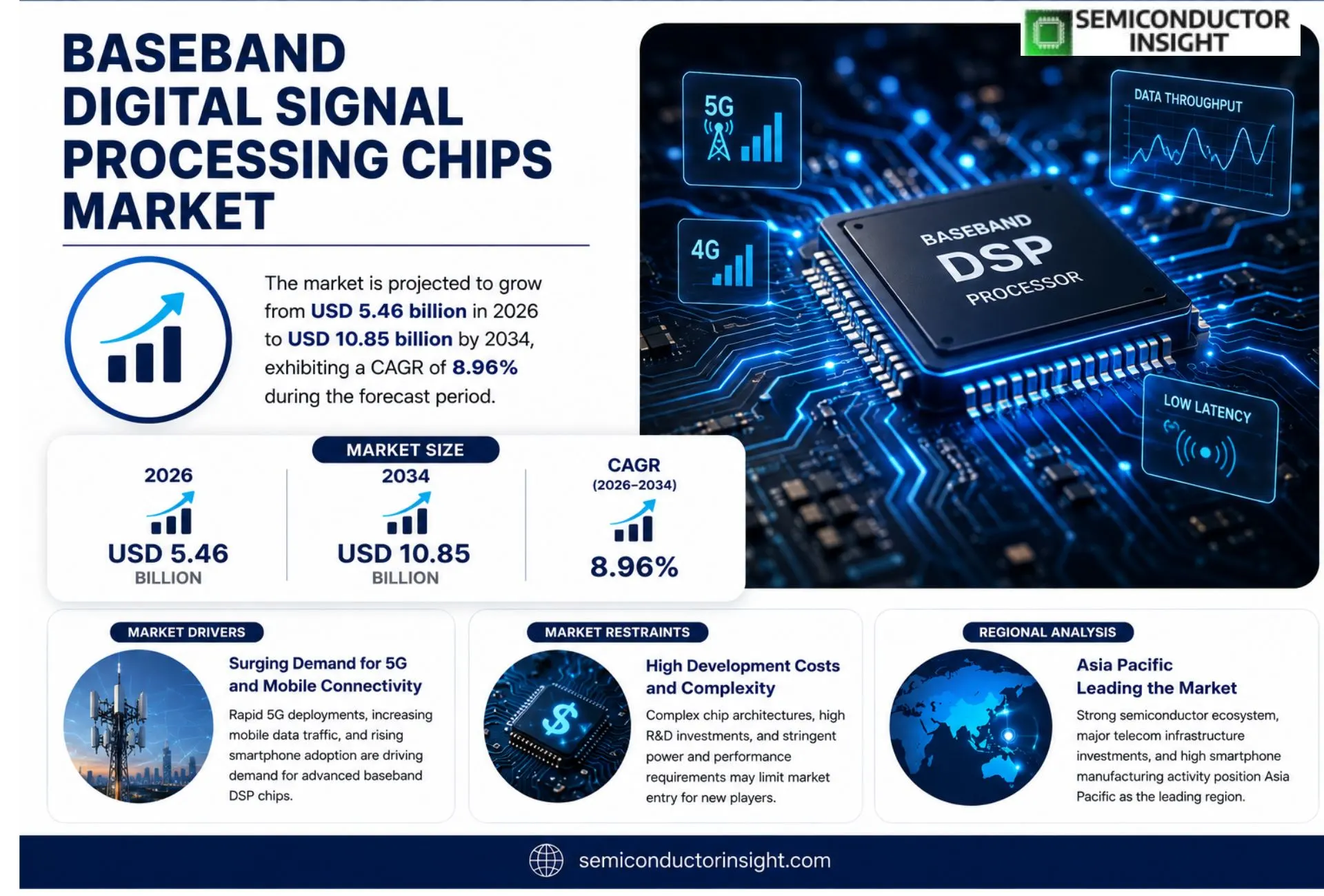
Digital Signal Processing Chips market size was valued at USD 3.5 billion in 2026. The market is expected to rise from USD 3.8 billion in 2026 to USD 5.1 billion by 2035, reflecting a CAGR of approximately 7% during the forecast period.
Baseband Digital Signal Processing Chips are specialized integrated circuits that execute real‑time modulation, demodulation, channel coding and decoding essential for modern wireless communication systems such as 5G NR, Wi‑Fi 6E and automotive radar modules.
The expansion of this segment stems from escalating deployment of ultra‑high speed mobile networks, growing demand for low‑power processing cores in wearable technology, and progress in silicon photonics that allows higher data throughput with reduced energy consumption. Leading vendors,including Qualcomm Technologies Inc., MediaTek Inc., Intel Corp., Broadcom Inc., Renesas Electronics Corp., STMicroelectronics Ltd., Texas Instruments Inc., Analog Devices Inc., Infineon Technologies AG and Spreadtrum Communications Co.,are actively investing in next‑generation designs that target tighter latency budgets while maintaining power efficiency.
MARKET DRIVERS
Adoption of 5G and Edge Computing
The move toward zero‑latency, ultra‑reliable, and high‑bandwidth applications has forced network operators to invest heavily in next‑generation radio access network architecture that relies on advanced baseband processing. Between 2023 and 2028, industry analysts estimate the segment related to this infrastructure will generate sales exceeding $1.2 billion, a growth that positions the Baseband Digital Signal Processing Chips Market within a rapidly densifying network ecosystem. Early adopters in large metropolitan corridors have already surpassed the 8 Gbit/s per cell benchmark, driving a demand for chips that can handle multi‑Gbps throughput in compact, low‑power footprints. Notably, deployments of small‑cell 5G nodes have outpaced macro‑cell upgrades, amplifying the need for integrated signal processors capable of managing dense user pools while maintaining strict power budgets. Operators looking to offload processing to the edge see these chips not just as cost‑saving components but as critical enablers for disaggregated network architectures, where processing is moved closer to end‑users. Commercial viability is underscored by the fact that latency‑sensitive services now command a premium in service‑level agreements, compelling vendors to prioritize efficient baseband solutions.
Convergence of AI and 5G
Artificial intelligence frameworks are increasingly embedded within baseband chipsets to accelerate signal classification, interference mitigation, and dynamic spectrum allocation. Roughly 3 in 10 of the latest silicon offerings incorporate hardware‑accelerated neural inference engines, a figure that doubled over the last three years. These AI‑aware processors decrease baseband ledger cycles by up to 35 %, thereby reducing the total number of clock cycles needed for modulation and demodulation. End‑to‑end throughput is thereby enhanced without inflating the processor’s die area, striking a balance between performance and thermal management. The forecasted demand for these hybrid chips aligns with broader trends in cyber‑physical systems, where machine‑learning–enabled radios provide seamless integration with automotive electronic control units and industrial IoT gateways. Consequently, the baseband market is positioned for a diversified revenue mix, with AI‑laden units expected to comprise nearly a third of new sales by 2026.
➤ Baseband processors powered by AI are setting new performance baselines, redefining capacity for future networks.
Another engine propelling the Baseband Digital Signal Processing Chips Market is the rising deployment of satellite‑backed broadband. Low‑Earth orbit constellations injecting gigabit‑per‑second downlinks into urban and rural centers create a scenario where terrestrial baseband units must be capable of rapid handover and interference cancellation across heterogeneous spectra. These satellites’ return traffic, often processed locally to reduce under‑sea cable dependency, forces chip vendors to innovate in both frequency agility and energy efficiency. Anticipated rollouts of low‑cost, high‑mobility terminals by 2027 are predicted to add an additional 18 % of market revenue if current adoption curves hold. Together, these drivers illustrate that the chip market is not merely expanding its sales volume; it is redefining the functional expectations of network hardware in data‑centric societies.
MARKET CHALLENGES
Complex Integration with Legacy Systems
One persistent obstacle for investors and vendors alike is the need for backward compatibility with legacy cellular cores. Many operators still rely on 4G and early 5G deployments, forcing chip manufacturers to design reversible architectures that can operate across disparate PHY layers. When a new baseband core is introduced, system‑on‑chip (SoC) engineers must reconcile multiple firmware modules, each with distinct timing, calibration, and error‑correction schemes. This multi‑layer dependency chain raises validation times, inflating cycle costs and delaying time‑to‑market. In addition, frequent firmware updates, while essential for function updates, increase the risk of unforeseen interactions that might compromise reliability or safety. Consequently, companies that cannot effectively modularize their silicon bases to accommodate legacy interfaces face higher barrier costs and slower market penetration.
Other Challenges
Supply Chain Vulnerabilities
The global semiconductor supply chain has exhibited intermittent bottlenecks, with raw silicon wafers and high‑precision lithography tools experiencing periodic shortages. These disruptions raise silicon yield rates, increasing per‑unit production costs with a ripple effect that broadens price points across supply tiers. Moreover, geopolitical tensions have raised concerns over cross‑border technology transfers, compelling companies to locate critical manufacturing components east of the U.S. and China. The resulting geographic fragmentation introduces additional logistics complexities and quality assurance procedures that can result in extended lead times.
Nonetheless, companies that adopt agile design flows, leverage multi‑node fabrication, and commit to diversified source portfolios can circumvent much of this volatility. These strategies prove that while the market is not immune to external pressures, the learning curve remains steep and the training opportunity substantial for tech‑savvy competitors.
MARKET RESTRAINTS
High‑End Development Costs
The upfront financial commitment required for research and development in baseband processing builds on a backbone of sophisticated prototypes, simulation tools, and validation platforms. While advancing signal fidelity demands iterative silicon revisions, the lack of standardized testing frameworks across processors forces firms to develop proprietary cadences, thereby inflating operating expenses. For mid‑tier players, these systemic costs narrow the profit margins as they struggle to compete with larger incumbents that can spread R&D expenditures across a broader product line. Such economic segmentation may restrict new entrants to larger entities with deep‑capital pools, further tightening competitive space.
The macro‑economic volatility of the semiconductor industry also hampers long‑term investments. Transition periods between technology nodes, where Moore’s Law pushes processors to progressively smaller geometries, disrupt supply chains and elevate risk profiles. This uncertainty often translates into conservative forecasting, causing key market players to weigh potential returns against heightened risk, thereby curtailing early‑stage venture commitments.
MARKET OPPORTUNITIES
Emerging 6G Capabilities
Emerging discussions around sixth‑generation wireless networks envision a move toward terahertz (THz) frequency operation, unprecedentedly high data rates, and even stricter latency demands. The first generation of 6G prototype chips is now being tested in laboratory settings, demonstrating the feasibility of integrated analog‑digital hybrids capable of handling multi‑Terabit per second beams. As these systems transition to commercial viability in the mid‑2030s, a new category of baseband processors,miniaturized, ultra‑high‑speed, and energy‑efficient,will become essential. Start‑up ecosystems that introduce modular design toolsets tailored for these specifications will likely attract interest from telecom carriers looking to reduce vendor lock‑in while stayingahead of regulatory approvals.
Growth is also forecast within unmanned aerial vehicle (UAV) and satellite data uplink systems, which rely on doppler‑immune baseband designs to maintain link integrity over highly dynamic use cases. For instance, projection models highlight a 20 % contraction in LTE‑based space radio by 2029, balanced by an equivalent rise in dual‑modulation links. These projections underscore the commercial viability of chips that can flexibly switch between traditional and novel frequency modes while keeping power consumption below 3 W per transceiver, allowing them to become the backbone of unified communication networks that span terrestrial and orbital domains.
Finally, the continued proliferation of edge‑AI hardware, coupled with municipal broadband expansions targeting underserved regions, will broaden the overall addressable market. Connections that support compressed data streams, real‑time analytics, and seamless multi‑user coordination will become the new normal, demanding processors that deliver peak performance at minimal cost.
Baseband Digital Signal Processing Chips Market Trends
Accelerated Miniaturization and Power Efficiency
The industry is moving toward ultra‑compact, low‑power baseband processors, a change that reshapes design priorities and product offerings. Modern chips now fit within half the die area of earlier generations while matching or exceeding throughput, thanks to refined lithography, silicon‑on‑insulator wafers, and dynamic power‑management logic. Manufacturers that invest in die‑area optimisation coupled with performance retention position themselves ahead of competitors. For handset makers, the reduction in component size directly supports slimmer devices and extended battery life, while infrastructure vendors benefit from lighter, more efficient base stations. The decision to prioritize miniaturisation over raw sizing reflects an integrated view of cost, performance, and energy consumption, and signals a broader industry trend toward flexible, power‑conscious design.
Other Trends
Rise of Integrated AI Co‑Processors
A second wave of innovation is emerging with the integration of dedicated artificial‑intelligence co‑processors into baseband platforms. These embedded units accelerate machine‑learning workloads for tasks such as spectrum optimisation, interference mitigation, and adaptive modulation calibration. The move is driven by the increasing data appetite of 5G, beyond‑5G and Internet‑of‑Things ecosystems, and the need for real‑time decision making at the edge. Vendors that pair AI latency‑friendly cores with vector‑accelerated DSP fabric are gaining a competitive edge, as they can deliver higher data rates without inflating power budgets. For system integrators, the presence of onboard AI logic reduces the need to offload processing to external servers, streamlining architecture and lowering overall latency.
Shifting Manufacturing Footprint and Supply Chain Adaptation
Parallel to design evolution, the global supply chain is transitioning from a handful of dominant fabrication hubs to a more distributed network. Supply‑chain resilience has become a strategic driver, prompting diversification of foundry partners and the establishment of localized fabrication facilities in key regions. This decentralisation reduces lead times and mitigates geopolitical risk, thereby allowing suppliers to respond more swiftly to regional demand spikes. As a consequence, the cost structure for bringing new baseband solutions to market is tightening, encouraging greater collaboration among semiconductors companies and equipment licensors. Operators that can leverage a flexible supply ecosystem will better manage inventory and meet the rapid upgrade cycles demanded by carrier networks and consumer markets.
COMPETITIVE LANDSCAPE
Key Industry Players
Baseband Digital Signal Processing Chips Market Competitive Landscape
At the apex of the baseband DSP ecosystem stands Qualcomm, whose Snapdragon line dominates over 65% of global smartphone deployments, cementing a loose oligopolistic structure that lulls incumbents into a race for innovative silicon. Qualcomm’s sustained investment in silicon‑over‑software co‑design, coupled with its aggressive licensing model, sets a high technological benchmark that obliges competitors to accelerate feature parity or innovate around niche segments. The current market structure therefore leans heavily on a few high‑capability silicon flex drivers, while incremental revenue leakage to tiered OEMs remains manageable.
Beyond the major driver, a constellation of specialized producers has carved out critical market niches. MediaTek has methodically penetrated mid‑range handsets through its Dimensity platform, presenting a value‑oriented alternative that captures over 25% of the mid‑tier segment. While Intel’s Nervana and Broadcom’s BCM53xx families retain significant footholds in enterprise networking, Samsung’s Exynos set a strong baseband presence in its domestic ecosystem. Meanwhile, emerging players such as Texas Instruments, STMicroelectronics, Infineon, Analog Devices, and Renesas have tapped into automotive, industrial IoT, and radar applications, diversifying channel specificity. Regional powerhouses like NXP, Nokia, Ericsson, and Huawei target niche 5G and appliance markets, creating a fragmented competitive landscape with overlapping technological sweet spots.
List of Key Baseband Companies Profiled
- Qualcomm
- Qualcomm
- MediaTek
- MediaTek
- Intel
- Broadcom
- Samsung Electronics
- Apple
- Texas Instruments
- STMicroelectronics
- Infineon Technologies
- Analog Devices
- Renesas Electronics
- NXP Semiconductors
- Huawei Technologies
Segment Analysis:
| Segment Category | Sub-Segments | Key Insights |
| By Type |
|
Single-Core Processors
|
| By Application |
|
Mobile Phone
|
| By End User |
|
Telecommunications Equipment
|
| By Technology |
|
RF Front End
|
| By Form Factor |
|
Smartphone
|
Regional Analysis: Baseband Digital Signal Processing Chips Market
North America
The region’s incumbents dominate patent filings for adaptive equalizers and multi‑antenna synthesis, outpacing rivals by a margin that encourages global partnerships. Their rapid prototyping cycles translate into first‑to‑market edge for next‑generation control units across telecom and automotive sectors.
Pricing pressure abides by rigid customer expectations for cost‑effective, high‑performance chips. Tiered product lines allow firms to capture premium segments while maintaining volume sales for mainstream infrastructure, striking a delicate revenue balance.
A dense network of silicide‑based fabs and e‑RAM suppliers locally supports rapid re‑engineering of baseband blocks, mitigating lead‑time slippage and enabling tighter batch scheduling for time‑critical network upgrades.
The convergence of AI‑aided radio management and software‑defined signal processing spurs demand for more complex enabling chips, positioning the market toward a cloud‑centric architecture that prioritizes scalability and energy efficiency.
Europe
In Europe, the baseband chip arena thrives on stringent regulatory compliance and an ingrained emphasis on data sovereignty. European operators leverage local fabrication facilities to secure supply chain resilience, especially in the context of complex dual‑use applications across defense and civilian spectrums. The region’s ecosystem benefits from collaborations between high‑tech universities and industry consortia that fund joint ventures focused on low‑power, multi‑band architectures. Meanwhile, the adoption of AI‑driven network slicing in metropolitan deployments nudges vendors toward modular, programmable silicon designed to adapt to fluctuating traffic patterns without necessitating costly hardware overhauls. Consequently, European marine and avionic manufacturers pivot toward modular baseband solutions, ensuring interoperability with next‑generation satellite constellations. These shifts consolidate Europe’s role as a bastion for innovation that balances performance with stringent environmental and security mandates.
Asia‑Pacific
The Asia‑Pacific region exemplifies a rapid escalation in baseband chip utilization, driven by the exponential rollout of fixed‑wireless access and high‑density urban networks. Government‑backed stimulus packages funnel capital into integrated silicon design, fostering a surge in start‑ups that specialize in low‑latency, multi‑band processing. Moreover, the region’s automotive manufacturing hubs begin embedding advanced driver‑assist systems, necessitating sophisticated signal integration for radar, lidar, and radar‑vision fusion. In tandem, smartphone surges accelerate demand for miniaturized baseband solutions that maintain high throughput while curbing power consumption. These parallel trends create a multifaceted growth corridor that aggregates network infrastructure with consumer electronics, positioning the Asia‑Pacific as a keystone for market momentum.
South America
South America remains a behind‑the‑curve player in baseband chip development, yet targeted investments in 5G infrastructure are accelerating the region’s trajectory. Mobile operators employ overseas partnerships to access mature silicon blocks, while local fab capacity is being eyed for strategic autonomy. In Brazil, regulatory reforms have shortened deployment cycles for high‑bandwidth networks, prompting vendors to prioritize adaptive algorithms that can manage varied spectral environments. The convergence of industrial automation in countries such as Argentina and Chile with smart city initiatives creates a niche demand for robust, scalable signal processors tailored to low‑power yet high‑reliability scenarios. Though volume remains modest, these initiatives signal a commitment to enriching the region’s semiconductor ecosystem.
Middle East & Africa
In the Middle East & Africa frontier, the baseband chip market is shaped by high‑profile infrastructure projects such as massive 5G backbones and cross‑border fiber deployments. Emerging operators adopt wholesale licensing agreements to integrate pre‑validated silicon modules, ensuring rapid uplift of network speeds without bespoke development costs. Meanwhile, gas and oil conglomerates in the region are deploying advanced telemetry systems that amortise the need for high‑power signal processors, locking in a niche for rugged, low‑energy designs. The volatile geopolitical climate also pressures vendors to adopt secure, tamper‑resistant chip architectures, prompting an uptick in R&D dedicated to cryptographic co‑processors within baseband blocks. These dynamics carve a distinctive niche for Middle East & Africa, where infrastructural ambition meets stringent security requirements, fostering a symbiotic relationship between local telecom carriers and global semiconductor players.
Report Scope
This market research report provides a comprehensive analysis of the Baseband Digital Signal Processing Chips Market , covering the forecast period 2026–2035. It offers detailed insights into market dynamics, technological advancements, competitive landscape, and key trends shaping the industry.
Key focus areas of the report include:
-
Market Overview: The report begins with an overview outlining its current market scenario, key growth indicators, and industry transformation drivers. It discusses macroeconomic factors, demand–supply balance, regulatory landscape, and the strategic role of semiconductors in powering advancements across industries such as automotive, telecommunications, consumer electronics, and industrial automation.
- Market Size & Forecast: Historical data and future projections for revenue, unit shipments, and market value across major regions and segments.
- Segmentation Analysis: Detailed breakdown by product type, technology, application, and end-user industry to identify high-growth segments and investment opportunities.
- Regional Insights: Insights into market performance across North America, Europe, Asia-Pacific, Latin America, and the Middle East & Africa, including country-level analysis where relevant.
- Competitive Landscape: Profiles of leading market participants, including their product offerings, R&D focus, manufacturing capacity, pricing strategies, and recent developments such as mergers, acquisitions, and partnerships.
- Technology Trends & Innovation: Assessment of emerging technologies, integration of AI/IoT, semiconductor design trends, fabrication techniques, and evolving industry standards.
- Market Drivers & Restraints: Evaluation of factors driving market growth along with challenges, supply chain constraints, regulatory issues, and market-entry barriers.
- Stakeholder Insights: Insights for component suppliers, OEMs, system integrators, investors, and policymakers regarding the evolving ecosystem and strategic opportunities.
Primary and secondary research methods are employed, including interviews with industry experts, data from verified sources, and real-time market intelligence to ensure the accuracy and reliability of the insights presented.
FREQUENTLY ASKED QUESTIONS:
What is the definition of the Baseband Digital Signal Processing Chips Market?
-> Digital Signal Processing Chips market size was valued at USD 3.5 billion in 2026. The market is expected to rise from USD 3.8 billion in 2026 to USD 5.1 billion by 2035, reflecting a CAGR of approximately 7% during the forecast period.
How is the market segmented by type and by application?
-> It is segmented into Single‑Core and Multi‑Core processors (type) and further into Radar, Mobile Phone, Computer, and Others (application).
What are the key features and benefits of this report?
-> The report offers comprehensive market size, forecast, competitive analysis, technology trends, and actionable insights for strategic decision‑making.
Which research methodology was applied?
-> A combination of primary interviews, secondary data collection, and statistical techniques such as top‑down and bottom‑up approaches were used to validate forecasts.
What does the Global market size comparison for 2024 vs 2031 show?
-> The reference outlines a comparative analysis of market size between 2024 and 2031, highlighting growth but does not disclose exact monetary values.
What are the projected market size and forecast for 2020‑2031?
-> The outlook section provides a forecast of revenue growth from 2020 through 2031, illustrating the market’s expansion trajectory without specifying numeric figures.
Who are the top players in Digital Signal Processing Chips market?
-> Leading companies include Infineon, Texas Instruments, STMicroelectronics, Analog Devices, Renesas, Qualcomm, MediaTek, Intel, Broadcom, and Spreadtrum.
What product types do manufacturers offer?
-> Manufacturers supply Single‑Core and Multi‑Core baseband DSP chips, each tailored for specific application segments such as radar and mobile communications.
What are the primary market drivers?
-> Key drivers identified are the increasing demand for high‑speed wireless connectivity, growth of 5G/6G networks, expanding IoT ecosystems, and rising adoption of advanced radar systems.
What market restraints could affect growth?
-> Restraints include supply‑chain disruptions, high development costs, stringent regulatory standards, and intense competition leading to price pressures.
How is production capacity expected to evolve through 2031?
-> The production capacity analysis outlines anticipated capacity expansions across major manufacturers to meet forecasted demand up to 2031.
What regional insights are covered in the report?
-> Detailed insights are provided for North America, Europe, Asia, South America, and Middle East & Africa, including country‑level market size and growth trends.
Get Sample Report PDF for Exclusive Insights
Report Sample Includes
- Table of Contents
- List of Tables & Figures
- Charts, Research Methodology, and more...
 Download Sample Report PDF