Band-Rejection Filter Market Insights
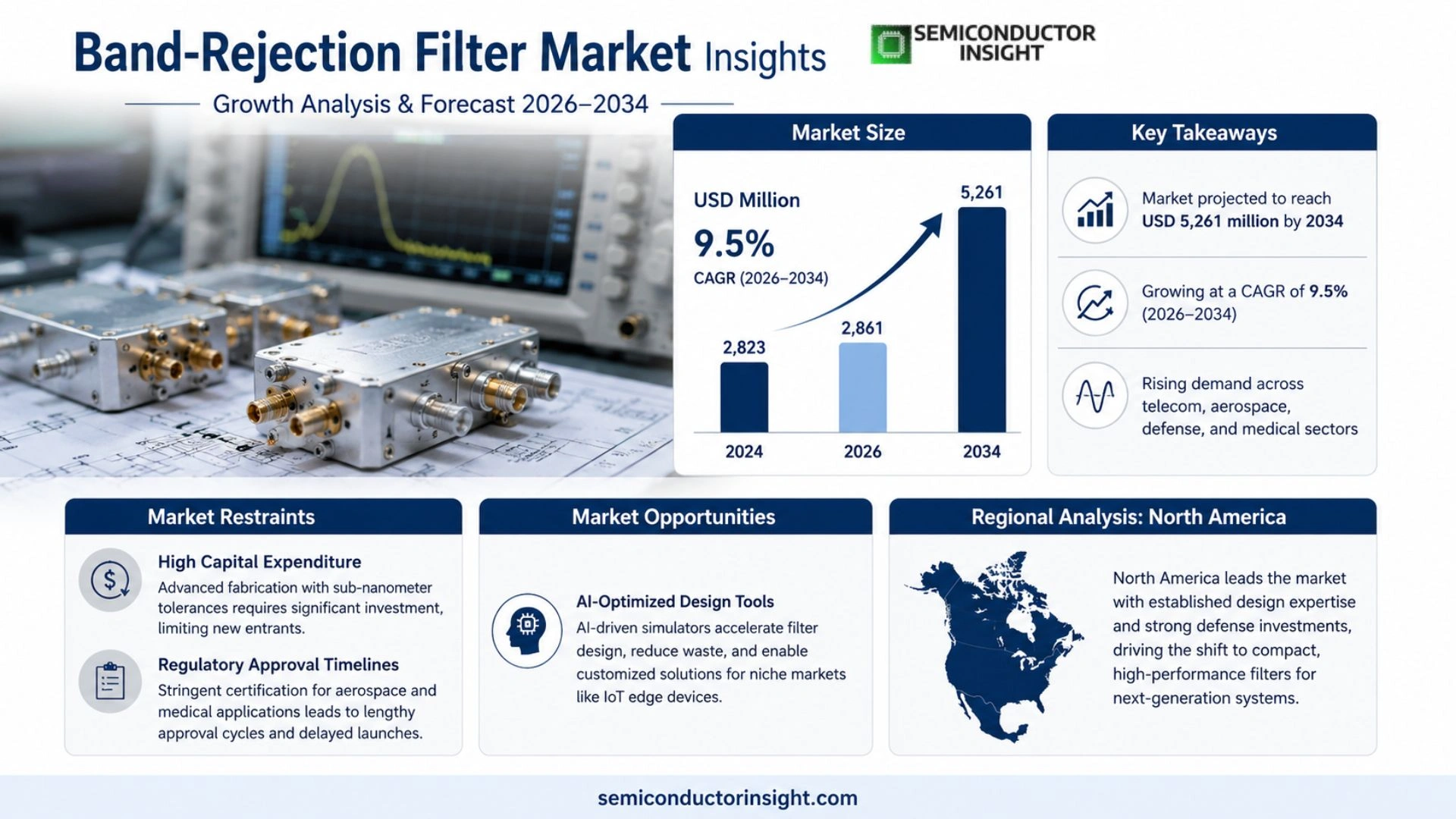
Global Band-Rejection Filter market size was valued at USD 2,823 million in 2024. The market is projected to grow from USD 2,861 million in 2026 to USD 5,261 million by 2034, exhibiting a CAGR of 9.5% during the forecast period.
Band‑rejection filter allows a specific range of frequencies to be blocked while lower and higher frequencies pass with minimal attenuation. A band‑stop filter removes or blocks certain frequencies in an input signal without affecting others, making it essential for applications such as military radar, communications, navigation and object‑recognition systems.
The market is gaining momentum because demand for high‑performance filters in smartphones, aerospace and defense continues to rise. Notch‑type filters dominate the segment as they meet stringent requirements for communication and radar applications. Leading manufacturers such as Murata, Qorvo, Skyworks and TDK‑EPC are expanding product portfolios and investing in tunable technologies to address emerging needs.
MARKET DRIVERS
Escalating Bandwidth Requirements in 5G Deployments
Band-Rejection Filter Market is gaining momentum as network operators expand 5G infrastructure. Higher frequency allocations increase the likelihood of interference between adjacent channels, compelling equipment manufacturers to embed more selective filtering solutions. This technical necessity translates into a measurable uplift in component orders across the telecom supply chain.
Growth of Optical Communication Systems
Optical transceivers are adopting dense wavelength division multiplexing (DWDM) to squeeze additional traffic onto existing fiber. Each wavelength pair must be isolated to prevent crosstalk, a task for which band‑rejection filters are uniquely suited. The shift toward higher‑density DWDM modules is therefore a direct catalyst for demand in the filter segment.
➤ Manufacturers that integrate tunable band‑rejection filters are able to offer customers a flexible product line that shortens time‑to‑market for new services.
Beyond telecommunications, automotive radar and satellite payloads are adopting wider spectral windows to meet safety and connectivity goals. In each case, the need to suppress out‑of‑band noise without sacrificing pass‑band performance fuels orders for advanced filter architectures.
MARKET CHALLENGES
Stringent Performance Specifications
Designers of high‑frequency front‑ends impose tight constraints on insertion loss, rejection depth, and temperature stability. Achieving these targets often requires expensive substrate materials and precision fabrication steps, which can inflate bill‑of‑materials costs for end‑users.
Other Challenges
Supply‑Chain Vulnerabilities
The reliance on specialty ceramics and rare‑earth dopants makes the filter supply chain sensitive to geopolitical disruptions. A shortfall in raw material availability can delay production schedules and erode margins for OEMs.
MARKET RESTRAINTS
High Capital Expenditure for Advanced Fabrication
Fabrication facilities capable of delivering sub‑nanometer tolerances command significant capital outlays. Smaller players often lack the financial bandwidth to invest in such equipment, limiting market entry to a handful of well‑funded firms.
Regulatory Approval Timelines
For aerospace and medical applications, filters must undergo rigorous certification processes. The lengthy approval cycles can postpone commercial launch, constraining short‑term revenue growth despite robust technological demand.
MARKET OPPORTUNITIES
Integration of AI‑Optimized Design Tools
Artificial‑intelligence driven electromagnetic simulators enable rapid iteration of filter topologies, reducing development time and material waste. Companies that adopt these tools are positioned to deliver customized solutions at scale, opening new revenue streams in niche markets such as IoT edge devices.
Expansion into Flexible Electronics
Emerging flexible substrates for wearable sensors require filters that maintain performance under bending stresses. Early entrants that engineer mechanically resilient band‑rejection filters can capture a growing share of the wearable‑tech ecosystem.
Band-Rejection Filter Market Trends
Rising Adoption of Notch Filters in Defense and Consumer Electronics
Operators in the defense sector are increasingly integrating band-rejection solutions to shield radar and communication links from hostile jamming. The same technology is migrating into premium smartphones, where manufacturers need to suppress narrow‑band interference without compromising overall signal integrity. This convergence is reshaping supplier strategies: firms that once catered exclusively to aerospace are now expanding design libraries to address the stringent size and power constraints of handheld devices. The practical impact is two‑fold,engineers gain a more flexible toolkit for frequency isolation, while end‑users experience fewer dropped calls and clearer audio in densely populated spectra.
Other Trends
Shift Toward Tunable Architectures
Historically, fixed‑frequency band‑stop configurations dominated the landscape, but recent advances in MEMS and varactor technologies are enabling on‑the‑fly tuning. Customers value this agility because it reduces inventory complexity; a single tunable module can replace multiple fixed variants across product lines. For OEMs, the benefit translates into shorter development cycles and lower tooling costs. Moreover, the ability to adjust rejection bands in real time supports emerging adaptive‑radar concepts, where the system must respond instantly to evolving threat signatures. The net effect is a modest but steady reallocation of R&D dollars toward programmable filter platforms.
Regional Production Hubs Accelerate Innovation
Asia‑Pacific manufacturers are leveraging cost‑competitive fabrication ecosystems to prototype novel filter topologies faster than their North American counterparts. This speed advantage is prompting several European players to establish joint ventures in the region, aiming to capture early‑stage intellectual property. The ripple effect is a more heterogeneous supply chain, where design expertise and manufacturing capacity are no longer confined to a single geography. Companies that can synchronize cross‑border collaboration stand to gain a decisive edge in securing contracts for next‑generation communication satellites and unmanned aerial systems.
COMPETITIVE LANDSCAPE
Key Industry Players
Band‑Rejection Filter Market Competitive Overview
The market is dominated by a handful of large silicon‑based and microwave specialists whose product portfolios span both tunable and non‑tunable band‑stop solutions. Murata stands out for its aggressive rollout of compact, high‑Q notch filters that cater to the expanding smartphone antenna space, while TDK‑EPC leverages its extensive RF‑module expertise to secure multi‑year contracts with aerospace OEMs. Qorvo’s acquisition of RF‑Lambda assets last year consolidated its position in the defense segment, allowing it to offer integrated filter‑amplifier assemblies that meet stringent MIL‑SPEC requirements. These leaders benefit from deep R&D pipelines and global supply‑chain footprints that enable rapid scaling across North America, Europe, and Asia‑Pacific.
Beyond the tier‑one firms, a cadre of niche innovators adds depth to the competitive fabric. Companies such as Anatech Electronics and KR Electronics Inc. focus on customized, low‑volume notch filters for specialized medical imaging equipment, while Skyworks has carved a margin in the automotive radar niche by embedding band‑rejection cells into its broader connectivity suites. Smaller players like MCV Microwave and UIY Technology differentiate themselves through flexible, tunable designs that address the emerging demand for software‑defined radio platforms. The overall structure resembles a tiered ecosystem in which large manufacturers command volume and brand equity, while agile specialists capture high‑margin, application‑specific opportunities.
List of Key Band‑Rejection Filter Companies Profiled
- Anatech Electronics
- Murata
- KR Electronics Inc
- TDK‑EPC
- MCV Microwave
- Qorvo
- RF‑Lambda
- Skyworks
- Wisol
- NDK
- Kyocera
- Teledyne Microwave Solutions
- UIY Technology
- Westell Technologies
Segment Analysis:
| Segment Category | Sub-Segments | Key Insights |
| By Type |
|
Notch Filters (Tunable)
|
| By Application |
|
High‑Performance Telecom
|
| By End User |
|
Mission‑Critical Military Systems
|
| By Frequency Range |
|
Mid‑Frequency Segment
|
| By Technology Trend |
|
Integrated RF Modules
|
Regional Analysis: Band-Rejection Filter Market
Companies prioritize low‑loss dielectric materials and advanced lithography to meet tighter stop‑band specifications, a shift that shortens time‑to‑market for high‑frequency platforms.
A resilient domestic supply chain, bolstered by multiple silicon‑on‑insulator (SOI) foundries, mitigates exposure to geopolitical disruptions and supports steady component availability.
Ongoing FCC rule revisions encourage tighter emission controls, prompting manufacturers to embed superior rejection characteristics within compact form factors.
Defense procurement dominates, yet aerospace OEMs and commercial telecom operators increasingly demand customized solutions for multi‑band antenna arrays.
Europe
European firms leverage strong academic‑industry linkages to experiment with metamaterial‑based rejection filters, positioning the continent as a niche innovator. Procurement policies within NATO‑aligned programs emphasize lifecycle cost efficiency, pushing suppliers toward modular designs that can be upgraded without full system replacement. Regulatory harmonization across the EU encourages cross‑border collaboration, allowing smaller players to pool R&D resources and compete with larger North American entities.
Asia‑Pacific
Rapid growth in mobile broadband and satellite constellations fuels demand for compact, high‑performance filters across the Asia‑Pacific. Nations such as South Korea and Japan invest heavily in photonic integration, seeking to embed rejection capabilities directly into optical transceivers. Meanwhile, emerging economies prioritize cost‑effective, mass‑produced filter stacks to support expanding defense communication networks, creating a dual‑track market that balances cutting‑edge performance with affordability.
South America
In South America, the focus lies on adapting existing filter architectures to harsh environmental conditions prevalent in remote mining and oil‑field installations. Local OEMs favor ruggedized packages that tolerate temperature swings and vibration, driving collaborations with North American firms that supply proven core technologies. Government‑led initiatives to modernize air‑traffic control infrastructure also create modest but steady demand for specialized band‑rejection solutions.
Middle East & Africa
The Middle East & Africa region experiences a split between high‑end defense contracts and nascent commercial deployments. Wealth‑funded defense ministries procure sophisticated filters for stealth communication systems, while telecom operators in urban hubs experiment with filter‑integrated base stations to alleviate spectrum congestion. Limited local manufacturing capacity encourages reliance on imported expertise, fostering strategic alliances that bring advanced filter designs to the region.
Report Scope
This market research report provides a comprehensive analysis of the Band-Rejection Filter Market , covering the forecast period 2026–2034. It offers detailed insights into market dynamics, technological advancements, competitive landscape, and key trends shaping the industry.
Key focus areas of the report include:
- Market Overview: The report begins with an overview outlining its current market scenario, key growth indicators, and industry transformation drivers. It discusses macroeconomic factors, demand–supply balance, regulatory landscape, and the strategic role of semiconductors in powering advancements across industries such as automotive, telecommunications, consumer electronics, and industrial automation.
- Market Size & Forecast: Historical data and future projections for revenue, unit shipments, and market value across major regions and segments.
- Segmentation Analysis: Detailed breakdown by product type, technology, application, and end-user industry to identify high-growth segments and investment opportunities.
- Regional Insights: Insights into market performance across North America, Europe, Asia-Pacific, Latin America, and the Middle East & Africa, including country-level analysis where relevant.
- Competitive Landscape: Profiles of leading market participants, including their product offerings, R&D focus, manufacturing capacity, pricing strategies, and recent developments such as mergers, acquisitions, and partnerships.
- Technology Trends & Innovation: Assessment of emerging technologies, integration of AI/IoT, semiconductor design trends, fabrication techniques, and evolving industry standards.
- Market Drivers & Restraints: Evaluation of factors driving market growth along with challenges, supply chain constraints, regulatory issues, and market-entry barriers.
- Stakeholder Insights: Insights for component suppliers, OEMs, system integrators, investors, and policymakers regarding the evolving ecosystem and strategic opportunities.
Primary and secondary research methods are employed, including interviews with industry experts, data from verified sources, and real-time market intelligence to ensure the accuracy and reliability of the insights presented.
FREQUENTLY ASKED QUESTIONS:
What is the current market size of Band-Rejection Filter Market?
-> Band-Rejection Filter market is projected to grow from USD 2,861 million in 2026 to USD 5,261 million by 2034, exhibiting a CAGR of 9.5%
Which key companies operate in Band-Rejection Filter Market?
-> Key players include Murata, Qorvo, Skyworks, TDK-EPC, Anatech Electronics, ECHO Microwave, KR Electronics Inc, MCV Microwave, Micro Lambda Wireless, Networks International Corporation, Planar Monolithics Industries, RF-Lambda, Wisol, NDK, Kyocera, Teledyne Microwave Solutions, UIY Technology, Wainwright Instruments, Westell Technologies.
What are the key growth drivers?
-> Key growth drivers include rising demand for smartphones and portable communication devices, increasing adoption of high‑performance filters in military and commercial applications, and growing need for notch filters in communication and radar systems.
Which region dominates the market?
-> Asia-Pacific holds the largest market share, driven by strong electronics manufacturing and telecom infrastructure growth, while North America remains a key region for advanced military and aerospace applications.
What are the emerging trends?
-> Emerging trends include the shift toward tunable band‑rejection filters, integration of notch filter technology in radar and 5G communications, and the development of compact, low‑loss filter architectures for space‑constrained devices.
Get Sample Report PDF for Exclusive Insights
Report Sample Includes
- Table of Contents
- List of Tables & Figures
- Charts, Research Methodology, and more...
 Download Sample Report PDF