Automotive Ultracapactor Market Insights
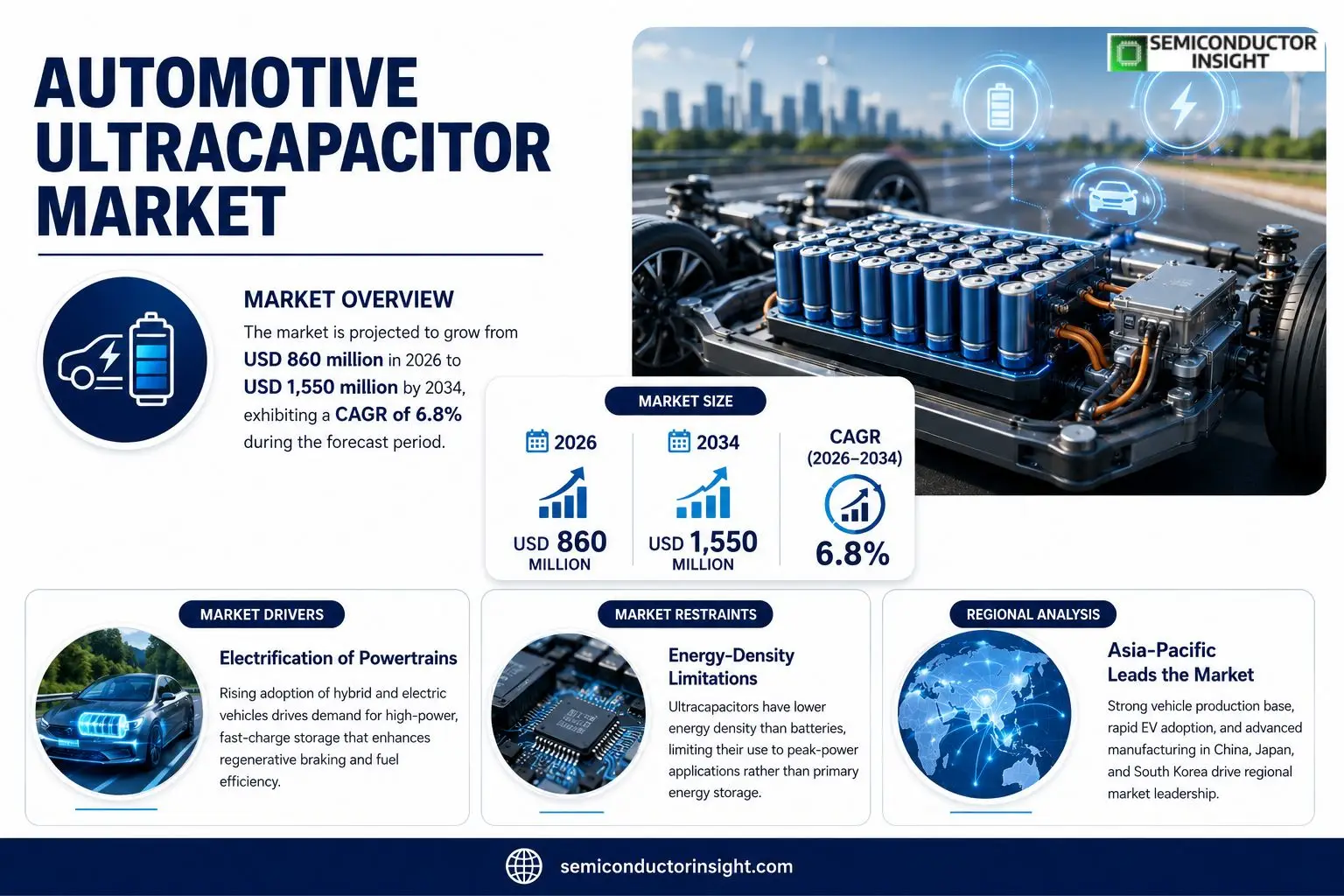
Automotive Ultracapactor Market size was valued at USD 857 million in 2025. The market will reach USD 1550 million by 2034, showing a CAGR of 6.8% during the forecast period.
Automotive ultracapactors are high‑power electronic components that store electric energy directly within vehicle power‑train systems. Often called supercapacitors, they deliver rapid charge‑discharge cycles, high power density and long operational life compared with conventional batteries, making them ideal for regenerative‑braking capture and engine‑stop‑start functions.The sector gains momentum because electric‑vehicle penetration accelerates worldwide and manufacturers seek ways to improve fuel efficiency while lowering emissions. Recent collaborationssuch as Maxwell Technologies partnering with major OEMs on next‑generation hybrid modulesillustrate how industry players are expanding product portfolios. Key companies active in this space include Maxwell Technologies, Nesscap Ultracapactors, Skeleton Technologies, ELNA America Inc., Ioxus Inc., LS Mtron, Panasonic and Tesla.
MARKET DRIVERS
Electrification of Powertrains
The shift toward hybrid and fully electric vehicles has heightened demand for rapid‑charge storage solutions. Automotive Ultracapacitor Market players benefit because ultracapacitors deliver high power density, enabling smoother torque delivery and regenerative‑braking efficiency that internal‑combustion engines cannot match.
Cost‑Effective Energy Management
Manufacturers are reassessing total‑ownership cost models; ultracapacitors, with longer cycle life and lower thermal management expenses, present a compelling alternative to batteries for certain load‑leveling functions. This economics‑driven rationale accelerates adoption in commercial fleets where downtime translates directly to revenue loss.
➤ “The ability to discharge 90 % of stored energy within seconds creates a distinct advantage for start‑stop systems, translating into measurable fuel‑economy gains.”
Policy incentives that target emissions reductions further reinforce this trajectory. As regulators tighten CO₂ limits, OEMs view ultracapacitors as a pragmatic tool to meet compliance without overhauling vehicle architecture.
MARKET CHALLENGES
Integration Complexity
Embedding ultracapacitor modules alongside existing battery packs demands sophisticated power‑electronics design. OEMs must resolve voltage‑matching, thermal‑runaway safeguards, and space‑allocation issues, which can extend development cycles and raise engineering costs.
Other Challenges
Supply‑Chain Vulnerabilities
The concentration of high‑purity carbon electrode production in a limited number of regions introduces risk. Any disruptionwhether geopolitical or naturalcan inflate component prices, eroding the cost advantage that ultracapacitors traditionally hold.
MARKET RESTRAINTS
Energy‑Density Limitations
While ultracapacitors excel at power delivery, their gravimetric energy density remains considerably lower than that of lithium‑ion cells. This physical constraint restricts their use to niche applications such as peak‑power assistance rather than primary traction.Consequently, vehicle designers often resort to hybrid configurations that blend batteries and ultracapacitors, adding system‑level complexity and potentially offsetting the anticipated simplicity gains.Consumer perception also plays a role; many buyers equate “more battery” with “longer range,” which can dampen enthusiasm for technologies perceived as supplemental.
MARKET OPPORTUNITIES
Heavy‑Duty and Commercial Vehicles
Long‑haul trucks and urban delivery vans experience frequent stop‑start cycles. Ultracapacitors can reclaim braking energy and supply rapid acceleration bursts, delivering fuel‑efficiency improvements that are especially valuable at scale. Companies that tailor modules to the weight‑bearing requirements of these fleets stand to capture a growing revenue stream.Emerging power‑train architectures, such as series‑hybrid configurations for buses, present another opening. By positioning ultracapacitors as the primary buffer between the engine and drivetrain, manufacturers can reduce reliance on large battery packs, lowering both capital expenditure and end‑of‑life recycling burdens.Finally, advancements in graphene‑based electrode materials promise to bridge the energy‑density gap. Early pilots indicate a potential 30 % uplift, which could unlock new market segments previously deemed unsuitable for ultracapacitor deployment.
Automotive Ultracapacitor Market Trends
Integration with Stop‑Start and Hybrid Powertrains
Automotive Ultracapacitor Market reflects a clear move toward embedding ultracapacitors into stop‑start and hybrid powertrains to capture kinetic energy that would otherwise be lost during braking. By delivering a burst of power within seconds, these devices support electric motor assistance at peak torque demand while reducing the load on lithium‑ion packs. The result is a measurable improvement in fuel consumption and a modest extension of battery cycle life. Recent model roll‑outs from leading Asian and European OEMs illustrate a preference for ultracapacitor modules that can be paired with existing battery management systems. This design choice aligns with stricter emissions legislation and rising consumer expectations for smoother acceleration, prompting suppliers to scale module production and refine thermal‑management packaging. Furthermore, the fast‑charging capability of ultracapacitors aligns with emerging urban mobility services that demand rapid vehicle turnaround.
Other Trends
Energy‑Density Advances in EDLC and Hybrid Capacitors
Within Automotive Ultracapacitor Market, energy‑density metrics for both electrostatic double‑layer and hybrid capacitor architectures have risen steadily as electrode materials evolve. Researchers report that nanostructured carbon foams now sustain gravimetric capacities approaching 150 Wh·kg‑¹, narrowing the performance gap with conventional batteries. Simultaneously, the incorporation of pseudocapacitive compounds in hybrid cells adds voltage swing without compromising cycle durability. These technical gains translate into smaller, lighter modules that fit within constrained vehicle chassis spaces, a factor that OEMs cite when negotiating component pricing. As manufacturers certify longer‑life parts, warranty costs diminish, encouraging broader adoption across midsize hybrid sedans and entry‑level electric SUVs. The cost trajectory has also softened, with per‑kilowatt prices falling by roughly 12 % year‑over‑year as production volumes climb.
Regional Production Shifts and Supply‑Chain Implications
For Automotive Ultracapacitor Market, production of cells concentrates in East Asia, where over half of output originates from facilities in China, Japan and South Korea. The concentration reflects both the availability of advanced carbon‑processing equipment and the proximity to major automotive assembly plants. Rising labor costs and trade‑policy fluctuations are prompting European tier‑one suppliers to explore joint‑venture plants in Eastern Europe, a move that could shorten logistics lead times for EU‑based car makers and diversify the risk profile of the supply chain. Analysts note that the evolving regulatory landscape in North America, which incentivizes reduced tailpipe emissions, may accelerate imports of Asian‑manufactured modules, offsetting some of the supply‑chain diversification gains. Monitoring these regional realignments is essential to anticipate pricing pressure and to secure component availability for next‑generation electric drivetrains.
COMPETITIVE LANDSCAPE
Key Industry Players
Automotive Ultracapacitor Market – Competitive Overview
Maxwell Technologies, now integrated within Texas Instruments, retains the largest share of the automotive ultracapacitor segment. Its portfolio combines high‑power density cells with a robust supply chain that aligns closely with Tier‑1 OEMs in North America and Europe. The firm’s strategic emphasis on vertical integrationcovering cell design, module assembly, and firmwareallows it to negotiate favourable pricing while meeting stringent automotive safety standards. Panasonic’s ultracapacitor line, meanwhile, benefits from the company’s entrenched relationships in the consumer electronics space, enabling cross‑leveraging of manufacturing capacity to serve hybrid‑vehicle programs. NEC‑Tokin and Hitachi AIC complement the top tier by focusing on niche applications such as regenerative braking in electric buses, where reliability under repeated charge‑discharge cycles is paramount. Collectively, these leaders shape a market structure that favours scale, quality certifications, and the ability to co‑develop with vehicle manufacturers.Beyond the dominant quartet, a cluster of specialised firms fuels innovation across the value chain. Skeleton Technologies distinguishes itself with graphene‑enhanced electrodes that push energy density beyond conventional carbon‑based cells, attracting interest from European EV startups. Nesscap and Ioxus target cost‑sensitive markets in Asia, offering compact modules for two‑wheelers and low‑speed commercial vehicles. CAP‑XX and SPEL Technologies concentrate on high‑temperature formulations for heavy‑duty trucks operating in extreme climates. NAWA Technologies, though smaller in revenue, supplies custom‑shaped cells for autonomous‑driving platforms that require rapid pulse power. This assemblage of niche players creates a competitive pressure that pushes the incumbents toward continual product refinement and collaborative R&D.
List of Key Automotive Ultracapacitor Companies Profiled
- Maxwell Technologies (Texas Instruments)
- Panasonic
- NEC‑Tokin
- Hitachi AIC Inc.
- Skeleton Technologies
- Nesscap Ultracapacitors
- Ioxus Inc.
- CAP‑XX
- SPEL Technologies
- NAWA Technologies
- ELNA America Inc.
- LS Mtron
- Yunasko
- Sumitomo Corporation
- Kemet Corporation
Segment Analysis:
| Segment Category | Sub-Segments | Key Insights |
| By Type |
|
Electrostatic Double‑Layer Capacitors
|
| By Application |
|
Automotive
|
| By End User |
|
Passenger Vehicles
|
| By Technology Trend |
|
Fast‑Charging Capability
|
| By Market Driver |
|
EV Adoption
|
Regional Analysis: Automotive Ultracapacitor Market
North America
Federal and state agencies have woven ultracapacitor considerations into broader zero‑emission vehicle mandates, encouraging manufacturers to explore hybrid configurations that leverage fast‑acting storage. Incentive programs that reward reductions in peak‑load demand indirectly promote ultracapacitor adoption, especially in fleet operations where stop‑go cycles dominate.
The continent benefits from a dense network of material suppliers, including firms that source high‑purity activated carbon and graphene. Proximity between component makers and assembly plants shortens lead times, allowing rapid iteration of cell designs and smoother scale‑up when a new model reaches production.
Automotive engineers are experimenting with ultracapacitors for regenerative‑braking capture, auxiliary‑power support, and as a buffer for high‑power bursts in performance vehicles. The willingness to trial mixed‑energy architectures accelerates knowledge transfer across OEMs and tier‑one suppliers.
End‑users in North America increasingly value short recharge intervals and consistent performance in varying climates. This preference nudges automakers toward solutions that combine battery endurance with ultracapacitor agility, reinforcing the market’s trajectory toward hybrid energy storage.
Europe
European manufacturers approach Automotive Ultracapacitor Market with a strong emphasis on sustainability standards that exceed many benchmarks. Energy‑efficiency directives encourage the inclusion of ultracapacitors in both passenger and commercial vehicles, especially where rapid acceleration and deceleration are routine. Collaborative research hubs in Germany and France are pioneering electrode formulations that aim to reduce reliance on rare metals. Meanwhile, the region’s mature recycling infrastructure offers a pathway for end‑of‑life ultracapacitors, aligning product development with circular‑economy goals and creating an additional incentive for OEMs to integrate this technology into upcoming model line‑ups.
Asia‑Pacific
In the Asia‑Pacific corridor, burgeoning automotive production capacity meets a growing appetite for electric‑mobility, setting the stage for heightened ultracapacitor relevance. Countries such as Japan and South Korea invest heavily in next‑generation cell chemistries, positioning themselves as technology exporters. Conversely, emerging manufacturers in India and Southeast Asia view ultracapacitors as a cost‑effective means to enhance vehicle efficiency without the expense of large battery packs. The region’s diverse climate conditions also drive interest in storage devices that can maintain performance across temperature extremes, prompting localized testing programs that feed back into design cycles.
South America
South American automakers are beginning to recognize the operational advantages offered by ultracapacitors, particularly in heavy‑duty applications where frequent stop‑start cycles erode fuel economy. Regulatory incentives in Brazil and Argentina, aimed at reducing urban emissions, have spurred pilot projects that pair conventional engines with ultracapacitor‑augmented regen‑braking systems. Although the market remains nascent, partnerships between local tier‑two suppliers and multinational component firms are laying the groundwork for a more robust supply chain, gradually lowering entry barriers for wider adoption.
Middle East & Africa
The Middle East & Africa region presents a mixed picture for Automotive Ultracapacitor Market. In the Gulf states, high ambient temperatures and a strong focus on luxury performance vehicles generate interest in storage solutions that can deliver quick energy bursts without overheating. Meanwhile, African markets, characterized by expanding urban populations and limited charging infrastructure, view ultracapacitors as a pragmatic supplement to smaller battery packs, enabling more reliable mobility in off‑grid settings. Collaborative ventures between regional universities and technology firms are slowly building the expertise needed to adapt ultracapacitor designs to these unique operating environments.
Report Scope
This market research report provides a comprehensive analysis of the Automotive Ultracapacitor Market , covering the forecast period 2026–2034. It offers detailed insights into market dynamics, technological advancements, competitive landscape, and key trends shaping the industry.
Key focus areas of the report include:
- Market Overview: The report begins with an overview outlining its current market scenario, key growth indicators, and industry transformation drivers. It discusses macroeconomic factors, demand–supply balance, regulatory landscape, and the strategic role of semiconductors in powering advancements across industries such as automotive, telecommunications, consumer electronics, and industrial automation.
- Market Size & Forecast: Historical data and future projections for revenue, unit shipments, and market value across major regions and segments.
- Segmentation Analysis: Detailed breakdown by product type, technology, application, and end-user industry to identify high-growth segments and investment opportunities.
- Regional Insights: Insights into market performance across North America, Europe, Asia-Pacific, Latin America, and the Middle East & Africa, including country-level analysis where relevant.
- Competitive Landscape: Profiles of leading market participants, including their product offerings, R&D focus, manufacturing capacity, pricing strategies, and recent developments such as mergers, acquisitions, and partnerships.
- Technology Trends & Innovation: Assessment of emerging technologies, integration of AI/IoT, semiconductor design trends, fabrication techniques, and evolving industry standards.
- Market Drivers & Restraints: Evaluation of factors driving market growth along with challenges, supply chain constraints, regulatory issues, and market-entry barriers.
- Stakeholder Insights: Insights for component suppliers, OEMs, system integrators, investors, and policymakers regarding the evolving ecosystem and strategic opportunities.
Primary and secondary research methods are employed, including interviews with industry experts, data from verified sources, and real-time market intelligence to ensure the accuracy and reliability of the insights presented.
FREQUENTLY ASKED QUESTIONS:
What is the current market size of Automotive Ultracapacitor Market?
-> Automotive Ultracapacitor Market was valued at USD 802 million in 2024 and is projected to reach USD 1,251 million by 2031, growing at a CAGR of 6.7% during the forecast period.
Which key companies operate in Automotive Ultracapacitor Market?
-> Key players include Maxwell Technologies, Nesscap Ultracapacitors, Skeleton Technologies, ELNA America Inc., Ioxus Inc, LS Mtron, Yunasko, Panasonic, Tesla, NAWA Technologies, SPEL Technologies, Nippon Chemi‑Con, CAP‑XX, NEC‑Tokin, Kemet Corporation, Sumitomo Corporation, Hitachi AIC Inc.
What are the key growth drivers?
-> Key growth drivers include increased adoption of electric and hybrid vehicles, demand for fuel‑efficiency improvements, regulatory pressure to reduce emissions, and the superior power‑density and fast‑charging characteristics of ultracapacitors.
Which region dominates the market?
-> Asia accounts for the largest share of automotive ultracapacitor demand, driven by high vehicle production (≈56% of output) and rapid EV rollout in China, Japan, and South Korea.
What are the emerging trends?
-> Emerging trends include integration of ultracapacitors in stop‑start systems, use alongside batteries to extend battery life, and development of hybrid capacitor technologies that combine energy and power density advantages.

Get Sample Report PDF for Exclusive Insights
Report Sample Includes
- Table of Contents
- List of Tables & Figures
- Charts, Research Methodology, and more...
 Download Sample Report PDF