Automotive Power Discrete Market Insights
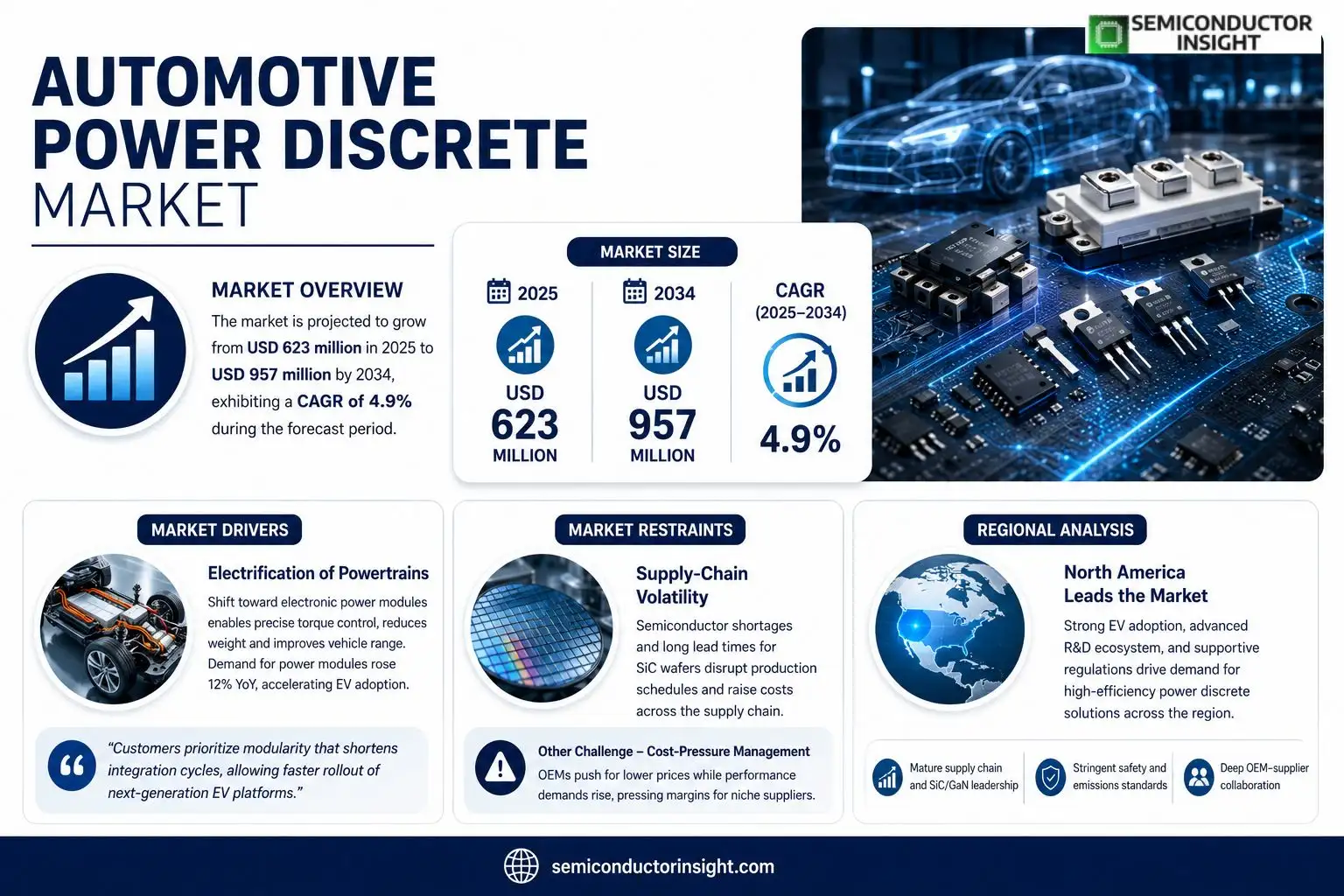
Automotive Power Discrete Market size was valued at USD 623 million in 2025. The market is projected to grow from USD 623 million in 2025 to USD 957 million by 2034, exhibiting a CAGR of 4.9 % during the forecast period.
Discrete devices such as diodes and transistors are single‑semiconductor components that regulate voltage, limit power draw, and reduce heat generation across automotive electronics. Power‑discrete partsultrafast diodes for DC‑DC converters or silicon‑based IGBT modules for medium‑voltage applicationsare engineered for reliability, robustness, and energy
MARKET DRIVERS
Electrification of Powertrains
Automotive manufacturers are substituting conventional hydraulic and mechanical actuators with electronic power modules to meet efficiency targets. Discrete power converters enable precise torque control while reducing weight, a factor that directly improves vehicle range in electric models. Recent production data indicates a 12% year‑over‑year rise in demand for these modules, reflecting the momentum behind full‑vehicle electrification.
Regulatory Incentives and Emissions Standards
Stringent CO₂ limits across Europe and North America have forced OEMs to adopt power‑dense, low‑loss components. Automotive Power Discrete Market players that can certify compliance at lower cost enjoy a competitive edge, as the cost of non‑compliant designs now includes penalties and redesign expenses. This regulatory pressure converts into tangible spending on discrete power solutions.
➤ “Customers prioritize modularity that shortens integration cycles, allowing faster rollout of next‑generation EV platforms.”
Suppliers that bundle thermal management with power conversion are seeing higher order values because manufacturers seek to simplify supply chains. The added value of integrated cooling translates into a 15% premium on contracts, encouraging vendors to invest in combined‑module R&D.
MARKET CHALLENGES
Supply‑Chain Volatility
Semiconductor shortages that began in 2021 continue to constrain the rollout of high‑performance power modules. Lead times for silicon carbide (SiC) wafers have stretched to six months, forcing OEMs to adjust production schedules and, in some cases, revert to legacy components.
Other Challenges
Cost‑Pressure Management
While performance demands rise, price sensitivity remains acute, especially in mass‑market segments. Manufacturers negotiate aggressively on unit cost, squeezing margins for niche suppliers that lack economies of scale.
MARKET RESTRAINTS
Technical Integration Complexity
Integrating discrete converters into tightly packed vehicle architectures requires sophisticated PCB design and electromagnetic compatibility (EMC) testing. Small‑volume projects often lack the resources to manage these complexities, limiting adoption in lower‑priced models.Furthermore, the need for rigorous validation across temperature extremes adds to development time, discouraging some manufacturers from pursuing advanced discrete solutions for short‑cycle models.
MARKET OPPORTUNITIES
Growth in High‑Performance EV Segments
Luxury and performance electric vehicles demand power modules that can handle peak currents exceeding 500 A. Suppliers that deliver robust, compact converters stand to capture a double‑digit share of this premium segment, where buyers value efficiency gains above cost considerations.In addition, the emergence of vehicle‑to‑grid (V2G) functionality creates a new demand niche for bidirectional converters. Early movers that certify V2G‑ready discrete modules can lock in contracts with fleet operators seeking to monetize idle battery capacity.
Automotive Power Discrete Market Trends
Shift Toward Wide‑Bandgap Semiconductors
The adoption of silicon‑carbide (SiC) and gallium‑nitride (GaN) devices is accelerating across vehicle power‑train architectures. Engineers favor these materials because they sustain higher switching frequencies while delivering lower conduction losses, which translates into smaller thermal footprints and lighter cooling systems. In hybrid and electric platforms, the ability to operate efficiently at elevated voltages enables designers to extract more mileage from each kilowatt‑hour of battery capacity. Suppliers that have re‑engineered their product lines to accommodate SiC and GaN are witnessing faster order‑to‑delivery cycles, while OEMs report a measurable reduction in overall vehicle weight. This technical evolution is reshaping the competitive landscape of Automotive Power Discrete Market, prompting legacy players to accelerate R&D investments and partnerships with specialty foundries.
Other Trends
Regional Production Concentration
Asia retains the dominant share of automotive assembly, and its semiconductor ecosystem has responded with a surge in localized discrete‑device fabs. The concentration of manufacturing capacity in China, Japan, and South Korea shortens supply‑chain lead times and lowers logistics costs for volume carmakers. At the same time, Europe’s emphasis on stringent emissions standards is driving niche fabs to specialize in high‑reliability power transistors for premium models. North America, while smaller in absolute volume, is leveraging government incentives to expand domestic wafer‑processing capabilities, thereby reducing dependence on imports for safety‑critical applications. This geographic diversification influences pricing dynamics and risk assessment for firms operating in Automotive Power Discrete Market, as buyers increasingly weigh the resilience of regional supply nodes against total cost of ownership.
Integration of Power Discretes in On‑Board Chargers
On‑board charger (OBC) architectures are evolving from discrete‑heavy designs toward highly integrated modules that embed ultrafast diodes and power transistors within a single footprint. The trend is motivated by the need to meet tighter electromagnetic‑compatibility (EMC) regulations while sustaining high efficiency across the 400‑V to 800‑V DC bus range common in modern EVs. By embedding power discretes directly into the converter topology, manufacturers can achieve finer control of voltage ripple and heat dissipation, which in turn supports faster charging rates without compromising battery longevity. This integration also opens opportunities for modular OBC families that can be scaled across vehicle segments, from compact city cars to long‑range trucks. Companies that master this integration are positioned to capture a larger slice of Automotive Power Discrete Market as OEMs standardize on unified charging solutions for future model lines.
COMPETITIVE LANDSCAPE
Key Industry Players
Competitive Dynamics Shaping the Automotive Power Discrete Sector
Infineon Technologies dominates the Automotive Power Discrete segment, leveraging its deep silicon carbide (SiC) and gallium nitride (GaN) product portfolio to meet the high‑voltage, high‑efficiency demands of on‑board chargers and DC‑DC converters. The company’s vertical integrationfrom wafer fabrication to module assemblyallows it to capture premium pricing while maintaining tight control over thermal performance. This strategic positioning forces midsize manufacturers to partner with Tier‑1 suppliers or specialize in lower‑cost silicon‑based devices. Market structure therefore reflects a tiered hierarchy: a handful of giants secure the majority of automotive contracts, while regional firms focus on niche vehicle classes or aftermarket replacements. Infineon’s recent joint ventures with European OEMs illustrate how deep supplier relationships translate into recurring revenue streams and technology co‑development, reinforcing its leadership in a market where reliability and power density dictate procurement decisions.Beyond the Tier‑1 cluster, several specialists are reshaping the competitive landscape through differentiated technologies and geographic focus. NXP Semiconductors and Renesas Electronics have accelerated GaN‑based diode programs aimed at lightweight electric‑vehicle platforms, leveraging their strong automotive microcontroller heritage to bundle discrete components with control ICs. Mitsubishi Electric, with its legacy in power modules, targets the commercial‑vehicle segment in Japan and Southeast Asia, where stricter efficiency standards drive demand for robust IGBT solutions. Smaller players such as Vishay, ITE Corp, and Fuji Electric sustain market depth by supplying cost‑effective silicon transistors for legacy models and emerging low‑volume EVs. The emergence of microchip‑focused entrants like Microchip Technology, which pairs power discretes with integrated power‑management firmware, signals a shift toward system‑level sourcing. Collectively, these firms compel incumbents to innovate on both performance and price, while also creating acquisition targets for firms seeking rapid entry into novel material technologies.
List of Key Automotive Power Discrete Companies Profiled
- Infineon Technologies
- Robert Bosch
- Continental AG
- ON Semiconductor
- Rohm Semiconductor
- STMicroelectronics
- Danfoss
- Vishay
- Texas Instruments
- NXP Semiconductors
- Mitsubishi Electric
- Renesas Electronics
- ITE Corp
- Fuji Electric
- Microchip Technology
Segment Analysis:
| Segment Category | Sub-Segments | Key Insights |
| By Type |
|
Leading Segment The silicon‑based power transistors continue to dominate because of their proven reliability, extensive design libraries and cost‑effective manufacturing. – Engineers favor silicon for legacy vehicle platforms where risk aversion is high. – The durability of silicon devices under thermal cycling aligns with automotive durability standards. – Ongoing material improvements keep silicon competitive despite the rise of wide‑bandgap solutions. |
| By Application |
|
Leading Segment On‑board charger circuits drive the demand for ultrafast diodes and robust transistors. – These devices must manage high current pulses while maintaining low loss, directly influencing vehicle range. – Tight integration with power‑electronics modules creates a preference for discrete components that can be precisely matched to thermal designs. – Continuous refinement of switching speed supports faster charging standards without compromising safety. |
| By End User |
|
Leading Segment Passenger vehicles shape the bulk of component specifications. – Mass‑market models prioritize cost efficiency and long‑term reliability, favoring proven silicon solutions. – Commercial trucks demand higher power handling and thermal robustness, pushing adoption of SiC devices for heavy‑duty inverters. – Performance cars explore aggressive power density, creating niche opportunities for GaN components that enable compact packaging. |
| By Voltage Level |
|
Leading Segment Medium‑voltage power devices are central to hybrid and mild‑hybrid architectures. – Designers seek a balance between voltage handling and switching speed to optimize energy recovery. – The voltage tier influences packaging choices, with discrete transistors preferred for modularity. – Industry standards around automotive voltage grades reinforce consistency in component selection across OEMs. |
| By Material Innovation |
|
Leading Segment Wide‑bandgap materials are gaining attention for their efficiency advantages. – Engineers value the lower conduction loss and higher thermal tolerance of SiC devices in high‑power inverter chains. – GaN’s fast switching characteristics support compact charger designs, especially in premium electric models. – Material‑level innovation drives collaborative R&D between semiconductor firms and automotive OEMs, shaping future architecture decisions. |
Regional Analysis: Automotive Power Discrete Market
North America
Recent revisions to safety standards in the United States and Canada mandate tighter voltage tolerance for electric‑drive systems. This regulatory pressure compels OEMs to source discrete power modules that can guarantee stability under extreme thermal cycles, thereby favoring suppliers with proven automotive‑grade qualification processes.
The North American supply chain benefits from domestic silicon‑carbide wafer production and a dense network of packaging specialists. While occasional raw‑material bottlenecks surface, strategic stockpiling and multi‑sourcing arrangements have mitigated major disruptions, allowing manufacturers to maintain steady component flow.
Tier‑1 suppliers are piloting wide‑bandgap devices in high‑voltage traction inverters, a move that shortens the development cycle for EV platforms. Early adopters report measurable gains in drivetrain efficiency, prompting ripple effects across the supplier ecosystem.
Companies that combine advanced thermal management with compact form factors gain leverage in procurement negotiations, as OEMs increasingly prioritize module density to free up chassis space for battery packs and auxiliary systems.
Europe
European manufacturers confront a regulatory environment that tightly couples CO₂ reduction targets with vehicle‑level efficiency metrics. This pressure drives a strategic pivot toward discrete power converters that can be tightly integrated into modular electric‑drive assemblies. Meanwhile, the continent’s strong emphasis on circular‑economy principles stimulates investments in recyclable packaging and low‑temperature soldering processes, giving suppliers that embed sustainability into design a distinct market advantage. Collaborative research programs across Germany, France, and the Nordics are also accelerating the transition from silicon‑based to wide‑bandgap technologies, positioning Europe as a hotbed for next‑generation power architecture innovation.
Asia‑Pacific
The Asia‑Pacific region is distinguished by its fast‑moving consumer market and aggressive EV rollout plans, particularly in China, Japan, and South Korea. OEMs in this corridor prioritize cost‑effective power modules that can be mass‑produced without compromising the reliability required for high‑volume platforms. Local governments supplement this drive with subsidies that reward higher‑efficiency power electronics, nudging manufacturers toward silicon‑carbide solutions despite higher upfront material costs. A burgeoning ecosystem of contract manufacturers and test houses supports rapid iteration, allowing firms to adapt designs to diverse vehicle architectures ranging from compact city cars to heavy‑duty trucks.
South America
South American automotive activity is heavily influenced by fluctuating fuel prices and import‑tariff structures, which together shape the cost calculus for electric‑power components. While overall EV penetration remains modest, regional governments are beginning to offer incentives for low‑emission fleets, creating a niche for discrete power modules that can be retrofitted into existing platforms. Localized assembly plants are emerging in Brazil and Argentina, focusing on modular designs that simplify supply‑chain logistics and reduce dependence on distant suppliers. This gradual domestication of production capabilities hints at a longer‑term shift toward greater regional self‑sufficiency.
Middle East & Africa
In the Middle East and Africa, the market narrative is shaped by a dual demand for high‑temperature tolerance and ruggedness, reflecting harsh climatic conditions and under‑developed road infrastructure. OEMs and fleet operators alike seek power modules that can sustain performance despite extreme ambient temperatures, prompting suppliers to emphasize robust encapsulation and advanced thermal‑interface materials. At the same time, emerging wealth in Gulf Cooperation Council states is spurring premium‑segment EV introductions, where customers expect top‑tier efficiency and compact packaging, offering an entry point for high‑end discrete power technologies.
Report Scope
This market research report provides a comprehensive analysis of the Automotive Power Discrete Market , covering the forecast period 2026–2034. It offers detailed insights into market dynamics, technological advancements, competitive landscape, and key trends shaping the industry.
Key focus areas of the report include:
- Market Overview: The report begins with an overview outlining its current market scenario, key growth indicators, and industry transformation drivers. It discusses macroeconomic factors, demand–supply balance, regulatory landscape, and the strategic role of semiconductors in powering advancements across industries such as automotive, telecommunications, consumer electronics, and industrial automation.
- Market Size & Forecast: Historical data and future projections for revenue, unit shipments, and market value across major regions and segments.
- Segmentation Analysis: Detailed breakdown by product type, technology, application, and end-user industry to identify high-growth segments and investment opportunities.
- Regional Insights: Insights into market performance across North America, Europe, Asia-Pacific, Latin America, and the Middle East & Africa, including country-level analysis where relevant.
- Competitive Landscape: Profiles of leading market participants, including their product offerings, R&D focus, manufacturing capacity, pricing strategies, and recent developments such as mergers, acquisitions, and partnerships.
- Technology Trends & Innovation: Assessment of emerging technologies, integration of AI/IoT, semiconductor design trends, fabrication techniques, and evolving industry standards.
- Market Drivers & Restraints: Evaluation of factors driving market growth along with challenges, supply chain constraints, regulatory issues, and market-entry barriers.
- Stakeholder Insights: Insights for component suppliers, OEMs, system integrators, investors, and policymakers regarding the evolving ecosystem and strategic opportunities.
Primary and secondary research methods are employed, including interviews with industry experts, data from verified sources, and real-time market intelligence to ensure the accuracy and reliability of the insights presented.
FREQUENTLY ASKED QUESTIONS:
What is the current market size of Automotive Power Discrete Market?
-> Automotive Power Discrete Market was valued at USD 593 million in 2024 and is expected to reach USD 827 million by 2031.
Which key companies operate in Automotive Power Discrete Market?
-> Key players include Infineon Technologies, Robert Bosch, Continental AG, ON Semiconductor, Rohm Semiconductor, ST Microelectronics, Danfoss, Vishay, Freescale Semiconductor, Texas Instruments, Rockwell Automation.
What are the key growth drivers?
-> Key growth drivers include rising automotive electrification, increasing demand for power‑efficient semiconductors, and the expansion of vehicle production in Asia.
Which region dominates the market?
-> Asia dominates the market, accounting for about 56% of automotive production, followed by Europe and North America.
What are the emerging trends?
-> Emerging trends include adoption of GaN and SiC power devices, ultrafast diodes for on‑board chargers, and silicon‑based IGBT solutions for medium‑voltage automotive applications.

Get Sample Report PDF for Exclusive Insights
Report Sample Includes
- Table of Contents
- List of Tables & Figures
- Charts, Research Methodology, and more...
 Download Sample Report PDF