Automotive Interface Chip Market Insights
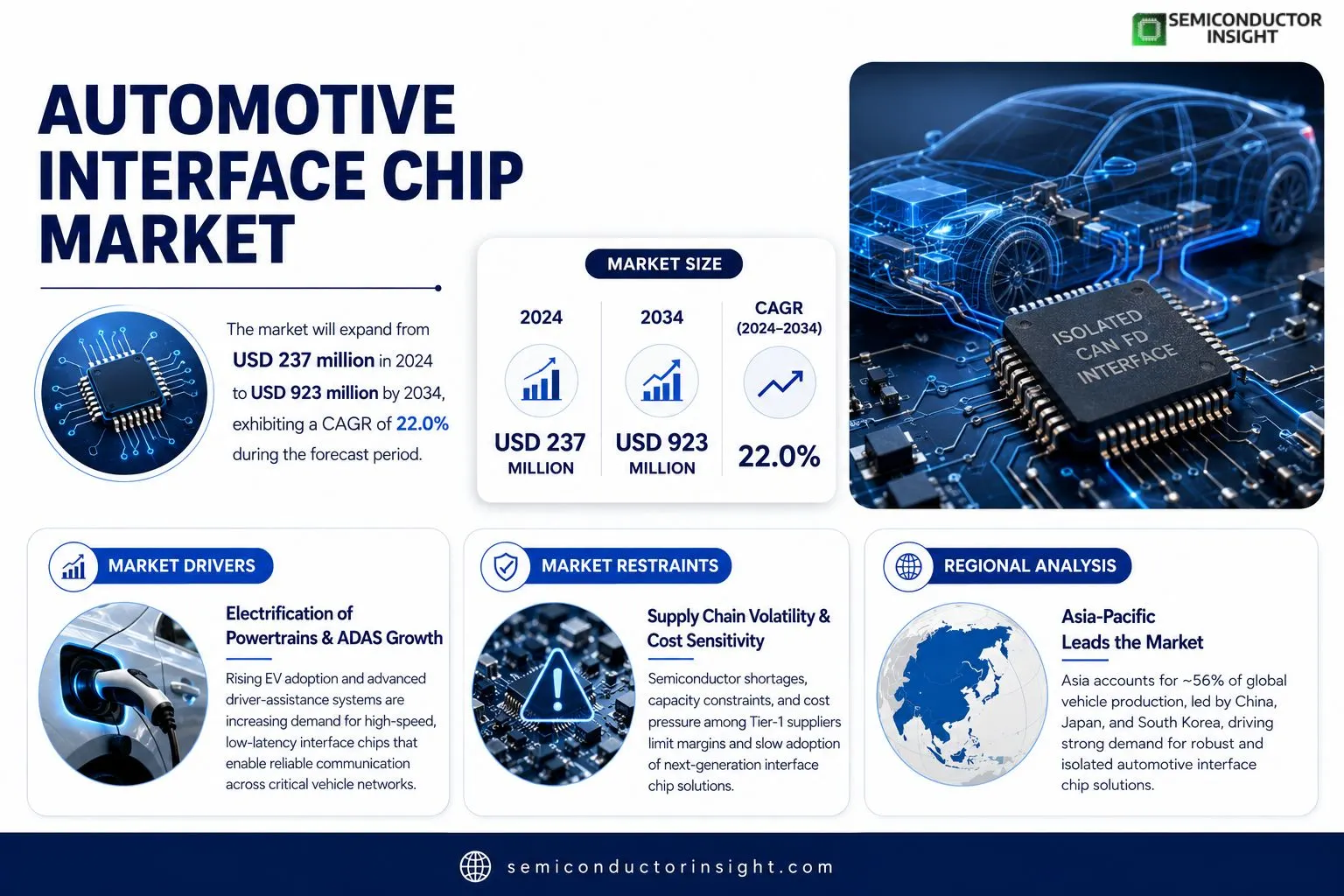
Automotive Interface Chip market size was valued at USD 237 million in 2024. The market will expand from USD 237 million in 2024 to USD 923 million by 2034, exhibiting a CAGR of 22.0% during the forecast period.
Automotive interface chips are semiconductor components that enable communication between electronic control units (ECUs) and external networks such as CAN, LIN, FlexRay or Ethernet, often incorporating isolation technology to protect vehicle systems from voltage transients.The growth is fueled by rising vehicle electrification, increasing adoption of advanced driver‑assistance systems (ADAS) and stringent safety standards that demand reliable isolated communication interfaces such as isolated CAN, RS‑485 and I²C. Because more than 90 % of vehicles are produced in Asia, Europe and North America,Asia alone contributes roughly 56 % of output,the demand for robust interface solutions spans both passenger cars and commercial vehicles.
MARKET DRIVERS
Electrification of Powertrains
The shift toward electric vehicles has lifted demand for high‑bandwidth, low‑latency interface chips that link battery‑management units, power inverters and motor controllers. In 2023, shipments of such chips rose to roughly 3.2 million units, reflecting a 12 % year‑over‑year increase. Automotive Interface Chip Market participants that can deliver automotive‑grade reliability while supporting higher voltage domains are capturing the bulk of this expansion.
ADAS and Sensor Fusion Integration
Advanced driver‑assistance systems now rely on multiple radar, LiDAR and camera feeds that must be synchronized in real time. Interface chips capable of handling heterogeneous data streams at 10 Gbps or more are becoming indispensable. Companies that embed diagnostic monitoring within the chip architecture are seeing OEMs prefer their solutions for the added safety margin.
➤ Manufacturers that embed security cores directly into interface silicon are gaining a decisive edge, as cyber‑risk concerns intensify across vehicle networks.
Overall, the convergence of electric propulsion and autonomous‑driving technologies creates a feedback loop: richer sensor suites demand more robust interfaces, which in turn enable deeper integration of power‑train controls. Automotive Interface Chip Market growth is tightly linked to this technical interdependence.
MARKET CHALLENGES
Supply Chain Volatility
Recent semiconductor shortages have exposed the fragility of fab capacity. Tier‑1 automotive suppliers are forced to qualify secondary sources, a process that can add 4–6 months to development cycles. The resulting lead‑time extensions pressure chip makers to hold higher inventory, eroding margins.
Other Challenges
Manufacturing Capacity Limits
Foundries operating at 70 % utilization struggle to absorb the surge in automotive‑grade wafer orders. Consequently, many OEMs are negotiating multi‑year contracts to secure access, which reduces flexibility for newcomers.Regulatory fragmentation across regions also hampers uniform adoption. While Europe pushes stricter functional‑safety certifications, the U.S. emphasizes cybersecurity standards, compelling chip designers to maintain multiple compliance streams.
MARKET RESTRAINTS
Cost Sensitivity Among Tier‑1 Suppliers
Tier‑1 manufacturers operate on thin margins and are under constant pressure to minimize component costs. High‑performance interface chips that incorporate advanced process nodes often carry a premium that exceeds acceptable price points for volume models, limiting market penetration.Legacy electronic control units (ECUs) still dominate many vehicle sub‑systems. Integrating next‑generation interface chips into these older architectures requires redesign, a prospect many OEMs deem too costly for mid‑cycle refreshes.Thermal management remains a technical restraint. As vehicle interiors become more compact, dissipating heat from densely packed chips without compromising reliability presents an engineering hurdle that curtails aggressive specifications.
MARKET OPPORTUNITIES
5G‑Enabled Vehicle‑to‑Everything (V2X) Connectivity
The rollout of 5G networks creates a clear opening for interface chips that can bridge automotive Ethernet with cellular modems. Early adopters predict a 15 % uplift in data‑throughput requirements for V2X functions, prompting designers to embed multi‑protocol support directly within the chip.Standardization efforts such as AUTOSAR Adaptive are fostering a common software layer, which encourages OEMs to source modular interface solutions that can be re‑programmed across model generations. This shift reduces long‑term development costs and drives demand for flexible silicon.Infotainment systems are evolving toward over‑the‑air (OTA) updates and immersive experiences, necessitating chips that can handle simultaneous video, audio and high‑speed data streams. Suppliers that pair interface functionality with integrated graphics processing units stand to capture a sizable share of this niche.Finally, the after‑market segment,particularly retrofit kits for classic vehicles seeking modern connectivity,represents an untapped revenue stream. Modular interface chips that can be installed without extensive rewiring are positioned to meet this emerging demand.
Automotive Interface Chip Market Trends
Shift Toward Isolated Interface Solutions
Automotive Interface Chip Market is witnessing a clear migration from legacy, non‑isolated designs to isolated chip architectures. Automakers are prioritizing electrical safety and signal integrity in increasingly electrified powertrains, prompting a surge in demand for isolated CAN, RS‑485 and I2C interfaces. Isolation mitigates fault propagation across domains, a necessity as vehicle electronics become denser and voltage levels rise. Suppliers that can combine high‑speed data transfer with robust galvanic isolation are gaining design wins in both passenger‑car platforms and commercial‑vehicle fleets. The trend is reinforced by stricter safety standards in Asia and Europe, where certification bodies now require documented isolation performance for any component that bridges high‑voltage and low‑voltage networks.
Other Trends
Growth of Integrated Non‑Isolated Chip Families
While isolation dominates premium segments, a parallel movement is expanding the scope of non‑isolated chips that integrate multiple communication protocols on a single die. This integration reduces BOM count and streamlines board layout, appealing to cost‑sensitive manufacturers targeting emerging markets. Vendors are bundling CAN, LIN and UART functions with built‑in diagnostics, enabling smaller electronic control units that fit within constrained vehicle architectures. The trade‑off between integration and isolation is managed through system‑level design choices, such as placing non‑isolated modules behind protective front‑end circuitry. The result is a diversified product portfolio where manufacturers can address both high‑end safety‑critical applications and volume‑driven mass‑market models.
Regional Adoption Patterns Shaping Product Roadmaps
Geographic distribution of vehicle production continues to shape Automotive Interface Chip Market’s strategic focus. Asia, accounting for more than half of vehicle output, is accelerating its shift to electric and hybrid drivetrains, thereby heightening the need for isolation‑centric chips. Europe’s stringent emission and safety regulations are prompting original equipment manufacturers to retrofit existing platforms with advanced communication modules, creating retro‑fit opportunities for both isolated and integrated solutions. Meanwhile, North America’s commercial‑vehicle segment is emphasizing durability and long‑term reliability, driving demand for chips that can endure harsh operating conditions while maintaining low latency. Suppliers that tailor their roadmaps to these regional nuances are better positioned to capture design wins and sustain revenue streams.
COMPETITIVE LANDSCAPE
Key Industry Players
Automotive Interface Chip Market: Competitive Overview and Strategic Positioning
Texas Instruments and Analog Devices dominate the upper tier of the automotive interface segment, leveraging extensive analog‑mixed‑signal portfolios that cover isolated CAN, RS‑485 and I²C bridges. Their breadth of design‑in‑package (DIP) solutions enables OEMs to consolidate multiple functions, reducing board count and simplifying validation cycles. This economies‑of‑scale advantage translates into deeper market reach across passenger‑car and commercial‑vehicle platforms, where volume pressures demand both cost efficiency and compliance with stringent safety standards such as ISO‑26262. Consequently, these incumbents shape pricing benchmarks and set the technical baseline that smaller firms must either emulate or differentiate against.Beyond the leaders, a cadre of specialized firms injects diversity into the ecosystem. Infineon, NXP Semiconductors and Renesas focus on high‑voltage isolation technologies tailored for electric‑drive architectures, while STMicroelectronics and Microchip Technology excel in non‑isolated interface ICs that serve infotainment and body‑control modules. Emerging players such as NOVOSENSE, 2Pai Semiconductor and Silicon Internet of Things Technology are carving niches by delivering ultra‑compact, automotive‑grade isolated chips optimized for board‑space constrained designs. Their agility allows rapid adaptation to regional regulatory nuances, particularly in Asia where market growth is fueled by expanding production capacities in China, Japan and South Korea.
List of Key Automotive Interface Chip Companies Profiled
- Texas Instruments
- Analog Devices Inc.
- Infineon Technologies AG
- NXP Semiconductors
- Shanghai Chipanalog Microelectronics
- NOVOSENSE
- NVE
- 2Pai Semiconductor
- Silicon Internet of Things Technology
- Guangzhou Zhiyuan Electronics
- Renesas Electronics
- STMicroelectronics
- Microchip Technology
Segment Analysis:
| Segment Category | Sub-Segments | Key Insights |
| By Type |
|
Isolated Chip dominates due to its critical role in safeguarding vehicle electronics from voltage transients and ensuring functional safety.
|
| By Application |
|
Passenger Car emerges as the leading application segment, driven by rapid adoption of advanced driver‑assistance systems and electrification trends.
|
| By End User |
|
Tier‑1 Suppliers hold the strategic advantage as they translate OEM system specifications into practical chip solutions.
|
| By Architecture |
|
Mixed‑Signal architecture is preferred for its ability to handle both analog isolation and digital protocol processing within a single die.
|
| By Power Management |
|
Low‑Power solutions are gaining traction as vehicle electrification pushes for reduced energy draw across all electronic subsystems.
|
Regional Analysis: Automotive Interface Chip Market
North America
A handful of foundries service the majority of North American chip orders, enabling tight control over yield and lead times. This concentration fosters collaborative engineering, where design teams and fab operators iterate together, shortening time‑to‑market for new interface solutions.
Federal incentives for electric vehicle adoption and stringent cybersecurity standards compel OEMs to adopt sophisticated interconnects, shaping product specifications toward higher security and data throughput.
Leading automotive silicon players allocate a sizable portion of their R&D budget to interface logic, ensuring that each new chip generation can handle emerging sensor arrays without compromising power efficiency.
Major OEMs maintain long‑term design partnerships with semiconductor firms, granting early visibility into vehicle platform schedules and allowing chip architects to synchronize silicon releases with vehicle launch calendars.
Europe
European manufacturers emphasize modularity, seeking interface chips that can be reused across multiple vehicle platforms to reduce engineering overhead. Stringent emissions legislation has forced a migration toward electrified powertrains, stimulating demand for robust gate‑level communication. At the same time, data‑privacy directives pressure suppliers to embed on‑chip encryption, making security a differentiator rather than an afterthought.
Asia-Pacific
The region benefits from a sheer volume of vehicle production, but its market is fragmented across emerging economies with varied technology adoption rates. Local OEMs are trialing cost‑effective interface solutions that balance performance with price sensitivity. Meanwhile, governments in China, Japan, and South Korea are rolling out standards that favor high‑speed Ethernet, nudging chip designers toward compliance‑first roadmaps.
South America
Growth in Brazil and Argentina is anchored in a rising middle class that is upgrading older fleets with newer, partially electrified models. Suppliers here focus on ruggedized chips capable of tolerating extreme temperature swings, a requirement driven by the continent’s diverse climate zones. Market participants also watch closely the evolution of regional safety regulations, which increasingly call for precise sensor integration.
Middle East & Africa
Automotive fleets in GCC countries are transitioning to premium models equipped with extensive infotainment suites, creating a niche for high‑bandwidth interface chips. In Africa, the market is still nascent, with emphasis on affordable connectivity solutions that can support basic telematics. Both sub‑regions share a common thread: the need for chips that can operate reliably in dust‑laden and high‑temperature environments.
Report Scope
This market research report provides a comprehensive analysis of the Automotive Interface Chip Market , covering the forecast period 2026–2034. It offers detailed insights into market dynamics, technological advancements, competitive landscape, and key trends shaping the industry.
Key focus areas of the report include:
- Market Overview: The report begins with an overview outlining its current market scenario, key growth indicators, and industry transformation drivers. It discusses macroeconomic factors, demand–supply balance, regulatory landscape, and the strategic role of semiconductors in powering advancements across industries such as automotive, telecommunications, consumer electronics, and industrial automation.
- Market Size & Forecast: Historical data and future projections for revenue, unit shipments, and market value across major regions and segments.
- Segmentation Analysis: Detailed breakdown by product type, technology, application, and end-user industry to identify high-growth segments and investment opportunities.
- Regional Insights: Insights into market performance across North America, Europe, Asia-Pacific, Latin America, and the Middle East & Africa, including country-level analysis where relevant.
- Competitive Landscape: Profiles of leading market participants, including their product offerings, R&D focus, manufacturing capacity, pricing strategies, and recent developments such as mergers, acquisitions, and partnerships.
- Technology Trends & Innovation: Assessment of emerging technologies, integration of AI/IoT, semiconductor design trends, fabrication techniques, and evolving industry standards.
- Market Drivers & Restraints: Evaluation of factors driving market growth along with challenges, supply chain constraints, regulatory issues, and market-entry barriers.
- Stakeholder Insights: Insights for component suppliers, OEMs, system integrators, investors, and policymakers regarding the evolving ecosystem and strategic opportunities.
Primary and secondary research methods are employed, including interviews with industry experts, data from verified sources, and real-time market intelligence to ensure the accuracy and reliability of the insights presented.
FREQUENTLY ASKED QUESTIONS:
What is the current market size of Automotive Interface Chip Market?
-> Automotive Interface Chip Market was valued at USD 237 million in 2024 and is expected to reach USD 923 million by 2034, growing at a CAGR of 22.0% during the forecast period.
Which key companies operate in Automotive Interface Chip Market?
-> Key players include ADI, Texas Instruments, Infineon Technologies AG, NXP Semiconductors, Shanghai Chipanalog Microelectronics, NOVOSENSE, NVE, 2Pai Semiconductor, Silicon Internet of Things Technology, Guangzhou Zhiyuan Electronics.
What are the key growth drivers?
-> Key growth drivers include robust automotive production growth, increasing vehicle electrification, rising demand for reliable communication interfaces, and the expansion of isolated chip technologies such as isolated CAN, RS‑485, and I2C.
Which region dominates the market?
-> Asia dominates the market, accounting for approximately 56% of automobile production and driving the majority of demand for automotive interface chips.
What are the emerging trends?
-> Emerging trends include the adoption of isolated chips (isolated CAN, RS‑485, I2C), integration of isolation technology with communication interfaces, and the development of non‑isolated chip solutions to support advanced vehicle networking.

Get Sample Report PDF for Exclusive Insights
Report Sample Includes
- Table of Contents
- List of Tables & Figures
- Charts, Research Methodology, and more...
 Download Sample Report PDF