Automotive Humidity & Rain Sensor IC Market Insights
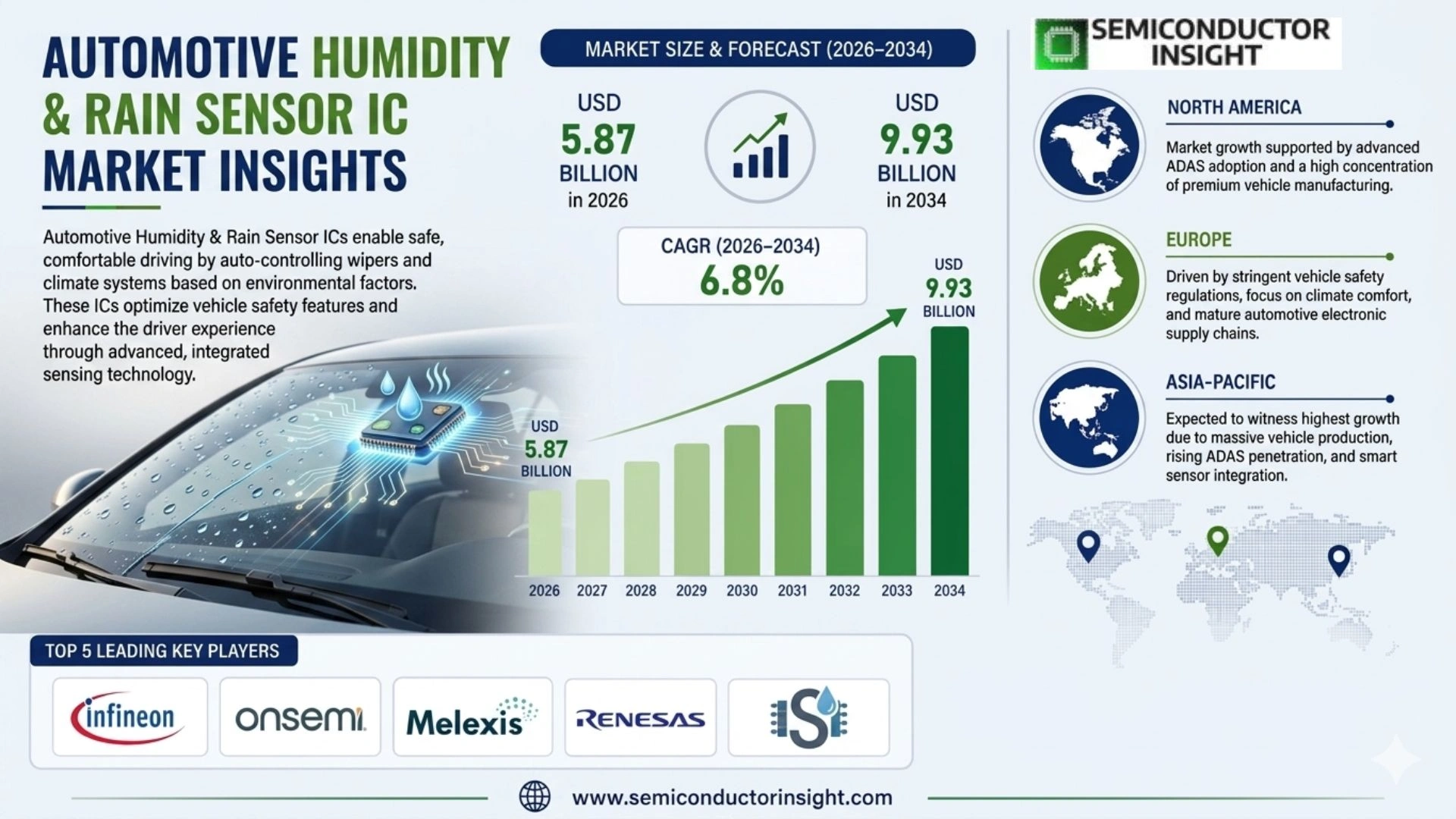
Automotive Humidity & Rain Sensor IC Market size was valued at USD 5.50 billion in 2025. The market is projected to grow from USD 5.7 billion in 2026 to USD 9.93 billion by 2034, exhibiting a CAGR of 6.8% during the forecast period.
Automotive Humidity & Rain Sensor ICs are specialized integrated circuits designed to detect moisture, rain, and humidity levels on vehicle windshields and within cabins. These components enable automatic wiper activation, headlight adjustment, and climate control systems by processing optical or capacitive signals related to environmental conditions. They typically integrate photodiodes, signal processing units, and interfaces like LIN or SPI for seamless communication with vehicle body control modules.
The market is experiencing steady growth due to several factors, including rising demand for advanced driver assistance systems (ADAS), increasing vehicle production worldwide, and growing consumer preference for safety and comfort features in both passenger and commercial vehicles. Furthermore, stricter safety regulations and the shift toward autonomous and semi-autonomous driving technologies are accelerating adoption. Initiatives by key players continue to drive innovation, such as the development of multifunctional sensors combining rain, light, and humidity detection for enhanced performance. Bosch, HELLA GmbH & Co. KGaA, Valeo SA, DENSO Corporation, and Continental AG are some of the key players that operate in the market with a wide range of portfolios.
MARKET DRIVERS
Rising ADAS Adoption and Vehicle Automation
The integration of Advanced Driver Assistance Systems (ADAS) continues to propel demand for Automotive Humidity & Rain Sensor ICs. These ICs enable automatic wiper activation, fog prevention, and climate control optimization by providing precise real-time data on precipitation and cabin humidity levels. As OEMs expand Level 2+ features across vehicle segments, sensor fusion architectures increasingly incorporate combined rain-humidity modules to enhance camera and LiDAR performance in adverse weather.
Electric Vehicle Expansion and Comfort Features
Electric vehicle platforms with higher voltage architectures support advanced signal processing in sensor ICs, improving accuracy under varying environmental conditions. Growing consumer demand for automated comfort features, including automatic defogging and efficient HVAC operation, drives the incorporation of these ICs in both premium and volume vehicle segments. Passenger vehicles continue to dominate adoption, accounting for the majority of installations due to emphasis on convenience and safety.
➤ Market projections indicate the broader automotive rain sensor segment growing at CAGRs between 5.5% and 8.8% through 2030-2034, with integrated humidity capabilities expanding the addressable IC market.
Regulatory pushes for enhanced visibility and safety ratings further accelerate OEM integration of these intelligent sensor solutions.
MARKET CHALLENGES
High Component Costs and Integration Complexity
Advanced Automotive Humidity & Rain Sensor ICs involve sophisticated MEMS and optical technologies that elevate production costs. This creates pricing pressure particularly in cost-sensitive vehicle segments, limiting penetration in entry-level models despite overall market growth.
Other Challenges
Calibration and Reliability Issues
Maintaining long-term accuracy of combined humidity and rain detection in harsh automotive environments poses ongoing engineering challenges, including windshield replacement impacts and sensor recalibration requirements.
Technological Complexity in Sensor Fusion
Integrating multiple sensing modalities within compact IC packages while ensuring compatibility with centralized vehicle architectures demands significant R&D investment from semiconductor suppliers.
MARKET RESTRAINTS
Cost Sensitivity and Alternative Technologies
High costs associated with premium sensor ICs and related system integration restrain broader market adoption, especially in emerging economies and budget vehicle lines. Competition from camera-based vision-only rain detection solutions presents a viable lower-cost alternative for some applications, potentially capping dedicated hardware demand.
MARKET OPPORTUNITIES
Emerging Markets and Sensor Integration Trends
Expansion into emerging automotive markets, combined with the trend toward multi-functional ICs incorporating rain, light, and humidity sensing, offers substantial growth potential. Semiconductor advancements in miniaturization and power efficiency position suppliers to capture value in next-generation centralized E/E architectures for EVs and autonomous vehicles. Increased focus on cabin air quality and defogging systems in electric vehicles creates new avenues for specialized humidity-sensing ICs, supporting both safety and passenger comfort differentiation.
Trends
Rising Integration with Advanced Driver Assistance Systems
Automotive Humidity & Rain Sensor ICs play a critical role in modern vehicles by accurately detecting moisture, rain, and humidity levels on windshields and within vehicle cabins. These specialized integrated circuits process optical or capacitive signals to enable automatic wiper activation, headlight adjustment, and climate control systems. Their integration with vehicle body control modules through interfaces such as LIN or SPI supports seamless operation of safety and comfort features.
The market continues to expand as vehicle manufacturers prioritize advanced driver assistance systems (ADAS) that rely on reliable environmental sensing. Growing consumer demand for enhanced safety and comfort in both passenger and commercial vehicles drives broader adoption of these components. Stricter safety regulations worldwide further accelerate the implementation of humidity and rain sensing technologies across vehicle platforms.
Other Trends
Innovation in Multifunctional Sensor Solutions
Key industry players are focusing on the development of integrated sensors that combine rain, light, and humidity detection capabilities. This approach improves overall system performance while reducing complexity in vehicle electronics. Companies such as Bosch, HELLA GmbH & Co. KGaA, Valeo SA, DENSO Corporation, and Continental AG continue to invest in advanced portfolios that address evolving requirements for precision and reliability in varying environmental conditions.
Expansion Driven by Autonomous and Semi-Autonomous Technologies
The shift toward autonomous and semi-autonomous driving significantly influences demand for Automotive Humidity & Rain Sensor ICs. These components provide essential data for vehicle systems to respond appropriately to weather conditions, supporting safer operation in diverse environments. Increasing global vehicle production reinforces the need for robust sensing solutions that maintain performance across different vehicle segments.
Manufacturers emphasize durable designs capable of withstanding harsh automotive conditions while delivering consistent signal processing. This focus ensures that humidity and rain detection contributes effectively to overall vehicle intelligence and user experience. As automotive technology evolves, these sensor ICs remain fundamental to achieving higher levels of safety, efficiency, and comfort in next-generation vehicles.
COMPETITIVE LANDSCAPE
Key Industry Players
Competitive Analysis of Automotive Humidity & Rain Sensor IC Market
Automotive Humidity & Rain Sensor IC Market is led by established Tier-1 automotive suppliers with strong technological capabilities in sensor integration and vehicle electronics. Robert Bosch GmbH maintains a dominant position through its comprehensive portfolio of multifunctional rain-light-humidity sensors that support advanced driver assistance systems (ADAS) and automatic climate control. The market exhibits a consolidated structure where leading players leverage vertical integration, extensive R&D investments, and strategic partnerships with OEMs to drive innovation in optical, capacitive, and combined sensing solutions.
Other significant players focus on niche technological advancements, such as high-precision signal processing ICs and cost-effective solutions for mid-range vehicles. Companies like HELLA, Valeo, DENSO, and Continental compete through product differentiation, including integration with LIN/SPI interfaces and enhanced environmental robustness, while semiconductor specialists contribute specialized IC components that enable next-generation autonomous driving features.
List of Key Automotive Humidity & Rain Sensor IC Companies Profiled
- Robert Bosch GmbH
- HELLA GmbH & Co. KGaA
- Valeo SA
- DENSO Corporation
- Continental AG
- ZF Friedrichshafen AG
- Infineon Technologies AG
- Melexis NV
- Hamamatsu Photonics K.K.
- KOSTAL Automobil Elektrik GmbH & Co. KG
- Sensata Technologies
- TE Connectivity
- ams-OSRAM AG
- STMicroelectronics N.V.
- Vishay Intertechnology, Inc.
Segment Analysis:
| Segment Category | Sub-Segments | Key Insights |
| By Type |
|
Multifunctional Combined ICs represent the leading segment due to their ability to simultaneously process rain, humidity, and light signals within a single compact unit. These solutions streamline vehicle electronic architecture by minimizing wiring and connector requirements. They deliver enhanced reliability through integrated signal processing that adapts dynamically to changing environmental conditions. Advanced designs incorporate sophisticated algorithms for noise filtering, ensuring precise detection even in challenging scenarios like heavy fog or light drizzle. |
| By Application |
|
Automatic Wiper Systems emerge as the dominant application segment. These sensors provide real-time responsiveness that significantly improves driver visibility and safety during variable weather conditions. Integration with body control modules allows for variable speed adjustment based on rainfall intensity, reducing manual intervention. The technology supports seamless operation across diverse driving environments while contributing to overall vehicle intelligence through data sharing with other ADAS components. |
| By End User |
|
Passenger Vehicles lead this segment through widespread consumer demand for enhanced comfort and safety features. Manufacturers prioritize these sensors to differentiate their offerings in competitive markets, particularly in mid-range and premium models. The sensors contribute to a refined driving experience by automating routine functions and supporting modern cabin environments. Growing emphasis on family safety and all-weather performance further drives consistent adoption across various passenger car categories. |
| By Technology |
|
CMOS-based Sensors stand out as the leading technology due to their excellent power efficiency and high-volume manufacturing compatibility. This approach enables cost-effective production while maintaining superior sensitivity to environmental changes. CMOS platforms facilitate easy interfacing with existing vehicle networks through standard protocols. Their scalability supports future upgrades as vehicles incorporate more sophisticated automation features. |
| By Integration Level |
|
System-on-Chip Solutions lead this category by offering comprehensive functionality within minimal footprint designs. These integrated circuits reduce overall system complexity and improve communication reliability with central vehicle controllers. They support advanced features through embedded processing capabilities that enable predictive adjustments. This integration level accelerates development cycles for automakers seeking rapid deployment of next-generation comfort and safety systems. |
Regional Analysis: Automotive Humidity & Rain Sensor IC Market
Asia-Pacific
Asia-Pacific’s extensive automotive production base creates sustained demand for compact, reliable humidity and rain sensor ICs. Regional foundries and assembly facilities support rapid scaling of these components, enabling cost-effective solutions tailored for both premium and mass-market vehicles.
Leading semiconductor companies in the region are embedding advanced signal processing within humidity and rain sensor ICs, facilitating better data accuracy and faster response times essential for ADAS and connected vehicle applications.
Close partnerships between local automakers and sensor IC providers accelerate customization, ensuring components meet specific regional requirements for performance in humid tropical climates and heavy monsoon seasons.
The shift toward software-defined vehicles and higher levels of autonomy positions Asia-Pacific for continued leadership, with humidity and rain sensor ICs becoming integral to multi-sensor fusion architectures.
North America
North America maintains a sophisticated position Automotive Humidity & Rain Sensor IC Market, emphasizing premium vehicle segments and safety innovations. The United States and Canada witness steady integration of these sensors in high-end SUVs, trucks, and electric vehicles, where precise environmental sensing improves driver comfort and operational safety. Strong focus on ADAS adoption by domestic and international OEMs drives demand for high-performance ICs capable of reliable operation across extreme temperature variations. Collaborative ecosystems between tech firms and automakers foster development of next-generation sensor solutions that align with evolving consumer expectations for intelligent climate management and automated features.
Europe
Europe demonstrates robust growth Automotive Humidity & Rain Sensor IC Market through its commitment to stringent vehicle safety regulations and sustainable mobility. Germany, France, and other key nations prioritize sensor technologies that enhance driver assistance systems and energy-efficient climate control in both traditional and electric vehicles. European manufacturers emphasize quality and precision engineering, leading to adoption of advanced humidity and rain sensor ICs that support sophisticated automated wiper and defogging functionalities. The region’s focus on reducing road accidents and improving overall vehicle intelligence creates sustained opportunities for innovative sensor solutions tailored to varied weather conditions across the continent.
South America
South America is emerging as a promising market for Automotive Humidity & Rain Sensor IC technologies, particularly in Brazil and Argentina where expanding automotive production meets rising safety awareness. Local vehicle manufacturers are gradually incorporating humidity and rain sensors to address tropical climate challenges and improve user experience in entry-level and mid-range models. While adoption remains more selective compared to mature regions, increasing foreign investments and technology transfers are helping elevate component standards. The market benefits from growing consumer preference for vehicles equipped with basic driver assistance features, setting the foundation for broader integration of environmental sensing ICs in the coming years.
Middle East & Africa
The Middle East and Africa region shows selective but growing interest Automotive Humidity & Rain Sensor IC Market, driven by luxury vehicle imports and infrastructure development projects. Gulf countries are incorporating these sensors in premium automobiles to handle extreme heat combined with occasional heavy rains, enhancing cabin comfort and visibility systems. South Africa maintains a more established automotive manufacturing footprint, supporting localized demand for reliable sensor components. As the region advances toward smarter mobility solutions, opportunities are expanding for cost-effective humidity and rain sensing technologies suited to diverse and challenging environmental conditions.
Report Scope
This market research report provides a comprehensive analysis of the Automotive Humidity & Rain Sensor IC Market , covering the forecast period 2026–2034. It offers detailed insights into market dynamics, technological advancements, competitive landscape, and key trends shaping the industry.
Key focus areas of the report include:
- Market Overview: The report begins with an overview outlining its current market scenario, key growth indicators, and industry transformation drivers. It discusses macroeconomic factors, demand–supply balance, regulatory landscape, and the strategic role of semiconductors in powering advancements across industries such as automotive, telecommunications, consumer electronics, and industrial automation.
- Market Size & Forecast: Historical data and future projections for revenue, unit shipments, and market value across major regions and segments.
- Segmentation Analysis: Detailed breakdown by product type, technology, application, and end-user industry to identify high-growth segments and investment opportunities.
- Regional Insights: Insights into market performance across North America, Europe, Asia-Pacific, Latin America, and the Middle East & Africa, including country-level analysis where relevant.
- Competitive Landscape: Profiles of leading market participants, including their product offerings, R&D focus, manufacturing capacity, pricing strategies, and recent developments such as mergers, acquisitions, and partnerships.
- Technology Trends & Innovation: Assessment of emerging technologies, integration of AI/IoT, semiconductor design trends, fabrication techniques, and evolving industry standards.
- Market Drivers & Restraints: Evaluation of factors driving market growth along with challenges, supply chain constraints, regulatory issues, and market-entry barriers.
- Stakeholder Insights: Insights for component suppliers, OEMs, system integrators, investors, and policymakers regarding the evolving ecosystem and strategic opportunities.
Primary and secondary research methods are employed, including interviews with industry experts, data from verified sources, and real-time market intelligence to ensure the accuracy and reliability of the insights presented.
FREQUENTLY ASKED QUESTIONS:
What is the current market size of Automotive Humidity & Rain Sensor IC Market?
-> Automotive Humidity & Rain Sensor IC Market was valued at USD 5.50 billion in 2025 and is expected to reach USD 9.93 billion by 2034.
Which key companies operate Automotive Humidity & Rain Sensor IC Market?
-> Key players include Bosch, HELLA GmbH & Co. KGaA, Valeo SA, DENSO Corporation, and Continental AG, among others.
What are the key growth drivers?
-> Key growth drivers include rising demand for advanced driver assistance systems (ADAS), increasing vehicle production worldwide, and growing consumer preference for safety and comfort features.
Which region dominates the market?
-> Asia-Pacific is the fastest-growing region, while Europe remains a dominant market.
What are the emerging trends?
-> Emerging trends include multifunctional sensors combining rain, light, and humidity detection, integration with ADAS, and advancements in autonomous driving technologies.

Get Sample Report PDF for Exclusive Insights
Report Sample Includes
- Table of Contents
- List of Tables & Figures
- Charts, Research Methodology, and more...