Key Statistics
Key Takeaways
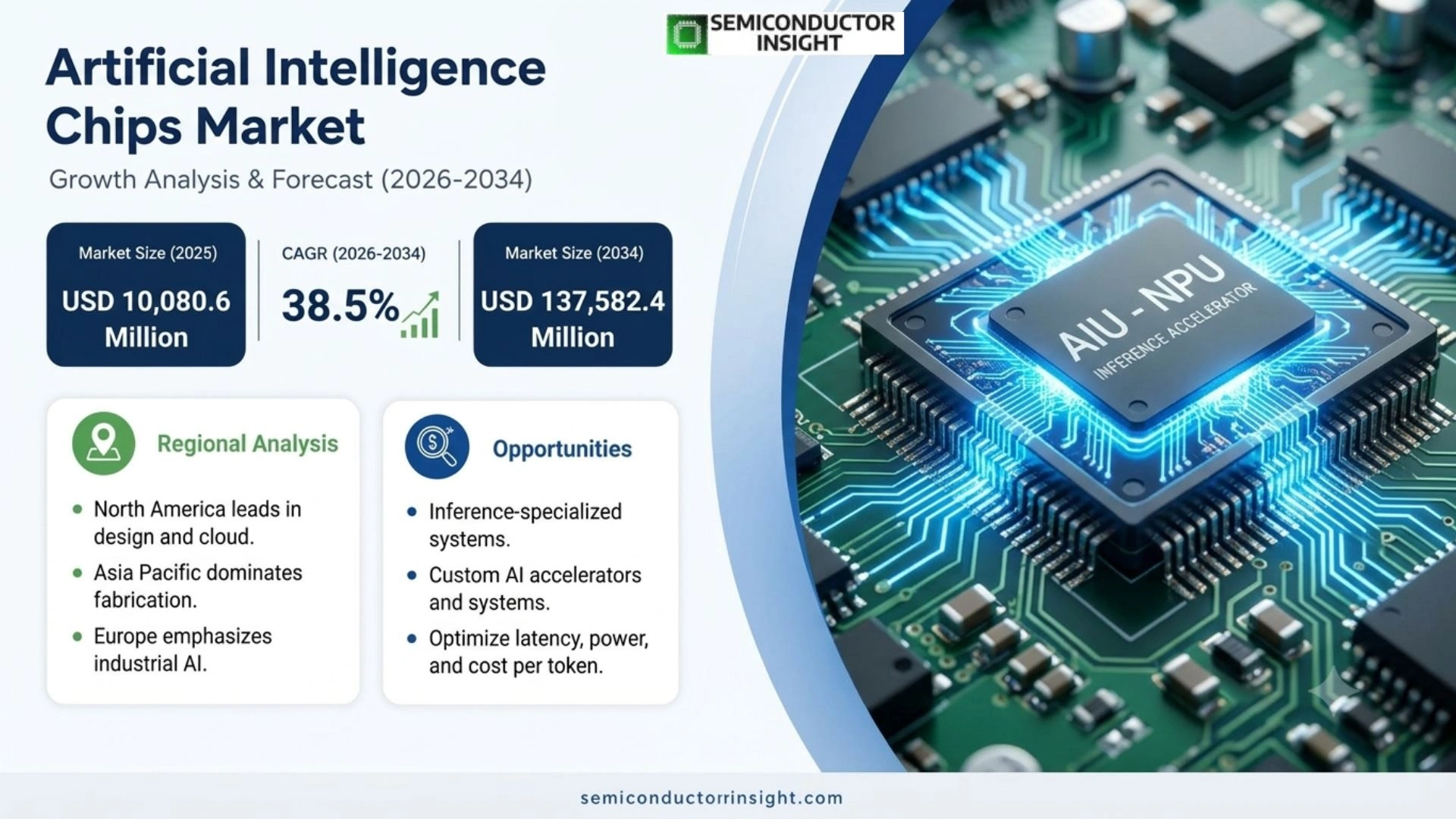
- The market was valued at USD 10,080.6 million in 2025 across data-center accelerators, edge processors and custom machine-learning silicon.
- Revenue is forecast to reach USD 137,582.4 million by 2034, representing a 38.5% CAGR during 2026–2034.
- North America is the largest market because it concentrates accelerator design, hyperscale cloud procurement, frontier-model development and the leading software ecosystems.
- GPUs retain the largest current share, while custom ASICs, NPUs and inference-focused accelerators gain as buyers optimize performance per watt, memory movement and total cost per token.
Artificial Intelligence (AI) Chips Market Overview
Artificial Intelligence Chips Market covers GPUs, application-specific accelerators, neural-processing units, FPGAs and supporting processor platforms sold for machine-learning training and inference. Valued at USD 10,080.6 million in 2025, the market is projected to reach USD 137,582.4 million by 2034 at a 38.5% CAGR during 2026–2034. Google Cloud’s TPU documentation explains how custom application-specific integrated circuits accelerate machine-learning workloads, while GPU platforms address broad parallel computing. The commercial boundary includes silicon and directly associated accelerator modules, but excludes complete data-center construction and unrelated general-purpose processors.
Market value is increasingly determined by the complete compute stack rather than peak arithmetic alone. Model developers compare supported numerical formats, high-bandwidth memory, interconnect scale, compiler maturity, kernel libraries, scheduling, reliability, power and cooling requirements. TSMC’s CoWoS description shows why advanced packaging is central: multiple compute dies and high-bandwidth-memory stacks must be integrated to deliver useful bandwidth. Software portability and available cloud capacity can therefore outweigh a favorable chip specification, especially when deployment deadlines and developer productivity are binding.
Segment Analysis: By Type
Type segmentation reflects the balance between programmability and workload specialization. GPUs lead because mature programming ecosystems and broad framework support reduce deployment friction. Custom ASICs and NPUs can offer superior economics for stable, high-volume workloads, while FPGAs serve low-latency and reconfigurable applications. CPUs remain essential orchestration processors but usually complement rather than replace dedicated matrix-compute engines in intensive AI systems.
| Type | Role in the market | Commercial outlook |
|---|---|---|
| Graphics Processing Units (GPUs) | Highly parallel programmable processors used for large-scale training, fine-tuning and inference, supported by mature libraries and system platforms. | Largest category through the forecast. Competition shifts from a chip benchmark toward rack-scale compute, networking, software availability and cost per useful token. |
| Application-Specific Integrated Circuits (ASICs) | Custom or merchant accelerators optimize matrix operations, data movement and selected model classes for cloud or enterprise deployment. | Fastest strategic expansion as hyperscalers and large users seek differentiated economics, but design cost, foundry access and software enablement create high entry barriers. |
| Neural Processing Units and Edge AI SoCs | Integrated engines execute vision, language, audio and sensor inference within phones, PCs, vehicles, cameras and industrial devices. | High unit-volume opportunity with lower revenue per device; privacy, latency and energy savings support adoption as models are compressed for local execution. |
| FPGAs, CPUs and Other Accelerators | Reconfigurable logic and general processors handle deterministic low-latency inference, preprocessing, orchestration and specialized research workloads. | Durable specialist role where flexibility, established toolchains or mixed workloads matter more than maximum dense-matrix throughput. |
Segment Analysis: By Application
Application demand divides between centralized AI infrastructure and distributed edge execution. Cloud and hyperscale data centers buy the highest-value accelerators and networking fabrics, while enterprise systems prioritize availability and integration. Automotive, industrial and consumer devices emphasize deterministic latency, qualification and energy use. The same model may use different chips for training, batch inference, interactive serving and on-device execution.
| Application | Purchase logic | Forecast implications |
|---|---|---|
| Cloud and Hyperscale Data Centers | Providers deploy large accelerator clusters for foundation-model training, reasoning and high-volume inference services. | Largest revenue pool. Demand depends on capital budgets, usable power, advanced packaging, HBM availability and the ability to monetize expensive installed capacity. |
| Enterprise and Sovereign AI | Organizations and governments operate dedicated infrastructure for privacy, data residency, regulated workloads and strategic compute access. | Strong growth opportunity for complete systems and open software, although procurement can be slower than hyperscale deployments and utilization must justify ownership. |
| Automotive and Industrial Systems | AI chips fuse camera, radar and sensor data for driver assistance, robotics, inspection, process control and predictive operation. | Long qualification cycles and functional-safety requirements temper adoption but create durable design wins and demand for deterministic edge inference. |
| Consumer Electronics and Intelligent Edge | Smartphones, AI PCs, wearables, cameras and appliances use NPUs for local generation, vision, audio and personalization. | Highest unit scale; value growth depends on demonstrably useful applications, memory capacity, battery efficiency and developer access to on-device acceleration. |
Regional Analysis
North America leads through accelerator design, hyperscale cloud demand and software ecosystems. Asia Pacific is indispensable for leading-edge fabrication, memory, packaging and electronics deployment, while Europe emphasizes industrial, automotive and sovereign-compute applications. South America and Middle East & Africa are smaller but expanding through cloud regions, national AI programs and sector-specific infrastructure. Regulation and access to electricity increasingly shape regional deployment timing.
North America
The United States anchors North American demand through NVIDIA, AMD, Intel, Google, Amazon, Microsoft and major cloud customers. Platform competition extends from silicon to interconnects, compilers and managed services. U.S. BIS rules also make advanced-computing exports and foundry due diligence material commercial constraints. Canada contributes research and cloud adoption, while Mexico participates through electronics and automotive production rather than frontier-accelerator design at comparable scale.
| Country / market | Commercial role | Evidence-led outlook |
|---|---|---|
| United States | Largest design and deployment market | Hyperscalers, model developers and semiconductor leaders support premium accelerator demand. |
| Canada | Research and cloud-compute market | AI institutes, data centers and enterprise adopters create focused demand for accessible accelerators. |
| Mexico | Automotive and electronics edge market | Manufacturing integration supports inference processors and intelligent equipment. |
Dated market instances
Europe
Europe combines automotive, industrial automation, scientific computing and a growing sovereign-AI agenda. The European Commission’s Chips Act seeks to strengthen semiconductor capability, while EuroHPC-backed AI factories broaden access to accelerator systems for researchers and companies. The region has processor IP and specialty-semiconductor strengths but imports many leading AI accelerators. Energy cost, permitting, data-governance requirements and fragmented procurement can slow deployments even when strategic demand is clear.
| Country / market | Commercial role | Evidence-led outlook |
|---|---|---|
| United Kingdom | AI research and processor-IP center | Cloud expansion, model development and Arm’s ecosystem support accelerator demand. |
| Germany | Industrial AI market | Automotive, machinery and research users prioritize reliable, energy-efficient inference. |
| France | Sovereign cloud and HPC hub | Public research and national infrastructure programs support accelerator clusters. |
Dated market instances
Asia Pacific
Asia Pacific is the physical manufacturing center for leading AI silicon. Taiwan provides advanced foundry and CoWoS packaging, South Korea supplies memory and foundry capacity, Japan contributes materials and equipment, and China supports a large domestic accelerator ecosystem under technology restrictions. TSMC’s 2025 annual report describes continued development of CoWoS, SoIC and other stacking platforms for energy-efficient computing. India, Singapore and Australia add cloud regions, design talent and sovereign-compute programs.
| Country / market | Commercial role | Evidence-led outlook |
|---|---|---|
| Taiwan | Leading-edge foundry and packaging hub | AI accelerator availability depends heavily on advanced-node and CoWoS execution. |
| China | Large localized demand market | Cloud, consumer and government demand supports domestic accelerator design amid export restrictions. |
| South Korea | HBM and semiconductor manufacturing center | Memory bandwidth and advanced packaging investment strengthen the regional AI stack. |
| Japan | Materials, equipment and research market | Policy support and industrial adoption create opportunities across the enabling ecosystem. |
| India | Fast-growing cloud and edge market | Data-center investment and device scale support both centralized and on-device AI. |
Dated market instances
South America
South American demand is concentrated in Brazil, with Chile, Colombia and Argentina developing cloud, research and enterprise applications. Most advanced chips and complete systems are imported, making currency, financing, logistics and access to cloud capacity important. National digital programs and new data-center investment can broaden accelerator consumption, but projects must also secure electricity, network connectivity and technical skills. Edge inference in agriculture, mining, financial services and public safety can expand without requiring every workload to use a frontier-scale cluster.
| Country / market | Commercial role | Evidence-led outlook |
|---|---|---|
| Brazil | Largest regional market | Cloud regions, financial services, government and industrial users drive accelerator consumption. |
| Chile | Data-center and mining opportunity | Renewable power and resource industries support centralized and edge deployments. |
| Colombia | Enterprise and public-service market | Cloud adoption and digital services create selective accelerator demand. |
| Argentina | Research and software talent base | Macroeconomic volatility limits hardware investment despite strong technical capability. |
Dated market instances
Middle East & Africa
The Gulf is investing in sovereign compute, cloud regions and large data-center projects, led by the United Arab Emirates and Saudi Arabia. The opportunity combines available capital with energy resources and government-backed digital programs. South Africa is the principal sub-Saharan enterprise and cloud hub, while other African markets emphasize accessible inference and edge devices. Advanced-chip procurement remains exposed to export licensing, vendor concentration, cooling-water design and the challenge of converting infrastructure announcements into sustained utilization and locally valuable applications.
| Country / market | Commercial role | Evidence-led outlook |
|---|---|---|
| United Arab Emirates | Regional AI infrastructure hub | Government-backed platforms and cloud partnerships support high-value accelerator systems. |
| Saudi Arabia | Large sovereign-compute investor | National transformation programs create demand for data centers and Arabic-language AI. |
| South Africa | Sub-Saharan cloud center | Financial services, telecom and research support enterprise accelerator demand. |
| Kenya | East African digital hub | Cloud and edge applications expand from a smaller installed base. |
Dated market instances
Key Artificial Intelligence (AI) Chip Manufacturers and Competitive Landscape
Competition spans merchant accelerator leaders, CPU and FPGA vendors, hyperscaler-designed ASICs, mobile and automotive SoC suppliers, and vertically integrated device companies. The source-page company set is retained in full. Sustainable advantage requires semiconductor architecture, leading-edge manufacturing access, memory and packaging allocation, system networking, a productive software stack, cloud availability and a roadmap that customers can trust across multi-year model-development programs.
| Competitive tier | Companies | Basis of position |
|---|---|---|
| Merchant accelerator and platform leaders | NVIDIA; AMD; Intel | Broad data-center products, software ecosystems, system partnerships and global sales channels. |
| Hyperscaler custom-silicon developers | Google; Amazon; Microsoft | Vertically optimized chips deployed through proprietary cloud services and internal workloads. |
| Diversified and edge-AI leaders | Apple; Qualcomm; Samsung; NXP; Huawei | High-volume device integration, automotive qualification, mobile NPUs and regional ecosystems. |
| Enterprise silicon and connectivity participants | IBM; Broadcom | Specialized AI systems, custom ASIC capability, networking and high-performance infrastructure IP. |
Companies covered in the report
- Advanced Micro Devices (AMD)
- Intel
- NVIDIA
- IBM
- Apple
- Qualcomm
- Samsung Electronics
- NXP Semiconductors
- Broadcom
- Huawei
- Amazon Web Services
- Microsoft
NVIDIA’s moat combines accelerator silicon, NVLink and networking, CUDA libraries, optimized inference software and broad availability through server and cloud partners. AMD competes with Instinct hardware and the open ROCm environment, while Intel spans CPUs, accelerators and FPGAs. Hardware challengers must prove not only benchmark performance but also compiler stability, distributed training behavior, model support, debugging tools and predictable supply. Switching costs rise when production pipelines depend on proprietary kernels or fleet-management interfaces.
Hyperscalers change market structure because Google, AWS and Microsoft can design chips for their own workloads, spread development cost across cloud demand and expose capacity as a service. Apple, Qualcomm, Samsung, NXP and Huawei compete primarily through integrated edge platforms, where battery life, memory sharing, security and application SDKs matter. Broadcom’s custom-silicon and networking capabilities and IBM’s enterprise systems add further pressure. Customers increasingly use heterogeneous fleets, creating opportunity for open frameworks and orchestration layers that reduce architecture lock-in.
Compute Architecture, Memory and Software-Stack Analysis
A conventional production-capacity section is not the most useful standalone lens for AI chips because commercial performance is constrained by the combined architecture: compute engines, HBM, packaging, interconnect, power delivery, cooling, compilers and model software. This replacement evaluates the bottlenecks that determine usable throughput and deployment economics rather than treating nominal wafer output as a sufficient measure of supply or competitiveness.
| Architecture layer | Critical qualification question | Commercial consequence |
|---|---|---|
| Compute and numeric formats | Does the accelerator efficiently support the precision, sparsity and model structures used in production? | Peak benchmark claims may not translate into cost-effective training or serving. |
| Memory and packaging | Are HBM capacity, bandwidth, chiplet links and advanced packaging available at the required scale? | Memory movement and package allocation can constrain shipments before compute-die supply. |
| Scale-up and scale-out networking | Can many accelerators communicate with predictable latency, reliability and fault recovery? | Rack and cluster efficiency determines the revenue produced by installed silicon. |
| Software and operations | Are frameworks, compilers, kernels, observability and security mature for the target workload? | Developer time, utilization and switching cost can dominate purchase decisions. |
Memory bandwidth sets the practical ceiling
Large language models move weights, activations and key-value caches through memory continuously. Additional arithmetic units do not improve output when HBM bandwidth or capacity is saturated. Designers therefore use wider interfaces, stacked memory, compression and lower-precision formats, while system buyers examine tokens per second at representative context lengths. AMD’s MI350X specification illustrates the emphasis on HBM3E capacity and bandwidth alongside compute capability.
Advanced packaging is a strategic technology
Modern accelerators combine very large compute dies or chiplets with multiple HBM stacks and high-density interposers. Package yield, substrate availability, thermal design and test all affect delivered systems. TSMC 3DFabric presents heterogeneous integration as a means to improve density, energy efficiency and latency. Commercial planning must therefore coordinate foundry wafers, HBM, interposers, substrates and system qualification instead of counting logic dies alone.
Software determines time to useful capacity
A new accelerator needs reliable framework integration, compilers, collective-communication libraries, optimized kernels, debuggers and model recipes. Even strong silicon can remain underutilized if operators cannot port custom code or diagnose distributed failures. Procurement should benchmark end-to-end workflows, not vendor-selected kernels, and should measure engineering effort, model accuracy, queue time and utilization. Open interfaces reduce risk, but production support and roadmap discipline remain necessary for enterprise adoption.
Power, cooling and utilization govern economics
AI servers concentrate electrical and thermal load. Buyers must secure grid capacity, switchgear, cooling distribution and network infrastructure before chips create revenue. Low utilization can erase a favorable performance-per-watt result because capital remains idle while depreciation continues. Rack-level planning should model training and inference separately, include failure domains and evaluate the output produced per megawatt. Accelerators that simplify liquid cooling or increase useful tokens per installed rack can command value beyond component performance.
Artificial Intelligence (AI) Chips Market Dynamics: Drivers, Restraints and Opportunities
Growth is driven by larger and more numerous AI workloads, inference-time reasoning, hyperscaler investment and the movement of AI into devices. Restraints include power availability, capital intensity, export controls, supply concentration and software lock-in. The directional ranges below are planning scenarios relative to the baseline forecast; they are not independent third-party market forecasts.
MARKET DRIVERS
Estimated impact of primary growth drivers
| Factor | Directional CAGR impact | Most exposed market | Time horizon |
|---|---|---|---|
| Generative and reasoning AI deployment | +5.0 to +8.0 percentage points | Cloud data centers | Immediate to medium term |
| Custom cloud accelerators | +2.5 to +4.5 percentage points | Hyperscalers | Medium term |
| On-device AI adoption | +1.8 to +3.2 percentage points | Consumer and automotive | Medium term |
| Sovereign AI infrastructure | +1.2 to +2.4 percentage points | Europe, Gulf and Asia | Medium to long term |
Inference is becoming a sustained compute workload
Training produces concentrated purchases, but production inference can run continuously as users generate text, images, video and agentic workflows. Reasoning models may spend additional compute at response time, raising demand after deployment. Vendors that improve latency and cost per token can expand the feasible application base. The resulting market is less dependent on a few training runs and more connected to recurring application usage, service-level commitments and the economics of serving each request.
Hyperscalers are investing across the stack
Cloud providers procure merchant GPUs while designing TPUs, Trainium and Maia accelerators for selected workloads. Custom silicon can lower cost, differentiate services and reduce dependence on one supplier. It also expands the total design market for foundries, HBM and packaging. Customers benefit from more choices but face portability questions because each platform has distinct compilers, instance types and performance characteristics. Multi-cloud and open model frameworks therefore become important complements to hardware investment.
Edge AI adds enormous unit volume
AI PCs, smartphones, cameras, vehicles and industrial systems increasingly include NPUs that process data locally. On-device execution reduces latency, cloud traffic and privacy exposure and can keep functions available without connectivity. The revenue effect depends on whether developers create applications that use the hardware consistently. Tooling, model compression, memory sharing and power management are critical because an accelerator that exists in a device but remains idle generates limited ecosystem value after the initial design win.
Sovereign access is becoming a procurement objective
Governments and regulated industries want assured compute capacity, data residency and control over sensitive models. This supports national supercomputers, regional cloud zones and dedicated enterprise clusters. Sovereign projects can diversify demand beyond U.S. hyperscalers and encourage local integration and services. They also risk poor utilization if procurement is separated from datasets, talent and application pipelines, so successful programs combine hardware access with software enablement, governance and user support.
MARKET RESTRAINTS
Estimated impact of primary restraints
| Factor | Directional CAGR impact | Most exposed market | Time horizon |
|---|---|---|---|
| Power and data-center readiness | -3.5 to -6.0 percentage points | Large training clusters | Immediate |
| Export controls and geopolitical fragmentation | -2.5 to -4.5 percentage points | Cross-border advanced compute | Immediate to medium |
| HBM and advanced packaging constraints | -2.0 to -3.5 percentage points | High-end accelerators | Immediate |
| Software lock-in and migration cost | -1.5 to -2.8 percentage points | Enterprise buyers | Medium term |
Electrical infrastructure can lag chip demand
Utilities, transformers, substations, backup generation and cooling systems have longer lead times than server procurement. A buyer may secure accelerators but be unable to energize them at the planned date. High-density liquid-cooled racks also require facility changes and operational expertise. Regional permitting and water constraints add uncertainty. This mismatch can shift demand between locations or delay recognized revenue, making infrastructure-ready cloud capacity more valuable than uninstalled component inventory.
Trade controls fragment products and channels
Advanced-computing export rules can restrict destination, performance level, end user and foundry relationship. BIS’s January 2025 action strengthened due diligence against diversion. Vendors may need region-specific products and compliance processes, while customers face licensing and availability uncertainty. Localization can stimulate domestic competitors but also duplicate engineering effort and reduce the global scale over which software and chip development costs are recovered.
Supply depends on a concentrated enabling stack
The highest-performance accelerators require leading-edge fabrication, HBM, large advanced packages, substrates and specialized assembly and test. Capacity at one layer cannot compensate for a shortage at another. Qualification changes are slow because signal integrity, thermals and system reliability must be revalidated. Customers respond with reservations, prepayments and multi-sourcing, but rapid technology transitions can create inventory risk if a constrained generation becomes available only after a more capable platform launches.
Architecture switching is expensive
AI teams build kernels, containers, monitoring, scheduling and operational knowledge around a specific platform. Recompiling a model is easier than reproducing performance and reliability at scale. Proprietary collective libraries and management interfaces deepen the cost. Buyers may accept higher chip prices to protect time to market, while challengers must fund migration tools and engineering support. Open standards help, but they do not automatically deliver optimized performance across diverse accelerators and model architectures.
MARKET OPPORTUNITIES
Inference-specialized systems
Interactive and batch inference differ from training in latency, memory access, batching and reliability. Purpose-built accelerators and systems can lower cost per token, especially for stable high-volume models. The strongest offerings combine silicon with quantization, serving software, networking and capacity planning. Vendors can address distinct tiers ranging from frontier reasoning to enterprise retrieval and small edge models rather than positioning one architecture as optimal for every workload.
Open heterogeneous orchestration
Enterprises increasingly combine GPUs, custom cloud chips, CPUs and edge NPUs. Software that schedules models across this fleet, preserves observability and avoids unnecessary rewriting can reduce lock-in. Compilers and portable kernel layers are opportunities, but commercial success requires reliable performance and support rather than nominal compatibility. Providers can also add benchmarking and cost controls that route workloads according to latency, data location, availability and energy objectives.
Energy-efficient AI infrastructure
Power is becoming a binding input, creating opportunity for lower-precision compute, sparsity, memory optimization, photonic interconnects and improved cooling. Buyers will reward improvements that increase useful output per megawatt without sacrificing accuracy or uptime. Chip vendors can co-design with data-center operators and utilities, while software vendors reduce waste through scheduling and model optimization. Credible measurement boundaries are essential so efficiency claims include the relevant memory, networking and cooling overhead.
Vertical and sovereign accelerators
Automotive, robotics, telecommunications, defense and public-sector applications may require deterministic behavior, local execution, data control or specific security evidence. Tailored accelerators can win where a general cloud GPU is too expensive or power hungry. National programs also create demand for locally controlled compute. Smaller vendors should target workloads with clear volume, stable algorithms and partners for fabrication, packaging and software instead of competing directly on frontier training scale.
AI Compute Platform Ecosystem Analysis
A conventional supply-chain narrative is replaced by an AI compute-platform ecosystem analysis because value depends on coordinated technical layers and customer utilization. The relevant system links architecture and IP, foundry and HBM, advanced packaging, servers and networks, compilers and frameworks, cloud or enterprise operations, and applications. Weakness at any boundary can prevent expensive silicon from becoming productive capacity.
Economic power is distributed unevenly. A leading accelerator vendor can capture platform margins through differentiated silicon and software, while foundries, memory suppliers and packaging providers benefit from difficult manufacturing requirements. Cloud companies monetize utilization and customer access, and model or application providers capture downstream value. Bargaining position changes by generation as bottlenecks move between HBM, packaging, networking and power. Investors should therefore track allocations and utilization across the ecosystem rather than assuming chip shipment growth translates proportionally to profit at every layer.
Partnerships and standards reduce execution risk but also define lock-in. An accelerator must be qualified in servers, connected through a supported fabric, available in cloud regions and integrated with frameworks and orchestration. Model developers need reproducible performance and access to capacity before committing. Suppliers that publish roadmaps, maintain backward compatibility and provide migration engineering can shorten adoption. Buyers should preserve data portability, workload benchmarks and contractual exit paths so rapid hardware improvement does not trap critical applications on an uneconomic generation.
Recent Developments in the Artificial Intelligence (AI) Chips Market
Developments tracked to September 2026. Entries are dated to their official announcement or publication period.
- January 2026
Source – Microsoft introduced Maia 200, an inference-focused accelerator built on TSMC’s 3 nm process with FP8 and FP4 tensor cores, 216 GB of HBM3E and 7 TB/s memory bandwidth. - January 2026
Source – NVIDIA launched the Rubin platform as a six-chip co-designed AI system spanning GPU, CPU, networking, DPU and switching components, highlighting the shift from isolated accelerators to rack-scale platforms. - December 2025
Source – AWS announced EC2 Trn3 UltraServers, extending its custom Trainium roadmap and intensifying competition between merchant accelerators and vertically integrated cloud silicon. - November 2025
Source – Google Cloud announced general availability of Ironwood TPUs and reported a large performance-per-chip improvement over Trillium for training and inference. - June 2025
Source – AMD launched Instinct MI350-series GPUs and ROCm 7.0 while outlining rack-scale systems, emphasizing an open software and infrastructure alternative for generative AI.
REPORT SCOPE & SEGMENTATION
| Attribute | Details |
|---|---|
| Category | Semiconductors > Processors and Accelerators > Artificial Intelligence Chips |
| Base Year | 2025 |
| Forecast Period | 2026–2034 |
| Market Size | USD 10,080.6 million in 2025; USD 137,582.4 million by 2034; 38.5% CAGR during 2026–2034 |
| By Type | GPU; ASIC; FPGA; CPU; NPU and Other Accelerators |
| By Application | Cloud and Hyperscale Data Centers; Enterprise and Sovereign AI; Automotive and Industrial Systems; Consumer Electronics and Intelligent Edge |
| By Workload | Training; Fine-Tuning; Batch Inference; Interactive and Reasoning Inference; Edge Inference |
| By Deployment | Merchant Accelerator Systems; Custom Cloud Silicon; Embedded SoCs; Accelerator-as-a-Service |
| By Component | Processor Silicon; Accelerator Modules and Cards; Directly Associated Platform Software |
| Regions | North America; Europe; Asia Pacific; South America; Middle East & Africa |
| Companies | Advanced Micro Devices (AMD); Google; Intel; NVIDIA; IBM; Apple; Qualcomm; Samsung Electronics; NXP Semiconductors; Broadcom; Huawei; Amazon Web Services; Microsoft |
Frequently Asked Questions
What is the current size of the artificial intelligence chips market?
The global artificial intelligence chips market was valued at USD 10,080.6 million in 2025. The scope includes dedicated machine-learning processors, accelerator silicon and directly associated modules used in data centers and edge systems. It excludes complete data-center buildings, general server revenue unrelated to AI acceleration and application software sold independently from the chip platform, keeping the estimate focused on semiconductor and accelerator value.
What will the market be worth by 2034?
The market is forecast to reach USD 137,582.4 million by 2034, representing a 38.5% CAGR during 2026–2034. This rapid path reflects generative and reasoning inference, custom cloud silicon, enterprise and sovereign infrastructure, and expanding on-device AI. Actual annual demand will vary with power availability, advanced packaging and HBM supply, capital budgets, export controls and how efficiently installed accelerators are utilized.
Which region leads the market?
North America is the largest market because the United States concentrates leading accelerator designers, hyperscale cloud companies, frontier-model developers, enterprise software ecosystems and major capital programs. Asia Pacific remains essential to manufacturing through advanced foundries, high-bandwidth memory and packaging. Europe, the Gulf and other regions are expanding sovereign compute, but their market timing depends on infrastructure readiness, chip access and application utilization.
Which chip type has the largest share?
GPUs hold the largest current share because they combine programmable parallel compute with mature libraries, frameworks, networking and broad cloud availability. ASICs and custom cloud chips are gaining where stable workloads justify design investment and vertically optimized economics. NPUs dominate many unit-volume edge deployments, while FPGAs and CPUs retain roles in low-latency processing, orchestration, preprocessing and workloads that value flexibility over maximum dense-matrix throughput.
What determines AI chip performance in production?
Production performance depends on model structure, numerical precision, memory capacity and bandwidth, interconnect behavior, compiler and kernel quality, batching, latency objectives, reliability and utilization. Peak operations per second alone is insufficient. Buyers should benchmark representative models at realistic context lengths and cluster sizes, include host, networking and cooling overhead, and measure useful output such as time to train, tokens per second and cost per completed task.
What are the primary market drivers?
The main drivers are persistent inference demand, larger reasoning workloads, hyperscaler and sovereign infrastructure investment, custom accelerators, and the integration of NPUs into PCs, phones, vehicles and industrial devices. Advanced packaging and lower-precision formats enable more compute per system. Growth is strongest when improved silicon economics unlock new applications rather than simply shifting the same workload between competing accelerator vendors.
What are the main restraints?
Key restraints include grid and data-center readiness, high capital cost, HBM and advanced packaging concentration, export controls, rapid product obsolescence and software switching costs. A customer may secure chips but lack power, cooling or networking to deploy them. New architectures can show attractive benchmarks yet face slow adoption if frameworks, kernels, debugging, security and production support are incomplete or if capacity is unavailable in required cloud regions.
Which companies are covered in the report?
The report covers AMD, Google, Intel, NVIDIA, IBM, Apple, Qualcomm, Samsung Electronics, NXP Semiconductors, Broadcom, Huawei, Amazon Web Services and Microsoft. Profiles compare accelerator architecture, workload focus, memory and packaging strategy, software ecosystem, cloud or device integration, manufacturing access, system partnerships, regional position and roadmap credibility. The list preserves the companies identified for coverage in the source report.
Why was production-capacity analysis replaced?
A standalone factory-capacity analysis was replaced because the binding constraint is the complete AI compute architecture, not nominal wafer output alone. High-end products require coordinated logic fabrication, HBM, advanced packaging, substrates, networking, power, cooling and software. The replacement section evaluates compute, memory, interconnect and software qualification, giving buyers and investors a more relevant explanation of usable supply, platform differentiation and deployment economics.
Where are the strongest opportunities?
The strongest opportunities include inference-specialized accelerators, open heterogeneous orchestration, energy-efficient systems, sovereign and vertical AI platforms, and edge processors that deliver useful applications within tight power budgets. Suppliers can capture additional value through compilers, optimized serving, networking and lifecycle support. Durable opportunities will demonstrate lower cost or better latency on real workloads and maintain portability, security and roadmap continuity as models and hardware change rapidly.
Get Sample Report PDF for Exclusive Insights
Report Sample Includes
- Table of Contents
- List of Tables & Figures
- Charts, Research Methodology, and more...
 Download Sample Report PDF