Market Insights
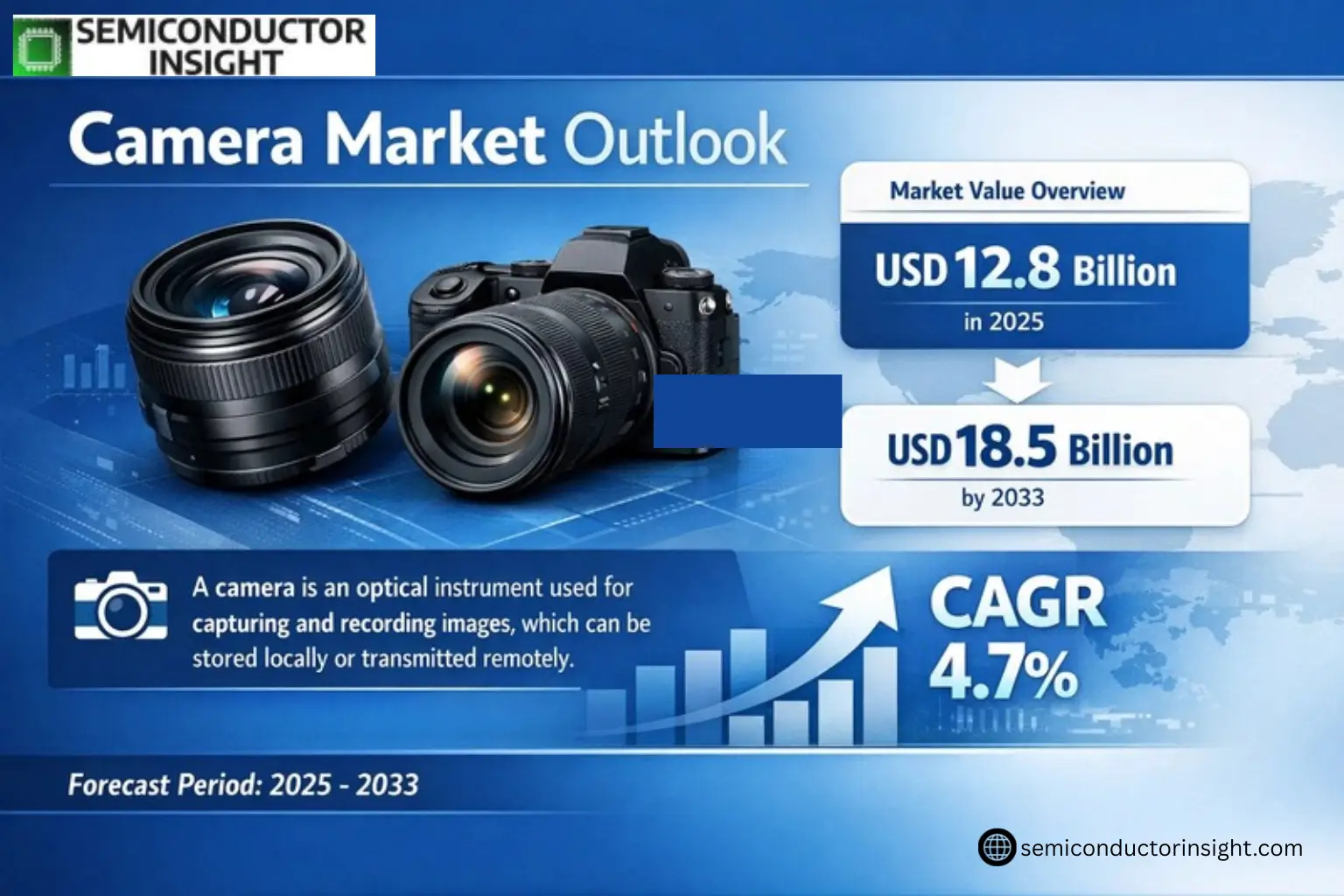
Global Camera Market was valued at USD 12.8 billion in 2025 and is projected to reach USD 18.5 billion by 2033, exhibiting a CAGR of 4.7% during the forecast period.
A camera is an optical instrument used for capturing and recording images, which can be stored locally or transmitted remotely. These images may be individual still photographs or sequences forming videos. The device operates as a remote sensor, capturing subjects without physical contact. Modern cameras have evolved from the camera obscura, an early mechanism for projecting images onto surfaces.
The market growth is driven by increasing demand for high-quality imaging in smartphones, rising popularity of content creation platforms, and advancements in mirrorless camera technology. However, the industry faces challenges from smartphone camera improvements reducing standalone device purchases. Key players like Canon, Nikon, and Sony continue innovating with features such as enhanced autofocus systems and higher resolution sensors to maintain market position.
MARKET DRIVERS
Rising Demand for High-Quality Imaging
Camera Market is experiencing growth due to increasing consumer demand for high-resolution photography and video recording. Smartphone camera advancements have fueled expectations for professional-grade imaging across all devices, pushing manufacturers to innovate. Global shift toward content creation, especially on platforms like YouTube and Instagram, has further accelerated this demand.
Technological Advancements in Mirrorless Cameras
Mirrorless cameras continue to dominate the Camera Market, offering compact designs, superior autofocus, and 8K video capabilities. Major brands are investing heavily in AI-powered features like real-time tracking and eye-detection, enhancing user experience. The transition from DSLRs to mirrorless systems has created a 23% year-on-year growth segment.
Additionally, the integration of computational photography techniques traditionally seen in smartphones is now expanding into dedicated cameras, improving low-light performance and dynamic range.
MARKET CHALLENGES
Smartphone Camera Competition
Camera Market faces intense competition from increasingly sophisticated smartphone cameras, which now feature multi-lens systems and AI-enhanced processing. Over 65% of consumers prioritize smartphone photography over standalone cameras for casual use, impacting entry-level camera sales.
Other Challenges
Supply Chain Disruptions
Semiconductor shortages and logistics delays have constrained production capacities, leading to longer lead times for high-end camera models and components.
Declining DSLR Segment
DSLR sales have dropped by nearly 30% as professionals and enthusiasts shift toward mirrorless systems, forcing manufacturers to reevaluate product portfolios.
MARKET RESTRAINTS
High Cost of Advanced Camera Systems
The premium pricing of professional camera equipment, especially full-frame mirrorless bodies and high-quality lenses, remains a significant barrier for mass adoption. Prices for flagship models often exceed USD 3,000, limiting purchases to professionals and serious enthusiasts.
MARKET OPPORTUNITIES
Expansion in Emerging Markets
Countries in Asia-Pacific and Latin America show growing interest in photography gear, with mid-range camera sales increasing by 14% year-on-year. Affordable mirrorless models and renewed interest in vlogging present untapped potential. Camera Market brands are expanding localized marketing and distribution channels to capture this demand.
MAIN TITLE HERE () Trends
Digital Photography Drives Camera Market Growth
Global Camera Market, valued at USD XX million in 2025, is projected to reach USD XX million by 2033, growing at a CAGR of X.X%. The digital camera segment dominates the market, expected to reach USD XX million by 2033. Technological advancements in mirrorless cameras and AI-powered imaging systems are accelerating market expansion.
Other Trends
Market Segmentation by Application
Security applications account for XX% of the market share, followed by professional photography at XX%. The growing demand for surveillance systems and the rise of content creation are fueling growth across these segments.
Regional Market Developments
Asia-Pacific leads the global Camera Market with XX% share in 2025, driven by strong demand from China and Japan. North America follows with XX% market share, where the U.S. remains the largest consumer of professional imaging equipment. Europe shows steady growth at X.X% CAGR, with Germany and the UK as key markets.
Competitive Landscape
Manufacturer Strategies
Canon, Nikon, and Sony collectively hold over XX% of the global Camera Market revenue. Companies are focusing on mirrorless technology, with Sony leading in full-frame mirrorless adoption. Product innovation and strategic partnerships are key growth strategies among top players.
Emerging Technology Trends
The integration of AI and computational photography is transforming camera capabilities. Market leaders are investing heavily in AI-powered autofocus systems and real-time image processing. The shift from DSLR to mirrorless systems continues, with XX% of new camera sales projected to be mirrorless by 2026.
COMPETITIVE LANDSCAPE
Key Industry Players
Global Camera Market Dominated by Imaging Giants and Niche Specialists
Global Camera Market is led by Japanese conglomerates Canon and Nikon, which collectively hold over 40% market share in 2025. Canon maintains dominance through its EOS DSLR and mirrorless systems, while Nikon leverages its Z-mount technology. Sony has aggressively captured market share with its Alpha series, particularly in the mirrorless segment. The market structure shows consolidation among top players but maintains healthy competition across price segments.
Specialist manufacturers like Leica and Fujifilm cater to premium and professional segments with medium-format systems. Action camera pioneer GoPro continues to lead the adventure photography niche, while OM Digital Solutions (formerly Olympus) maintains strong positions in micro four-thirds systems. Emerging Chinese brands like DJI are gaining traction in drone-mounted and specialized industrial camera segments.
List of Key Camera Companies Profiled
- Canon Inc.
- Nikon Corporation
- Sony Group Corporation
- Fujifilm Holdings
- Leica Camera AG
- OM Digital Solutions
- Ricoh Imaging (Pentax)
- GoPro Inc.
- Panasonic Corporation
- Hasselblad
- DJI
- Sigma Corporation
- Blackmagic Design
- Phase One
- ZEISS
Segment Analysis:
| Segment Category | Sub-Segments | Key Insights |
| By Type |
|
Digital Camera dominates the market due to:
|
| By Application |
|
Security Applications lead market demand because:
|
| By End User |
|
Professional Photographers represent the most valuable segment due to:
|
| By Technology |
|
Mirrorless Technology is gaining rapid adoption due to:
|
| By Distribution Channel |
|
Online Retail shows strongest growth because:
|
Regional Analysis: Global Camera Market
Japan maintains its position as the camera technology hub, with leading brands investing heavily in R&D. The country’s precision engineering capabilities support high-end camera production. Local manufacturers are pioneering advances in sensor technology and image processing algorithms.
China serves as a production base for many global camera brands while developing its own competitive manufacturers. The country benefits from complete supply chain integration and cost advantages. Government support for technology sectors is boosting domestic camera innovation.
South Korea is emerging as both a manufacturing and consumption hub, with strong demand for premium camera equipment. Local brands are gaining recognition in the mirrorless segment. The country’s advanced digital infrastructure supports online camera sales and content creation culture.
Countries like Vietnam and Thailand are becoming important camera manufacturing locations due to cost advantages. Rising middle-class populations fuel demand for entry-level and mid-range cameras. Tourism growth also drives camera purchases in these markets.
North America
The North American Camera Market benefits from strong professional and enthusiast segments. The U.S. leads in adoption of high-end DSLR and mirrorless cameras, supported by a large content creation industry. Canada shows growing interest in outdoor and action cameras. The region sees significant innovation in computational photography technologies, with camera manufacturers collaborating with software companies. Retail distribution is well-developed, with both specialty camera stores and major electronics retailers playing important roles. The used Camera Market is particularly active in this region.
Europe
Europe maintains a stable Camera Market with Germany, UK, and France as key territories. The region has strong demand for premium compact and mirrorless cameras due to urban lifestyles. Eastern Europe shows growth potential as disposable incomes rise. European consumers value sophisticated design and advanced features in cameras. The region has strict environmental regulations influencing product design and manufacturing processes. Travel photography remains a major driver of camera sales across the continent.
South America
The South American Camera Market is characterized by price sensitivity and strong demand for entry-level models. Brazil is the largest market, with growing interest in action cameras. Economic fluctuations impact consumer purchasing power, making installment payment options important. The used Camera Market is significant due to affordability concerns. Local retailers play a crucial role in distribution, though e-commerce is growing. Camera manufacturers are adapting products for local conditions including weather resistance and durability.
Middle East & Africa
This region shows diversification across markets, with Gulf countries focused on premium camera equipment while North Africa favors affordable options. The UAE serves as a regional hub for professional photography equipment. Tourism activities create demand for rugged and waterproof cameras. South Africa has a growing community of photography enthusiasts. Infrastructure challenges affect distribution in some areas, favoring established brands with strong local presence.
Report Scope
This market research report provides a comprehensive analysis of the Camera Market, covering the forecast period 2025–2033. It offers detailed insights into market dynamics, technological advancements, competitive landscape, and key trends shaping the industry.
Key focus areas of the report include:
- Market Overview: The report begins with an overview outlining its current market scenario, key growth indicators, and industry transformation drivers. It discusses macroeconomic factors, demand–supply balance, regulatory landscape, and the strategic role of semiconductors in powering advancements across industries such as automotive, telecommunications, consumer electronics, and industrial automation.
- Market Size & Forecast: Historical data and future projections for revenue, unit shipments, and market value across major regions and segments.
- Segmentation Analysis: Detailed breakdown by product type, technology, application, and end-user industry to identify high-growth segments and investment opportunities.
- Regional Insights: Insights into market performance across North America, Europe, Asia-Pacific, Latin America, and the Middle East & Africa, including country-level analysis where relevant.
- Competitive Landscape: Profiles of leading market participants, including their product offerings, R&D focus, manufacturing capacity, pricing strategies, and recent developments such as mergers, acquisitions, and partnerships.
- Technology Trends & Innovation: Assessment of emerging technologies, integration of AI/IoT, semiconductor design trends, fabrication techniques, and evolving industry standards.
- Market Drivers & Restraints: Evaluation of factors driving market growth along with challenges, supply chain constraints, regulatory issues, and market-entry barriers.
- Stakeholder Insights: Insights for component suppliers, OEMs, system integrators, investors, and policymakers regarding the evolving ecosystem and strategic opportunities.
Primary and secondary research methods are employed, including interviews with industry experts, data from verified sources, and real-time market intelligence to ensure the accuracy and reliability of the insights presented.
FREQUENTLY ASKED QUESTIONS:
What is the current market size of the Camera Market?
-> Camera Market was valued at USD 12.8 billion in 2025 and is projected to reach USD 18.5 billion by 2033, exhibiting a CAGR of 4.7% during the forecast period.
What is the growth rate of the Camera Market?
-> The market is expected to grow at a CAGR of % during the forecast period 2025-2033.
Which are the key players in the Camera Market?
-> Key players include Canon, Nikon, Pentax, Sony, Olympus, Fujifilm, GoPro, and Leica, among others.
Which segment leads the Camera Market by type?
-> The digital camera segment is projected to reach USD million by 2033, growing at a CAGR of % over the next six years.
Which regions are analyzed in this report?
-> The report covers North America, Europe, Asia-Pacific, Latin America, and Middle East & Africa, with country-level analysis for major markets.

Get Sample Report PDF for Exclusive Insights
Report Sample Includes
- Table of Contents
- List of Tables & Figures
- Charts, Research Methodology, and more...
 Download Sample Report PDF