Archival Grade Blu-ray Discs Market Insights
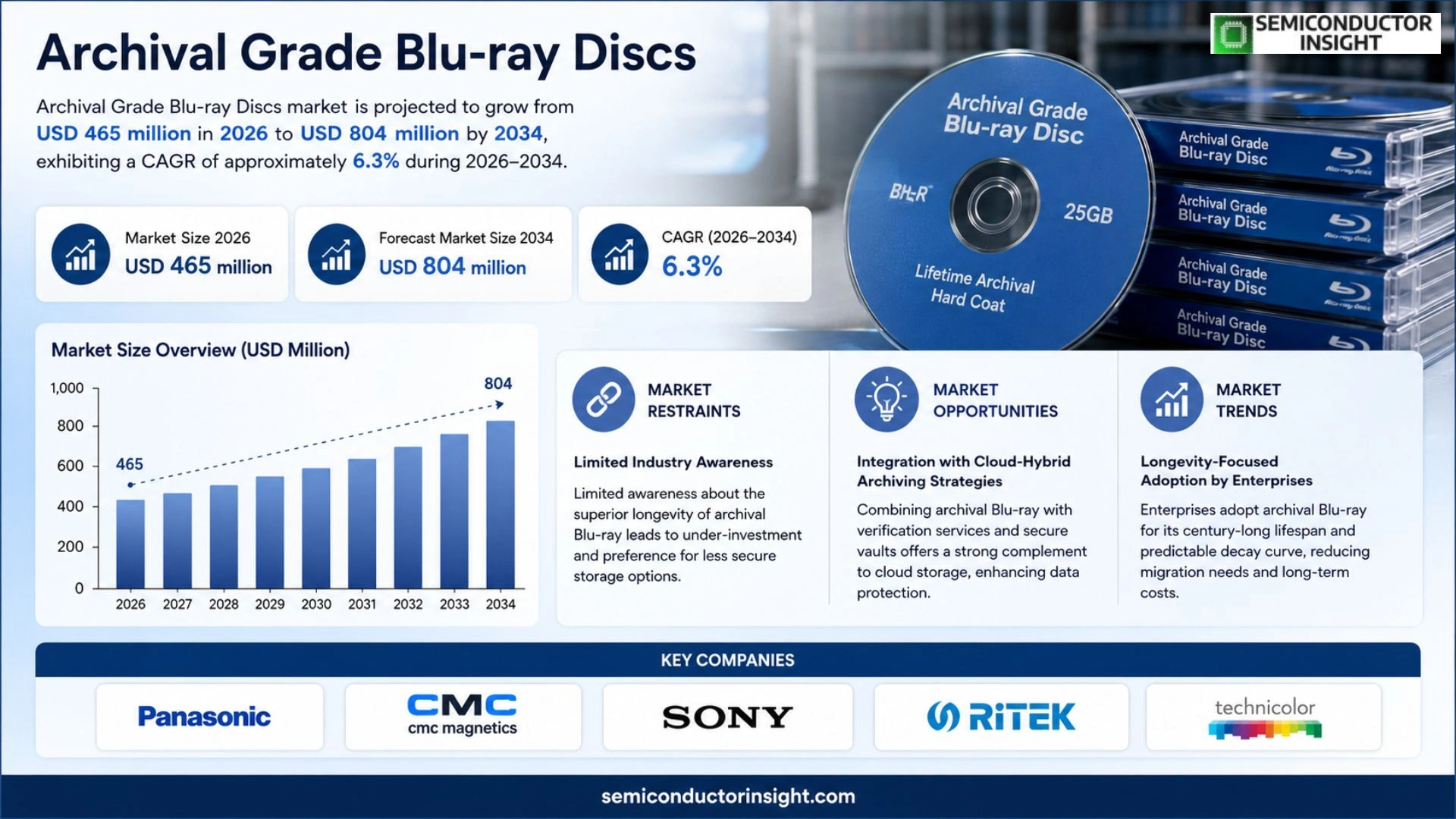
Archival Grade Blu-ray Discs market size was valued at USD 438 million in 2024. The market is projected to grow from USD 465 million in 2026 to USD 804 million by 2034, exhibiting a CAGR of approximately 6.3% during the forecast period.
Archival Grade Blu-ray Discs are high‑stability optical storage media designed to retain digital information for decades, with some specifications promising data integrity for up to one hundred years.
The sector benefits from increasing demand for long‑term data preservation across enterprises, research institutions, and cultural archives because physical degradation of conventional media remains a concern. Recent collaborations among manufacturers such as Panasonic and Sony aim to enhance disc longevity through advanced silica layers, while heightened regulatory focus on digital heritage encourages procurement of archival‑grade solutions.
MARKET DRIVERS
Long‑Term Data Preservation Needs
Enterprises handling legal, medical, or cultural archives increasingly prioritize media that can survive decades without degradation. Archival Grade Blu-ray Discs offer a silica‑based substrate that resists humidity and temperature swings, making them a preferred choice over conventional optical formats that exhibit higher error rates after ten years of storage.
Growth of 4K Content and Master Copies
The rise of 4K ultra‑high‑definition productions has amplified the demand for high‑capacity, lossless storage solutions. Studios and post‑production houses need a medium that can hold up to 200 GB of uncompressed data while ensuring integrity for future re‑releases; Archival Grade Blu-ray Discs meet that requirement without incurring the high costs associated with magnetic tape migrations.
➤ “Reliability over three decades has become the decisive factor for institutions that cannot afford data loss.”
Regulatory pressures, especially in sectors such as pharmaceuticals, now require proof of data preservation for audit cycles extending beyond 15 years. Companies that adopt robust optical archives can demonstrate compliance while avoiding expensive redundant storage architectures.
MARKET CHALLENGES
Compatibility with Emerging Playback Devices
While Archival Grade Blu-ray Discs excel in longevity, the shrinking market for dedicated Blu‑ray readers poses a logistical hurdle. Many organizations lack the hardware to routinely verify disc health, leading to potential blind spots in data integrity checks.
Other Challenges
Cost Sensitivity
The premium pricing of archival‑grade optical media,often 30 % higher than standard Blu‑ray discs,creates budgetary constraints for mid‑size firms that must balance preservation goals with immediate operational expenditures.
MARKET RESTRAINTS
Limited Industry Awareness
Decision‑makers outside of niche archival circles frequently underestimate the durability gap between archival and consumer‑grade optical media, resulting in under‑investment and reliance on less secure storage alternatives.
MARKET OPPORTUNITIES
Integration with Cloud‑Hybrid Archiving Strategies
Providers that bundle Archival Grade Blu-ray Discs with managed verification services and secure off‑site vaults can tap into organizations seeking a layered defense against ransomware and cyber‑theft, positioning the optical format as a complementary safeguard to cloud repositories.
Archival Grade Blu-ray Discs Market Trends
Longevity‑Focused Adoption by Enterprises
Enterprises that manage critical research archives, legal records, or cultural assets are turning to archival‑grade optical media because it offers a predictable decay curve that can extend well beyond a century. The guarantee of data integrity without the need for periodic migration lowers long‑term total cost of ownership, especially for organizations with limited IT staffing. As data‑center power costs climb, the modest energy footprint of passive storage further reinforces the business case. Companies that have historically relied on tape libraries are now evaluating a hybrid approach, positioning optical discs as a “cold‑storage anchor” that complements cloud tiering strategies. This shift is reflected in procurement patterns that emphasize volume discounts for 100 GB and 200 GB formats, signalling a maturation of the supply chain.
Other Trends
Shift Toward Higher Capacity Formats
The industry’s roadmap shows a steady gravitation from legacy 50 GB discs to 200 GB and 300 GB offerings. Manufacturers such as Panasonic, Sony, and Ritek have introduced multi‑layer architectures that retain the same error‑correction standards while expanding payload. Higher capacity reduces the physical footprint of archival libraries, a benefit for organizations facing space constraints in legacy vaults. Moreover, the larger per‑unit data ratio improves logistics efficiency, decreasing handling cycles and associated labor costs. Buyers are therefore ordering mixed‑capacity shipments to balance short‑term demand for rapid‑access items with long‑term preservation needs.
Geographic Concentration of Production and Demand
Production capacity remains clustered in East Asia, where firms benefit from established optical‑media fabs and a skilled labor base. Meanwhile, demand is accelerating in North America and Europe, driven by regulatory pressures on data retention and a growing emphasis on cultural heritage digitization. This geographic mismatch is prompting strategic joint ventures that locate assembly lines closer to end users, shortening lead times and reducing freight expenses. The emerging partnership model also facilitates technology transfer, allowing regional players to adopt the latest multilayer coating techniques without rebuilding full‑scale facilities.
COMPETITIVE LANDSCAPE
Key Industry Players
Archival Grade Blu‑ray Discs Competitive Overview
Panasonic commands the upper tier of the archival disc market, leveraging its proprietary high‑density recording layer to produce 100 GB and 300 GB formats that meet the most stringent longevity claims. The firm’s extensive patent portfolio restricts entry for new competitors and allows Panasonic to negotiate premium pricing with large‑scale institutional buyers such as national archives and cloud‑storage providers. Its vertically integrated supply chain,spanning thin‑film coating, mastering, and distribution,reduces lead‑time and sustains a cost advantage that translates into a sizable share of global revenue. The company’s recent investment in cryogenic storage compatibility underscores a strategic push to align optical media with emerging cold‑storage architectures, a move that could reshape procurement criteria for enterprises seeking multi‑decadal data preservation.
Beyond the market leader, a constellation of specialized manufacturers creates a fragmented but dynamically competitive environment. CMC Magnetics concentrates on the 50 GB segment, offering low‑cost media that satisfy budget‑constrained university libraries and regional archives. Sony capitalizes on its legacy optical‑media brand by bundling archival discs with hybrid drive solutions that fit into existing data‑center racks, thereby lowering integration friction. Ritek’s expansive distribution network across Southeast Asia accelerates adoption among broadcasters and government agencies. Technicolor distinguishes itself through color‑coded labeling and bespoke print services, attracting museums and cultural institutions that require visual traceability. New Cyberian Systems targets European research labs with environmentally certified production processes, while CDA GmbH and CD Video Manufacturing focus on German‑language markets, emphasizing compliance with DIN standards. Smartbuy operates a robust e‑commerce platform that aggregates small‑batch orders, giving niche players a viable sales channel. Tongfang leverages Chinese manufacturing scale to serve domestic cloud operators, and Lenovo together with Tsinghua Unigroup has begun bundling archival discs with high‑performance compute platforms, hinting at a convergence of storage and processing assets. Centurion, Nanjing Superstack, and Beijing Shengzan round out the field by supplying region‑specific solutions for government digitization projects, thereby reinforcing the market’s geographic diversification and creating multiple avenues for partners to capture value.
List of Key Archival Grade Blu-ray Discs Companies Profiled
- Panasonic
- CMC Magnetics
- Sony
- Ritek
- Technicolor
- New Cyberian Systems
- CDA GmbH
- CD Video Manufacturing
- Smartbuy
- Tongfang
- Lenovo
- Tsinghua Unigroup
- Centurion
- Nanjing Superstack
- Beijing Shengzan
Segment Analysis:
| Segment Category | Sub-Segments | Key Insights |
| By Type |
|
High‑Capacity 200G‑300G is considered the leading segment because it balances long‑term stability with substantial data density.
|
| By Application |
|
Enterprise Data Preservation dominates this category as large corporations seek reliable media for regulatory compliance and disaster‑recovery archives.
|
| By End User |
|
Government Archives emerge as the leading end‑user segment due to statutory mandates for long‑term retention of official records.
|
| By Storage Environment |
|
Controlled Climate is the preferred environment because it maximizes the disc’s engineered lifespan.
|
| By Distribution Channel |
|
Specialized Distributors lead this segment because they provide value‑added services such as certification, custom packaging, and technical support.
|
Regional Analysis: Archival Grade Blu-ray Discs Market
North America
Domestic coating plants have expanded line capacity to meet increasing demand from archival stakeholders, allowing quicker turn‑around for custom orders. Facility upgrades focus on contamination‑free environments, which are essential for maintaining the disc’s claimed lifespan.
A diversified supplier base for the polymer substrates and metal layers mitigates risk of single‑point failures. Regional logistics firms specialize in temperature‑controlled transport, preserving disc integrity during long hauls.
Federal guidelines on data preservation endorse physical media as a compliant backup option, prompting federal archives to allocate funds for high‑grade Blu‑ray discs. Compliance checks focus on burn‑error rates and disc durability metrics.
Universities and research institutes have incorporated archival discs into their data‑management policies, citing the medium’s resistance to bit‑rot and its suitability for long‑term offline storage.
Europe
European cultural institutions, particularly in the United Kingdom and Germany, have embraced Archival Grade Blu-ray Discs market as a safeguard against digital obsolescence. Funding programs from the European Union emphasize the preservation of heritage collections, prompting museums to adopt optical media for high‑resolution video archiving. Cross‑border collaborations between disc manufacturers and audiovisual archivists have yielded standards that harmonize encoding practices across member states. While the region faces pressure from stringent environmental regulations, manufacturers are responding with recyclable disc sleeves and greener production techniques, aligning sustainability goals with preservation needs.
Asia‑Pacific
In the Asia‑Pacific sphere, emerging archival projects in South Korea, Japan, and Australia have sparked modest growth for Archival Grade Blu-ray Discs market. Government‑backed digitization drives prioritize the retention of early television broadcasts and historic film reels, where optical media remains a trusted fallback. Local manufacturers leverage advanced laser‑etching technology to enhance pit accuracy, offering a competitive edge over imported alternatives. Nonetheless, the rapid expansion of cloud‑based storage solutions introduces a strategic tension, pushing archival managers to balance cost, redundancy, and physical media reliability.
South America
South American archives are beginning to recognize the value of archival‑grade optical discs as a counterbalance to limited broadband infrastructure. National film institutes in Brazil and Argentina have initiated pilot programs that test disc durability under tropical humidity, adapting coating formulations to local climate challenges. Partnerships with North American suppliers facilitate technology transfer, allowing regional players to meet international preservation standards without extensive capital outlays. The nascent market is still constrained by budgetary pressures, yet the tangible benefits of offline storage keep the medium relevant.
Middle East & Africa
Across the Middle East and Africa, preservation initiatives are still in their infancy, but several governmental archives are evaluating archival Blu‑ray solutions for safeguarding oil‑industry records and cultural artifacts. Climate‑controlled vaults in the United Arab Emirates have demonstrated that, with proper handling, the discs can endure extreme temperature swings. African research consortia, confronting unreliable power grids, view physical media as a dependable fallback when digital repositories become inaccessible. Early adoption is largely driven by donor‑funded projects that seek durable, low‑maintenance storage options.
Report Scope
This market research report provides a comprehensive analysis of the Archival Grade Blu-ray Discs Market , covering the forecast period 2026–2034. It offers detailed insights into market dynamics, technological advancements, competitive landscape, and key trends shaping the industry.
Key focus areas of the report include:
- Market Overview: The report begins with an overview outlining its current market scenario, key growth indicators, and industry transformation drivers. It discusses macroeconomic factors, demand–supply balance, regulatory landscape, and the strategic role of semiconductors in powering advancements across industries such as automotive, telecommunications, consumer electronics, and industrial automation.
- Market Size & Forecast: Historical data and future projections for revenue, unit shipments, and market value across major regions and segments.
- Segmentation Analysis: Detailed breakdown by product type, technology, application, and end-user industry to identify high-growth segments and investment opportunities.
- Regional Insights: Insights into market performance across North America, Europe, Asia-Pacific, Latin America, and the Middle East & Africa, including country-level analysis where relevant.
- Competitive Landscape: Profiles of leading market participants, including their product offerings, R&D focus, manufacturing capacity, pricing strategies, and recent developments such as mergers, acquisitions, and partnerships.
- Technology Trends & Innovation: Assessment of emerging technologies, integration of AI/IoT, semiconductor design trends, fabrication techniques, and evolving industry standards.
- Market Drivers & Restraints: Evaluation of factors driving market growth along with challenges, supply chain constraints, regulatory issues, and market-entry barriers.
- Stakeholder Insights: Insights for component suppliers, OEMs, system integrators, investors, and policymakers regarding the evolving ecosystem and strategic opportunities.
Primary and secondary research methods are employed, including interviews with industry experts, data from verified sources, and real-time market intelligence to ensure the accuracy and reliability of the insights presented.
FREQUENTLY ASKED QUESTIONS:
What is the current market size of Archival Grade Blu-ray Discs Market?
-> Archival Grade Blu-ray Discs market is projected to grow from USD 465 million in 2026 to USD 804 million by 2034, exhibiting a CAGR of approximately 6.3%
Which key companies operate in Archival Grade Blu-ray Discs Market?
-> Key players include Panasonic, CMC Magnetics, Sony, Ritek, Technicolor, New Cyberian Systems, CDA GmbH, CD Video Manufacturing, Smartbuy, Tongfang, among others.
What are the key growth drivers?
-> Key growth drivers include the need for long‑term data preservation, the ability of discs to retain data without loss for up to 100 years, increasing adoption by archival institutions, and rising demand for durable optical storage solutions.
Which region dominates the market?
-> Asia-Pacific is expected to lead the market due to its strong manufacturing base and growing archival requirements, while North America and Europe also show significant demand.
What are the emerging trends?
-> Emerging trends include development of higher‑capacity discs such as 50G and 100G, use of advanced polymer substrates for enhanced longevity, and a shift toward sustainable production processes.
Get Sample Report PDF for Exclusive Insights
Report Sample Includes
- Table of Contents
- List of Tables & Figures
- Charts, Research Methodology, and more...
 Download Sample Report PDF