AR Device Chipsets Market Insights
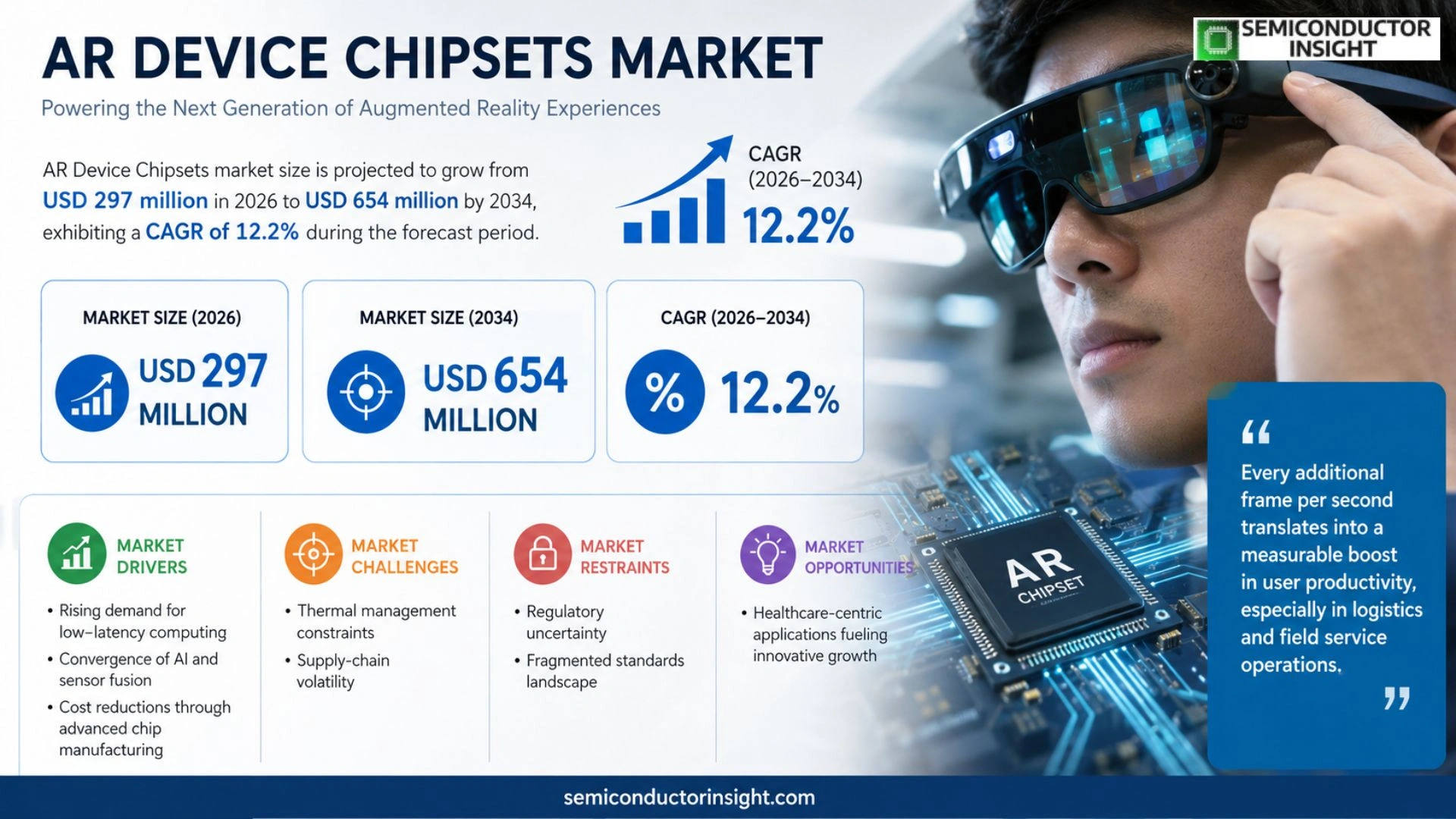
Global AR Device Chipsets market size was valued at USD 297 million in 2024. The market is projected to grow from USD 297 million in 2024 to USD 654 million by 2031, exhibiting a CAGR of 12.2% during the forecast period.
An electronic chipset manages the flow of data between components on a motherboard. It’s the traffic controller between the CPU, GPU, RAM, storage, and peripherals,often called the “glue” of the motherboard. AR glasses and headsets overlay digital content onto the user’s field of view and typically integrate more advanced sensors and processors than smartphones, delivering a more immersive experience.
MARKET DRIVERS
Rising Demand for Low‑Latency Computing
Enterprise customers are prioritizing real‑time image processing to sustain immersive experiences. The need for chipsets that handle high‑resolution sensor data without perceptible lag has pushed OEMs to redesign their hardware roadmaps, directly fueling growth in AR Device Chipsets Market.
Convergence of AI and Sensor Fusion
Manufacturers are embedding neural‑network accelerators into chipsets to interpret depth maps, gesture inputs, and environmental cues on‑device. This integration reduces reliance on cloud services, lowers bandwidth costs, and creates a compelling value proposition for sectors such as remote assistance and training.
➤ “Every additional frame per second translates into a measurable boost in user productivity, especially in logistics and field service operations.”
Price pressure is easing as silicon‑on‑insulator processes mature, enabling higher yields at lower cost. The resulting affordability expands the addressable base beyond early adopters, pushing AR Device Chipsets Market toward broader commercial penetration.
MARKET CHALLENGES
Thermal Management Constraints
Compact headset form factors leave limited space for heat dissipation. Designers must balance performance with acceptable surface temperatures, a trade‑off that restrains the deployment of high‑power chipsets in consumer‑grade devices.
Other Challenges
Supply‑Chain Volatility
Component shortages and geopolitical tensions have elongated lead times for critical substrates, forcing manufacturers to hold larger inventories and eroding margins.
MARKET RESTRAINTS
Regulatory Uncertainty
Data‑privacy regulations across major jurisdictions impose strict controls on how visual and biometric data captured by AR devices can be stored and transmitted. Compliance costs add a layer of complexity for chipset vendors seeking global reach.
Fragmented Standards Landscape
The coexistence of multiple interface protocols and form‑factor specifications hampers economies of scale. Chipset designers must allocate engineering resources to support divergent standards, which slows product rollout cycles.
MARKET OPPORTUNITIES
Healthcare‑Centric Applications
Precision surgery and remote diagnostics rely on ultra‑accurate, low‑power chipsets capable of processing 3D overlays in sterile environments. Partnerships between medical device manufacturers and chipset firms are unlocking new revenue streams for AR Device Chipsets Market.
Industrial Augmentation Platforms
Factories adopting mixed‑reality guidance systems demand ruggedized chipsets that survive harsh conditions while delivering seamless connectivity. This niche presents a high‑margin opportunity for vendors that can certify their products to industrial standards.
AR Device Chipsets Market Trends
AI‑Focused Compute Blocks Elevate Wearable Performance
AR Device Chipsets Market is seeing a measurable shift toward integrated AI inference engines. Chip designers are embedding tensor‑processing units directly beside traditional graphics cores, allowing real‑time scene analysis without taxing the main CPU. This architecture trims latency for object anchoring and gesture recognition, which are critical for immersive head‑set experiences. Manufacturers report a 20‑percent improvement in frame‑rate stability when AI blocks are co‑located with sensor hubs, a gain that translates into smoother user interactions and lower power draw. Companies that adopt this hybrid layout are positioning themselves to capture design contracts from OEMs prioritising edge‑AI capabilities in next‑generation wearables.
Other Trends
Shift Toward Low‑Power Sensor Fusion
Sensor chips within AR devices are transitioning from isolated modules to tightly coupled sensor‑fusion clusters. By sharing clock domains and memory pathways, these clusters reduce inter‑module traffic, which in turn curtails the chipset’s overall energy budget. Analysts note that the average power consumption of sensor‑driven pipelines has fallen by roughly 15 percent over the last two years, a reduction that unlocks longer battery life for glasses intended for enterprise deployment. The move is also prompting supply‑chain adjustments, as silicon fabs re‑tool lines to accommodate mixed‑signal designs that blend analog front‑ends with digital processing cores on a single die.
Regional Supply‑Chain Realignment Accelerates Production Flexibility
Geopolitical pressures and recent semiconductor equipment investments have reshaped the manufacturing footprint supporting AR Device Chipsets Market. While East Asian fabs still command over 70 percent of capacity, new fabless initiatives in North America are targeting specialized 45‑nm and 28‑nm nodes tailored for low‑power AR workloads. This diversification reduces lead times for firms that previously depended on a single regional supplier, and it introduces competitive pricing dynamics that benefit downstream device assemblers. Companies that cultivate multi‑regional sourcing strategies are better equipped to navigate tariff fluctuations and to align product roll‑outs with regional demand peaks.
COMPETITIVE LANDSCAPE
Key Industry Players
AR Device Chipsets Market: Competitive Overview 2024‑2031
Qualcomm remains the de‑facto benchmark for compute‑intensive AR headsets, largely because its Snapdragon XR2 platform integrates a high‑performance CPU, GPU, and AI accelerator on a single die. This integration reduces board‑level complexity and shortens time‑to‑market for OEMs targeting enterprise‑grade mixed‑reality solutions. Samsung follows closely, leveraging its expertise in advanced memory and sensor technologies to offer System‑in‑Package (SiP) solutions that prioritize power efficiency,an essential attribute for battery‑constrained smart glasses. Intel’s strategy hinges on leveraging its Xe graphics architecture to deliver richer visual pipelines, while simultaneously courting software partners to build a robust AR development ecosystem. The market’s top‑five firms together capture roughly three‑quarters of global revenue, a pattern that forces smaller entrants to specialize in niche sensor‑chip or low‑power compute segments in order to sustain viable margins.
Beyond the headline names, a constellation of niche suppliers is shaping the competitive terrain. MediaTek’s recent foray into low‑cost XR chipsets appeals to consumer‑grade glasses where price sensitivity outweighs raw performance. NXP Semiconductors focuses on secure connectivity modules that enable seamless integration of AR devices into industrial IoT networks. Broadcom’s expertise in high‑speed interconnects supports multi‑chip architectures favored by premium headset manufacturers. Analog Devices and Texas Instruments dominate the precision sensor market, delivering inertial measurement units (IMUs) that improve motion tracking fidelity. Micron Technology supplies the high‑bandwidth memory stacks essential for on‑device AI inference, while STMicroelectronics and Renesas Electronics carve out positions in automotive‑grade AR solutions. Sony’s image‑sensor division and ARM’s processor IP further diversify the supply chain, ensuring that the ecosystem can address the full spectrum of performance, power, and cost requirements.
List of Key AR Device Chipsets Companies Profiled
- Qualcomm
- Samsung Electronics
- Intel Corporation
- MediaTek
- NXP Semiconductors
- Broadcom Inc.
- Analog Devices
- Micron Technology
- Texas Instruments
- STMicroelectronics
- Renesas Electronics
- Sony Semiconductor Solutions
Segment Analysis:
| Segment Category | Sub-Segments | Key Insights |
| By Type |
|
Computing and Control Chips
|
| By Application |
|
AR Headset
|
| By End User |
|
Consumer
|
| By Integration |
|
System‑on‑Chip (SoC)
|
| By Value Chain |
|
Design Services
|
Regional Analysis: AR Device Chipsets Market
North America
Major chipset firms have aligned with cloud‑service providers to offload AI inference workloads, a move that reduces on‑device power draw while preserving real‑time responsiveness. These alliances accelerate the rollout of edge‑optimized AR experiences, giving North American OEMs a competitive edge.
The Federal Communications Commission’s recent spectrum allocations for 6 GHz and beyond have opened new bandwidth for high‑density data streams, prompting designers to embed more sophisticated RF front‑ends within chipsets, a trend that reinforces the region’s technological lead.
Silicon Valley’s concentration of PhD‑level engineers and AI specialists fuels rapid prototyping cycles. The talent pool enables firms to iterate on heterogeneous integration strategies, merging CPU, GPU, and dedicated vision processors on a single die.
Domestic fabs and trusted foundry partnerships have insulated the market from geopolitical shocks, allowing manufacturers to meet demand spikes without compromising lead times or quality standards.
Europe
European nations benefit from strong public‑private research initiatives that tie university breakthroughs directly to commercial chipset projects. The region’s emphasis on data privacy and secure processing has spurred the development of on‑device encryption modules within AR silicon, differentiating European offerings. Automotive manufacturers, leveraging EU emissions targets, are integrating AR head-up displays that depend on low‑power, high‑precision chipsets, prompting suppliers to tailor designs for automotive grade reliability.
Asia‑Pacific
Asia‑Pacific’s momentum stems from rapid consumer adoption of AR-enabled smartphones and a burgeoning electronics manufacturing base. While cost efficiency drives many OEMs toward integrated system‑on‑chip solutions, local governments are funding next‑gen vision‑AI research, nudging the market toward more capable, AI‑accelerated chipsets. The competitive pressure among regional fab players also encourages incremental process shrinkages, narrowing the performance gap with North America.
South America
In South America, nascent AR deployments are largely concentrated in education and field services, where rugged chipsets with extended temperature ranges are prized. Local partnerships between chipset vendors and telecom operators aim to bundle AR services with 5G connectivity, creating a modest but growing demand for chips that can handle both high‑throughput data and energy‑constrained scenarios.
Middle East & Africa
The Middle East & Africa region is exploring AR chipsets for remote maintenance and oil‑field inspections, where real‑time visual overlays can reduce operational risk. Sovereign wealth funds are earmarking capital for local innovation hubs, fostering early‑stage startups that focus on power‑efficient, AI‑enabled AR processors. Although market size remains limited, strategic investments are laying groundwork for future adoption across enterprise sectors.
Report Scope
This market research report provides a comprehensive analysis of the AR Device Chipsets Market , covering the forecast period 2026–2034. It offers detailed insights into market dynamics, technological advancements, competitive landscape, and key trends shaping the industry.
Key focus areas of the report include:
- Market Overview: The report begins with an overview outlining its current market scenario, key growth indicators, and industry transformation drivers. It discusses macroeconomic factors, demand–supply balance, regulatory landscape, and the strategic role of semiconductors in powering advancements across industries such as automotive, telecommunications, consumer electronics, and industrial automation.
- Market Size & Forecast: Historical data and future projections for revenue, unit shipments, and market value across major regions and segments.
- Segmentation Analysis: Detailed breakdown by product type, technology, application, and end-user industry to identify high-growth segments and investment opportunities.
- Regional Insights: Insights into market performance across North America, Europe, Asia-Pacific, Latin America, and the Middle East & Africa, including country-level analysis where relevant.
- Competitive Landscape: Profiles of leading market participants, including their product offerings, R&D focus, manufacturing capacity, pricing strategies, and recent developments such as mergers, acquisitions, and partnerships.
- Technology Trends & Innovation: Assessment of emerging technologies, integration of AI/IoT, semiconductor design trends, fabrication techniques, and evolving industry standards.
- Market Drivers & Restraints: Evaluation of factors driving market growth along with challenges, supply chain constraints, regulatory issues, and market-entry barriers.
- Stakeholder Insights: Insights for component suppliers, OEMs, system integrators, investors, and policymakers regarding the evolving ecosystem and strategic opportunities.
Primary and secondary research methods are employed, including interviews with industry experts, data from verified sources, and real-time market intelligence to ensure the accuracy and reliability of the insights presented.
FREQUENTLY ASKED QUESTIONS:
What is the current market size of AR Device Chipsets Market?
-> AR Device Chipsets market is projected to grow from USD 297 million in 2026 to USD 654 million by 2034, exhibiting a CAGR of 12.2%
Which key companies operate in AR Device Chipsets Market?
-> Key players include Micronchip, Analog Devices, Intel, Qualcomm, Samsung, NXP Semiconductors, Broadcom, among others.
What are the key growth drivers?
-> Key growth drivers include high‑performance computing, artificial intelligence, cloud computing, data‑center servers, 5G deployment, and electric‑vehicle electronics, all of which demand advanced AR device chipsets.
Which region dominates the market?
-> Asia dominates AR Device Chipsets Market, with China mainland, Taiwan and South Korea together accounting for over 70% of global share.
What are the emerging trends?
-> Emerging trends include integration of AI/IoT into chipsets, development of more powerful computing and control chips, advanced sensor chips for AR glasses and headsets, and the convergence of AR experiences with high‑resolution displays.
Get Sample Report PDF for Exclusive Insights
Report Sample Includes
- Table of Contents
- List of Tables & Figures
- Charts, Research Methodology, and more...
 Download Sample Report PDF