Anti-Static Cover Tape Market Insights
Global Anti-Static Cover Tape market is forecasted to rise from USD 233 million in 2026 to USD 393 million by 2034, exhibiting a CAGR of 6 % during the forecast period.
Anti‑Static Cover Tape refers to a strip product used in electronic packaging together with carrier tape; it is typically manufactured from polyester or polypropylene film and incorporates adhesive and antistatic properties that protect components during tape‑and‑reel handling.
The sector benefits from expanding semiconductor production, heightened sensitivity to electrostatic discharge protection, and ongoing miniaturization of electronic devices, which together increase demand for reliable packaging solutions.
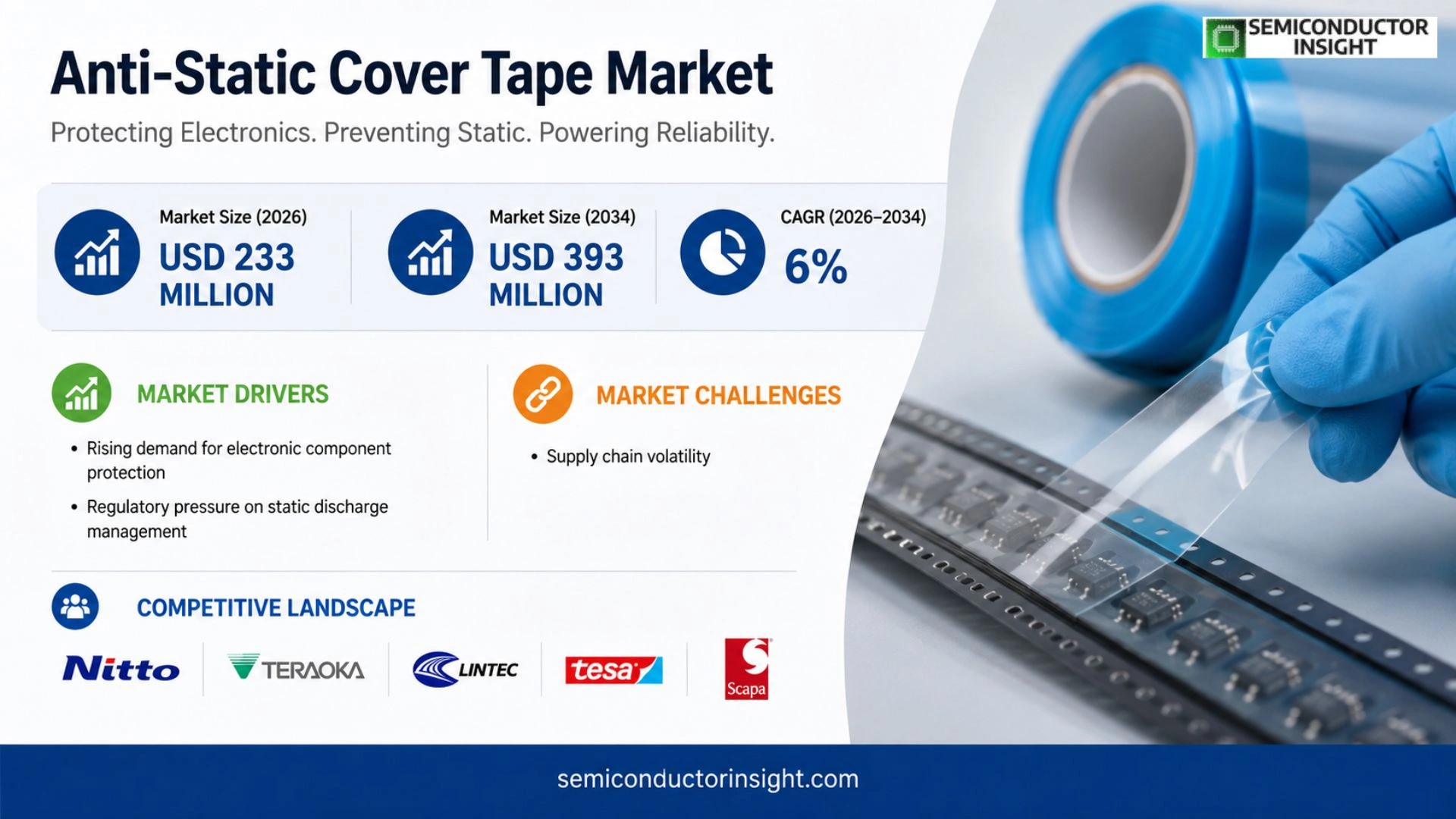
MARKET DRIVERS
Rising Demand for Electronic Component Protection
Manufacturers of semiconductors, printed‑circuit boards, and automotive electronics are intensifying their focus on static‑discharge protection as device geometries shrink below 30 µm. Anti‑Static Cover Tape offers a low‑cost barrier that can be applied directly during assembly, reducing failure rates that would otherwise erode yield. This operational advantage translates into measurable savings on rework and warranty costs, prompting procurement teams to prioritize static‑control solutions in their bill‑of‑materials.
Regulatory Pressure on Static Discharge Management
Safety standards such as IEC 61340‑5‑1 and aerospace specifications now mandate documented static‑mitigation practices. Companies that ignore these guidelines face inspection failures and potential liability. Anti‑Static Cover Tape satisfies the requirement for surface resistance control without extensive redesign, allowing firms to stay compliant while keeping production cycles intact.
➤ “Adopting anti‑static sealing solutions has become a non‑negotiable step for OEMs aiming to safeguard high‑value circuitry against electrostatic events.”
Beyond compliance, the material’s ease of integration,compatible with both manual and automated applicators,means that line‑speed upgrades can incorporate static protection without sacrificing throughput. Consequently, firms view Anti‑Static Cover Tape not merely as a safety add‑on but as an enabler of higher‑volume, higher‑reliability output.
MARKET CHALLENGES
Supply Chain Volatility
Global shortages of polymer resins and specialty additives have introduced lead‑time uncertainty for tape manufacturers. When feedstock prices fluctuate, suppliers often pass the increase onto end‑users, compressing margins for companies that rely on predictable material costs. This pressure is amplified in regions where local sourcing options are limited, compelling buyers to maintain safety stocks that tie up capital.
Other Challenges
Cost Sensitivity
Many downstream industries operate on razor‑thin profit margins, especially in consumer electronics. Even modest price hikes in Anti‑Static Cover Tape can tip the cost‑benefit equation, prompting some manufacturers to explore alternative static‑mitigation technologies such as conductive coatings or reusable grounding fixtures. The decision hinges on lifecycle cost analyses that weigh upfront material expense against long‑term reliability gains.
MARKET RESTRAINTS
Material Cost Constraints
The premium polymer blends required for consistent surface resistance are subject to raw‑material price volatility, especially when petrochemical markets experience spikes. Companies that lack strategic sourcing capabilities may encounter cost overruns, which can deter investment in Anti‑Static Cover Tape programs. Moreover, price sensitivity among small‑batch manufacturers sometimes leads them to forgo the tape altogether, opting for less expensive, albeit less reliable, static‑control measures.
MARKET OPPORTUNITIES
Emergence of Flexible Electronics
Flexible displays, wearable sensors, and roll‑to‑roll photovoltaic modules are expanding the application envelope for Anti‑Static Cover Tape. These technologies demand conformable, thin protective layers that sustain performance under repeated bending. Innovators that engineer tapes with enhanced elasticity and superior dielectric strength stand to capture a growing share of the flexible‑electronics supply chain, where static‑discharge risk is amplified by the delicate nature of the substrates.
Anti-Static Cover Tape Market Trends
Escalating Demand from Semiconductor Packaging
The surge in semiconductor output has tightened specifications for component protection, and manufacturers are opting for anti‑static cover solutions that combine adhesive reliability with electrostatic dissipation. Recent plant upgrades in China and Taiwan show a marked preference for tapes that can be integrated directly into high‑speed reel‑to‑reel lines, reducing handling time and scrap rates. As yields become more valuable, the cost of electrostatic damage translates into a measurable pressure on supply‑chain budgets, prompting buyers to prioritize tapes that guarantee consistent performance across temperature swings. This shift is reflected in the latest procurement data, where orders for pressure‑sensitive variants have risen by roughly eight percent year‑over‑year, nudging the overall Anti‑Static Cover Tape Market toward a more application‑intensive profile.
Other Trends
Emergence of Heat‑Activated Cover Tapes
Heat‑activated films are carving out a niche in advanced packaging where space constraints demand a slimmer profile. By eliminating the need for a permanent adhesive layer, these tapes enable tighter winding around miniature chips while still offering the necessary static control. Early adopters in Japan report a reduction in line changeover time of up to 15 minutes per shift, a gain that directly improves equipment utilization. Although the material cost is modestly higher than traditional pressure‑sensitive options, the operational efficiencies offset the premium, especially in high‑volume fabs targeting sub‑10 µm pitch designs. Analysts observe that the adoption curve is accelerating as more suppliers introduce formulations compatible with existing laminating equipment, signaling a broader move toward process‑streamlined solutions.
Geographic Shift Towards Asian Production Hubs
Regional analyses reveal that the majority of new capacity is being allocated to sites in Southeast Asia and the Korean peninsula, where labor costs remain competitive and government incentives support high‑tech manufacturing. Companies are establishing localized sourcing strategies to cut transit time for raw polymer films, thereby shortening lead times for finished tape rolls. This rebalancing of supply locations not only improves responsiveness to customer design cycles but also reshapes the competitive landscape, as domestic manufacturers gain market share against legacy Western players. For stakeholders, the implication is clear: proximity to chip fabs will become a decisive factor when selecting partners for anti‑static cover solutions.
COMPETITIVE LANDSCAPE
Key Industry Players
Competitive Overview of Anti-Static Cover Tape
Anti‑static cover tape market recorded revenue of approximately $220 million in 2024. Forecasts place the 2031 total near $328 million, reflecting a compound annual growth rate of roughly 6.1 %. The sector is anchored by a handful of large‑scale manufacturers that command the majority of volume through extensive product portfolios and global distribution networks. Among them, 3M remains the clear market leader, leveraging its deep‑rooted adhesive expertise and a diversified customer base spanning semiconductor fabs, contract manufacturers, and OEMs. Its ability to integrate anti‑static functionality directly into high‑performance polyester and polypropylene films gives it a pricing advantage and facilitates long‑term supply contracts that shape the competitive contours of the market.
Beyond the dominant incumbents, a constellation of specialized firms is gaining traction by targeting niche segments or by offering differentiated value propositions. Advantek, Denka and Shin‑Etsu, for example, focus on heat‑activated tapes that cater to high‑density reel packaging where precise release characteristics are critical. Meanwhile companies such as U‑PAK, Chase Corporation and Sumitomo Bakelite pursue pressure‑sensitive formulations optimized for passive component handling, emphasizing low‑outgassing and moisture‑resistant properties. Regional players,including Taiwan Carrier Tape, Zhejiang Jiemei, Hwa Shu Enterprise, Hunan ESTEE Technologies, Shark Tape, Force‑One Applied Materials and PPI Adhesive Products,add depth to the supply chain by providing cost‑effective alternatives and rapid prototyping services that appeal to emerging chip manufacturers in Asia and Latin America. Their agility in adapting film thicknesses and adhesive chemistries creates a competitive pressure that encourages continuous innovation across the entire industry.
List of Key Anti-Static Cover Tape Companies Profiled
- 3M
- Advantek
- Denka
- Shin‑Etsu
- U‑PAK
- Chase Corporation
- Sumitomo Bakelite
- Taiwan Carrier Tape
- Zhejiang Jiemei
- Hwa Shu Enterprise
- Hunan ESTEE Technologies
- Shark Tape
- Force‑One Applied Materials
- PPI Adhesive Products
Segment Analysis:
| Segment Category | Sub-Segments | Key Insights |
| By Type |
|
Pressure‑Sensitive Cover Tapes
|
| By Application |
|
Active Components
|
| By End User |
|
Semiconductor Fabricators
|
| By Material |
|
Polyester Film
|
| By Performance |
|
High‑Performance Antistatic
|
Regional Analysis: Anti-Static Cover Tape Market
Regulators in the United States and Canada enforce OSHA and IEC standards that explicitly call for static‑dissipative protection in environments handling combustible or sensitive electronics. Compliance audits routinely verify the presence of approved cover tapes, compelling manufacturers to source products with documented resistance values. This regulatory pressure not only validates product performance but also accelerates adoption across new facilities.
The aerospace sector leverages anti‑static cover tape to protect composite lay‑up tools and wiring harnesses during assembly, while the electronics industry employs it inside clean rooms for PCB handling. Automotive plants integrate the tape into battery module packaging to prevent charge accumulation during transport. These high‑value segments prioritize reliability, translating into premium pricing and longer contract horizons.
Material scientists are experimenting with nano‑filled polymers that offer lower surface resistivity while maintaining tensile strength, enabling thinner films without sacrificing protection. Concurrently, the rise of flexible printed circuitry prompts developers to design tapes compatible with bend‑test specifications. Such innovations expand the applicability of anti‑static solutions beyond traditional shielding, opening opportunities in wearables and IoT device manufacturing.
North America’s tape manufacturers increasingly adopt vertically integrated models, controlling resin sourcing, extrusion, and slitting to mitigate lead‑time risks. Strategic partnerships with logistics firms ensure temperature‑controlled transport, preserving material integrity. While raw material price swings persist, firms offset exposure through long‑term resin contracts and diversified supplier bases, stabilizing availability for downstream assemblers.
Europe
Europe’s anti‑static cover tape environment is heavily influenced by the EU’s RoHS and REACH directives, which mandate the use of non‑hazardous materials in electronic manufacturing. German and French firms, renowned for precision engineering, embed static‑dissipative layers within aerospace component packaging to meet both safety and sustainability targets. The region’s intensive focus on Industry 4.0 drives integration of smart sensors, creating niche demand for tapes that can coexist with wireless data transmission without introducing interference. Collaborative research initiatives across the Netherlands and Scandinavia further refine polymer blends, positioning Europe as a hub for high‑performance static control solutions.
Asia‑Pacific
In the Asia‑Pacific arena, rapid expansion of consumer electronics factories in China, South Korea and Vietnam fuels a steady intake of anti‑static cover tape. Local manufacturers benefit from cost‑effective polymer feedstocks, allowing them to meet aggressive price points while maintaining functional specifications. Simultaneously, the region’s burgeoning electric‑vehicle supply chain necessitates reliable static protection for battery module transport, especially in emerging hubs such as India and Thailand. Government incentives promoting green manufacturing encourage adoption of tapes that comply with low‑VOC standards, aligning environmental goals with operational safety. This convergence of volume growth and regulatory alignment creates a fertile landscape for both domestic producers and multinational entrants.
South America
South America’s market dynamics revolve around Brazil’s sizable aerospace and automotive sectors, where OEMs increasingly recognize static discharge as a critical quality parameter. Local standards, while less prescriptive than in North America, are gradually tightening as multinational suppliers demand consistent protection across global footprints. The continent’s growing renewable‑energy installations,particularly wind turbine blade assembly,introduce new use cases for anti‑static cover tape, requiring materials that withstand outdoor exposure. Moreover, Brazil’s investment in semiconductor fabs stimulates demand for clean‑room compliant shielding. Companies that can combine competitive pricing with proven compliance documentation stand to capture the region’s evolving procurement preferences.
Middle East & Africa
The Middle East & Africa region exhibits a patchwork of demand drivers, with the United Arab Emirates leading in high‑tech data‑center construction and oil‑field instrumentation that rely on static‑controlled environments. Saudi Arabia’s Vision 2030 agenda promotes diversification into aerospace and advanced manufacturing, prompting local firms to adopt anti‑static solutions for both ground support equipment and aerospace components. In Africa, burgeoning telecom infrastructure projects require protective coverings for fiber‑optic splicing tools, where static buildup can compromise signal integrity. While supply chains are often anchored to European or Asian manufacturers, emerging logistics hubs in the Gulf are shortening lead times, enabling more responsive procurement cycles for regional players.
Report Scope
This market research report provides a comprehensive analysis of the Anti-Static Cover Tape Market , covering the forecast period 2026–2034. It offers detailed insights into market dynamics, technological advancements, competitive landscape, and key trends shaping the industry.
Key focus areas of the report include:
- Market Overview: The report begins with an overview outlining its current market scenario, key growth indicators, and industry transformation drivers. It discusses macroeconomic factors, demand–supply balance, regulatory landscape, and the strategic role of semiconductors in powering advancements across industries such as automotive, telecommunications, consumer electronics, and industrial automation.
- Market Size & Forecast: Historical data and future projections for revenue, unit shipments, and market value across major regions and segments.
- Segmentation Analysis: Detailed breakdown by product type, technology, application, and end-user industry to identify high-growth segments and investment opportunities.
- Regional Insights: Insights into market performance across North America, Europe, Asia-Pacific, Latin America, and the Middle East & Africa, including country-level analysis where relevant.
- Competitive Landscape: Profiles of leading market participants, including their product offerings, R&D focus, manufacturing capacity, pricing strategies, and recent developments such as mergers, acquisitions, and partnerships.
- Technology Trends & Innovation: Assessment of emerging technologies, integration of AI/IoT, semiconductor design trends, fabrication techniques, and evolving industry standards.
- Market Drivers & Restraints: Evaluation of factors driving market growth along with challenges, supply chain constraints, regulatory issues, and market-entry barriers.
- Stakeholder Insights: Insights for component suppliers, OEMs, system integrators, investors, and policymakers regarding the evolving ecosystem and strategic opportunities.
Primary and secondary research methods are employed, including interviews with industry experts, data from verified sources, and real-time market intelligence to ensure the accuracy and reliability of the insights presented.
FREQUENTLY ASKED QUESTIONS:
What is the current market size of Anti-Static Cover Tape Market?
-> Anti-Static Cover Tape market is forecasted to rise from USD 233 million in 2026 to USD 393 million by 2034, exhibiting a CAGR of 6 %
Which key companies operate in Anti-Static Cover Tape Market?
-> Key players include 3M, Advantek, Denka, Shin‑Etsu, U‑PAK, Chase Corporation, Sumitomo Bakelite, Taiwan Carrier Tape, Zhejiang Jiemei, Hwa Shu Enterprise, Hunan ESTEE Technologies, Shark Tape, Force‑One Applied Materials, PPI Adhesive Products.
What are the key growth drivers?
-> Key growth drivers include rapid expansion of the electronics industry, increasing demand for semiconductor packaging, rising need for electrostatic protection of sensitive components, and ongoing miniaturization of electronic devices.
Which region dominates the market?
-> Asia dominates the market, driven by large-scale semiconductor manufacturing hubs in China, Japan, South Korea, and emerging production in Southeast Asia.
What are the emerging trends?
-> Emerging trends include development of advanced polymer films with improved antistatic performance, integration of smart adhesive technologies, and increased adoption of eco‑friendly, recyclable cover‑tape materials.

Get Sample Report PDF for Exclusive Insights
Report Sample Includes
- Table of Contents
- List of Tables & Figures
- Charts, Research Methodology, and more...
 Download Sample Report PDF