Aluminum Nitride (AlN) Substrate Market Insights
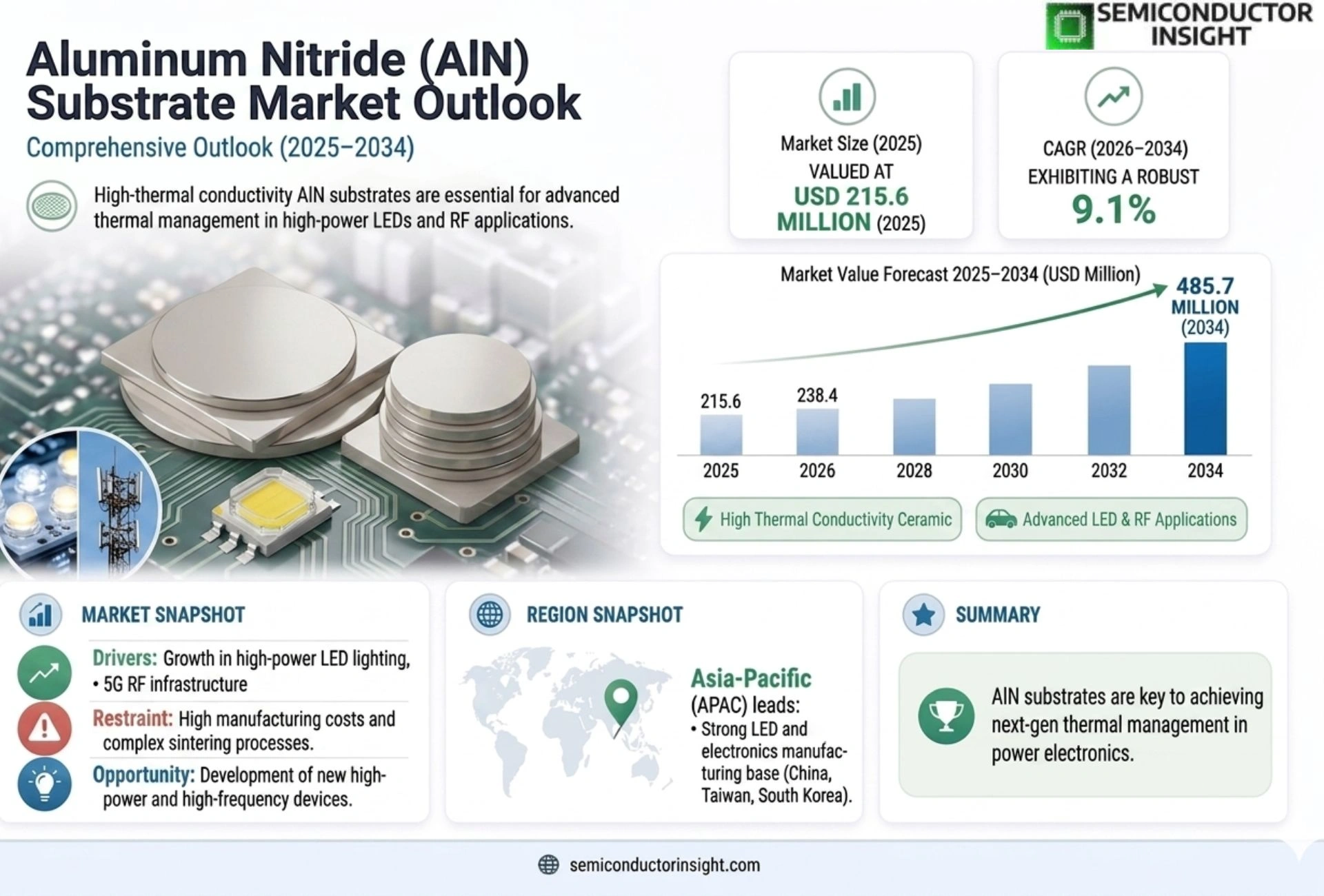
Global Aluminum Nitride (AlN) Substrate Market size was valued at USD 215.6 million in 2025. The market is projected to grow from USD 238.4 million in 2026 to USD 485.7 million by 2034, exhibiting a CAGR of 9.1% during the forecast period.
Aluminum Nitride (AlN) substrates are advanced ceramic materials renowned for their exceptional thermal conductivity, high electrical resistivity, and superior mechanical strength. These substrates serve as critical components in high-power electronic devices, including LED modules, power semiconductors, and RF/microwave circuits, where efficient heat dissipation and electrical insulation are paramount. Unlike traditional materials such as alumina or beryllium oxide, AlN substrates offer a non-toxic alternative with thermal conductivity values approaching 170–200 W/m·K, making them indispensable in applications demanding robust thermal management solutions.
The market is witnessing significant expansion due to the proliferation of electric vehicles (EVs), renewable energy systems, and 5G telecommunications infrastructure. Furthermore, advancements in wide-bandgap semiconductor technologies, such as gallium nitride (GaN) and silicon carbide (SiC), are amplifying demand for AlN substrates because of their compatibility with high-temperature operations. Strategic collaborations among key industry players,such as Tokuyama Corporation, Maruwa Co., Ltd., and Kyocera Corporation,are accelerating innovation in substrate manufacturing processes, including tape casting and sintering techniques, to enhance product performance while reducing production costs.
MARKET DRIVERS
Rising Demand for Efficient Thermal Management Solutions
The global market for Aluminum Nitride (AlN) Substrate Market is primarily propelled by the critical need for effective heat dissipation in high-power electronic devices. Unlike traditional ceramic substrates, AlN offers significantly higher thermal conductivity, often exceeding 170 W/mK, which is essential for modern processors and power modules. As electronic devices become more compact and powerful, the thermal bottleneck intensifies, creating a strong demand for materials that can handle higher heat loads efficiently. Industry analysts project that this demand will drive a compound annual growth rate (CAGR) of approximately 6.8% through the next decade, supported by the rapid evolution of semiconductor technology.
Expansion of 5G Infrastructure and Microwave Applications
The proliferation of 5G networks and the ongoing evolution toward 6G telecommunications require substrates with superior electrical properties and high thermal stability. AlN substrates are increasingly preferred for RF and microwave applications due to their low dielectric constant and excellent dielectric strength. This technological shift ensures a sustained market volume for Aluminum Nitride (AlN) Substrate Market participants focused on telecommunications infrastructure. Furthermore, the automotive industry’s push towards autonomous driving systems relies on complex sensor arrays that demand these high-performance substrates to ensure signal integrity and thermal reliability.
➤ The shift towards wide-bandgap semiconductors (GaN and SiC) necessitates substrates with minimal thermally induced expansion mismatch, positioning AlN as the material of choice.
Growth in Electric Vehicle Power Electronics
The electrification of the automotive sector presents a substantial driver for the industry. Electric vehicles (EVs) utilize power electronics conversion systems that generate significant heat. The transition from Lithium-Ion to Solid-State batteries and the development of higher efficiency electric motors require substrates that can withstand harsh thermal environments without degrading. Consequently, Aluminum Nitride (AlN) Substrate Market is witnessing an influx of investments from automotive OEMs and Tier 1 suppliers aiming to improve thermal management efficiency, thereby accelerating product adoption in this sector.
MARKET CHALLENGES
High Production Costs and Energy Intensity
One of the primary hurdles facing the expansion of Aluminum Nitride (AlN) Substrate Market is the relatively high cost of raw materials and the energy-intensive nature of the manufacturing process. The production of high-purity AlN powder requires careful control of raw material inputs and sophisticated sintering techniques, which are capital and operationally expensive. These high production costs often make AlN substrates a more expensive option compared to established materials like aluminum oxide (Al2O3), potentially limiting their adoption in cost-sensitive consumer electronics unless performance advantages are strictly required.
Other Challenges
Machining and Shaping Complex Geometries
While AlN ceramics offer excellent thermal properties, they are mechanically brittle and difficult to machine into complex shapes with the required precision. Unlike aluminum or copper, standard machining tools can cause micro-cracks and chipping in the brittle substrate matrix. This necessitates specialized diamond tooling and slower processing speeds, which further drives up the cost of production.
MARKET RESTRAINTS
Competition from Established Ceramic Substrates
The market faces significant restraint due to the widespread availability and lower cost of alternative substrate materials, notably Alumina (Al2O3) and Beryllia (BeO). Alumina is a legacy material with well-understood processing techniques and a vast existing supply chain. Although AlN has superior thermal properties, the price/performance ratio often favors Alumina for applications where extreme thermal conductivity is not the limiting factor. This price sensitivity acts as a ceiling on the immediate uptake of higher-cost AlN solutions across broader markets.
MARKET OPPORTUNITIES
Integration with Wide Bandgap Semiconductors
A significant opportunity for Aluminum Nitride (AlN) Substrate Market lies in its synergistic relationship with Wide Bandgap (WBG) semiconductor materials such as Gallium Nitride (GaN) and Silicon Carbide (SiC). As the industry moves toward higher frequencies and power densities, the demand for substrates that can manage the thermal stress of these new transistors is projected to skyrocket. Market research indicates that the combined market for WBG power devices and their requisite substrates is poised for exponential growth, positioning AlN as a critical enabler for next-generation power electronics.
Advanced Applications in High-Frequency RF Millimeter-Wave Antennas
The development of 5G, satellite communication, and radar systems requires materials capable of supporting high-frequency signals while efficiently removing heat from dense antenna arrays. AlN’s unique combination of high thermal conductivity and electrical insulation makes it ideal for these high-frequency applications. Manufacturers that can optimize the composite structures of these substrates for specific RF requirements stand to capitalize on the expanding aerospace and defense sector, which continues to prioritize material performance for critical systems.
Trends
Superior Thermal Management in Emerging Technologies
Aluminum Nitride substrates are increasingly becoming the preferred material for high-performance electronic applications due to their exceptional thermal conductivity and electrical resistivity. These advanced ceramics serve as critical components in power semiconductors and RF circuits, where efficient heat dissipation is essential for preventing thermal runaway and ensuring device longevity. The material’s high mechanical strength and non-toxic composition provide a robust, safe, and cost-effective alternative to traditional ceramics, driving a significant shift in thermal management strategies across the electronics industry.
Other Trends
Demand from Electric Vehicle and 5G Infrastructure
The market is experiencing robust expansion fueled by the rapid proliferation of electric vehicles and renewable energy systems. Electric vehicles require complex power inverter systems that generate significant thermal loads, necessitating substrates capable of efficient heat management. Similarly, the deployment of 5G telecommunications infrastructure demands high-frequency circuits that operate reliably under high thermal stress. These megatrends in sustainable energy and high-speed connectivity create a stable and growing demand base for specialized substrate solutions in the automotive and telecommunication sectors.
Advancements in Manufacturing and Semiconductor Integration
Strategic collaborations among key industry players, including companies like Tokuyama Corporation and Kyocera Corporation, are accelerating innovation in substrate manufacturing processes. These partnerships focus on refining tape casting and sintering techniques to enhance product performance while reducing production costs. By optimizing these fabrication methods, manufacturers are better positioned to integrate AlN substrates with wide-bandgap semiconductor technologies such as Gallium Nitride and Silicon Carbide. These advancements are crucial for meeting the rigorous operational demands of next-generation power electronics, marking a significant evolution in the industry’s approach to material science.
COMPETITIVE LANDSCAPE
Key Industry Players
Analyzing the High-Performance Ceramic Materials Sector
The competitive landscape of Aluminum Nitride (AlN) Substrate Market is defined by key industry players focusing on high thermal conductivity and advanced material engineering. As the global market expands from USD 215.6 million in 2025, driven by the proliferation of electric vehicles and renewable energy systems, established manufacturers are competing to supply critical components for power semiconductors and RF/microwave circuits. Market analysis suggests a structure where dominant entities drive innovation in wide-bandgap semiconductor technologies, utilizing non-toxic alternatives to traditional beryllium oxide for superior thermal management solutions. These substrates are being selected for their exceptional thermal conductivity and high electrical resistivity, which are paramount in high-power electronic devices.
Specialized manufacturers are increasingly focusing on tape casting and sintering techniques to enhance product performance while reducing production costs, a critical strategy for maintaining competitiveness. These niche significant players support the ecosystem by delivering AlN substrates that offer a non-toxic alternative with thermal conductivity values approaching 170–200 W/m·K. The landscape is further shaped by a surge in demand stemming from 5G telecommunications infrastructure and the adoption of Gallium Nitride (GaN) and Silicon Carbide (SiC) technologies, which necessitate substrates compatible with high-temperature operations and efficient heat dissipation. Strategic collaborations among these companies are essential to meet the forecasted CAGR of 9.1% driving the market projected to reach USD 485.7 million by 2034.
List of Key [Industry] Companies Profiled
- Tokuyama Corporation
- Maruwa Co., Ltd.
- Kyocera Corporation
- Morgan Advanced Materials
- CeramTec
- 3M (3M Advanced Materials)
- NGK Spark Plug
- Laird Technologies
- Sumitomo Chemical
- DuPont
- Murata Manufacturing
- Shin-Etsu Chemical
- ROHM Co., Ltd.
- AT&S (Advanced Technology and Materials)
- IBIDEN Co., Ltd.
Segment Analysis:
| Segment Category | Sub-Segments | Key Insights |
| By Type |
|
Leading Segment analysis indicates a shift towards non-toxic, high-performance ceramic variants. The market distinguishes between traditional structural materials and advanced polycrystalline AlN, the latter offering superior thermal management compatibility. The demand is driven by the need for material integrity under thermal stress, distinguishing these substrates as a strategic, safer alternative to hazardous oxide materials in high-power circuitry. |
| By Application |
|
Leading Segment focuses on power semiconductors and LED modules, where thermal dissipation is critical. The market sees significant uptake in renewable energy applications such as solar inverters, driven by the rigorous thermal requirements of energy conversion hardware. The robust ability of AlN substrates to combine high electrical resistivity with superior thermal conductivity is the primary factor propelling growth in these high-power sectors. |
| By End User |
|
Leading Segment includes automotive and telecom sectors, which are undergoing rapid electrification and infrastructure modernization. Original Equipment Manufacturers in the EV space are prioritizing thermal management substrates to optimize battery and powertrain performance, while telecom operators invest in these solutions to support 5G network densification. This dual-driver approach ensures sustained demand from industrial and technological end-users. |
| By Frequency Range |
|
Leading Segment highlights the increasing complexity of signal processing requirements necessitating specialized substrates. Analysts observe a growing preference for materials capable of minimizing dielectric loss and attenuation at high frequencies. This trend is driven by the expansion of radar and high-speed communication systems, where precise thermal management is essential to maintain signal quality and device reliability. |
| By Technology Compatibility |
|
Leading Segment underscores the symbiotic relationship between substrate technology and semiconductor device manufacturing. The market analysis identifies a strong correlation between AlN acceptance and the rise of wide-bandgap semiconductor technologies. Manufacturers are favoring substrates that can endure high-temperature sintering processes and robust operational environments, thereby facilitating the broader adoption of energy-efficient, high-performance power modules. |
Regional Analysis: Aluminum Nitride (AlN) Substrate Market
The steady growth Aluminum Nitride (AlN) Substrate Market is largely driven by the critical need for efficient thermal management solutions in high-performance electronics. As electronic devices become more compact and powerful, the heat generated poses a significant challenge, making AlN an ideal material due to its exceptional thermal conductivity and electrical insulation properties. This demand is particularly pronounced in sectors where reliability is paramount, pushing manufacturers to prioritize substrates that can maintain optimal operating temperatures under heavy loads.
Power modules represent a core application area withAluminum Nitride (AlN) Substrate Market, serving as the backbone for modern electric vehicles and industrial automation systems. The transition towards green energy and electrification has amplified the need for substrates that can withstand high voltages and temperatures while ensuring efficient energy transfer. Key players are focusing on expanding their product portfolios to cater to these power-hungry applications, thereby stabilizing demand and fostering long-term relationships with automotive OEMs.
Aluminum Nitride (AlN) Substrate Market, business strategies are increasingly centered on technological innovation and strategic acquisitions to capture niche segments. Companies are focusing on overcoming the higher manufacturing costs associated with AlN by improving production yield rates and simplifying fabrications processes. This approach allows market participants to offer competitive pricing without compromising on quality, fostering a landscape where strategic collaborations are crucial for gaining a foothold in emerging technological sectors.
The supply chain landscape of Aluminum Nitride (AlN) Substrate Market is undergoing a significant transformation, with a noticeable shift towards localization and vertical integration. To reduce dependency on international exports, key regional hubs are investing heavily in establishing dedicated manufacturing plants. This strategic pivot not only insulates producers from geopolitical uncertainties but also reduces turnaround times, enabling a more responsive and efficient distribution network capable of meeting the fluctuating demands of global electronics markets.
North America
North America holds a significant share of Aluminum Nitride (AlN) Substrate Market, primarily fueled by the robust automotive and renewable energy sectors. The region’s early adoption of electric vehicles and high-fidelity telecommunications infrastructure has created a sustained demand for high-performance components. Key drivers include stringent regulatory standards regarding energy efficiency and thermal management, which compel manufacturers to integrate advanced substrates into their designs. Additionally, strong investment in research and development by defense and aerospace industries contributes to the market’s stability, ensuring a consistent flow of innovation and technical expertise within the regional landscape.
Europe
Europe is witnessing steady growth withAluminum Nitride (AlN) Substrate Market, driven by a strong emphasis on high-efficiency industrial automation and automotive engineering. The region’s commitment to reducing carbon emissions has accelerated the adoption of electric mobility, thereby bolstering the need for AlN substrates in power electronics. European manufacturers face unique challenges related to energy costs and environmental regulations, which fosters a market environment favoring sustainable materials and long-term reliability. Consequently, businesses in the region prioritize quality and compliance, creating a niche for advanced substrates that can meet rigorous performance criteria in diverse industrial settings.
South America
The South American Aluminum Nitride (AlN) Substrate Market is in a nascent but developing phase, characterized by gradual industrialization and increasing investment in energy infrastructure. While the volume of demand is currently smaller compared to global leaders, the potential for growth is evident as the region expands its manufacturing base. Key growth drivers include the modernization of power grids and the rising middle class consumption of consumer electronics, which indirectly stimulates demand for electronic components. Stakeholders are cautiously optimistic about future expansion, focusing on building supply chain resilience to support local industrial development.
Middle East & Africa
The Middle East and Africa region present a niche yet strategic opportunity for Aluminum Nitride (AlN) Substrate Market. Although the local electronics manufacturing sector remains limited, increasing infrastructure projects and the gradual introduction of smart technologies are slowly integrating advanced substrates into the supply chain. The primary demand is currently driven by imports to support large-scale energy projects and telecommunication towers that require efficient thermal management solutions. As the region seeks to modernize its industrial capabilities, the gradual integration of localized electronic component production is expected to bolster the market trajectory in the coming years.
Report Scope
This market research report provides a comprehensive analysis of the Aluminum Nitride (AlN) Substrate Market , covering the forecast period 2026–2034. It offers detailed insights into market dynamics, technological advancements, competitive landscape, and key trends shaping the industry.
Key focus areas of the report include:
- Market Overview: The report begins with an overview outlining its current market scenario, key growth indicators, and industry transformation drivers. It discusses macroeconomic factors, demand–supply balance, regulatory landscape, and the strategic role of semiconductors in powering advancements across industries such as automotive, telecommunications, consumer electronics, and industrial automation.
- Market Size & Forecast: Historical data and future projections for revenue, unit shipments, and market value across major regions and segments.
- Segmentation Analysis: Detailed breakdown by product type, technology, application, and end-user industry to identify high-growth segments and investment opportunities.
- Regional Insights: Insights into market performance across North America, Europe, Asia-Pacific, Latin America, and the Middle East & Africa, including country-level analysis where relevant.
- Competitive Landscape: Profiles of leading market participants, including their product offerings, R&D focus, manufacturing capacity, pricing strategies, and recent developments such as mergers, acquisitions, and partnerships.
- Technology Trends & Innovation: Assessment of emerging technologies, integration of AI/IoT, semiconductor design trends, fabrication techniques, and evolving industry standards.
- Market Drivers & Restraints: Evaluation of factors driving market growth along with challenges, supply chain constraints, regulatory issues, and market-entry barriers.
- Stakeholder Insights: Insights for component suppliers, OEMs, system integrators, investors, and policymakers regarding the evolving ecosystem and strategic opportunities.
Primary and secondary research methods are employed, including interviews with industry experts, data from verified sources, and real-time market intelligence to ensure the accuracy and reliability of the insights presented.
FREQUENTLY ASKED QUESTIONS:
What is the current market size of Aluminum Nitride (AlN) Substrate Market?
-> Aluminum Nitride (AlN) Substrate Market size was valued at USD 215.6 million in 2025. The market is projected to grow from USD 238.4 million in 2026 to USD 485.7 million by 2034, exhibiting a CAGR of 9.1% during the forecast period.
Which key companies operate Aluminum Nitride (AlN) Substrate Market?
-> Key players include Tokuyama Corporation, Maruwa Co., Ltd., and Kyocera Corporation, among others.
What are the key growth drivers?
-> Key growth drivers include proliferation of electric vehicles (EVs), renewable energy systems, and 5G telecommunications infrastructure.
Which region dominates the market?
-> Asia-Pacific is the fastest-growing region, while Europe remains a dominant market.
What are the emerging trends?
-> Emerging trends include strategic collaborations among key industry players and innovation in manufacturing processes like tape casting and sintering.

Get Sample Report PDF for Exclusive Insights
Report Sample Includes
- Table of Contents
- List of Tables & Figures
- Charts, Research Methodology, and more...
 Download Sample Report PDF