Key Statistics
Key Takeaways
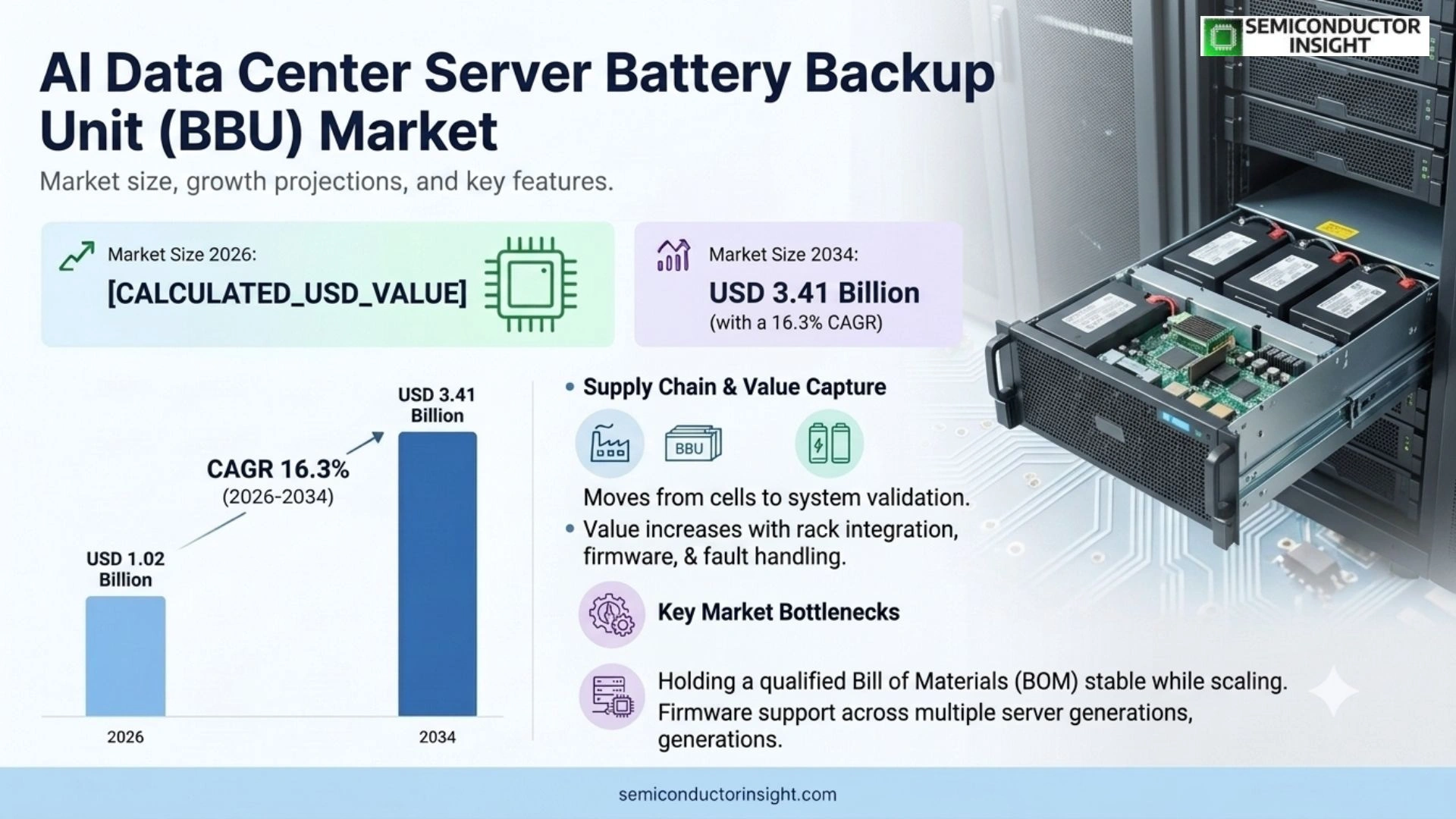
- Market revenue rises from USD 878 million in 2025 to USD 3.41 billion by 2034 at a 16.3% CAGR during 2026–2034, creating enough growth to support rapid supplier investment while still rewarding architectures that reduce rack-level power risk. 3–5.5 kW BBU modules form the core type segment because the ORv3 architecture standardizes 3 kW-class modules and contemporary 33 kW shelves aggregate six 5.5 kW power supplies, giving rack designers a practical modular range for redundancy and serviceability.
- GPU servers remain the primary application because accelerated-computing racks combine synchronized load steps with very high rack power, making local ride-through, telemetry and transient support more valuable than in conventional enterprise server racks.
- North America is the largest commercial market in 2025, supported by the deepest concentration of hyperscale AI infrastructure and U.S. data-centre electricity use that already represented 4.4% of national electricity consumption in 2023.
- Asia Pacific has the strongest capacity-led growth outlook: China is one of the two largest contributors to global data-centre electricity-demand growth, while Singapore is adding at least 300 MW of near-term capacity under its Green Data Centre Roadmap.
- Rack power is shifting from passive backup toward active power shaping. OCP-defined 48 V architectures, high-voltage DC roadmaps and capacitor or battery shelves increasingly address short-duration load transients as well as outage ride-through.
- Thermal safety, cell availability and architecture transitions remain the principal restraints, because higher discharge rates increase heat rejection and protection requirements while the industry is simultaneously evaluating 48/50 V and 400–800 V DC approaches.
AI Data Center Server Battery Backup Unit (BBU) Market Overview
AI Data Center Server Battery Backup Unit (BBU) Market was valued at USD 878 million in 2025 and is projected to reach USD 3.41 billion by 2034, representing a CAGR of 16.3% for 2026–2034. North America is the largest market in 2025, while Asia Pacific carries the strongest expansion profile as new AI capacity is built across China, Singapore, India, Japan and other regional hubs.
A server battery backup unit is a rack-level or rack-adjacent power subsystem that stores energy and releases it through controlled power electronics when the upstream AC or DC supply cannot support the instantaneous server load. In Open Rack V3, the BBU is not merely a battery pack: the specification combines cells, a battery-management system, charger and discharger functions, communications, health monitoring and power-transition behavior. That architecture makes BBU selection part of rack power engineering rather than a stand-alone facility UPS decision.
The technical requirement has changed with accelerated computing. NVIDIA’s GB300 NVL72 reference architecture uses eight 33 kW power shelves, each with six 5.5 kW power supplies, and the full rack can require up to 142 kW. This raises the cost of any short power interruption and also increases the amplitude of load transients seen by upstream electrical infrastructure. Local energy buffering therefore creates value in two ways: it protects compute continuity and can prevent every millisecond-scale demand excursion from propagating directly to the facility power train.
The broader demand environment is unusually strong. The International Energy Agency projects global data-centre electricity consumption to reach 945 TWh in 2030, with 2024–2030 demand growing 15% per year in its base case and electricity use from accelerated servers growing 30% per year. In the United States, the Department of Energy reports that data centres consumed 4.4% of national electricity in 2023 and could reach 6.7–12% by 2028. Those figures do not measure BBU revenue, but they establish the scale and speed of the rack-power requirement that BBU suppliers must serve.
Commercial differentiation now sits at the interface between cell chemistry, conversion efficiency, thermal design, firmware and rack interoperability. Delta, LITEON and other established power-electronics suppliers can integrate BBU shelves with power shelves, busbars and cooling systems, while newer energy-storage specialists such as Skeleton compete by changing the chemistry and voltage architecture. This means a supplier can win without being the lowest-cost cell buyer if it can demonstrate faster recharge, lower footprint, safer failure behavior, better telemetry or tighter qualification with the server and rack ecosystem.
Segment Analysis: By Type
By output class, the market is segmented into below 3 kW, 3–5.5 kW and above 5.5 kW BBU solutions. The 3–5.5 kW class is the central volume position because it aligns with modular Open Rack power design, while the above-5.5 kW segment is gaining strategic importance as vendors move from one-module-per-server concepts toward higher-power rack, sidecar and high-voltage energy-storage systems for AI clusters.
| Type | Market position and technical logic |
|---|---|
| Below 3 kW | Lower-power BBUs fit enterprise servers, edge systems and legacy rack designs where the load being protected is materially below an AI rack’s aggregate demand. Their commercial advantage is ease of integration and lower stored-energy requirement, but they are less suitable for the synchronized power steps of GPU-dense systems. As AI server density rises, this tier increasingly serves distributed or specialized installations rather than the defining hyperscale architecture. |
| 3–5.5 kW | This class sits closest to today’s standardized rack-power building blocks. The Open Rack V3 BBU module specification defines a 3 kW discharger and requires the battery pack to sustain that discharge for at least four minutes under specified life and temperature conditions. In parallel, 33 kW power shelves commonly use six 5.5 kW supplies. The result is a modular design language that favors serviceable, redundant units in this middle range. |
| Above 5.5 kW | Higher-power BBUs become more important when backup is consolidated at rack or sidecar level, or when the architecture shifts toward 400 V and 800 V DC distribution. Skeleton’s BBU400 module specifies 66 kW nominal and 100 kW peak output, while Delta markets a 72 kW BBU in its broader AI data-centre portfolio. These products trade simple module replacement for much higher power density, fewer parallel units and more complex cooling and safety engineering. |
Secondary segmentation: voltage architecture and battery technology
| Secondary axis | Commercial significance |
|---|---|
| 12 V architecture | 12 V remains relevant in legacy server designs and lower-density enterprise environments, but conductor current rises rapidly as rack power increases. The commercial implication is a shrinking design-in opportunity for new high-density AI racks, where copper mass, busbar losses and connector current become expensive. Suppliers serving this segment compete mainly on compatibility with installed fleets rather than on the leading edge of AI power architecture. |
| 24 V architecture | 24 V provides an intermediate step that can reduce current relative to 12 V without changing the power system as radically as 48/50 V. It persists in specialized equipment and transitional platforms, but has less ecosystem momentum than Open Rack V3’s 48 V class. For BBU vendors, this is therefore a selective market tied to customer-specific designs rather than the broadest standardized hyperscale opportunity. |
| 48/50 V architecture | Open Rack V3 makes 48/50 V the clearest standardized architecture for current hyperscale racks. OCP lists a Meta 48 V PSU, BBU module and BBU shelf within the same rack-and-power ecosystem, while Delta’s OCP-recognized 33 kW shelf operates at 48/50 VDC. Higher bus voltage reduces current for a given rack power and makes modular BBU shelves commercially attractive because they can connect directly to a common rack busbar. |
| High-voltage DC | The leading edge is moving beyond 48 V for very high rack and row power. Delta’s COMPUTEX 2025 portfolio included 800 V in-row power rated at 800 kW and a 72 kW HVDC power shelf, while Skeleton’s GrapheneBBU uses a 400 VDC interface. This creates a new design space in which BBU suppliers compete on isolated or non-isolated conversion, liquid cooling, protection and safe high-voltage service procedures. |
| Lithium-ion / LFP | Lithium-based cells remain the established choice because they combine mature manufacturing, high energy density and a well-developed BMS ecosystem. The OCP reference BBU specification uses an 11S6P arrangement of 18650 lithium-ion cells as a reference configuration and defines cell balancing, state-of-health, state-of-charge and remote firmware capabilities. The competitive pressure is moving from basic chemistry availability toward thermal behavior, cycle life, safety validation and fast recharge. |
| Ultracapacitor / SuperBattery systems | High-power nontraditional storage is entering the market where the required backup duration is measured in seconds rather than many minutes. Skeleton specifies 45–90 seconds of backup, 66 kW nominal module power, 100 kW peak power and 97% peak efficiency for its 400 V GrapheneBBU. These systems target rapid cycling and power density, creating an alternative for AI operators that prioritize transient support, fast recharge and reduced rack footprint over long-duration autonomy. |
Pricing and specification economics
Selling price is governed less by stored kilowatt-hours than by delivered rack functionality. A basic lithium module with modest power electronics competes on cell cost and standardized mechanics, while a high-power product can command materially more value through bidirectional conversion, liquid cooling, firmware, telemetry, rack qualification and safety certification. The purchase decision is therefore best understood as cost per protected rack and cost per usable kilowatt of transient support, not simply battery cost per kilowatt-hour. As rack power rises, downtime exposure and space scarcity increase the economic value of higher-density BBUs.
Segment Analysis: By Application
By server application, the market is segmented into GPU server, ASIC server, FPGA server and other server platforms. GPU servers represent the largest demand pool because modern AI training and inference racks combine many accelerators, high-bandwidth networking and tightly synchronized power behavior. ASIC servers are the most important alternative growth path as hyperscalers deploy custom accelerators, while FPGA systems remain smaller but technically demanding where deterministic latency or specialized inference is required.
| Application | Demand characteristics |
|---|---|
| GPU Server | GPU racks are the principal BBU demand engine because accelerator density converts a server-power interruption into a high-value compute interruption. NVIDIA’s GB300 NVL72 architecture places 72 Blackwell Ultra GPUs and 36 Grace CPUs in one rack and specifies eight 33 kW power shelves. That scale makes rack-level ride-through, telemetry and fast transient response economically important, and it rewards BBU designs that integrate cleanly with the same power and cooling ecosystem as the accelerator rack. |
| ASIC Server | Custom AI accelerators used by hyperscalers can create power profiles as demanding as merchant GPUs, but the procurement model differs. The operator often controls server, rack and power architecture together, allowing BBUs to be co-designed with proprietary boards, firmware and facility controls. Suppliers that win these programs must support customization, long qualification cycles and large-volume consistency. The opportunity therefore favors vendors with strong engineering engagement and manufacturing scale rather than catalog availability alone. |
| FPGA Server | FPGA-based systems are used for adaptable acceleration, network functions and specialized inference where deterministic performance matters. Aggregate rack volumes are smaller than for GPUs, but power continuity can be equally critical because the FPGA may sit inside a latency-sensitive service chain. BBU suppliers serve this segment through configurable voltage, telemetry and power-limit features that can be tuned to a customer’s workload rather than through a one-size-fits-all hyperscale module. |
| Others | CPU-dominant enterprise servers, storage, networking and edge-compute equipment remain relevant because BBU architecture can be shared across a rack even when not every workload is AI accelerated. These systems usually have lower peak density and may tolerate longer transfer windows, reducing the need for extreme power density. Their value lies in fleet size, replacement demand and the ability to standardize a common backup shelf across mixed racks within a data hall. |
Regional Analysis
North America is the largest BBU market in 2025, while Asia Pacific has the strongest capacity-led growth outlook. The distinction matters: North America already has the deepest concentration of hyperscale AI deployment and the U.S. Department of Energy projects a sharp increase in data-centre electricity use by 2028, while China and Southeast Asia account for a large share of the next wave of electricity and data-centre capacity growth. Europe is increasingly shaped by energy-performance regulation, South America by new cloud regions, and the Middle East by sovereign AI infrastructure.
How does regional demand differ across the AI server BBU market?
Regional demand differs more by data-centre build pattern and power-system constraint than by server brand. The United States is driven by hyperscale AI campuses and grid connection pressure; Europe places greater weight on energy reporting, efficiency and flexible power; Asia combines huge Chinese demand with constrained hubs such as Singapore; South America is adding new cloud availability zones and local capacity; and the Middle East is building sovereign AI clusters at unusually large announced power scales. These differences influence voltage architecture, redundancy philosophy, cooling choice and vendor qualification.
| Region | Position | Growth outlook | Demand profile | What decides supplier selection |
|---|---|---|---|---|
| North America | Largest in 2025 | High | The United States combines the world’s largest concentration of advanced AI cloud operators with fast-rising data-centre electricity use. DOE cites 176 TWh of U.S. data-centre electricity consumption in 2023 and a 325–580 TWh range by 2028. The commercial result is strong demand for rack power systems that can be deployed quickly without sacrificing redundancy, telemetry or compatibility with high-density liquid-cooled accelerator racks. | Suppliers are selected on hyperscale qualification, firmware integration, redundant shelf behavior, safety testing, serviceability and ability to deliver at data-centre scale. OCP compatibility is important where operators use open rack designs, while NVIDIA ecosystem alignment matters for GB200/GB300 deployments. Domestic support and traceable reliability data carry more weight than a low battery-cell price because failed transition behavior can interrupt extremely expensive compute. |
| Europe | Established | Moderate to high | European demand is shaped by a combination of AI capacity growth and policy pressure on energy performance. The European Commission requires reporting for significant data centres and is developing an EU rating and minimum-performance framework. That makes the BBU part of a wider efficiency conversation: conversion losses, thermal load, monitoring and potential participation in flexible power management can influence design choices alongside conventional uptime requirements. | Market access depends on electrical safety, environmental compliance, lifecycle documentation and credible efficiency performance. Buyers increasingly evaluate whether rack-level storage can reduce facility over-provisioning or support power flexibility without creating additional cooling and fire-risk burdens. Suppliers that can expose energy, state-of-health and operational telemetry to data-centre management systems have an advantage because the European policy environment is moving toward measurable rather than purely claimed efficiency. |
| Asia Pacific | Second-largest / fastest expansion | Highest | China is one of the two largest contributors to global data-centre electricity-demand growth through 2030, while Southeast Asian capacity is expanding from hubs such as Singapore and southern Malaysia. Singapore already has more than 1.4 GW of data-centre capacity and its Green Data Centre Roadmap targets at least 300 MW of additional near-term capacity. This creates demand for dense, energy-efficient BBU architectures that fit constrained sites and hot-climate cooling systems. | Supplier selection varies sharply by country. Global hyperscalers prioritize qualified OCP-style power systems and consistent manufacturing, while domestic Chinese operators can favor local power-electronics and battery suppliers with strong cost positions. In Singapore, efficiency and facility resource constraints raise the value of compact high-efficiency solutions. Across the region, local service, cell sourcing, thermal design and ability to customize firmware for operator-specific rack standards are central commercial gates. |
| South America | Emerging | High from smaller base | Brazil and Chile are the clearest infrastructure expansion points. AWS announced R$10.1 billion of infrastructure investment in Brazil through 2034 and more than $4 billion for a new Chile Region planned with three Availability Zones at launch. New regional cloud capacity creates fresh rack specifications rather than only replacement demand, which is favorable for modern BBU designs because power architecture is chosen at the same time as servers, cooling and electrical distribution. | Buyers emphasize availability, local maintenance, import logistics, grid quality and total installed cost. A supplier that can ship a complete shelf with documented rack compatibility has an advantage over a component-only vendor because regional projects must minimize commissioning risk. Chile also introduces seismic design considerations, while Brazilian projects can place a premium on surge resilience and service networks. The market remains more project-driven than standardized across the continent. |
| Middle East & Africa | Emerging strategic | Very high in selected Gulf markets | The strongest demand is concentrated in Gulf sovereign-AI programs rather than evenly distributed across the region. The UAE and United States announced a 1 GW AI data-centre first phase within a planned 5 GW Abu Dhabi technology cluster, while Microsoft and G42 announced a separate 200 MW capacity expansion through Khazna Data Centers. These power scales move BBU design toward high-density, high-temperature, rack- or row-level systems that can integrate with liquid cooling and high-voltage distribution. | Supplier qualification emphasizes operation in hot ambient conditions, rapid local service, cybersecurity for connected power controls, and integration with large campus electrical systems. Gulf buyers can support advanced architectures because many sites are greenfield, but they also demand rigorous safety and redundancy. African demand outside the Gulf-facing ecosystem is more fragmented and often constrained by project economics, so modularity and maintainability can matter more than the highest available power density. |
Key AI Data Center Server BBU Manufacturers and Competitive Landscape
Competition is led by power-electronics companies that can deliver the full rack power path rather than only energy-storage cells. Delta Electronics and LITEON have publicly demonstrated power shelves, BBUs and cooling hardware for current AI racks, giving them an integration advantage. Skeleton represents a different competitive vector: its 400 V GrapheneBBU uses high-power SuperBattery technology and targets rapid recharge, safety and reduced footprint. The market therefore spans established rack-power incumbents, battery specialists, server-power manufacturers and regional cost competitors.
The first competitive axis is architecture ownership. Vendors that supply the power shelf, BBU shelf, controller and busbar can optimize transition logic and fault handling across the whole rack. Delta’s OCP participation and COMPUTEX portfolio illustrate this systems position, while LITEON pairs a 55 kW rack-mounted power shelf with a 33 kW lithium BBU for NVIDIA-class infrastructure. Customers value this integration because it reduces qualification combinations and gives one supplier responsibility for power behavior across normal and backup modes.
The second axis is energy-storage technology. Conventional lithium-ion and LFP systems benefit from scale, established safety standards and supply-chain maturity. High-power alternatives compete where the backup window is short and cycling frequency is high. Skeleton’s BBU400 specifies 45–90 seconds of runtime, 66 kW nominal power and 100 kW peak power at 400 V, and the company positions fast recharge and reduced footprint as the economic benefit. These characteristics matter most when rack space and rapid repeated transient support are more valuable than long-duration autonomy.
The third axis is hyperscale qualification and firmware. A technically strong BBU can still fail commercially if its communications, state-of-charge estimation, remote firmware update or fault behavior do not match an operator’s control plane. OCP specifications require extensive monitoring and control, including state of health, state of charge, failure logging and remote firmware capability. That pushes competition toward software quality and reliability validation, creating a barrier for low-cost hardware vendors that cannot support long qualification cycles or field firmware maintenance.
The fourth axis is manufacturing and service scale. The report’s profiled list includes Asian battery and power suppliers alongside global infrastructure brands, reflecting the fact that cell sourcing, PCB assembly, magnetics, mechanical packaging and firmware can be distributed across several vendors. Large AI programs reward suppliers that can commit capacity, dual-source critical components, maintain regional field teams and support design changes across multiple server generations. Price still matters, but lifecycle assurance and delivery risk increasingly determine which vendors retain design-in positions.
Tier structure
| Competitive tier | How suppliers compete |
|---|---|
| Integrated rack-power leaders | Delta Electronics and LITEON Technology have public evidence of AI rack power shelves and BBU systems. Their strength is the ability to qualify backup energy together with AC/DC conversion, rack mechanics, busbars, controls and cooling interfaces. This lowers system-integration risk for hyperscalers and server OEMs. Competitive advantage is strongest when a customer wants a repeatable rack reference design rather than assembling cells, converters and controls from separate suppliers. |
| Advanced energy-storage challengers | Skeleton Technologies competes through a differentiated energy-storage platform rather than a conventional lithium module. Its 400 V BBU400 integrates DC/DC conversion and battery management, specifies 66 kW nominal and 100 kW peak module power, and supports 45–90 seconds of backup. Such suppliers can gain share where high cycling, rapid recharge, thermal safety and rack footprint are more important than minimizing upfront cell cost. |
| Broad profiled ecosystem | AES-KY, Dynapack, STL Technologies, Sysgration, Panasonic, FSP Group, Highpower Technology, Shenzhen Megmeet Electrical, Shenzhen Vapel Power Supply Technology, Sunwoda Electronic, Vertiv and Eaton appear in the report’s profiled competitive set. Their roles span battery packs, power conversion, server power, facility power and integrated infrastructure. Commercial relevance depends on whether the supplier is qualified for rack-level AI BBU programs rather than merely participating elsewhere in backup power. |
Key companies profiled
- Delta Electronics
- LITEON Technology
- AES-KY
- Dynapack
- STL Technologies
- Sysgration
- Panasonic
- Skeleton Technologies
- FSP Group
- Highpower Technology
- Shenzhen Megmeet Electrical
- Shenzhen Vapel Power Supply Technology
- Sunwoda Electronic
- Vertiv
- Eaton Corporation
AI Data Center Server BBU Production Capacity Analysis
BBU production capacity is not constrained by one dedicated manufacturing process; it is assembled from battery cells, battery-management electronics, high-power converters, magnetics, controls, metalwork and thermal systems. The strategic constraint is therefore qualified capacity rather than generic factory floor space. A supplier may be able to build battery packs at volume yet still lack enough validated DC/DC converter capacity, firmware test capability or liquid-cooling integration to serve a hyperscale AI rack program. Production planning must treat the BBU as a power-electronics system with a battery inside it.
Asian manufacturing has an inherent supply-chain advantage because major battery-cell, power-supply, PCB and electronics assembly ecosystems are concentrated in China, Taiwan, Japan, South Korea and Southeast Asia. Delta and LITEON are headquartered in Taiwan, while several profiled suppliers are Chinese. This does not make every Asian product interchangeable: hyperscale qualification, component traceability and firmware change control are stringent. The commercial implication is that low-cost manufacturing is necessary but insufficient; suppliers must pair it with quality systems and regional engineering support.
Power density is pushing production toward more demanding thermal and electrical construction. OCP’s reference 3 kW BBU module uses an 11S6P cell arrangement and defines voltage, current, balancing and lifecycle requirements, while emerging 400 V systems integrate liquid cooling and much higher power conversion. Delta’s AI portfolio now spans 55 kW and 72 kW power shelves, 72 kW BBUs, 800 kW in-row power and 1.5 MW liquid-to-liquid cooling. Such portfolios require shared production competence in high-current conductors, isolation, control firmware and thermal management.
Capacity risk also shifts with chemistry. Conventional lithium systems depend on mature cell supply and safety-qualified pack assembly, while niobium- or capacitor-based products use different materials and manufacturing steps. Operators increasingly seek dual sourcing because BBU failure or shortage can delay entire rack deployments. For suppliers, the winning capacity strategy is therefore modular: qualify more than one cell source where possible, design converter and mechanical platforms that can evolve across server generations, and maintain end-of-line testing that reproduces high-power transient conditions rather than only static battery checks.
Selected production and architecture evidence
| Reference platform | Verified technical parameters and production implication |
|---|---|
| OCP ORv3 BBU module | 3 kW discharge; at least 4 minutes at defined end-of-life condition; reference 11S6P pack; 18650 reference cells; 3.5–3.7 V nominal per cell; 4.2 V maximum; 30 A maximum continuous discharge. These values show that today’s standardized BBU starts from a modular battery-and-converter building block rather than a large centralized UPS battery string. |
| OCP ORv3 BBU shelf | Six BBU positions; shelf-level design supports 15 kW discharge with redundancy logic and a 48 V-class bus. The shelf specification defines charge input behavior and transition from the power shelf when AC input is lost. This arrangement shows why module count, shared communications and shelf fault handling are production requirements, not optional software features. |
| Delta OCP power shelf | 33 kW maximum from six 5.5 kW power supplies, or 27.5 kW with 5+1 redundancy; 48/50 VDC output; more than 97.5% efficiency. This is the electrical neighborhood in which many current rack BBUs operate, so BBU output, transition thresholds and communications must be validated with the power shelf rather than evaluated independently. |
| NVIDIA GB300 NVL72 | Eight 33 kW power shelves; six 5.5 kW PSUs per shelf; rack power requirement up to 142 kW; 72 B300 GPUs and 36 Grace CPUs. These specifications explain why localized energy storage has become strategically important: the protected compute value and instantaneous rack demand are both much higher than in conventional enterprise architectures. |
| Skeleton BBU400 module | 400 VDC interface; 66 kW nominal power; 100 kW peak power; 60 kW continuous power; 45–90 seconds backup; 4.5 MJ usable energy; 97% peak efficiency; 21-inch ORv3 form factor at 3 OU. The specification illustrates the move toward high-voltage, short-duration and liquid-cooled backup optimized for AI power density. |
| Delta COMPUTEX 2025 | 55 kW power shelf, BBU shelf, 80 kW liquid-to-air cooling, 1,500 kW liquid-to-liquid cooling, 800 kW in-row power at up to 800 VDC and up to 98% efficiency, plus a 20 kW capacitance shelf providing up to 15 seconds of backup. The range shows convergence of backup, transient shaping and thermal systems. |
AI Data Center Server BBU Market Dynamics: Drivers, Restraints and Opportunities
The market is being pulled by three linked forces: rapid expansion of accelerated computing, a step-change in rack power density, and growing difficulty in provisioning utility and facility power fast enough for AI campuses. BBUs respond by moving storage closer to the rack and adding active power-control functions. Against that growth are real engineering constraints: thermal safety, high discharge current, qualification time, chemistry risk and a moving voltage architecture that can shorten product lifecycles. Opportunities therefore concentrate where suppliers solve power-system bottlenecks rather than merely add battery capacity.
MARKET DRIVERS
Drivers Impact Analysis*
| Factor | Impact | Commercial transmission |
|---|---|---|
| Accelerated-server electricity growth | High | IEA projects electricity use from accelerated servers to grow 30% per year in its base case through 2030. More accelerator racks increase both the number of protected loads and the economic cost of interruption. BBU suppliers benefit when operators deploy local energy buffering as a standard rack component rather than only for selected high-availability workloads. |
| Rack power density | High | NVIDIA’s GB300 NVL72 architecture can require up to 142 kW per rack. Higher rack power raises current, thermal load and transient magnitude, which makes short-duration local storage more valuable. The commercial response is a shift toward higher-power modules, 48/50 V busbars, 400–800 V DC concepts and liquid-cooled storage or conversion equipment. |
| Grid and interconnection constraints | High | DOE and IEA data show data-centre electricity demand rising much faster than overall electricity consumption. When utility interconnections, transformers and switchgear are constrained, operators have an incentive to smooth fast rack demand and reduce peak excursions. BBUs can support that objective if their control systems coordinate charge and discharge without compromising emergency reserve. |
| Open rack standardization | Medium to high | OCP publishes interoperable rack, power shelf, BBU module and BBU shelf specifications, lowering the engineering friction of common architectures. Standardization does not eliminate supplier differentiation; instead it moves competition toward efficiency, firmware, safety, qualification and manufacturing scale. Vendors that meet a recognized interface can address multiple server programs with a common platform. |
Accelerated computing makes backup power a compute-utilization issue
Global data-centre electricity use is projected by the IEA to reach 945 TWh in 2030, and accelerated-server electricity consumption grows much faster than conventional-server use in the base case. That matters to BBU demand because every incremental AI rack carries more expensive processors and a denser power profile. Operators therefore evaluate backup not only as insurance against an outage but as a way to protect utilization of scarce accelerator capacity during grid events and short power disturbances.
High rack density creates a local power-shaping requirement
An AI rack can change load far faster than a utility transformer or generator system can economically follow. NVIDIA’s GB300 reference design illustrates the magnitude, with eight 33 kW power shelves and a rack requirement up to 142 kW. When many racks synchronize, upstream equipment sees sharp aggregate ramps. A BBU with bidirectional power electronics can absorb or supply short-duration energy, reducing the need to size every upstream component for the most extreme instantaneous event.
48/50 V modular power reduces integration friction
OCP’s ORv3 specification set combines 48 V-class power shelves, BBU modules and BBU shelves within one rack architecture. That standardization gives server builders and hyperscalers a repeatable electrical interface and gives suppliers a clearer qualification target. Commercially, it allows a successful BBU design to scale across many racks and facilities, while still leaving room for differentiation in cell selection, controller firmware, fault response, thermal design and long-term state-of-health accuracy.
Data-centre buildout is geographically broadening
The next wave of capacity is not confined to established U.S. hubs. Singapore’s roadmap seeks at least 300 MW of additional near-term capacity, AWS is building a Chile Region with three Availability Zones, and the UAE is pursuing gigawatt-scale AI infrastructure. Every greenfield region creates new rack-power specifications and local service requirements. BBU vendors with globally repeatable platforms and regional compliance support can therefore grow faster than vendors tied to one operator or one country.
MARKET RESTRAINTS
Restraints Impact Analysis*
| Factor | Impact | Commercial transmission |
|---|---|---|
| Thermal safety and ageing | High | High C-rate discharge and rapid recharge generate heat inside cells and converters, while elevated ambient temperature accelerates battery ageing. The BBU must preserve emergency reserve even after years of operation. This raises cooling, sensing, cell balancing and validation cost, and it can reduce usable rack density if the storage system requires additional airflow or dedicated liquid cooling. |
| Architecture transition risk | Medium to high | The market is standardizing 48/50 V racks while also evaluating 400 V and 800 V DC distribution for the next power-density step. A platform optimized for one bus voltage can require major redesign for another. Suppliers therefore face product-obsolescence risk and customers may delay large commitments until server, rack and facility roadmaps converge. |
| Cell and component qualification | Medium | Battery cells, high-current semiconductors, magnetics and controllers may be broadly available, but hyperscale-qualified combinations are not. Any change in cell, converter or firmware can trigger requalification. This limits a supplier’s ability to respond to shortages by substituting components quickly and can turn a commodity component shortage into a rack deployment delay. |
| Capital and service complexity | Medium | High-power BBUs add conversion electronics, communications, protection and sometimes liquid cooling. The installed cost therefore exceeds the price of cells, and operators need maintenance procedures, spare modules, firmware support and safety training. Where grid reliability is high and rack density is modest, traditional centralized UPS architecture may remain economically adequate, limiting BBU penetration. |
Thermal management sets a hard engineering boundary
The BBU must deliver high power while preserving cell life and maintaining emergency availability. OCP’s reference specification explicitly links four-minute discharge capability to a four-year life condition at 35°C, demonstrating that power, temperature and ageing are inseparable. As racks become liquid cooled and facility air temperatures rise, suppliers need more accurate state-of-health models, lower-resistance cells, robust pack sensing and thermal designs that avoid transferring excessive heat into an already constrained rack environment.
A moving voltage standard can shorten design life
Current OCP racks are built on 48/50 V distribution, but vendors are already demonstrating 400 V and 800 V DC concepts for higher power. This transition can strand engineering investment because contactors, insulation, converters, connectors and safety procedures change with voltage class. A supplier that commits too narrowly to one architecture risks losing relevance, while supporting several voltage platforms simultaneously raises R&D, validation and inventory cost.
Qualification slows component substitution
Hyperscale operators demand repeatable failure behavior and long field life, so battery cells and power semiconductors cannot be swapped casually when supply conditions change. Firmware, cell impedance, thermal behavior and protection thresholds interact. A substitute part may pass a bench electrical test yet still alter ageing or transient response. This makes qualified bill-of-material continuity a competitive asset and increases the working capital required to secure long-lead components.
Centralized UPS remains a credible alternative in some sites
BBUs are not automatically superior for every data centre. A facility with moderate rack power, ample UPS capacity and low cost of floor space may prefer to keep backup energy centralized, especially where maintenance teams are standardized on existing UPS and battery systems. Rack-level BBUs win when they solve a specific density, transient or deployment-speed problem. Their addressable market therefore expands with high-density AI adoption rather than simply replacing every installed UPS.
MARKET OPPORTUNITIES
High-voltage DC BBU platforms for next-generation AI racks
The move from 48/50 V toward 400–800 V DC creates an opportunity for vendors that can combine high-voltage conversion, protection and energy storage in a compact system. Delta is already demonstrating 800 V in-row power and Skeleton uses a 400 V interface. Suppliers that establish safe service procedures, liquid cooling and interoperable controls early can capture design positions before high-voltage rack architectures become widely standardized, when customer switching costs will be higher.
Power shaping and grid-interactive control
The most valuable BBU may spend very little time responding to outages. If firmware can reserve enough energy for emergency ride-through while also absorbing rapid GPU load changes, the same asset can reduce facility peak excursions and stabilize the upstream electrical system. This creates software-led differentiation in charge scheduling, state-of-health estimation and fleet orchestration. Hyperscalers benefit through better utilization of constrained power capacity, while suppliers gain recurring firmware and systems-engineering value beyond hardware margin.
Short-duration, ultra-fast recharge storage
Some AI data centres need tens of seconds of bridging rather than several minutes of autonomy because generators, UPS systems or alternative sources already cover longer events. Skeleton’s 45–90 second BBU and Delta’s 15-second power-capacitance shelf demonstrate this design space. High-power storage that recharges quickly can support repeated transients and reduce battery footprint. Vendors that match storage duration precisely to the facility’s transfer sequence can offer lower space and cooling burden than a longer-duration pack.
Greenfield expansion in Asia, South America and the Gulf
New data-centre regions in Singapore, Chile, Brazil and the UAE create clean-sheet opportunities where rack power, cooling and backup can be specified together. Greenfield sites are especially attractive for new BBU architectures because they do not have to preserve compatibility with installed 12 V server fleets or legacy UPS room layouts. Suppliers that pair a globally standardized core platform with local service, compliance and thermal engineering can convert regional buildout into multi-year program revenue.
AI Data Center Server BBU Supply Chain Analysis
The BBU supply chain begins with energy-storage cells and power semiconductors, moves through battery-pack and converter manufacturing, then into rack-level integration and hyperscale qualification. Value capture increases as a supplier moves closer to the rack architecture because it takes responsibility for firmware, fault handling, telemetry and system validation. The most important bottleneck is not raw material in isolation; it is the ability to hold a qualified bill of materials stable while scaling high-current production and supporting field firmware across several server generations.
Upstream cells and power semiconductors
Cell selection determines energy density, discharge rate, thermal behavior and cycle life, while MOSFETs, IGBTs or other power devices determine conversion efficiency and switching performance. These components are globally traded, but qualification narrows the usable vendor pool. A BBU maker therefore creates supply resilience by validating multiple sources where technically possible and by avoiding firmware or mechanical choices that make a single cell format impossible to replace over the product’s service life.
Pack, BMS and converter manufacturing
This stage converts commodity inputs into a safety-critical power subsystem. Cell matching, busbar resistance, insulation, BMS accuracy, current sensing, thermal interfaces and end-of-line load testing all affect field behavior. OCP requires health monitoring, state-of-charge, failure logging and remote firmware support, so manufacturing quality extends into software configuration and calibration. Suppliers capture more value here because customers buy predictable transient performance and lifecycle reliability rather than loose cells.
Rack and server qualification
The rack integration stage has the strongest barrier to entry. The BBU must transition correctly with the power shelf, remain stable during GPU load steps, communicate with the rack controller, fit mechanical envelopes and fail safely. A design that passes these tests can be repeated across thousands of racks, creating durable design-in revenue. Conversely, a firmware defect can halt deployment at scale, so hyperscalers often prefer suppliers with established validation labs and direct engineering teams.
Deployment, monitoring and lifecycle service
Field value continues after shipment because battery state changes with time, temperature and cycling. Operators need remote state-of-health data, replacement planning, spare modules and controlled firmware updates. Large BBU fleets can generate operational data that improves ageing models and fault prediction. Suppliers that convert this data into dependable maintenance intervals can reduce unexpected rack downtime and strengthen customer lock-in, turning service quality into a competitive moat even when hardware specifications converge.
Recent Developments in the AI Data Center Server BBU Market
- 4 February 2026 ENERGY EFFICIENCY
The UAE Ministry of Energy and Infrastructure, Khazna Data Centers and Agility announced a pilot using Phaidra AI to improve energy efficiency across data centres and district cooling. For BBU suppliers, the significance is the growing integration of facility power controls with AI-driven optimization: rack storage that exposes reliable telemetry and controllable charge behavior can become part of a broader energy-management layer rather than operating as a sealed emergency device. Source - 15 October 2025 PRODUCT LAUNCH
Skeleton Technologies and Acbel demonstrated GrapheneBBU at the OCP Global Summit. Skeleton positions the niobium SuperBattery design for rapid recharge, high power and thermal safety. The launch broadens competitive chemistry beyond conventional lithium-ion packs and shows that AI backup is becoming a specialized short-duration power product. That increases pressure on incumbent BBU vendors to differentiate on cycle life, recharge time, safety and usable rack footprint. Source - 20–23 May 2025 SYSTEM ARCHITECTURE
At COMPUTEX 2025, Delta presented an AI infrastructure stack including a 55 kW power shelf, BBU shelf, 80 kW liquid-to-air cooling, 800 kW in-row power up to 800 VDC and a 20 kW capacitance shelf with up to 15 seconds of backup. The breadth of the portfolio illustrates how backup storage is merging with transient support, high-voltage distribution and liquid cooling at the system level. Source - 2025 AI RACK POWER
LITEON introduced a 55 kW rack-mounted power shelf and a 33 kW high-efficiency lithium BBU for NVIDIA GB200 and GB300 NVL72-class infrastructure. Pairing the power shelf and BBU in one launch is commercially important because operators increasingly qualify complete rack power subsystems. This favors suppliers that can coordinate conversion, backup and cooling for a known server architecture rather than selling a generic battery shelf. Source - 2025–2026 REFERENCE ARCHITECTURE
NVIDIA’s NVL72 AI Factory reference architecture documents eight 33 kW power shelves in a GB300 NVL72 rack, with six 5.5 kW power supplies per shelf and a rack requirement up to 142 kW. The reference quantifies the power-density step confronting data-centre designers and supports the shift toward rack-local energy buffering, higher-voltage distribution and tightly coordinated power and cooling systems. Source
REPORT SCOPE & SEGMENTATION
| Attribute | Details |
|---|---|
| Study Period | The overview uses 2025 as the base year, 2026 as the estimated year and 2034 as the forecast endpoint. Market revenue is presented in U.S. dollars. The forecast series is kept internally consistent with the 2025 and 2034 market values, while 2026 is used as the first forecast year for discussion of current deployment patterns and architecture adoption. |
| Market Size | USD 878 million in 2025, rising to USD 3.41 billion in 2034 at a 16.3% CAGR for 2026–2034. These values define the global revenue scope for rack-level and server-focused BBU systems used in AI data centres, including the battery pack, battery-management functions and power-conversion content supplied as a BBU module, shelf or closely integrated backup subsystem. |
| By Type | Below 3 kW; 3–5.5 kW; Above 5.5 kW. The segmentation reflects output class rather than stored energy. This is important because AI BBUs are increasingly selected on discharge power, response, rack integration and backup duration. The 3–5.5 kW tier aligns with standardized modular rack designs, while higher-power systems capture growing rack, sidecar and high-voltage configurations. |
| By Application | GPU Server; ASIC Server; FPGA Server; Others. GPU servers are the largest application because accelerator racks concentrate high-value compute and create rapid power excursions. ASIC demand grows as hyperscalers deploy custom accelerators, while FPGA and other servers provide smaller but technically differentiated use cases. Application classification follows the protected server architecture rather than the data-centre facility type. |
| By End User | Hyperscalers; Cloud Service Providers; Enterprise Data Centers. Hyperscalers set many of the most demanding requirements because they deploy large fleets and can standardize rack power architecture across sites. Cloud providers overlap with hyperscale demand but may use several server platforms, while enterprise data centres place greater weight on backward compatibility, service simplicity and integration with installed UPS and facility power systems. |
| By Voltage Architecture | 12 V; 24 V; 48 V, with high-voltage DC discussed as an emerging architecture outside the original three-category segmentation. The report retains the stated 12/24/48 V segmentation while analyzing 400 V and 800 V systems as technology developments. This preserves segment boundaries while still reflecting the engineering direction visible in current supplier roadmaps. |
| By Battery Technology | Lithium-Ion; Lithium Iron Phosphate; Ultracapacitors. The market is evaluated by the storage technology supplied inside the BBU, with attention to discharge rate, recharge time, thermal behavior, cycle life, footprint and BMS requirements. High-power SuperBattery and capacitor-based systems are discussed within the ultracapacitor/alternative high-power storage context where their commercial function is short-duration bridging and power shaping. |
| Regions | North America; Europe; Asia Pacific; South America; Middle East & Africa. North America is the largest market in 2025, while Asia Pacific has the strongest capacity-led expansion profile. Country analysis covers the United States, Canada, Mexico, Germany, France, the United Kingdom, China, Japan, South Korea, Southeast Asia, India, Brazil, Chile, the UAE, Saudi Arabia and selected African markets. |
| Companies Profiled | Delta Electronics; LITEON Technology; AES-KY; Dynapack; STL Technologies; Sysgration; Panasonic; Skeleton Technologies; FSP Group; Highpower Technology; Shenzhen Megmeet Electrical; Shenzhen Vapel Power Supply Technology; Sunwoda Electronic; Vertiv; Eaton Corporation. The profiled set spans rack-power electronics, battery integration, energy storage and data-center power infrastructure suppliers serving global and regional AI deployments.. Competitive analysis distinguishes public evidence of rack-level BBU systems from broader participation in batteries, server power or facility backup infrastructure. |
| Customization | Country, company, power-class, voltage-architecture, chemistry and end-user cuts can be extended for procurement or strategy work. Custom analysis can also compare OCP-aligned 48/50 V architectures with emerging 400–800 V DC systems, evaluate supplier qualification criteria, map battery-cell and power-semiconductor dependencies, or model BBU demand from planned accelerator-rack deployments and data-centre power capacity. |
Frequently Asked Questions
What is the current size of the AI data center server BBU market?
The global AI data center server BBU market was valued at USD 878 million in 2025 and is projected to reach USD 3.41 billion by 2034. Those endpoints imply a 16.3% CAGR for 2026–2034. Growth is supported by accelerated-computing deployment, higher rack power density and the increasing value of local energy buffering for both outage ride-through and short-duration power shaping.
Which region is the largest market in 2025?
North America is the largest market in 2025 because the United States combines a large installed cloud base with the deepest concentration of hyperscale AI infrastructure. The U.S. Department of Energy reports that data centres used 176 TWh of electricity in 2023 and could use 325–580 TWh in 2028. That rapid load growth makes rack power availability, grid constraints and high-density backup architecture central purchasing issues.
Which region has the strongest growth outlook?
Asia Pacific has the strongest capacity-led growth outlook. The IEA projects China to add 175 TWh of data-centre electricity consumption by 2030 compared with 2024, and it expects Southeast Asian data-centre electricity demand to more than double. Singapore also targets at least 300 MW of additional near-term capacity. These greenfield additions create new rack specifications where modern 48/50 V and higher-voltage BBU architectures can be designed in from the start.
What BBU power class is most important?
The 3–5.5 kW class is the central standardized segment because Open Rack V3 defines a 3 kW BBU module and current 33 kW power shelves commonly use six 5.5 kW power supplies. This middle tier supports modular redundancy and field replacement. Above-5.5 kW systems are strategically important because rack and sidecar designs are moving toward much higher aggregate power and 400–800 V DC distribution.
Why are GPU servers the largest application?
GPU servers concentrate expensive accelerators and high synchronized power demand in a single rack. NVIDIA’s GB300 NVL72 reference architecture includes 72 B300 GPUs, 36 Grace CPUs and eight 33 kW power shelves, with rack demand up to 142 kW. A short power interruption can therefore strand substantial compute capacity, while rapid workload changes can create large transients. Those economics justify rack-level backup and active power shaping.
How does a rack BBU differ from a conventional facility UPS?
A facility UPS protects a broader electrical domain, while a rack BBU sits much closer to the server load and can react to local transients with less dependence on long distribution paths. Modern BBUs integrate cells, BMS, DC/DC conversion, communications, health monitoring and firmware. They can complement rather than replace the UPS by bridging short events, smoothing rack demand and preserving reserve for the most critical local load.
Why is 48/50 V important in current AI racks?
Higher bus voltage reduces current for the same delivered power, lowering conductor loss and easing busbar and connector design compared with 12 V architectures. Open Rack V3 standardizes a 48 V-class ecosystem including power shelves, BBU modules and BBU shelves. Delta’s OCP-recognized 33 kW power shelf also uses 48/50 VDC. This common electrical interface supports modular rack design and creates a broad qualification target for BBU vendors.
Are 400 V and 800 V DC systems replacing 48 V BBUs?
They are emerging rather than universally replacing 48/50 V systems. Skeleton markets a 400 V BBU, and Delta has demonstrated 800 V in-row power and 72 kW HVDC power shelves for very high-density AI infrastructure. Higher voltage can reduce current and distribution loss at extreme rack and row power, but it also changes insulation, service, protection and conversion requirements. The market is therefore likely to support multiple voltage architectures during the transition.
What are the main restraints on BBU adoption?
The main restraints are thermal safety, battery ageing, high-power converter cost, long hyperscale qualification cycles and uncertainty over future voltage architecture. Rack-level storage also adds maintenance, firmware and service requirements that a centralized UPS may avoid. BBUs create the strongest economic case where rack density, grid constraints or transient behavior impose a clear problem; in lower-density facilities with ample UPS capacity, the incremental value can be smaller.
Which companies are profiled in the market?
The profiled set includes Delta Electronics, LITEON Technology, AES-KY, Dynapack, STL Technologies, Sysgration, Panasonic, Skeleton Technologies, FSP Group, Highpower Technology, Shenzhen Megmeet Electrical, Shenzhen Vapel Power Supply Technology, Sunwoda Electronic, Vertiv and Eaton Corporation. Public evidence shows particularly clear rack-level AI power and BBU positioning for Delta, LITEON and Skeleton, while other profiled companies participate across batteries, server power, conversion and facility infrastructure.
Research Sources & Evidence Base
Get Sample Report PDF for Exclusive Insights
Report Sample Includes
- Table of Contents
- List of Tables & Figures
- Charts, Research Methodology, and more...
 Download Sample Report PDF