Key Statistics
Key Takeaways
- Stand-alone Vision Processors lead the product segmentation because cameras, autonomous systems and industrial vision require dedicated AI acceleration close to image sensors.
- Automotive is the leading application in the report scope, supported by ADAS, in-cabin intelligence, sensor fusion and autonomous-driving compute.
- North America leads the market through hyperscale AI infrastructure, semiconductor design, cloud adoption and a large ecosystem of accelerator vendors.
- Asia Pacific is the fastest-growing region because advanced semiconductor manufacturing, server production, edge-device scale and domestic AI-chip programs are expanding together.
- ASIC-based hardware gains importance where workload-specific acceleration can reduce energy per inference compared with general-purpose compute.
- Rack-scale AI systems are becoming a major competitive layer as vendors co-design GPUs, CPUs, networking, storage and software to reduce training time and inference cost.
AI Computing Hardware Market Overview
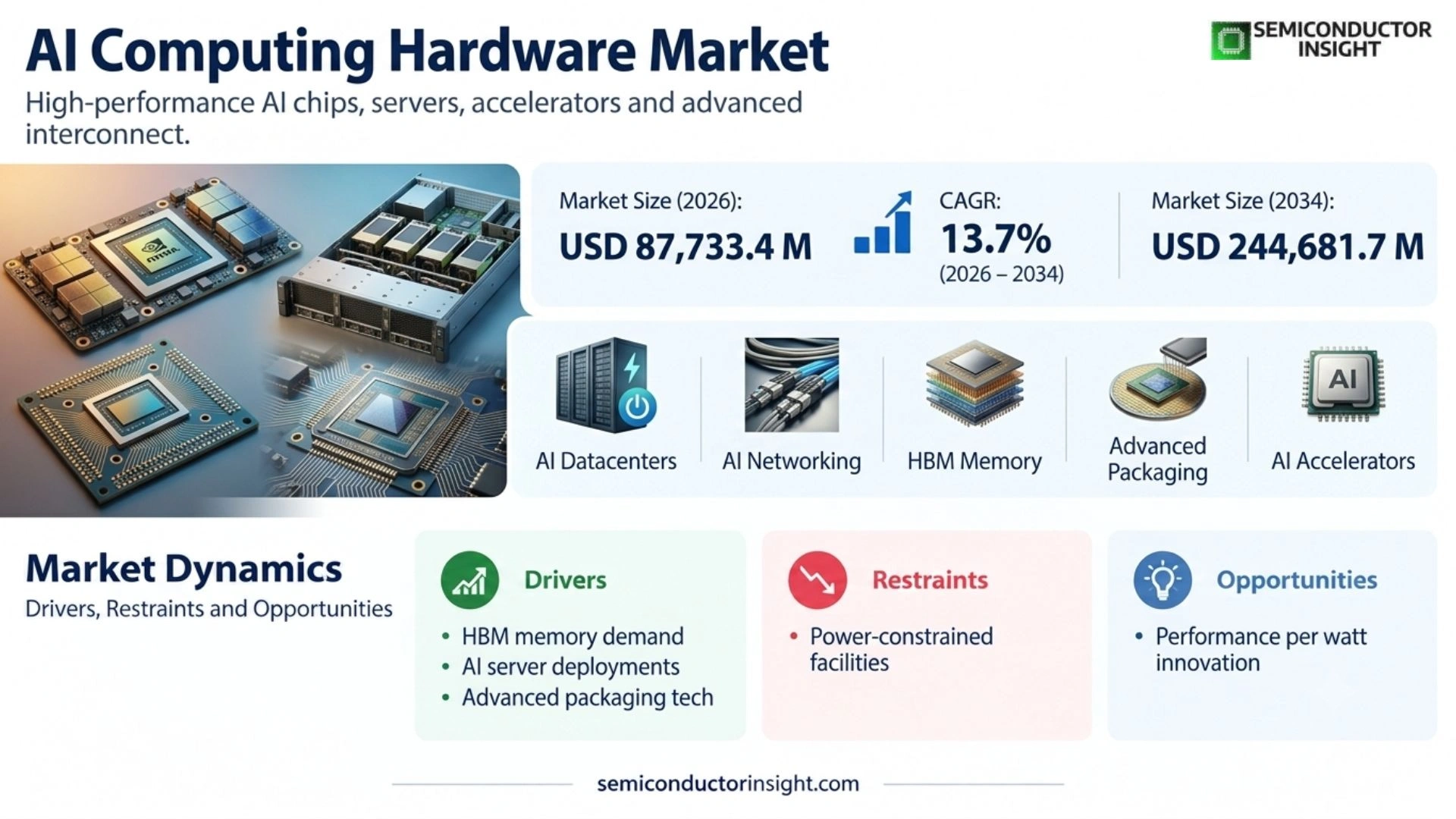
AI Computing Hardware Market was valued at USD 77,176.6 million in 2025, is estimated at USD 87,733.4 million in 2026, and is projected to reach USD 244,681.7 million by 2034, representing a CAGR of 13.7% during 2026–2034. North America is the largest regional market in 2025, while the commercial growth mechanism is increasingly shaped by agentic AI, cloud training and inference, edge vision and sound processing, AI-specific accelerators, larger memory bandwidth, and rack-scale systems.
AI computing hardware includes semiconductor processors and integrated systems designed to accelerate machine-learning workloads in data centers, enterprises, vehicles and edge devices. Within the report scope, the product segmentation includes stand-alone and embedded vision processors as well as stand-alone and embedded sound processors, while the wider competitive environment includes GPUs, ASICs, FPGAs, DSPs and specialized neural processors.
Demand is expanding because AI is moving simultaneously in two directions: toward larger cloud systems for training and reasoning, and toward smaller edge systems that perform perception locally. Data-center platforms require massive parallel compute, HBM, networking and power efficiency, while embedded vision and sound processors must deliver useful inference under strict cost and thermal limits.
The market is increasingly shaped by platform economics rather than raw silicon specifications alone. NVIDIA, AMD, Intel and other suppliers combine chips with software libraries, networking and system reference designs, while embedded vendors compete through model-conversion tools and long product lifecycles. Customers therefore compare time to deployment, performance per watt and software compatibility alongside TOPS, FLOPS or memory bandwidth.
Segment Analysis: By Type
By type, the market includes Stand-alone Vision Processor, Embedded Vision Processor, Stand-alone Sound Processor, and Embedded Sound Processor. Stand-alone Vision Processors hold the leading position because computer vision is one of the broadest AI hardware workloads across automotive, security, robotics and industrial systems.
| Type | Technical role | Market position |
|---|---|---|
| Stand-alone Vision Processor | Dedicated AI hardware processes one or more camera streams and runs detection, classification, segmentation or tracking independent of a central application processor. | The leading segment, supported by automotive, security, robotics and industrial machine vision where deterministic local perception is important. |
| Embedded Vision Processor | Vision acceleration is integrated into a larger SoC alongside CPU, connectivity, control and multimedia functions. | Strong growth in cost-sensitive edge devices because integration reduces board area, power and component count. |
| Stand-alone Sound Processor | Dedicated DSP or neural hardware performs speech recognition, voice activity detection, acoustic classification or audio enhancement. | A specialized market in smart speakers, conferencing, hearables and industrial acoustic monitoring. |
| Embedded Sound Processor | Audio AI is integrated inside a microcontroller or application processor for always-on low-power operation. | A high-volume edge opportunity as voice and acoustic intelligence move into appliances, vehicles and wearables. |
Why does AI hardware split between cloud scale and embedded specialization?
Cloud systems justify very large accelerators because models and batch sizes are large, while embedded products operate within battery, thermal and cost constraints. This creates different hardware architectures but a common need for efficient matrix computation and optimized software. Vision and sound processors represent the specialized edge side of the market, while data-center GPUs and ASICs represent the scale-up side. Vendors that can span both environments gain leverage through shared models, tools and developer ecosystems.
Segment Analysis: By Application
By application, the report covers BFSI, Automotive, Healthcare, IT and Telecom, Aerospace and Defense, Energy and Utilities, Government and Public Services, and Others. Automotive leads in the report segmentation, while IT and telecom is the largest infrastructure-heavy demand pool for cloud AI hardware.
| Application | Demand characteristics | |
|---|---|---|
| Automotive | ADAS, autonomous-driving research, driver monitoring and smart-cockpit systems require vision, sensor fusion and low-latency AI inference. | A leading application because vehicles increasingly contain dedicated AI compute and long-lived embedded processors. |
| IT and Telecom | Cloud service providers, telecom operators and enterprise data centers deploy accelerators for training, inference, recommendation, coding and agentic workloads. | The largest infrastructure opportunity, with rack-scale systems, networking and memory becoming strategic. |
| Healthcare | Medical imaging, diagnostics and clinical AI use both cloud accelerators and local inference systems. | A high-value segment where reliability, privacy and model validation affect procurement. |
| BFSI | Fraud detection, risk models, document processing and agentic workflows drive enterprise AI infrastructure. | Demand favors scalable inference, security and lower operating cost. |
| Aerospace and Defense | Autonomous sensing, ISR, mission planning and secure analytics require rugged or high-performance AI systems. | A premium segment with strong security and lifecycle requirements. |
| Energy and Utilities | Predictive maintenance, grid optimization and industrial vision use edge and cloud AI hardware. | A growing industrial segment where real-time inference can reduce downtime. |
| Government and Public Services | Digital services, research, public safety and sovereign AI projects create large compute requirements. | Growth is tied to national AI infrastructure and procurement programs. |
| Others | Retail, education, logistics and research broaden the market. | A diverse demand base that benefits from falling inference cost and easier deployment tools. |
Why is rack-scale design becoming a semiconductor competitive advantage?
Large AI workloads are limited by memory, network communication, power delivery and cooling as much as by arithmetic throughput. NVIDIA’s Vera Rubin platform combines CPU, GPU, NVLink, Ethernet, DPU and storage functions, while AMD’s Helios platform combines MI400 GPUs with EPYC CPUs and networking. Co-design across the rack can reduce data movement and improve utilization, so hardware vendors increasingly sell an integrated compute architecture rather than an isolated accelerator card.
Regional Analysis
North America leads the AI Computing Hardware market through hyperscale cloud infrastructure, semiconductor design and enterprise AI adoption. Asia Pacific is the fastest-growing region through manufacturing scale and domestic AI programs, while Europe invests in sovereign compute, industrial AI and edge systems.
How do regional AI hardware markets differ?
North America leads high-end design and deployment through cloud providers, AI labs and major semiconductor companies. Asia Pacific combines fabrication, server manufacturing and large domestic demand. Europe emphasizes sovereign compute, industrial applications and regulation-driven local processing. South America is adopting AI infrastructure selectively, while the Middle East is investing aggressively in sovereign AI and data-center capacity.
| Region | Position | Growth outlook | Demand profile | What decides supplier selection |
|---|---|---|---|---|
| North America | Largest | Very strong | Hyperscale cloud, AI labs and enterprise AI | Performance per watt, software ecosystem and supply |
| Asia Pacific | Fastest-growing | Very strong | Manufacturing, domestic accelerators and edge devices | Cost, foundry access and local ecosystem |
| Europe | Sovereign & industrial market | Strong | Industrial AI, research and sovereign compute | Energy efficiency, interoperability and regulation |
| South America | Emerging market | Selective | Cloud, fintech, agritech and public-sector AI | Capital cost and imported hardware access |
| Middle East & Africa | Sovereign AI growth market | Selective high growth | AI data centers, oil & gas and smart infrastructure | Power, partnerships and deployment support |
Competitive Landscape
The market combines large accelerator vendors with embedded-AI and processor-IP suppliers. Key participants include NVIDIA, Intel, AMD, IBM, Qualcomm, Samsung Electronics, TSMC, Cadence, Synopsys, NXP, CEVA, Arm, GreenWaves, Allied Vision, Knowles, Andrea Electronics and Basler.
NVIDIA leads high-end AI systems through GPU, networking and software integration, while AMD is expanding rapidly with MI400 and Helios. Intel competes through Gaudi and broader CPU/edge portfolios, and Qualcomm targets lower-power embedded and automotive AI.
NXP, Arm, CEVA and GreenWaves participate strongly in embedded processing and IP, where software portability and power efficiency matter more than maximum data-center throughput. Vision and audio specialists such as Allied Vision, Basler and Knowles link AI processing to sensor and application ecosystems.
TSMC and Samsung are critical manufacturing enablers through advanced nodes and packaging. Cadence and Synopsys provide design technology that enables increasingly complex AI chips, making the competitive ecosystem broader than branded processor vendors alone.
| Competitive tier | Representative companies | Commercial basis |
|---|---|---|
| Data-center AI platform leaders | NVIDIA; AMD; Intel; IBM | Accelerators, CPUs, networking, software and rack-scale systems. |
| Embedded and edge AI suppliers | Qualcomm; NXP; Arm; CEVA; GreenWaves Technologies | Low-power SoCs, processor IP and specialized edge acceleration. |
| Design, sensing & manufacturing ecosystem | Cadence; Synopsys; TSMC; Samsung Electronics; Allied Vision; Knowles; Basler | EDA, foundry, memory, camera and audio technologies that enable AI hardware platforms. |
Key Market Participants
NVIDIA, Intel, AMD, IBM, Qualcomm, Samsung Electronics, TSMC, Cadence Design Systems, Synopsys, NXP Semiconductors, CEVA, Allied Vision Technologies, Arm, Knowles Electronics, GreenWaves Technologies, Andrea Electronics, Basler.
Production Capacity Analysis
AI computing hardware capacity depends on advanced-node wafers, HBM, chiplet packaging, networking silicon, server manufacturing and software qualification. High-end accelerator supply is constrained by coordinated availability across several semiconductor and system layers, while embedded AI devices use a wider mix of mature and advanced nodes.
High-end GPUs and ASICs use advanced process nodes and large die areas, making wafer yield and foundry allocation important. Leading devices also depend on advanced packaging that places logic next to HBM, so front-end wafer capacity alone does not determine shipment volume.
Memory and networking are strategic supply layers. AI workloads require large HBM bandwidth and scale-out links between accelerators, while rack-scale platforms increasingly include DPUs, NICs and Ethernet or proprietary fabrics as part of the compute system.
Embedded AI processors have a different manufacturing profile. Many vision and sound chips can use mature or mid-range nodes, reducing cost and enabling long product lifecycles. Software validation, however, remains essential because customer models must run consistently across hardware revisions.
| Capacity layer | Where it concentrates | Commercial constraint |
|---|---|---|
| Advanced logic wafers | Taiwan, South Korea and leading foundry ecosystems | Leading-node capacity, yield and large-die economics. |
| HBM & memory | South Korea, United States-linked and global memory sites | Bandwidth, stack yield and synchronized accelerator supply. |
| Advanced packaging & networking | Taiwan, Asia Pacific and global semiconductor hubs | 2.5D/3D packaging, interconnect and high-speed fabric availability. |
| Server / edge system integration | Taiwan, China, United States, Europe and global ODM sites | Power delivery, cooling, firmware and software qualification. |
Market Dynamics
AI computing hardware is one of the fastest-changing semiconductor markets because model size, inference intensity and deployment architectures continue evolving. Demand remains strong, but high capital cost, power constraints and ecosystem lock-in shape buyer decisions.
Market Drivers
| Factor | Directional impact | Why it matters |
|---|---|---|
| Agentic and reasoning AI | High | Longer inference chains increase accelerator and memory demand per user task. |
| Cloud AI infrastructure | High | Hyperscalers continue expanding training and inference capacity. |
| Edge AI | High | Vision and sound processors move inference into vehicles, factories and devices. |
| AI-specific ASICs | Medium-High | Workload-specific designs can improve performance per watt and lower operating cost. |
Reasoning workloads increase inference intensity
Agentic systems execute many model steps before returning an answer. This raises compute, memory and network use per user request, strengthening demand for platforms optimized around inference throughput and energy efficiency.
Cloud providers build AI factories
Large AI labs and hyperscalers are deploying rack-scale systems at growing scale. Hardware demand therefore includes accelerators, CPUs, networking, storage and power infrastructure.
Edge inference broadens the hardware market
Vehicles, cameras, appliances and industrial systems need local AI for latency, privacy and reliability. Embedded vision and sound processors benefit even when cloud investment dominates headlines.
Custom accelerators improve workload economics
ASICs can remove unused general-purpose features and optimize dataflow for target models. The trade-off is higher design cost and less flexibility, so custom hardware is most attractive at large deployment scale.
Market Restraints
| Factor | Directional impact | Why it matters |
|---|---|---|
| Power and cooling limits | High | Accelerator density is constrained by rack and data-center power. |
| High development cost | High | Advanced AI chips require expensive design, packaging and software investment. |
| Rapid architecture change | Medium-High | Model evolution can reduce the value of narrowly optimized hardware. |
| Supply concentration | Medium-High | Leading foundries, HBM and advanced packaging are concentrated among few suppliers. |
Power is becoming the main deployment bottleneck
AI clusters can consume megawatts, making performance per watt a critical economic metric. Hardware that reduces token cost and network power can unlock more useful compute within a fixed facility envelope.
Advanced silicon requires enormous capital
Leading-node masks, verification and packaging are expensive, while software frameworks must be maintained continuously. Only vendors with large revenue opportunities can fund repeated annual product cycles.
Workloads change faster than conventional hardware lifecycles
Transformers, multimodal models and agentic inference alter compute patterns. Flexible accelerators and programmable software stacks can adapt, while overly fixed architectures risk obsolescence.
Supply chains are concentrated
High-end systems depend on foundries, HBM and advanced packaging with limited qualified alternatives. Strong demand can create allocation pressure and force customers to plan capacity far in advance.
Market Opportunities
Rack-scale AI systems
Co-designed GPUs, CPUs, networking and storage can improve utilization and lower total cost per token.
Sovereign AI infrastructure
Governments are building domestic compute capacity for security, language models and research.
Edge vision and sound processors
Local inference in vehicles, cameras and appliances expands hardware demand beyond data centers.
Energy-efficient custom ASICs
Large customers can use workload-specific chips to reduce operating cost at scale.
Supply Chain Analysis
Architecture & EDA. AI chips require large teams and sophisticated verification because compute, memory and interconnect must be co-optimized. Cadence and Synopsys provide design technology, while Arm and CEVA supply reusable processor IP.
Foundry & Memory. TSMC, Samsung and memory suppliers provide the wafer and HBM foundation. Yield and node availability influence both accelerator cost and production timing.
Packaging & Systems. Advanced packaging connects logic to HBM, while system manufacturers integrate boards, networking, power and cooling into rack-scale platforms.
Software & Deployment. CUDA, ROCm, Gaudi software and embedded AI SDKs determine how quickly customers can move models into production. Ecosystem maturity can be a stronger switching barrier than hardware price.
Recent Developments in the AI Computing Hardware Market
Developments tracked to September 2026. Entries are dated to the official publication date where available.
- 23 July 2026 Platform
AMD launched the MI400 Series, 6th Gen EPYC CPUs and Helios rack-scale AI systems. The portfolio broadens competition across training, inference and physical AI infrastructure. Source - 22 June 2026 HPC
NVIDIA announced Vera Rubin supercomputing deployments for major scientific institutions. The platform combines AI and FP64 performance for science and national laboratories. Source - 31 May 2026 Production
NVIDIA said Vera Rubin is ramping into full production through a global server and semiconductor supply chain. Taiwan plays a central manufacturing role in the ramp. Source - 16 March 2026 Architecture
NVIDIA announced seven Vera Rubin platform chips in full production. The system integrates GPU, CPU, DPU, networking and storage components for agentic AI factories. Source - 2026 Product
Intel continues offering Gaudi 3 PCIe accelerators for LLM, multimodal and enterprise AI workloads using Ethernet scale-out. Source
Report Scope & Segmentation
| Attribute | Coverage |
|---|---|
| Report title | AI Computing Hardware Market, Trends, Business Strategies 2025-2032 |
| Base / estimate / forecast | 2025 base year; 2026 estimated year; 2034 forecast end year; CAGR measured for 2026–2034. |
| By Type | Stand-alone Vision Processor; Embedded Vision Processor; Stand-alone Sound Processor; Embedded Sound Processor |
| By Application | BFSI; Automotive; Healthcare; IT and Telecom; Aerospace and Defense; Energy and Utilities; Government and Public Services; Others |
| By Technology | GPU; ASIC; FPGA; DSP; Others |
| By End User | Enterprise; Cloud Service Providers; Government; Academic & Research Institutions |
| Regions | North America, Europe, Asia-Pacific, South America, and Middle East & Africa, with country-level analysis across the principal national markets. |
| Companies | NVIDIA, Intel, AMD, IBM, Qualcomm, Samsung Electronics, TSMC, Cadence Design Systems, Synopsys, NXP Semiconductors, CEVA, Allied Vision Technologies, Arm, Knowles Electronics, GreenWaves Technologies, Andrea Electronics, Basler |
| Customization Scope | Free report customization (equivalent to up to 4 analyst working days) with purchase. Addition or alteration to country, regional and segment scope. |
Frequently Asked Questions
What is the size of the AI Computing Hardware market?
The global AI Computing Hardware market is valued at USD 77,176.6 million in 2025, is estimated at USD 87,733.4 million in 2026, and is projected to reach USD 244,681.7 million by 2034, representing a 13.7% CAGR during 2026–2034.
Which region leads the AI Computing Hardware market?
North America leads through hyperscale AI deployment, semiconductor design and enterprise adoption, while Asia Pacific is the fastest-growing region.
Which product type leads the report segmentation?
Stand-alone Vision Processors lead because automotive, security, robotics and industrial applications require dedicated local computer-vision acceleration.
Which application leads?
Automotive leads within the report application segmentation, supported by ADAS, driver monitoring, smart cockpit and autonomous-system compute.
Why are ASICs gaining share?
ASICs can optimize dataflow and memory movement for target AI workloads, improving performance per watt when deployment volume is large enough to justify the development cost.
Why is HBM important?
HBM provides the very high memory bandwidth required to feed large AI accelerators. Its availability and package integration can limit accelerator shipments even when logic wafers are available.
What are the main restraints?
Power and cooling limits, high development cost, rapid model evolution and concentrated advanced semiconductor supply are the main constraints.
Who are the major companies?
Major companies include NVIDIA, Intel, AMD, IBM, Qualcomm, Samsung, TSMC, Cadence, Synopsys, NXP, Arm, CEVA and GreenWaves, along with vision and audio hardware specialists.
How is edge AI different from cloud AI hardware?
Edge AI prioritizes low power, latency and integration, while cloud AI prioritizes large parallel throughput, memory bandwidth and rack-scale networking.
Where are the strongest opportunities?
The strongest opportunities are in rack-scale AI systems, sovereign AI, edge vision and sound processors, and energy-efficient custom accelerators.
Research Sources & Evidence Base
Get Sample Report PDF for Exclusive Insights
Report Sample Includes
- Table of Contents
- List of Tables & Figures
- Charts, Research Methodology, and more...
 Download Sample Report PDF