AI Inference Processor Market Insights
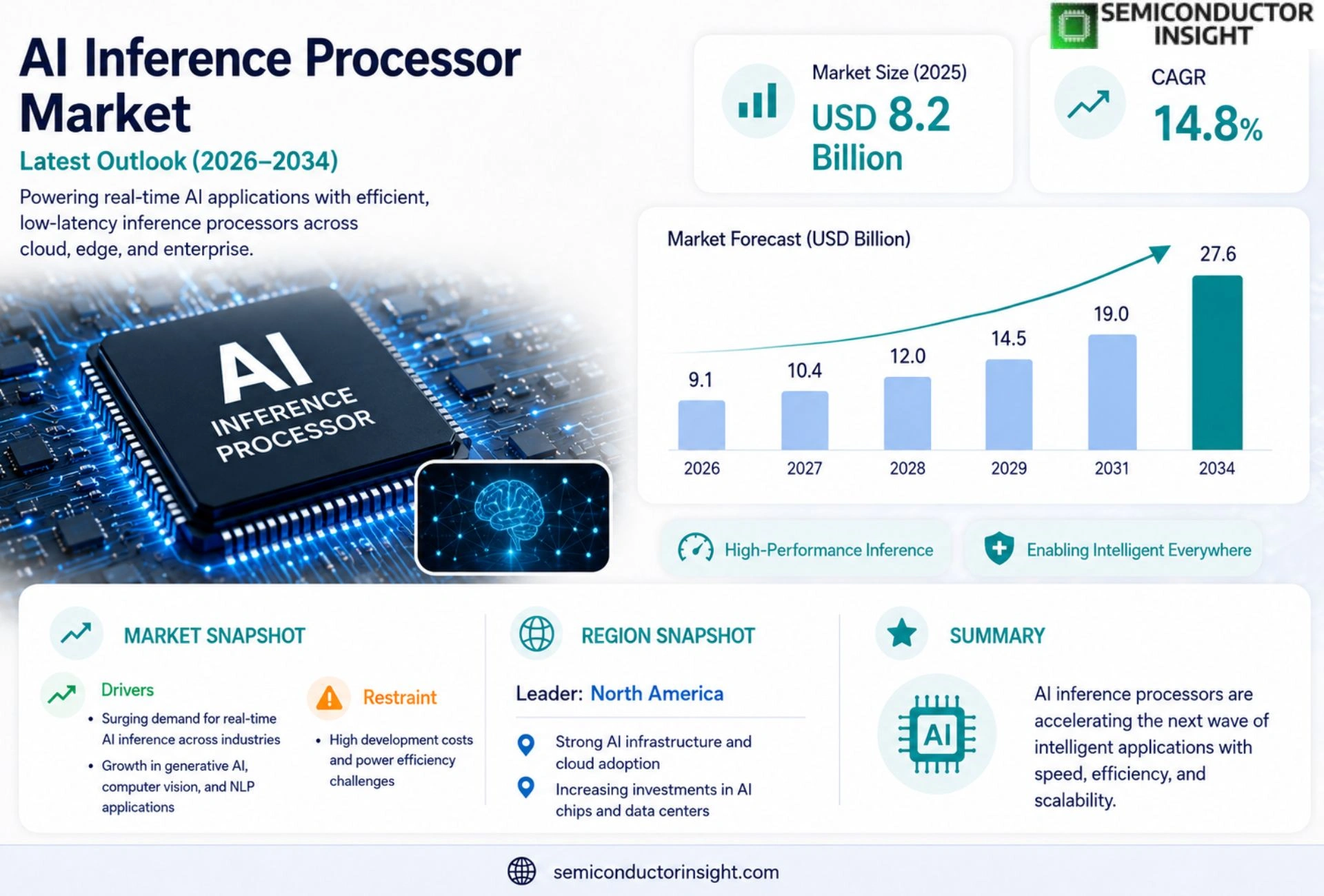
Global AI inference processor market size was valued at USD 8.2 billion in 2025. The market is projected to grow from USD 9.1 billion in 2025 to USD 27.6 billion by 2034, exhibiting a CAGR of 14.8% during the forecast period.
AI inference processors are specialized hardware accelerators engineered to run trained machine‑learning models efficiently at the point of use, enabling real‑time image recognition, natural‑language processing and recommendation workloads.
The market is experiencing rapid growth because cloud platforms and edge deployments demand low‑latency inferencing while enterprises pour capital into generative‑AI services; however, semiconductor supply constraints pose challenges.
Furthermore, leading vendors,including NVIDIA, Intel (Habana Labs), AMD and Google,continue launching next‑generation chips such as NVIDIA’s H100 Tensor Core GPU and Google’s TPU v5e, driving broader adoption across data centers and edge devices.
MARKET DRIVERS
Rising Edge‑AI Deployments
AI Inference Processor Market is being propelled by a surge in edge‑AI applications such as smart cameras, autonomous drones, and industrial IoT gateways. Enterprises are prioritizing on‑device processing to reduce latency, lower bandwidth costs, and meet stringent data‑privacy regulations.
Advances in Low‑Power Architectures
Recent silicon innovations,including mixed‑signal compute engines and neuromorphic cores,allow inference workloads to run on milliwatt budgets. This efficiency enables wider adoption in wearables and battery‑operated devices, expanding the addressable market.
➤ Embedded AI inference chips now achieve sub‑millisecond latency in vision tasks, delivering real‑time decision making at the sensor level.
Combined, these drivers create a virtuous cycle: higher performance fuels new use‑cases, which in turn stimulate further investment in specialized inference processors.
MARKET CHALLENGES
Design Complexity and Toolchain Gaps
Engineers face steep learning curves when mapping deep‑learning models to heterogeneous inference hardware. Existing development kits often lack comprehensive profiling tools, slowing time‑to‑market for new solutions.
Other Challenges
Manufacturing Yield Constraints
Advanced process nodes required for high‑density inference cores can experience lower yields, driving up component costs and limiting volume scalability for emerging manufacturers.
MARKET RESTRAINTS
Supply‑Chain Volatility
Global semiconductor shortages continue to affect the availability of critical substrates and packaging materials. Companies that rely on just‑in‑time inventories may encounter production bottlenecks, tempering short‑term growth.
MARKET OPPORTUNITIES
Emerging 5G‑Enabled Edge Nodes
The rollout of 5G networks creates new opportunities for distributed inference processors that can handle high‑throughput data streams at the edge. Operators are exploring AI‑enhanced base stations to enable real‑time analytics for smart city initiatives.
Customization for Domain‑Specific Models
Verticals such as healthcare imaging and autonomous logistics are demanding tailor‑made inference accelerators that optimize for specific model architectures. This trend encourages a shift toward ASIC‑as‑a‑service offerings, unlocking additional revenue streams for chipset vendors.
AI Inference Processor Market Trends
Accelerated Adoption in Edge and Cloud Environments
Enterprises are increasingly deploying AI inference processors to meet the stringent latency requirements of real‑time workloads. Specialized hardware accelerators enable on‑device processing for image recognition, natural‑language understanding, and recommendation engines, reducing reliance on centralized data‑center resources. The convergence of cloud‑native services and edge deployments drives a steady shift toward heterogeneous compute stacks, where inference processors complement CPUs and GPUs to optimize power consumption and throughput. Major cloud providers are integrating these accelerators into their service portfolios, offering customers a seamless path from model training to production inference.
Other Trends
Supply Chain Constraints Impact Deployment Timelines
Global semiconductor shortages continue to affect the availability of advanced AI inference chips. Lead times for new silicon generations have lengthened, prompting OEMs and system integrators to prioritize high‑margin use cases and to explore secondary sourcing strategies. Companies are also investing in in‑house fabrication capabilities and diversified supplier networks to mitigate risk. Consequently, project schedules are being adjusted, and some manufacturers are delaying the rollout of next‑generation devices until capacity stabilizes.
Innovation in Chip Architectures and Software Ecosystems
Leading vendors such as NVIDIA, Intel’s Habana Labs, AMD, and Google are releasing iterative enhancements that improve matrix multiplication efficiency, on‑chip memory bandwidth, and interconnect latency. These improvements are accompanied by robust software stacks, including optimized libraries and compiler tools that abstract hardware complexity for developers. The integration of proprietary instruction sets with open standards encourages broader ecosystem participation, allowing startups and established firms alike to accelerate time‑to‑market for AI‑driven products. As the ecosystem matures, we expect a rise in domain‑specific accelerators tailored for vision, speech, and recommendation workloads, further expanding the reach of inference processors across industries.
COMPETITIVE LANDSCAPE
Key Industry Players
AI Inference Processor Market Competitive Overview
AI Inference Processor Market is anchored by a handful of dominant vendors that shape technology roadmaps and pricing dynamics. NVIDIA leads the segment with its H100 Tensor Core GPU, delivering unmatched throughput for data‑center workloads and establishing a de‑facto standard for high‑performance inference. Intel, through its Habana Labs acquisition, competes vigorously with the Gaudi family of chips, emphasizing modular scalability for both cloud and edge deployments. AMD, leveraging its acquisition of Xilinx, offers adaptive compute acceleration that targets heterogeneous AI workloads, while Google’s custom TPU v5e underscores the growing influence of hyperscale cloud providers in dictating processor specifications. Collectively, these leaders account for the majority of market revenue and drive the overall CAGR of 14.8% by introducing successive generations that lower latency and power consumption.
Beyond the headline names, a diverse set of niche innovators contributes specialized capabilities that address emerging use cases. Qualcomm’s AI Engine integrates inference directly into mobile SoCs, enabling real‑time vision and language tasks on consumer devices. Apple’s Neural Engine focuses on on‑device privacy‑preserving inference for its ecosystem. Samsung’s Exynos AI and Huawei’s Ascend processors target edge and telecom environments with optimized power envelopes. European and Israeli startups such as Graphcore, Cerebras Systems, Mythic, Tenstorrent, and Baidu’s Kunlun chip bring novel architectures,including IPU, wafer‑scale engine, and analog compute,that challenge conventional GPU dominance and attract partnerships with OEMs seeking differentiated performance per watt.
List of Key AI Inference Processor Companies Profiled
- NVIDIA
- Intel (Habana Labs)
- AMD
- Google (TPU)
- Qualcomm
- Apple
- Samsung
- Huawei
- Graphcore
- Cerebras Systems
- Mythic
- Baidu
- Tenstorrent
- Amazon Web Services
- Xilinx
Segment Analysis:
| Segment Category | Sub-Segments | Key Insights |
| By Type |
|
GPU‑based solutions dominate the type landscape because they combine high parallelism with a mature software ecosystem.
|
| By Application |
|
Data‑center AI services represent the strongest application driver.
|
| By End User |
|
Cloud service providers lead end‑user adoption because they require massive, on‑demand inference capacity.
|
| By Architecture |
|
Tensor‑core architectures shape the competitive narrative.
|
| By Deployment Scenario |
|
Real‑time inference is the most compelling scenario because latency directly impacts user experience.
|
Regional Analysis: North America
The increasing adoption of cloud computing services in the US is a major driver for AI inference processors, as cloud providers offer scalable infrastructure for deploying and running AI models.
The growing trend of edge AI, where inference processing is performed closer to the data source, is creating significant opportunities for specialized AI inference processors in the US market.
The US automotive industry, with its focus on developing autonomous driving technologies, is a key consumer of high-performance AI inference processors, significantly impacting market trends.
The healthcare sector in the US is increasingly leveraging AI for diagnostics, drug discovery, and personalized medicine, creating demand for powerful AI inference solutions.
Europe
Europe represents the second largest market for AI inference processors. Key drivers include strong government support for AI initiatives, a concentration of research institutions, and growing industrial applications. The European market is characterized by a focus on data privacy and security, influencing the development of edge-centric AI solutions. Business strategies in Europe often emphasize collaboration between academia and industry, and adherence to stringent regulatory frameworks like GDPR. The automotive and industrial sectors are significant consumers of AI inference processors in the region. The emphasis on sustainable AI practices and energy efficiency is also shaping market trends in Europe.
Asia-Pacific
The Asia-Pacific region is experiencing rapid growth AI Inference Processor Market, driven by increasing investments in technology and a large pool of skilled talent. China is emerging as a major player, with significant government initiatives promoting AI development. Other key markets in the region include Japan, South Korea, and India. The demand for AI inference processors is being fueled by applications in e-commerce, manufacturing, and telecommunications. Business strategies in Asia-Pacific often involve catering to the specific needs of local markets and building strong partnerships with local companies. The region is also witnessing a rise in open-source AI platforms and frameworks, fostering innovation and competition AI Inference Processor Market.
South America
South America is an emerging market for AI inference processors, with growing adoption across various industries. The region’s potential is driven by increasing internet penetration and the rise of digital economies. Key applications include retail analytics, financial services, and agriculture. Business strategies in South America often focus on cost-effective solutions and adapting to local market dynamics. While still nascent, the demand for AI inference processors is expected to grow significantly in the coming years, driven by increasing investments in digital transformation.
Middle East & Africa
The Middle East & Africa region presents significant growth opportunities for AI Inference Processor Market. Governments in the region are actively investing in AI initiatives as part of their broader digital transformation strategies. Key sectors driving demand include finance, healthcare, and defense. Business strategies in this region often involve partnerships with local governments and businesses, and focusing on solutions that address specific regional challenges. The increasing adoption of smart city initiatives and the expansion of e-commerce are also contributing to the growth of AI Inference Processor Market in the Middle East & Africa.
Report Scope
This market research report provides a comprehensive analysis of the AI Inference Processor Market , covering the forecast period 2026–2034. It offers detailed insights into market dynamics, technological advancements, competitive landscape, and key trends shaping the industry.
Key focus areas of the report include:
- Market Overview: The report begins with an overview outlining its current market scenario, key growth indicators, and industry transformation drivers. It discusses macroeconomic factors, demand–supply balance, regulatory landscape, and the strategic role of semiconductors in powering advancements across industries such as automotive, telecommunications, consumer electronics, and industrial automation.
- Market Size & Forecast: Historical data and future projections for revenue, unit shipments, and market value across major regions and segments.
- Segmentation Analysis: Detailed breakdown by product type, technology, application, and end-user industry to identify high-growth segments and investment opportunities.
- Regional Insights: Insights into market performance across North America, Europe, Asia-Pacific, Latin America, and the Middle East & Africa, including country-level analysis where relevant.
- Competitive Landscape: Profiles of leading market participants, including their product offerings, R&D focus, manufacturing capacity, pricing strategies, and recent developments such as mergers, acquisitions, and partnerships.
- Technology Trends & Innovation: Assessment of emerging technologies, integration of AI/IoT, semiconductor design trends, fabrication techniques, and evolving industry standards.
- Market Drivers & Restraints: Evaluation of factors driving market growth along with challenges, supply chain constraints, regulatory issues, and market-entry barriers.
- Stakeholder Insights: Insights for component suppliers, OEMs, system integrators, investors, and policymakers regarding the evolving ecosystem and strategic opportunities.
Primary and secondary research methods are employed, including interviews with industry experts, data from verified sources, and real-time market intelligence to ensure the accuracy and reliability of the insights presented.
FREQUENTLY ASKED QUESTIONS:
What is the current market size of AI Inference Processor Market?
-> AI inference processor market size was valued at USD 8.2 billion in 2025. The market is projected to grow from USD 9.1 billion in 2025 to USD 27.6 billion by 2034.
Which key companies operate AI Inference Processor Market?
-> Key players include NVIDIA, Intel (Habana Labs), AMD, Google, among others.
What are the key growth drivers?
-> Key growth drivers include cloud platform demand for low‑latency inferencing, edge deployments, and enterprise investments in generative‑AI services.
Which region dominates the market?
-> The reference does not specify a single dominant region; market growth is observed globally across data‑center and edge locations.
What are the emerging trends?
-> Emerging trends include development of next‑generation AI processors such as NVIDIA H100 Tensor Core GPU and Google TPU v5e, and increasing focus on semiconductor supply chain resilience.

Get Sample Report PDF for Exclusive Insights
Report Sample Includes
- Table of Contents
- List of Tables & Figures
- Charts, Research Methodology, and more...
 Download Sample Report PDF