AI Chip Substrate (FCBGA) Market Insights
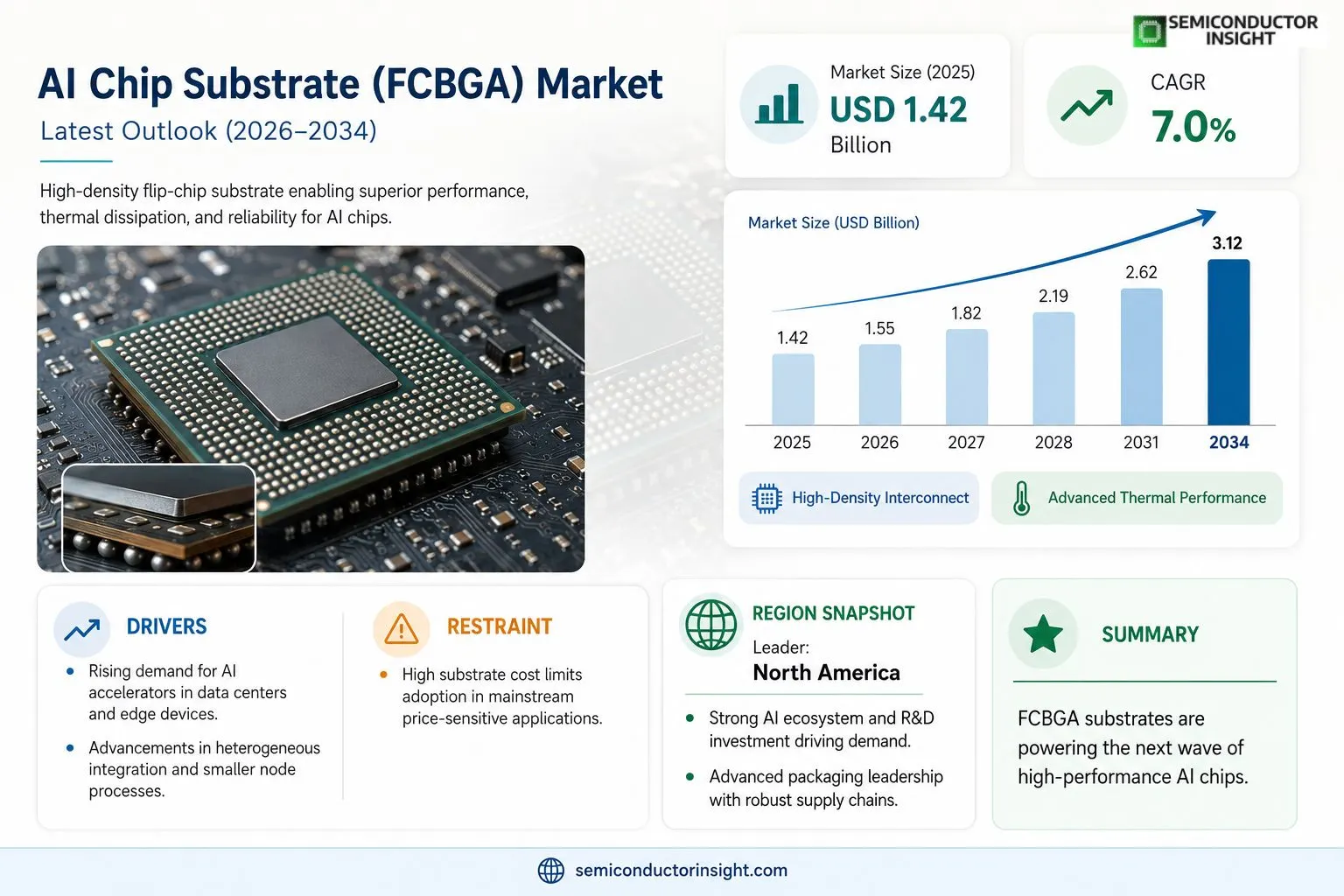
Global AI chip substrate (FCBGA) market size was valued at USD 1.42 billion in 2025. The market is projected to grow from USD 1.55 billion in 2026 to USD 3.12 billion by 2034, exhibiting a CAGR of 7.0% during the forecast period.
AI chip substrate (FCBGA), or flip‑chip ball grid array, is a high‑density interconnect technology that enables direct attachment of silicon dies onto substrates using microscopic solder balls. This architecture provides superior electrical performance, thermal dissipation, and mechanical stability,critical attributes for modern artificial‑intelligence processors that demand high bandwidth and low latency.The market is experiencing rapid growth because demand for AI accelerators across data centers, edge devices, and autonomous systems is soaring. Furthermore, advancements in heterogeneous integration and the push toward smaller node processes are driving adoption of FCBGA solutions. Key players such as TSMC, ASE Technology Holding, Amkor Technology, Intel and Samsung are expanding their advanced packaging capabilities and forming strategic alliances,e.g., Nvidia’s partnership with TSMC on next‑generation AI chips,to capture emerging opportunities.
MARKET DRIVERS
Rising Demand for Edge AI Computing
AI Chip Substrate (FCBGA) Market is being propelled by the rapid deployment of edge AI devices such as autonomous sensors, smart cameras, and industrial IoT gateways. These applications require high‑density interconnects and excellent thermal performance, qualities that FCBGA substrates uniquely deliver.
Growth of High‑Performance Data Centers
Data‑center operators are scaling up AI workloads, prompting a shift toward multi‑chip‑module designs that rely on fine‑pitch BGA technology. The resulting need for reliable, low‑impedance pathways fuels investment in advanced substrate solutions across AI Chip Substrate (FCBGA) Market.
➤ “Substrate efficiency now determines AI accelerator competitiveness, making FCBGA a critical enabler for next‑gen AI systems.”
Manufacturers are also benefitting from process‑node miniaturization, which reduces power consumption while maintaining performance, further reinforcing demand for high‑quality FCBGA substrates.
MARKET CHALLENGES
Complexity of Advanced Manufacturing
Production of FCBGA substrates requires precise alignment, sophisticated material handling, and tight quality control. The steep learning curve and high capital expenditure can deter new entrants, limiting supply flexibility for AI Chip Substrate (FCBGA) Market.
Other Challenges
Supply Chain Constraints
Global shortages of high‑purity copper and advanced epoxy materials have intermittently slowed stack‑up deliveries, creating lead‑time uncertainties for key AI hardware projects.
MARKET RESTRAINTS
Cost Sensitivity in Mainstream Applications
While premium AI workloads justify higher substrate costs, many consumer‑grade devices remain price‑driven, restraining broader adoption of expensive FCBGA solutions.Additionally, competing interconnect technologies such as silicon interposers and organic substrates offer cost advantages for lower‑performance segments, diverting potential volume away from AI Chip Substrate (FCBGA) Market.Regulatory scrutiny over material sustainability is prompting manufacturers to reassess epoxy formulations, potentially adding compliance costs and slowing new product introductions.
MARKET OPPORTUNITIES
Customization for Emerging AI Verticals
Specialized AI applications in healthcare imaging, autonomous robotics, and 5G base stations require tailored substrate stack‑ups. Companies that can offer rapid design‑for‑manufacturing (DFM) cycles stand to capture sizable share in these high‑growth niches.Furthermore, the convergence of photonic integration with FCBGA platforms opens pathways for ultra‑low‑latency AI accelerators, representing a frontier opportunity for differentiated product portfolios within AI Chip Substrate (FCBGA) Market.
AI Chip Substrate (FCBGA) Market Trends
Rising Demand for High‑Performance AI Accelerators
Data‑center operators are scaling AI workloads at an unprecedented rate, and the need for faster, lower‑latency compute has pushed designers toward flip‑chip ball grid array solutions. The AI Chip Substrate (FCBGA) architecture accommodates higher I/O counts and superior thermal pathways, enabling AI processors to sustain peak throughput without overheating. Edge devices, including autonomous vehicles and intelligent cameras, also benefit from the dense interconnects and mechanical robustness offered by this substrate, which reduces board‑level parasitics and supports aggressive power‑efficiency targets. Consequently, the market is witnessing a clear shift from traditional wire‑bond packages to FCBGA as the preferred choice for next‑generation AI silicon.
Other Trends
Strategic Alliances and Packaging Advances
Leading foundries and packaging specialists are deepening collaborations to accelerate time‑to‑market for AI chips. TSMC has expanded its advanced packaging line to support finer pitch FCBGA configurations, while ASE Technology Holding and Amkor Technology are investing in thermal‑optimized substrates that integrate micro‑vias for enhanced signal integrity. Intel and Samsung are jointly exploring heterogeneous integration platforms that embed FCBGA within multi‑chip‑module stacks. Notably, Nvidia’s partnership with TSMC on next‑generation AI processors leverages the high‑density interconnects of flip‑chip ball grid arrays to meet the bandwidth demands of large language models. These alliances reinforce the ecosystem supporting AI Chip Substrate (FCBGA) Market.
Shift Toward Heterogeneous Integration
Manufacturers are increasingly pairing FCBGA with emerging 3‑D integration techniques to create compact, high‑performance modules. By stacking memory, networking fabric, and compute dies within a single package, designers achieve reduced latency and lower power consumption,key metrics for AI inference at the edge. The substrate’s ability to host microsolder balls across a broad area facilitates reliable electrical connections in these densely packed assemblies. As the industry moves toward system‑in‑package solutions, AI Chip Substrate (FCBGA) Market is positioned to capture the growing need for modular, scalable packaging that aligns with the rapid evolution of AI workloads.
COMPETITIVE LANDSCAPEKey Industry Players
Competitive Dynamics in AI Chip Substrate (FCBGA) Market
AI Chip Substrate (FCBGA) Market is presently anchored by a handful of vertically integrated semiconductor manufacturers that command both design expertise and advanced packaging capacity. TSMC leads the ecosystem, leveraging its 5‑nm and beyond process nodes to deliver high‑density interconnects for AI accelerators, while forming strategic alliances with Nvidia and Intel to secure long‑term demand. This concentration creates a tiered structure where a small number of foundries dominate high‑volume production, complemented by specialized OSAT providers that offer heterogeneous integration and thermal management services essential for next‑generation AI workloads.Beyond the dominant tier, a diverse set of niche players adds depth to the competitive landscape. ASE Technology Holding and Amkor Technology operate as premier OSATs, delivering flip‑chip ball grid array solutions to fabless designers and reinforcing supply chain resilience. Samsung’s foundry division expands its advanced packaging portfolio to rival TSMC, while GlobalFoundries targets mid‑range nodes for cost‑sensitive AI applications. Intel, Micron Technology, Qualcomm, AMD, STMicroelectronics, Renesas, Texas Instruments, and Broadcom contribute differentiated substrate technologies, often focusing on edge‑AI, automotive, and telecommunications segments, thereby fostering a vibrant market of specialized offerings.
List of Key AI Chip Substrate (FCBGA) Companies Profiled
- TSMC
- ASE Technology Holding
- Amkor Technology
- Samsung Electronics
- Intel Corporation
- GlobalFoundries
- Micron Technology
- Qualcomm Incorporated
- Advanced Micro Devices (AMD)
- STMicroelectronics
- Renesas Electronics
- Texas Instruments
- Broadcom Inc.
Segment Analysis:
| Segment Category | Sub-Segments | Key Insights |
| By Type |
|
High‑Performance AI Chips dominate the segment because they require the utmost electrical performance and thermal dissipation; • FCBGA enables dense interconnects that meet bandwidth demands of large neural networks; • Robust mechanical stability supports high‑frequency operation in data‑center environments. Low‑Power Edge AI Chips are gaining traction as device form‑factor shrinks; • The substrate’s efficient heat spreading reduces cooling complexity; • Flip‑chip architecture shortens signal paths, preserving latency characteristics essential for real‑time inference. |
| By Application |
|
Data‑Center Accelerators benefit from FCBGA’s high‑density routing, which sustains massive parallel processing; • Superior thermal paths enable sustained performance under heavy workloads; • The technology aligns with heterogeneous integration trends, allowing co‑packaging of memory and logic. Autonomous Vehicles require rugged, reliable substrates; • Flip‑chip design improves vibration resistance; • Enhanced heat extraction is critical for continuous operation in varied climates. Consumer Electronics leverage the compact footprint of FCBGA to fit AI capabilities into thin form‑factors while maintaining power efficiency. |
| By End User |
|
Cloud Service Providers prioritize scalability and reliability; • FCBGA’s low‑latency interconnects support multi‑tenant AI workloads; • Its thermal efficiency reduces cooling infrastructure demands. Automotive OEMs focus on safety‑critical performance; • Robust mechanical bonding offers enhanced durability under automotive stresses; • Consistent electrical characteristics simplify validation cycles. Edge Device Manufacturers need compact, power‑aware solutions; • The substrate’s small footprint enables sleek product designs; • Efficient heat removal allows longer device lifetimes without active cooling. |
| By Integration Strategy |
|
Heterogeneous Integration is the primary driver for FCBGA adoption; • It enables co‑location of compute, memory, and passive components, reducing signal loss; • The architecture aligns with emerging AI workloads that span multiple dies. System‑in‑Package (SiP) leverages the substrate’s ability to host diverse functions, delivering compact solutions for edge AI. Chip‑on‑Board (CoB) benefits from the reliable attachment method of flip‑chip, ensuring consistent performance across varying operating conditions. |
| By Market Driver |
|
Performance Demand fuels the need for high‑density interconnects; • FCBGA’s short signal paths and high pin count support ultra‑fast AI inference. Thermal Management is a critical enabler for sustained AI workloads; • The substrate’s efficient heat spreader mitigates hotspots, preserving chip longevity. Miniaturization pushes designers toward compact packaging; • Flip‑chip technology eliminates traditional wire‑bond footprints, allowing thinner, lighter AI modules. |
Regional Analysis: North America
United States
The primary driver for AI Chip Substrate (FCBGA) Market in the United States is the rapid proliferation of AI applications across various industries, including autonomous vehicles, healthcare, and finance. Increased computing power requirements for sophisticated AI models are directly correlated with the demand for advanced packaging solutions like FCBGA. Business strategies are heavily focused on innovation and customization to meet the evolving needs of AI developers.
The competitive landscape in the US market is characterized by a mix of established players and emerging companies. Intense competition exists among manufacturers focused on delivering high-performance and reliability in FCBGA substrates. Business strategies often involve forging strategic partnerships and collaborations to enhance technological capabilities and expand market reach. A key aspect of competitive advantage lies in the ability to offer customized solutions tailored to specific AI chip designs.
Several emerging trends are shaping AI Chip Substrate (FCBGA) Market in the United States. These include the increasing adoption of 3D packaging technologies, the integration of advanced materials for enhanced thermal performance, and a growing focus on miniaturization to accommodate higher chip densities. Business strategies are adapting to these trends by investing in research and development of next-generation FCBGA solutions.
Government initiatives in the United States are significantly impacting AI Chip Substrate (FCBGA) Market. Policies aimed at incentivizing domestic semiconductor manufacturing and fostering innovation are creating a favorable environment for growth. These initiatives, combined with funding for research and development, are expected to strengthen the position of the US as a global leader in AI chip substrate technology. Business strategies are increasingly aligned with these government priorities.
Europe
Europe represents a significant and growing market for AI Chip Substrate (FCBGA). The region’s strength lies in its established automotive industry and increasing focus on edge computing. European nations are actively investing in AI research and development, particularly within the automotive, industrial automation, and cybersecurity sectors. Business strategies often emphasize collaboration between research institutions, universities, and industry players to accelerate innovation in AI chip substrate technology. The EU’s focus on data privacy and security is also driving demand for secure and reliable FCBGA solutions. However, fragmentation across European markets and varying levels of technological advancement present challenges. The demand for AI chip substrates is expected to rise steadily, driven by the growing adoption of AI-powered applications in various sectors.
Asia-Pacific
Asia-Pacific is poised to be the fastest-growing market for AI Chip Substrate (FCBGA) during the forecast period. The region’s robust semiconductor manufacturing ecosystem, particularly in countries like Taiwan, South Korea, and China, provides a strong foundation for growth. Rapid adoption of AI across various industries, including consumer electronics, telecommunications, and automotive, is fueling demand for advanced packaging solutions. Business strategies in the Asia-Pacific region are often characterized by a focus on cost competitiveness and rapid scaling of production capacity. Government support for the semiconductor industry across the region is also a significant driver. However, geopolitical tensions and supply chain vulnerabilities pose challenges to the sustained growth of the market. The Asia-Pacific AI chip substrate market is expected to witness substantial investment in research and development to maintain its competitive edge.
South America
South America presents a relatively nascent but promising market for AI Chip Substrate (FCBGA). The increasing adoption of AI in industries like finance, retail, and agriculture is creating opportunities for growth. However, the market is characterized by limited domestic manufacturing capabilities and a reliance on imports. Business strategies in South America often involve partnerships with international suppliers and a focus on providing customized solutions to meet specific regional needs. The development of local AI talent and the establishment of robust supply chains will be crucial for unlocking the full potential of the market. Government initiatives aimed at promoting technological advancement and attracting foreign investment are expected to play a key role in driving growth.
Middle East & Africa
The Middle East and Africa represent emerging markets for AI Chip Substrate (FCBGA). The region’s growing investments in infrastructure development, smart cities, and digital transformation initiatives are driving demand for AI-powered solutions. While the market is relatively small compared to other regions, it offers significant potential for future growth. Business strategies in the Middle East and Africa often involve focusing on providing tailored solutions to meet the specific needs of local industries. Government support for technology adoption and initiatives aimed at fostering innovation are expected to contribute to market growth. However, factors such as limited technological infrastructure and geopolitical instability pose challenges to the sustained expansion of the market.
Report Scope
This market research report provides a comprehensive analysis of the AI Chip Substrate (FCBGA) Market , covering the forecast period 2026–2034. It offers detailed insights into market dynamics, technological advancements, competitive landscape, and key trends shaping the industry.
Key focus areas of the report include:
- Market Overview: The report begins with an overview outlining its current market scenario, key growth indicators, and industry transformation drivers. It discusses macroeconomic factors, demand–supply balance, regulatory landscape, and the strategic role of semiconductors in powering advancements across industries such as automotive, telecommunications, consumer electronics, and industrial automation.
- Market Size & Forecast: Historical data and future projections for revenue, unit shipments, and market value across major regions and segments.
- Segmentation Analysis: Detailed breakdown by product type, technology, application, and end-user industry to identify high-growth segments and investment opportunities.
- Regional Insights: Insights into market performance across North America, Europe, Asia-Pacific, Latin America, and the Middle East & Africa, including country-level analysis where relevant.
- Competitive Landscape: Profiles of leading market participants, including their product offerings, R&D focus, manufacturing capacity, pricing strategies, and recent developments such as mergers, acquisitions, and partnerships.
- Technology Trends & Innovation: Assessment of emerging technologies, integration of AI/IoT, semiconductor design trends, fabrication techniques, and evolving industry standards.
- Market Drivers & Restraints: Evaluation of factors driving market growth along with challenges, supply chain constraints, regulatory issues, and market-entry barriers.
- Stakeholder Insights: Insights for component suppliers, OEMs, system integrators, investors, and policymakers regarding the evolving ecosystem and strategic opportunities.
Primary and secondary research methods are employed, including interviews with industry experts, data from verified sources, and real-time market intelligence to ensure the accuracy and reliability of the insights presented.
FREQUENTLY ASKED QUESTIONS:
What is the current market size of AI Chip Substrate (FCBGA) Market?
-> AI Chip Substrate (FCBGA) Market was valued at USD 1.42 billion in 2025 and is projected to reach USD 3.12 billion by 2034, exhibiting a CAGR of 7.0%.
Which key companies operate in AI Chip Substrate (FCBGA) Market?
-> Key players include TSMC, ASE Technology Holding, Amkor Technology, Intel, Samsung.
What are the key growth drivers?
-> Key growth drivers include demand for AI accelerators in data centers, edge devices, autonomous systems, and advancements in heterogeneous integration and smaller node processes.
Which region dominates the market?
-> The market is globally distributed with strong activity in North America, Asia‑Pacific, and Europe, reflecting worldwide demand for AI‑enabled semiconductor solutions.
What are the emerging trends?
-> Emerging trends include heterogeneous integration, advanced packaging technologies, and strategic alliances among leading semiconductor firms.

Get Sample Report PDF for Exclusive Insights
Report Sample Includes
- Table of Contents
- List of Tables & Figures
- Charts, Research Methodology, and more...
 Download Sample Report PDF