Aerospace and Automotive MRAM Market Insights
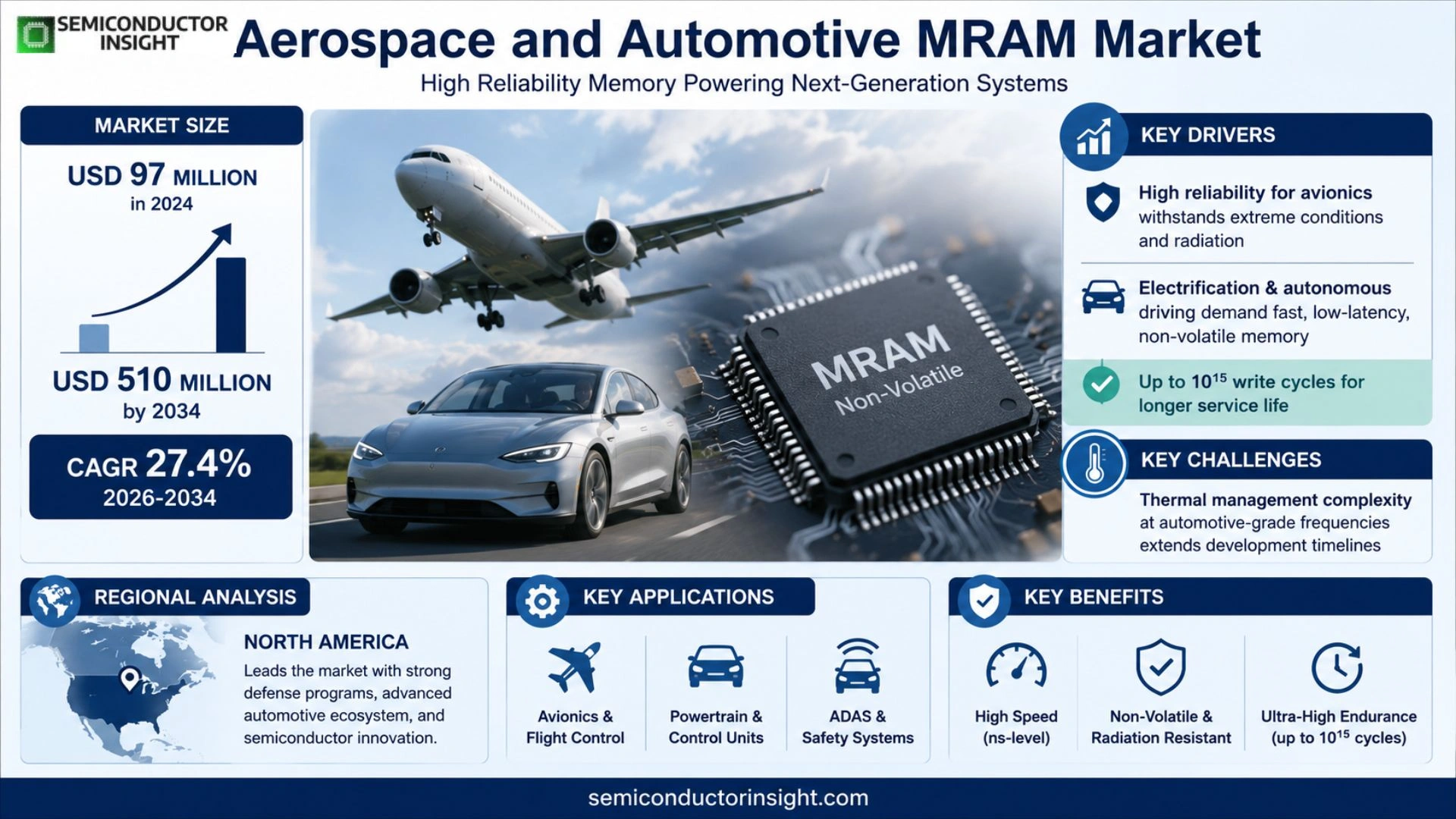
Global Aerospace and Automotive MRAM market was valued at USD 97 million in 2024 and is forecasted to reach USD 510 million by 2034, reflecting a CAGR of 27.4% during the forecast horizon.
Magnetoresistive random‑access memory (MRAM) is a non‑volatile memory technology that stores data by manipulating magnetic domains rather than electric charge. Because the magnetic state retains information without power, MRAM combines the speed of SRAM with the endurance of flash, making it suitable for safety‑critical aerospace systems and high‑reliability automotive electronics.
The upward trajectory of this segment stems largely from automotive demand; OICA data show that worldwide vehicle production peaked at 97.3 million units in 2017 and remains concentrated,over 90 %,in Asia, Europe and North America, with Asia contributing roughly 56 % of output. Simultaneously, aerospace manufacturers are integrating more electronic control units that require radiation‑hard memory solutions, prompting suppliers such as Everspin Technologies and Honeywell to expand their MRAM portfolios. Consequently, both sectors are accelerating adoption of MRAM for its low power consumption, instant‑on capability, and robustness against harsh operating conditions.
MARKET DRIVERS
Increasing Reliability Demands in Avionics
Aerospace and Automotive MRAM Market is feeling pressure from aircraft manufacturers that require memory that can survive extreme temperature swings and radiation exposure. MRAM’s intrinsic non‑volatility eliminates the need for frequent power cycling, a characteristic that aligns tightly with safety‑critical flight‑control systems. Consequently, vendors that can certify their products under stringent aerospace standards are attracting premium contracts.
Electrification and Autonomous Driving Trends
Automotive OEMs are moving toward electric powertrains and higher levels of driver assistance, both of which rely on fast, low‑latency data storage. MRAM’s ability to retain information without power while delivering nanosecond read/write speeds makes it an attractive substitute for legacy EEPROM and Flash in power‑train control units. As vehicle software architectures become more modular, the memory component that can be re‑programmed on‑the‑fly gains tactical importance.
➤ MRAM’s endurance surpasses traditional Flash, offering up to 10^15 write cycles, which translates into longer service intervals for aircraft and vehicle platforms.
Combined, these forces create a momentum that encourages suppliers to invest in process‑node refinements, thereby lowering unit costs and widening the addressable base for Aerospace and Automotive MRAM Market.
MARKET CHALLENGES
Thermal Management Complexity
High‑performance MRAM cells generate localized heat when operated at automotive‑grade frequencies. Managing that thermal envelope without compromising the compact packaging required for modern vehicle designs introduces a layer of engineering effort that can extend development timelines.
Other Challenges
Manufacturing Yield
Current production lines for spin‑transfer torque MRAM still contend with variability in magnetic layer deposition. Yield rates below 80 % inflate per‑chip pricing, which can deter cost‑sensitive OEMs from committing to large‑scale adoption.
MARKET RESTRAINTS
High Initial Capital Expenditure
Establishing a dedicated MRAM fab requires multi‑hundred‑million‑dollar investment in lithography, deposition, and testing equipment. For many semiconductor players, the financial hurdle postpones entry until a clear volume threshold is demonstrated.
Limited Design Ecosystem
Design engineers accustomed to conventional memory hierarchies must learn new verification flows for magnetic storage. The scarcity of mature IP blocks and reference designs slows integration into existing vehicle and aircraft architectures.
Regulatory Certification Burden
Both aerospace and automotive sectors impose rigorous qualification standards (e.g., DO‑160, ISO 26262). Achieving certification for a relatively novel memory technology adds testing cycles and documentation overhead, which can delay market entry.
MARKET OPPORTUNITIES
Integration with Advanced Driver Assistance Systems
ADAS platforms require rapid access to sensor fusion data and deterministic latency. Embedding MRAM directly within edge‑compute modules reduces data transfer bottlenecks, enabling smoother real‑time decision making for functions such as lane‑keeping and adaptive cruise control.
Adoption in Satellite Constellations
Low‑Earth‑orbit satellites operate under harsh radiation and temperature extremes where traditional volatile memory would demand frequent resets. MRAM’s resilience presents a compelling case for on‑board data buffering and mission‑critical firmware storage, opening a niche yet expanding segment for Aerospace and Automotive MRAM Market.
Hybrid Memory Architectures
System designers are experimenting with MRAM as a cache‑level tier between SRAM and Flash, leveraging its speed while preserving non‑volatility. This hybrid approach promises performance gains for electric‑vehicle power‑management units and avionics navigation computers, creating a fresh revenue stream for memory suppliers willing to tailor solutions.
Aerospace and Automotive MRAM Market Trends
STT‑MRAM Gains Visibility in Automotive Safety Systems
Automakers are integrating spin‑transfer‑torque MRAM (STT‑MRAM) into advanced driver‑assistance and electric‑vehicle control units because the technology combines true non‑volatility with fast read/write cycles. Engineers cite the ability to retain configuration data after power loss as a decisive advantage for redundant safety architectures. The shift is prompting Tier‑1 suppliers to redesign printed‑circuit‑board layouts, trimming board space and cutting the overall mass of electronic modules. For Aerospace and Automotive MRAM Market, this trend translates into a higher proportion of volume shipments destined for automotive safety electronics, prompting manufacturers to expand capacity in fab sites that meet automotive‑grade quality standards.
Other Trends
Toggle MRAM Finds a Niche in Space‑Qualified Electronics
Spacecraft and high‑altitude platforms demand memory that tolerates ionizing radiation without the need for error‑correction overhead. Toggle MRAM satisfies those requirements by leveraging magnetic domain stability, which remains intact under neutron and gamma exposure typical of low‑Earth orbit. Recent satellite programs have earmarked toggle MRAM for flight‑software storage, citing lower total‑ownership cost compared with traditional SRAM solutions that require frequent replacement. This adoption is nudging equipment manufacturers to certify production lines for aerospace‑grade reliability, thereby widening the addressable market for Aerospace and Automotive MRAM Market.
Regional Divergence: Asia Leads Volume, North America Emphasizes High‑Reliability Modules
Asia’s automotive production share exceeding 50 % of global output has created a robust demand pipeline for high‑density MRAM, encouraging local chipmakers to invest in wafer‑scale integration and cost‑effective packaging. Conversely, North American aerospace contractors prioritize reliability over sheer volume, driving orders for MRAM parts qualified under stringent MIL‑STD specifications. European firms are balancing both approaches by targeting electric‑vehicle platforms that require ultra‑low power consumption. Companies that can flexibly shift between large‑scale automotive deliveries and specialized aerospace contracts are better positioned to capture incremental revenue across these divergent regions.
COMPETITIVE LANDSCAPE
Key Industry Players
Aerospace and Automotive MRAM Competitive Overview
Everspin Technologies continues to dominate the MRAM supply chain for both aerospace and automotive applications, leveraging its early‑stage Spin‑Transfer Torque (STT‑MRAM) platform and a robust portfolio of radiation‑hard parts certified for flight‑critical systems. The firm’s ability to combine high endurance with low power consumption has secured long‑term contracts with major aerospace OEMs and automotive Tier‑1 suppliers, anchoring a sizable share of the global market. Everspin’s vertical integration,spanning design, wafer fabrication, and final‑testing,creates a barrier to entry for newcomers and channels revenue into sustained R&D, reinforcing its leadership position.
Beyond the market leader, a constellation of specialized players shapes the competitive fabric. Avalanche Technology and Crocus Nano Electronics focus on niche Toggle‑MRAM cells that excel in ultra‑low‑latency environments, attracting defense contractors seeking deterministic performance. Honeywell International and Cobham capitalize on legacy aerospace expertise, embedding MRAM modules into avionics suites where reliability under extreme conditions is non‑negotiable. Renesas Electronics, Samsung Electronics, and STMicroelectronics extend their semiconductor ecosystems into automotive ECUs, embedding MRAM to meet the growing demand for secure, fast‑boot memory in autonomous driving platforms. Meanwhile, Intel, IBM, and Micron are experimenting with hybrid memory stacks that combine MRAM with conventional DRAM to deliver higher density solutions for next‑generation vehicle infotainment and telemetry. This diversified roster reflects a market where incumbents augment core competencies while pure‑play MRAM firms double‑down on niche technological advantages.
List of Key Aerospace and Automotive MRAM Companies Profiled
- Everspin Technologies
- Avalanche Technology
- Honeywell International
- Renesas Electronics
- Crocus Nano Electronics
- Samsung Electronics
- Cobham plc
- NVE Corporation
- STMicroelectronics
- Intel Corporation
- IBM
- Micron Technology
- TSMC
- Fujitsu Limited
- Globalfoundries
Segment Analysis:
| Segment Category | Sub-Segments | Key Insights |
| By Type |
|
STT‑MRAM is emerging as the dominant technology owing to its superior scalability and lower write energy. It supports higher density integration, enabling more complex avionics and vehicle control units. Designers appreciate its non‑volatility combined with fast read/write cycles, which aligns with safety‑critical requirements in aerospace and automotive electronics. |
| By Application |
|
Automotive applications are driving adoption because MRAM offers instant‑on capability and resilience to temperature extremes. Vehicle manufacturers value its ability to store critical calibration data without power, which enhances reliability of ADAS and infotainment platforms. The technology also simplifies architecture by reducing the need for separate backup memory. |
| By End User |
|
OEMs prioritize MRAM for its ability to meet stringent aerospace certification standards and automotive safety protocols. They emphasize design‑time predictability, which reduces validation cycles. The memory’s radiation tolerance is particularly valued for satellite and high‑altitude platforms, while its endurance supports long‑life vehicle electronics. |
| By Integration Level |
|
Embedded MRAM is gaining traction as system designers seek to consolidate memory footprints. Embedding MRAM directly into ASICs improves signal integrity and reduces board space, which is crucial for lightweight aerospace modules and compact automotive ECUs. It also streamlines supply chains by decreasing the number of discrete components. |
| By Functional Benefit |
|
Radiation Tolerance is a decisive advantage for aerospace missions where exposure to cosmic rays can corrupt conventional memories. MRAM’s magnetic storage cells remain stable, preserving mission‑critical parameters. In automotive, this benefit translates to enhanced reliability in harsh electromagnetic environments, supporting safety‑critical control loops. |
Regional Analysis: Aerospace and Automotive MRAM Market
North America
Military aircraft programs prize MRAM for its immunity to radiation and ability to survive power interruptions, enabling avionics that can sustain mission data even under extreme conditions. Program managers view the technology as a pathway to reduce weight and simplify board layouts, which translates into measurable performance gains for combat and reconnaissance platforms.
Leading car manufacturers are establishing joint development agreements with memory specialists to embed MRAM in electronic control units for advanced driver‑assistance systems. These collaborations focus on meeting functional safety standards while delivering the low‑latency response required for real‑time sensor fusion.
The presence of world‑class wafer fabs in the United States and Canada shortens production cycles for MRAM chips. Close ties between design houses and foundries facilitate rapid iteration, allowing companies to address automotive qualification cycles without lengthy overseas shipping delays.
Harmonized safety directives across the Federal Aviation Administration and National Highway Traffic Safety Administration create a clear compliance pathway for MRAM, encouraging OEMs to invest in the technology earlier in their product development timelines.
Europe
European aerospace firms are leveraging MRAM to satisfy stringent certification regimes, especially in satellite and unmanned aerial vehicle programs where reliability under temperature extremes is non‑negotiable. Automotive manufacturers in Germany and France are experimenting with MRMR (magnetoresistive) memory as a bridge to full MRAM deployment, aiming to reduce power consumption in infotainment units. Cross‑border research initiatives funded by the European Union foster collaboration between universities and industry, accelerating knowledge transfer and standard‑setting. While the market share lags behind North America, the regulatory push for greener vehicles and higher data integrity in flight systems positions Europe as a fast‑approaching contender.
Asia‑Pacific
The Asia‑Pacific region exhibits a dual narrative: on one hand, rapid expansion of automotive production volumes creates a sizable demand for memory that can endure harsh operating environments. On the other, several East Asian governments have launched strategic programs to embed non‑volatile memory into next‑generation electric vehicles and drones. Domestic semiconductor champions are investing in MRAM process nodes, yet they must contend with intellectual‑property constraints that limit technology transfer. Consumer‑driven demand for connected car features fuels interest, but the prevailing focus remains on cost‑effective solutions, implying a measured but steady adoption curve.
South America
South American aerospace activities are concentrated around satellite launch services and regional air‑transport contracts, where mission assurance is paramount. Although automotive production is modest compared with other regions, emerging low‑cost vehicle manufacturers are beginning to assess MRAM for its resilience to voltage spikes common in tropical climates. Trade agreements that lower tariff barriers for high‑tech components have opened channels for North American and European suppliers, enabling a gradual infusion of MRAM‑based modules into local supply chains. Market momentum is contingent upon the development of local testing facilities that can certify the technology against regional standards.
Middle East & Africa
In the Middle East, defense spending on advanced fighter jets and unmanned platforms drives interest in memory that can survive high‑temperature operations, making MRAM an attractive candidate. African aviation operators, focused on expanding regional connectivity, are looking to upgrade avionics with more reliable storage solutions to reduce maintenance overhead. Automotive sectors across the Gulf states are experimenting with electrified vehicle platforms, where MRAM’s low‑power profile aligns with sustainability goals. However, limited local manufacturing capacity means the region currently relies heavily on imported components, a situation that could shift if partnerships with global fab facilities materialize.
Report Scope
This market research report provides a comprehensive analysis of the Aerospace and Automotive MRAM Market , covering the forecast period 2026–2034. It offers detailed insights into market dynamics, technological advancements, competitive landscape, and key trends shaping the industry.
Key focus areas of the report include:
- Market Overview: The report begins with an overview outlining its current market scenario, key growth indicators, and industry transformation drivers. It discusses macroeconomic factors, demand–supply balance, regulatory landscape, and the strategic role of semiconductors in powering advancements across industries such as automotive, telecommunications, consumer electronics, and industrial automation.
- Market Size & Forecast: Historical data and future projections for revenue, unit shipments, and market value across major regions and segments.
- Segmentation Analysis: Detailed breakdown by product type, technology, application, and end-user industry to identify high-growth segments and investment opportunities.
- Regional Insights: Insights into market performance across North America, Europe, Asia-Pacific, Latin America, and the Middle East & Africa, including country-level analysis where relevant.
- Competitive Landscape: Profiles of leading market participants, including their product offerings, R&D focus, manufacturing capacity, pricing strategies, and recent developments such as mergers, acquisitions, and partnerships.
- Technology Trends & Innovation: Assessment of emerging technologies, integration of AI/IoT, semiconductor design trends, fabrication techniques, and evolving industry standards.
- Market Drivers & Restraints: Evaluation of factors driving market growth along with challenges, supply chain constraints, regulatory issues, and market-entry barriers.
- Stakeholder Insights: Insights for component suppliers, OEMs, system integrators, investors, and policymakers regarding the evolving ecosystem and strategic opportunities.
Primary and secondary research methods are employed, including interviews with industry experts, data from verified sources, and real-time market intelligence to ensure the accuracy and reliability of the insights presented.
FREQUENTLY ASKED QUESTIONS:
What is the current market size of Aerospace and Automotive MRAM Market?
-> Aerospace and Automotive MRAM market is forecasted to reach USD 510 million by 2034, reflecting a CAGR of 27.4% during the forecast horizon.
Which key companies operate in Aerospace and Automotive MRAM Market?
-> Key players include Everspin Technologies, Avalanche Technology, Honeywell, Renesas, Crocus Nano Electronics, Samsung Electronics, Cobham, NVE Corporation.
What are the key growth drivers?
-> Key growth drivers include rising automotive electronic content, increasing demand for reliable non‑volatile memory in aerospace safety‑critical systems, and the adoption of MRAM for low‑power, high‑speed applications.
Which region dominates the market?
-> Asia leads the market, driven by dominant automotive production and expanding aerospace activities, while Europe and North America also show strong adoption.
What are the emerging trends?
-> Emerging trends include the shift toward STT‑MRAM technology, integration of MRAM in advanced driver‑assistance systems (ADAS), and increased R&D investment for aerospace‑grade MRAM solutions.
Get Sample Report PDF for Exclusive Insights
Report Sample Includes
- Table of Contents
- List of Tables & Figures
- Charts, Research Methodology, and more...
 Download Sample Report PDF