Active Semiconductor Disk Lasers Market Insights
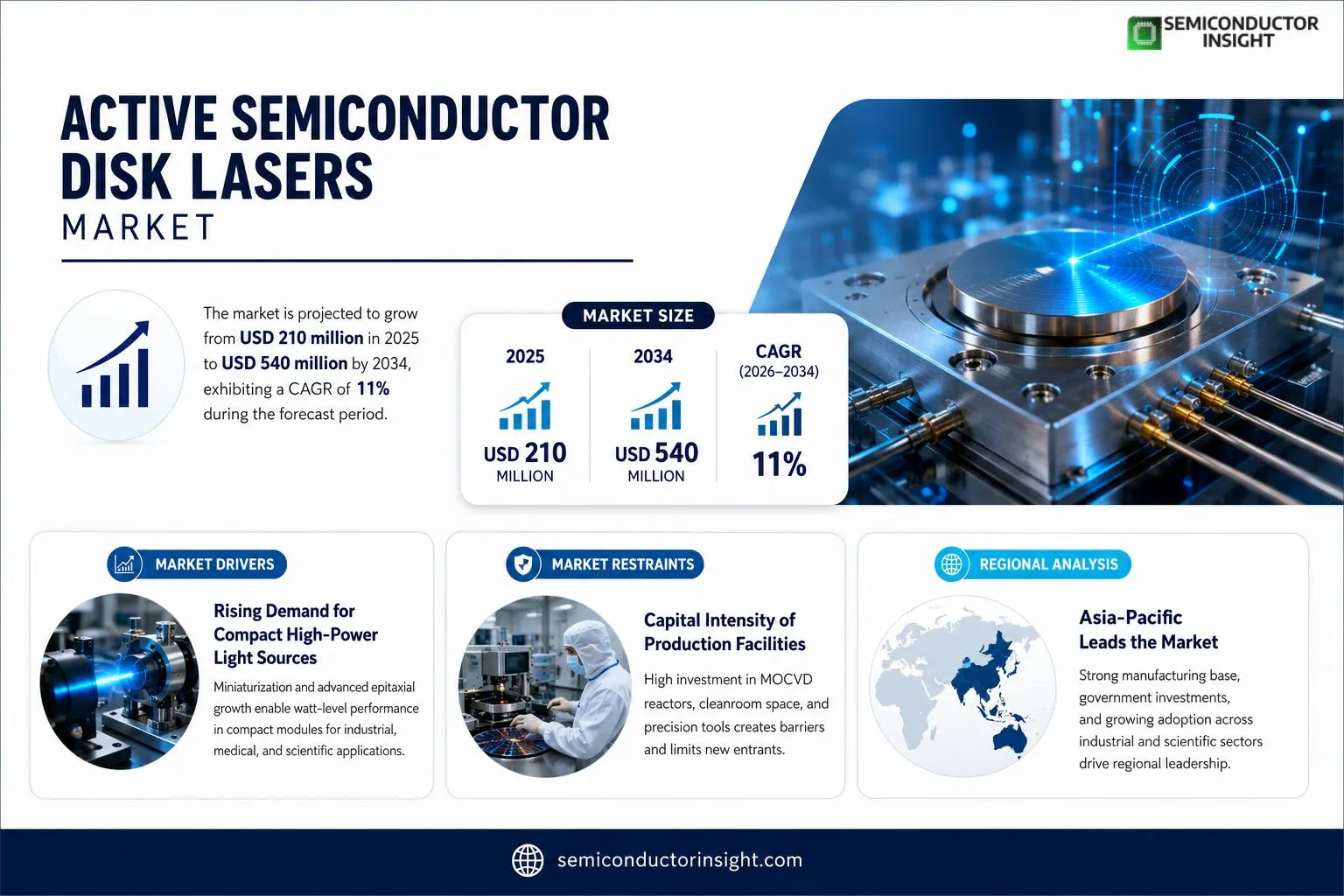
Active Semiconductor Disk Lasers market size was valued at USD 210 million in 2025. The market is projected to grow from USD 210 million in 2025 to USD 540 million by 2034, exhibiting a CAGR of 11% during the forecast period.
Active Semiconductor Disk Lasers combine the most important advantages of semiconductor gain media with thin‑disk geometry, delivering high optical efficiency and excellent thermal management. They are primarily employed as near‑infrared sources for laser cooling, high‑resolution spectroscopy, and have been explored for emerging telecommunications links.The market is gaining momentum because photonic integration budgets are expanding, demand for compact high‑power NIR sources is rising across industrial processing and medical diagnostics, and several manufacturersincluding II‑VI, Furukawa Electric, Anritsu, Lumentum, Thorlabs and Gooch & Housegomaintain broad product portfolios that address both OEM and research customers.
MARKET DRIVERS
Rising Demand for Compact High‑Power Light Sources
Active Semiconductor Disk Lasers Market benefits from manufacturers seeking smaller footprints without compromising output power. Recent advances in epitaxial growth enable devices that deliver watt‑level performance in a module comparable in size to a fingertip, opening doors for portable manufacturing equipment and field‑deployable sensors.
Efficiency Gains Through Novel Cavity Designs
New resonator geometries, such as strained‑layer quantum wells, are shaving several percent off wall‑plug losses. That efficiency lift translates directly into lower operating costs for end‑users, especially in continuous‑wave applications where power consumption has long been a cost driver.
➤ “Engineered disk structures now achieve >30% wall‑plug efficiency, redefining cost‑per‑watt calculations for industrial lasers.”
When system integrators evaluate overall total cost of ownership, the improved thermal profile of modern disks reduces cooling infrastructure, making the technology attractive for high‑volume production lines.
MARKET CHALLENGES
Manufacturing Yield and Process Complexity
Fabricating defect‑free semiconductor disks requires tight control over crystal uniformity. Small variations can trigger catastrophic optical damage, driving yields down and inflating unit prices. Suppliers are therefore investing heavily in inline metrology to keep variance within sub‑nanometer tolerances.
Other Challenges
Thermal Management Constraints
Despite higher efficiency, the concentration of heat in the active region remains a design hurdle. Conventional heat‑sink solutions add mass, counteracting the compactness advantage that customers seek.
MARKET RESTRAINTS
Capital Intensity of Production Facilities
Establishing a line capable of delivering high‑volume disk lasers demands multi‑million‑dollar investments in MOCVD reactors, cleanroom space, and precision alignment equipment. Smaller players often lack the financial bandwidth to compete, limiting market concentration.Moreover, the long ramp‑up time for new fabsoften exceeding 18 monthscreates a bottleneck that can slow the introduction of next‑generation devices, especially when demand spikes from emerging sectors.
MARKET OPPORTUNITIES
Expansion into Autonomous Vehicle LiDAR
LiDAR arrays require eye‑safe, high‑repetition‑rate lasers with tight beam quality. Disk lasers, with their intrinsic single‑mode operation and fast modulation capability, are being positioned as a direct substitute for traditional fiber‑laser stacks, promising cost reductions for vehicle manufacturers.Beyond automotive, the medical imaging sector is exploring disk lasers for minimally invasive procedures. Their compact form factor and precise wavelength control meet the stringent sterility and footprint constraints of operating rooms.Government defense programs are also earmarking budgets for next‑generation directed‑energy platforms. The high peak power and ruggedness of semiconductor disks align with requirements for field‑deployable laser designators, suggesting a pipeline of contracts for early adopters.
Active Semiconductor Disk Lasers Market Trends
Emerging Integration of Disk Lasers in Spectroscopy
Active Semiconductor Disk Lasers Market is witnessing an increasingly tight coupling with near‑infrared spectroscopy platforms. By combining the thermal robustness of thin‑disk architectures with the electronic agility of semiconductor gain media, these sources deliver stable output at wavelengths that match key molecular absorption lines. This technical alignment reduces calibration cycles for analytical instruments, allowing end‑users in chemical analysis and environmental monitoring to achieve higher throughput without sacrificing accuracy. The shift is not merely a product upgrade; it reshapes equipment design cycles, prompting manufacturers to allocate engineering resources toward tighter optical‑electrical integration rather than separate laser modules.
Other Trends
Application Diversification
Beyond laboratory diagnostics, Active Semiconductor Disk Lasers Market is expanding into metal processing, medical imaging, and communication test equipment. In metal processing, the high peak power combined with narrow spectral width enables precise surface alloying while limiting thermal damage to surrounding material. Medical firms are exploiting the compact footprint of disk lasers for endoscopic tools that require rapid wavelength tuning, a capability that conventional fiber lasers struggle to provide. Meanwhile, test gear for fiber‑optic networks leverages the devices’ fast modulation to emulate traffic patterns, supporting more realistic performance validation. Each of these verticals introduces distinct volume forecasts and product‑customization pressures that manufacturers must address through modular designs.
Manufacturing Cost Pressures and Supply Chain Evolution
Cost structures in Active Semiconductor Disk Lasers Market are undergoing revision as component suppliers experience tighter raw‑material availability, especially for high‑purity semiconductor wafers. The broader semiconductor ecosystemvalued at US$579 billion in 2022 and projected to approach US$790 billion by 2029exhibits analog IC growth of roughly 21 % in 2022, illustrating a willingness among fab operators to prioritize niche high‑performance layers. However, the same environment forces disk‑laser producers to negotiate longer lead times for epitaxial substrates, prompting a shift toward regional sourcing strategies. Companies that realign their supply chains to reduce dependence on distant foundries gain operational resilience and can pass modest cost efficiencies to downstream system integrators.
COMPETITIVE LANDSCAPEKey Industry Players
Competitive positioning of leading Active Semiconductor Disk Laser manufacturers
II‑VI Incorporated dominates the upper tier of the active semiconductor disk laser arena, leveraging its extensive portfolio that spans high‑power thin‑disk modules, custom wavelength solutions, and integrated photonic platforms. The firm’s aggressive acquisition of niche wafer‑scale technology assets in 2022 broadened its capacity to address both near‑infrared cooling systems and spectroscopy equipment. By aligning product roadmaps with major equipment OEMs, II‑VI has entrenched itself as a preferred supplier for large‑scale laboratory installations, translating into a revenue footprint that eclipses most rivals. Its vertical integrationfrom epitaxial growth to module packagingprovides cost visibility and short lead times, a competitive edge that compels downstream manufacturers to incorporate its lasers as standard components.Beyond the market leader, a constellation of specialists contributes depth and geographic diversity. Lumentum and Anritsu sustain strong footholds in telecommunications‑adjacent applications, each emphasizing reliability under harsh field conditions. Furukawa Electric’s Japanese engineering base fuels rapid prototyping for medical imaging lasers, while 3SP Technologies focuses on ultra‑compact designs for portable spectrometers. European firms such as Gooch & Housego and Thorlabs capitalize on precision engineering to serve research laboratories, whereas Asian manufacturersincluding DoGain Laser Technology, Sunboon, Lumics, Oxxius, Holmarc Opto‑Mechatronics, and InnoLastarget emerging markets in semiconductor testing and metal processing. The competitive mosaic is characterized by differentiated wavelength offerings (976 nm, 980 nm, 1480 nm) and application‑specific engineering, prompting collaborations and joint‑development agreements that reshape pricing dynamics and accelerate innovation cycles.
List of Key Active Semiconductor Disk Lasers Companies Profiled
- II‑VI Incorporated
- Lumentum
- Furukawa Electric
- Anritsu
- 3SP Technologies
- Gooch & Housego
- Thorlabs
- DoGain Laser Technology
- Sunboon
- Lumics
- Oxxius
- Holmarc Opto‑Mechatronics
- InnoLas
Segment Analysis:
| Segment Category | Sub-Segments | Key Insights |
| By Type |
|
Near‑Infrared (976 nm) is the leading type because it delivers high beam quality and efficient thermal management.
|
| By Application |
|
Metal Processing dominates this dimension due to its capability to deliver high‑power, continuous‑wave output suitable for cutting and welding.
|
| By End User |
|
Industrial Manufacturers are the primary end users, driven by demand for high‑efficiency laser sources in production equipment.
|
| By Wavelength |
|
Mid Wavelength segment stands out because it balances photon energy and material absorption, making it versatile for both scientific and industrial uses.
|
| By Integration Mode |
|
Embedded Systems are emerging as the most influential integration mode, fostering tighter coupling with photonic and electronic subsystems.
|
Regional Analysis: Active Semiconductor Disk Lasers Market
North America
OEMs in the telecom sector are moving from fiber‑laser prototypes to fully‑integrated disk‑laser modules, attracted by higher wall‑plug efficiency and broader wavelength flexibility. This shift fuels demand for turnkey solutions that combine driver electronics with the laser cavity, prompting vendors to bundle software diagnostics with hardware.
Proximity to leading wafer fabs and specialty glass manufacturers reduces transit time for critical substrates. Companies that lock in long‑term contracts with these suppliers can maintain stable pricing, an advantage in an environment where raw‑material volatility often stalls capital projects.
Federal export controls on high‑power photonic devices shape market entry strategies. Firms that secure early compliance certifications gain a smoother path to government‑backed research grants, reinforcing the region’s leadership position.
End‑users ranging from defense contractors to semiconductor lithography equipment manufacturers prioritize reliability and low‑maintenance operation, driving demand for ruggedized disk‑laser platforms that can endure harsh industrial cycles.
Europe
European nations combine strong academic research with a fragmented industrial base. Germany’s precision‑machining firms and France’s aerospace consortiums seek compact, high‑efficiency lasers for additive manufacturing, encouraging local startups to focus on niche wavelength tuning. The EU’s emphasis on sustainability also pushes customers toward devices that minimize energy consumption, creating a market niche for disk lasers with superior wall‑plug efficiency. Nevertheless, the region’s reliance on imported semiconductor wafers introduces supply‑chain sensitivities that vendors must manage through diversified sourcing strategies.
Asia-Pacific
In Asia‑Pacific, rapid industrialization and sizable government investment in photonics drive adoption across China, Japan, and South Korea. Manufacturing hubs leverage disk‑laser technology to upscale production of micro‑electronics and automotive components, attracted by the ability to achieve high output power without compromising beam quality. Although the market benefits from a dense network of component suppliers, varying standards across countries compel vendors to offer adaptable product lines that can be customized for local certification regimes.
South America
South American economies, led by Brazil and Mexico, are beginning to explore active semiconductor disk lasers for mineral processing and medical device manufacturing. Limited domestic semiconductor capacity means regional players often partner with North American or European firms to import critical components. This reliance on external supply chains, combined with emerging domestic R&D programs, creates an environment where joint ventures can accelerate market entry while mitigating technology transfer risks.
Middle East & Africa
The Middle East & Africa region shows nascent interest, primarily driven by defense and oil‑field automation projects in the United Arab Emirates and South Africa. Investment incentives and strategic partnerships with laser manufacturers are encouraging technology transfer, yet the overall market remains modest due to constrained industrial diversification. Companies that can bundle comprehensive service contracts with their laser offerings are poised to capture early adopters seeking reliable performance in harsh operational settings.
Report Scope
This market research report provides a comprehensive analysis of the Active Semiconductor Disk Lasers Market , covering the forecast period 2026–2034. It offers detailed insights into market dynamics, technological advancements, competitive landscape, and key trends shaping the industry.
Key focus areas of the report include:
- Market Overview: The report begins with an overview outlining its current market scenario, key growth indicators, and industry transformation drivers. It discusses macroeconomic factors, demand–supply balance, regulatory landscape, and the strategic role of semiconductors in powering advancements across industries such as automotive, telecommunications, consumer electronics, and industrial automation.
- Market Size & Forecast: Historical data and future projections for revenue, unit shipments, and market value across major regions and segments.
- Segmentation Analysis: Detailed breakdown by product type, technology, application, and end-user industry to identify high-growth segments and investment opportunities.
- Regional Insights: Insights into market performance across North America, Europe, Asia-Pacific, Latin America, and the Middle East & Africa, including country-level analysis where relevant.
- Competitive Landscape: Profiles of leading market participants, including their product offerings, R&D focus, manufacturing capacity, pricing strategies, and recent developments such as mergers, acquisitions, and partnerships.
- Technology Trends & Innovation: Assessment of emerging technologies, integration of AI/IoT, semiconductor design trends, fabrication techniques, and evolving industry standards.
- Market Drivers & Restraints: Evaluation of factors driving market growth along with challenges, supply chain constraints, regulatory issues, and market-entry barriers.
- Stakeholder Insights: Insights for component suppliers, OEMs, system integrators, investors, and policymakers regarding the evolving ecosystem and strategic opportunities.
Primary and secondary research methods are employed, including interviews with industry experts, data from verified sources, and real-time market intelligence to ensure the accuracy and reliability of the insights presented.
FREQUENTLY ASKED QUESTIONS:
What is the current market size of Active Semiconductor Disk Lasers Market?
-> Active Semiconductor Disk Lasers Market was valued at USD 210 million in 2025 USD 210 million in 2025 to USD 540 million by 2034, exhibiting a CAGR of 11% during the forecast period
Which key companies operate in Active Semiconductor Disk Lasers Market?
-> Key players include II-VI, Furukawa Electric, Anritsu, Lumentum, 3SP Technologies, Gooch & Housego, DoGain Laser Technology, Sunboon, Lumics, Oxxius, Thorlabs, Holmarc Opto-Mechatronics, InnoLas, among others.
What are the key growth drivers?
-> Key growth drivers include advantages of semiconductor and thin‑disk laser technology, expanding near‑infrared applications in laser cooling and spectroscopy, and growing demand for high‑performance lasers in telecommunications and photonic systems.
Which region dominates the market?
-> Asia‑Pacific is projected to hold the largest share of the market, driven by strong manufacturing bases and increasing adoption of advanced photonic solutions.
What are the emerging trends?
-> Emerging trends include integration of thin‑disk lasers into telecom infrastructure, development of compact high‑power near‑infrared sources, and exploration of new spectroscopy and medical diagnostic applications.
Get Sample Report PDF for Exclusive Insights
Report Sample Includes
- Table of Contents
- List of Tables & Figures
- Charts, Research Methodology, and more...
 Download Sample Report PDF