AC to DC Power Supply Adapter Market Insights
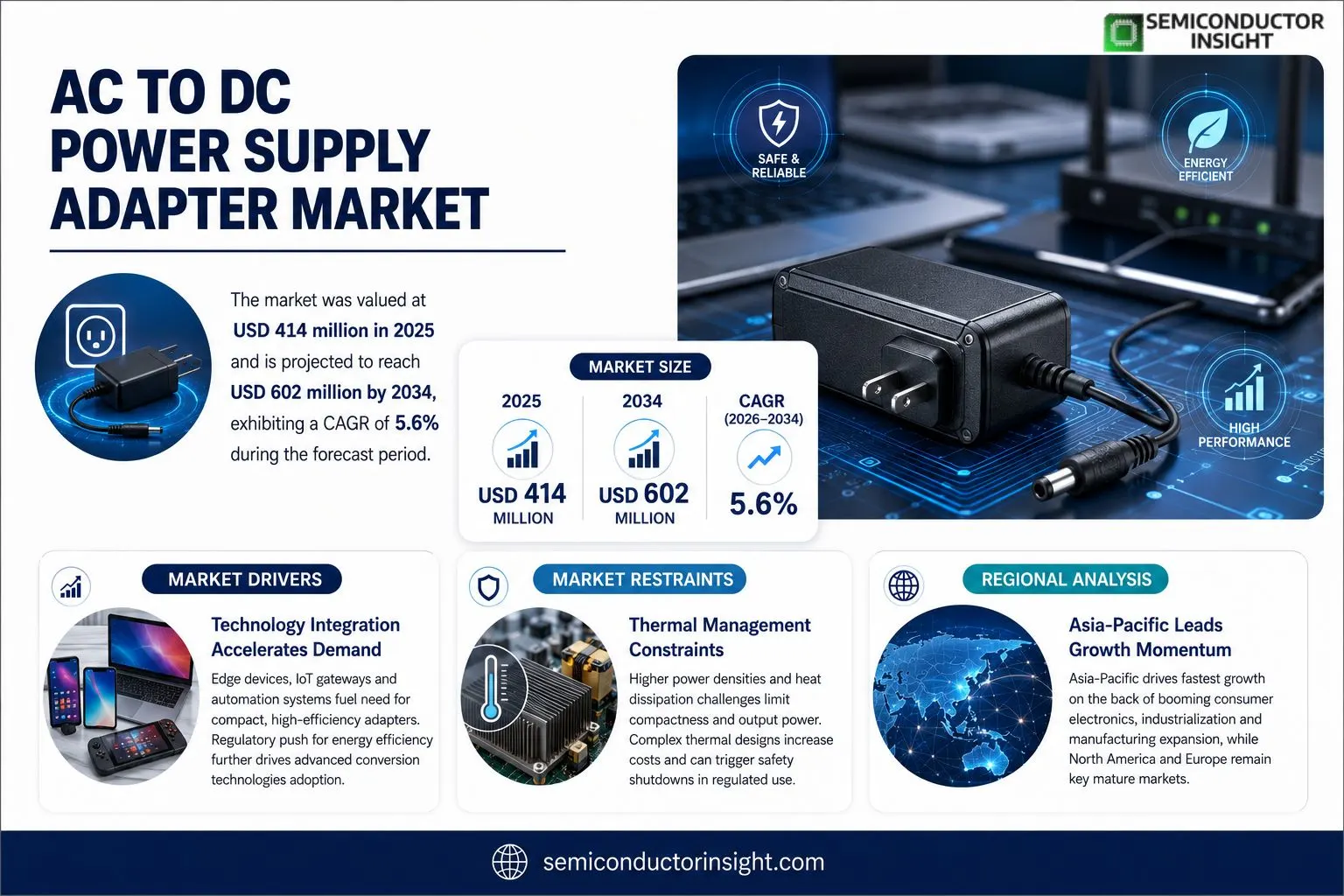
AC to DC Power Supply Adapter market size was valued at USD 414 million in 2025 and is projected to reach USD 602 million by 2034, exhibiting a CAGR of 5.6% during the forecast period.
An external power supply is an AC‑DC power supply adapter designed for battery‑powered devices lacking a dedicated source. It safeguards users by stepping down high‑voltage mains electricity to low‑voltage levels suitable for appliances such as electric irons, hairdryers, and similar equipment. The adaptability, durability and safety functions of these adapters make them highly attractive across consumer and industrial segments.The expansion of this market stems from several intertwined forces. Growing ownership of smartphones, tablets, laptops and gaming consoles increases demand for reliable charging solutions, while manufacturers in automotive and healthcare sectors adopt more electronic sub‑systems that require precise DC conversion. Energy‑efficiency standards push suppliers toward advanced conversion technologies that cut losses and lower operating costsan advantage for data‑center operators and telecom providers alike. Regional demand remains strongest in North America and Europe due to mature device penetration, whereas Asia‑Pacific’s rapid consumer‑electronics growth fuels a sizable share of new installations. Prominent manufacturers such as Advantech, Delta Electronics, Murata Power Solutions and TDK‑Lambda are actively expanding product portfolios and investing in next‑generation converter designs.
MARKET DRIVERS
Technology Integration Accelerates Demand
The rise of edge‑computing devices and IoT gateways has forced OEMs to select adapters capable of delivering stable DC output from ubiquitous AC sources. Design engineers now prioritize converters that combine compact form‑factor with high efficiency, prompting a noticeable uptick in bill‑of‑materials for new product lines.
Regulatory Push for Energy Efficiency
Stringent energy‑consumption standards in North America and the EU require AC to DC adapters to meet minimum efficiency thresholds of 85 % and 80 %, respectively. Manufacturers that fail to certify compliance risk market exclusion, driving a shift toward silicon‑carbide and gallium‑nitride topologies that unlock lower losses.
➤ Adoption of wide‑bandgap semiconductors has reduced average component size by roughly 30 % while shaving 15 % off the loss profile.
As enterprises modernize legacy equipment, the retrofit market for plug‑in adapters expands. Service providers find a lucrative niche converting outdated AC supplies to meet contemporary digital loads, reinforcing the overall market momentum.
MARKET CHALLENGES
Supply Chain Volatility
Semiconductor shortages and freight bottlenecks have elongated lead times for critical driver ICs. Buyers now contend with unpredictable pricing, forcing many to adopt dual‑source strategies that increase inventory overhead.
Other Challenges
Cost Pressures
Raw‑material price swings, particularly for copper and aluminum, erode margin windows. Companies that cannot negotiate long‑term contracts see profitability squeezed as end‑users demand lower price points.
MARKET RESTRAINTS
Thermal Management Constraints
Higher power densities demand sophisticated heat‑dissipation techniques. Design teams often compromise on form‑factor to accommodate larger heatsinks, limiting applicability in space‑constrained enclosures.When operating within regulated environments, excessive temperature rise can trigger safety shutdowns, prompting manufacturers to add protective circuitry that further inflates bill‑of‑materials.Emerging miniaturized devices therefore encounter a ceiling on attainable output power, curbing adoption in sectors that require both compactness and high wattage.
MARKET OPPORTUNITIES
Emerging Applications in Renewable Energy
The surge in residential solar installations creates a parallel need for DC‑link adapters that convert variable AC output from inverters into stable DC for storage systems. Integrators that offer modular, easily upgradable adapters can capture a growing slice of this nascent market.Similarly, electric‑vehicle charging infrastructure relies on high‑efficiency AC to DC conversion to feed battery‑management modules. Companies that align product roadmaps with emerging 800 V charging standards stand to gain early‑mover advantage.Lastly, the rollout of 5G micro‑cell sites introduces a demand for rugged, weather‑proof adapters capable of continuous operation in outdoor enclosures. Suppliers that certify IP‑rated designs will likely see incremental revenue streams as telecom operators expand network density.
AC to DC Power Supply Adapter Market Trends
Rising Demand from Consumer Electronics
The proliferation of smartphones, tablets, laptops and gaming platforms has turned power conversion units into a routine component of every household gadget. Manufacturers are responding by integrating compact, high‑efficiency adapters that meet stricter safety standards and accommodate fast‑charging protocols. This shift elevates the AC to DC Power Supply Adapter Market beyond a peripheral accessory, positioning it as a critical enabler of device reliability. Suppliers that can guarantee low electromagnetic emissions and consistent voltage regulation are gaining preference, prompting original equipment makers to prioritize qualified partners in their sourcing strategies.
Other Trends
Industrial Automation and Energy Efficiency
Factories embracing robotics and digital control systems increasingly rely on external converters to feed precise DC voltages to PLCs, sensors and motor drives. Parallel to this, data‑center operators and telecom back‑haul networks are imposing tighter efficiency criteria, pressuring adapter makers to adopt synchronous rectification and wide‑bandgap semiconductor technologies. The outcome is a product portfolio that blends rugged mechanical design with power‑loss reductions measured in single‑digit percentages. Companies that master this blend can secure long‑term contracts, while those lagging risk being edged out by rivals offering greener, cost‑saving solutions.
Regional Shifts and Supply Chain Resilience
North America and Europe continue to exhibit mature demand patterns, yet the Asia‑Pacific corridor is reshaping the competitive landscape through accelerated consumer‑electronics consumption and expanding manufacturing footprints. Recent disruptions in semiconductor supply chains have spurred many OEMs to diversify sourcing, favoring vendors with multi‑regional production capabilities. This strategic realignment compels adapter producers to invest in localized assembly lines and to streamline logistics networks. Firms that achieve a balanced footprint can mitigate lead‑time volatility, preserve margin stability and better serve a market that values both price competitiveness and uninterrupted delivery.
COMPETITIVE LANDSCAPE
Key Industry Players
Competitive dynamics in the AC‑DC Power Supply Adapter market
The AC‑DC adapter market remains anchored by a handful of multinational OEMs that dominate volume sales to consumer‑electronics and industrial end‑users. Delta Electronics, for instance, leverages a vertically integrated supply chain, extensive R&D facilities in Taiwan and a diversified product portfolio that spans high‑efficiency wall adapters to rugged external plug‑in units. This breadth enables the company to capture both mass‑market pricing pressure and premium‑segment contracts tied to data‑center power‑optimization programs. Meanwhile, Advantech and Huawei Technologies have reinforced their positions by aligning adapter development with broader IoT and smart‑device strategies, allowing them to cross‑sell across telecommunications, automotive and healthcare verticals. The concentration of market share among these titans creates a competitive environment where scale, compliance expertise and the ability to deliver custom voltage solutions are decisive factors.Beyond the dominant firms, a vibrant ecosystem of specialist manufacturers contributes depth and innovation to the sector. MEAN WELL Enterprises and TDK‑Lambda Corporation focus on high‑density, low‑profile modules that cater to compact consumer gadgets and emerging electric‑vehicle charging stations. Murata Power Solutions and Microchip Technology differentiate through integrated power‑management ICs that embed safety circuitry directly into the adapter chassis, a trend that resonates with OEMs seeking to reduce bill‑of‑materials costs. Smaller players such as B&K Precision Corporation, BandB Electronics, Motorola Solutions, Phoenix Contact, Renesas Electronics and the niche‑focused B&K Precision bring regional market knowledge and niche certifications that allow them to win contracts in regulated environments like medical equipment and aerospace. This tiered competitive landscape encourages continual product refinement, with emphasis on efficiency standards, miniaturization and compliance with safety directives.
List of Key AC to DC Power Supply Adapter Companies Profiled
- Advantech
- Delta Electronics
- BandB Electronics
- B&K Precision Corporation
- MEAN WELL Enterprises
- Microchip Technology
- Huawei Technologies
- Murata Power Solutions
- Phoenix Contact
- Renesas Electronics
- TDK‑Lambda Corporation
- Motorola Solutions
Segment Analysis:
| Segment Category | Sub-Segments | Key Insights |
| By Type |
|
Wall Power Adaptors are favored for their compact footprint and plug‑and‑play convenience – they enable quick deployment in residential and office environments. ‑ Robust designs address safety concerns, incorporating over‑voltage and short‑circuit protection. ‑ Compatibility with a broad range of consumer electronics drives widespread adoption across the market. ‑ Manufacturers focus on energy‑efficient topologies to meet eco‑friendly expectations. |
| By Application |
|
Consumer Electronics dominate usage patterns – portable devices demand reliable, lightweight adapters that can sustain frequent plug‑in cycles. ‑ Industrial automation seeks rugged adapters with high reliability to support continuous operation of control panels and sensors. ‑ Healthcare applications prioritize safety certifications and low electromagnetic emissions to protect sensitive medical equipment. |
| By End User |
|
Individual Consumers value ease of use and aesthetic design, often choosing adapters that blend with home décor. ‑ SMEs focus on cost‑effective solutions that deliver dependable performance for office equipment and small‑scale production lines. ‑ Large enterprises invest in centralized power management strategies, preferring adapters that integrate with monitoring platforms and support bulk purchasing agreements. |
| By Technology |
|
GaN‑Based Adapters are emerging as a leading technology due to their superior power density and reduced heat generation. ‑ Wide‑bandgap solutions enable thinner form factors while maintaining high efficiency, appealing to portable device manufacturers. ‑ Traditional silicon adapters continue to serve legacy equipment where cost sensitivity outweighs the need for cutting‑edge performance. |
| By Market Trend |
|
Energy‑Efficient Design drives R&D towards adapters that meet stringent regulatory standards and reduce operational costs. ‑ Smart IoT integration enables remote monitoring of power performance, fostering predictive maintenance and better user experience. ‑ Modular architectures allow manufacturers to easily adapt adapters to varying voltage requirements, supporting a wide array of device ecosystems. |
Regional Analysis: AC to DC Power Supply Adapter Market
North America
Strong demand for energy‑efficient devices in data centers and IoT gateways fuels adoption of adapters that minimize loss while delivering stable DC outputs. End‑user pressure for greener operations amplifies the focus on high‑efficiency conversion, prompting manufacturers to redesign power paths around advanced semiconductor technologies.
Stringent safety and electromagnetic compatibility standards in the United States and Canada compel suppliers to certify adapters against rigorous testing protocols. Compliance becomes a differentiator, encouraging firms to embed robust filtering and protection features early in the design cycle.
A handful of legacy players dominate volume production, yet niche innovators are gaining traction through specialized adapters tailored to aerospace and medical applications. Partnerships between silicon providers and original equipment manufacturers sharpen the competitive edge of firms that can rapidly iterate.
Growth in electric‑vehicle charging infrastructure and renewable‑energy storage introduces new voltage‑conversion challenges. Adapter designers are adapting modular architectures that can be reconfigured for diverse power‑train requirements, expanding the market beyond traditional industrial uses.
Europe
Europe’s position reflects a blend of regulated markets and strong engineering expertise. The region’s emphasis on sustainability drives adoption of adapters that meet the European Union’s ecodesign requirements, pushing manufacturers toward higher efficiency classes. Automotive electrification and precision medical devices create demand for adapters with tight tolerance and robust reliability, encouraging local suppliers to invest in specialized testing facilities. While the market is not as volume‑driven as North America, European firms leverage deep domain knowledge to carve out premium segments, often exporting solutions to adjacent markets. Collaborative initiatives among industry associations and research institutes further accelerate standards‑aligned innovation, ensuring that European offerings remain competitive on a scale.
Asia‑Pacific
Asia‑Pacific exhibits a fast‑changing landscape driven by the sheer scale of its electronics manufacturing footprint. Cost considerations dominate, yet rising awareness of energy‑efficiency standards is reshaping product specifications. The region’s burgeoning renewable‑energy projects and rapid rollout of smart‑city infrastructure generate a steady flow of requirements for adapters that can handle diverse input conditions while maintaining compactness. Local contract manufacturers are increasingly integrating design‑for‑manufacturability principles, allowing original equipment manufacturers to shorten development cycles. Although price pressure persists, the growing sophistication of domestic component suppliers is narrowing the gap with higher‑margin markets, positioning Asia‑Pacific as both a production hub and an emerging source of innovative adapter topologies.
South America
In South America, market momentum is linked to expanding telecommunications networks and incremental industrial automation. The region’s regulatory environment is evolving, with governments encouraging energy‑saving measures that indirectly boost demand for efficient AC to DC conversion. Companies operating in Brazil and Argentina are adopting adapters that can tolerate fluctuating grid quality, reflecting the need for resilient power solutions in less stable electrical grids. While the overall volume remains modest, localized partnerships between multinational vendors and regional distributors help bridge technology gaps, fostering gradual market maturation.
Middle East & Africa
Middle East & Africa present a diverse set of opportunities shaped by infrastructure development and the rise of renewable‑energy installations. Harsh climatic conditions demand adapters with enhanced thermal resilience and protection against voltage spikes. In the Gulf Cooperation Council states, large‑scale data‑center projects and oil‑and‑gas automation are major drivers, prompting suppliers to emphasize reliability and compliance with stringent safety codes. Meanwhile, African markets are beginning to prioritize rugged solutions for off‑grid applications, where adapters must operate efficiently across wide temperature ranges. Strategic collaborations with local engineering firms are emerging as a pathway for players to adapt their portfolios to regional nuances.
Report Scope
This market research report provides a comprehensive analysis of the AC to DC Power Supply Adapter Market , covering the forecast period 2026–2034. It offers detailed insights into market dynamics, technological advancements, competitive landscape, and key trends shaping the industry.
Key focus areas of the report include:
- Market Overview: The report begins with an overview outlining its current market scenario, key growth indicators, and industry transformation drivers. It discusses macroeconomic factors, demand–supply balance, regulatory landscape, and the strategic role of semiconductors in powering advancements across industries such as automotive, telecommunications, consumer electronics, and industrial automation.
- Market Size & Forecast: Historical data and future projections for revenue, unit shipments, and market value across major regions and segments.
- Segmentation Analysis: Detailed breakdown by product type, technology, application, and end-user industry to identify high-growth segments and investment opportunities.
- Regional Insights: Insights into market performance across North America, Europe, Asia-Pacific, Latin America, and the Middle East & Africa, including country-level analysis where relevant.
- Competitive Landscape: Profiles of leading market participants, including their product offerings, R&D focus, manufacturing capacity, pricing strategies, and recent developments such as mergers, acquisitions, and partnerships.
- Technology Trends & Innovation: Assessment of emerging technologies, integration of AI/IoT, semiconductor design trends, fabrication techniques, and evolving industry standards.
- Market Drivers & Restraints: Evaluation of factors driving market growth along with challenges, supply chain constraints, regulatory issues, and market-entry barriers.
- Stakeholder Insights: Insights for component suppliers, OEMs, system integrators, investors, and policymakers regarding the evolving ecosystem and strategic opportunities.
Primary and secondary research methods are employed, including interviews with industry experts, data from verified sources, and real-time market intelligence to ensure the accuracy and reliability of the insights presented.
FREQUENTLY ASKED QUESTIONS:
What is the current market size of AC to DC Power Supply Adapter Market?
-> AC to DC Power Supply Adapter Market was valued at USD 414 million in 2025 and is expected to reach USD 602 million by 2034 with a CAGR of 5.6% during the forecast period.
Which key companies operate in AC to DC Power Supply Adapter Market?
-> Key players include Advantech, BandB Electronics, B&K Precision Corporation, Delta Electronics, ETA-USA, Huawei Technologies, MEAN WELL Enterprises, Microchip Technology, Motorola, Murata Power Solutions, Phoenix Contact, Renesas Electronics, TDK-Lambda Corporation.
What are the key growth drivers?
-> Key growth drivers include increasing adoption of electronic devices (smartphones, tablets, laptops, gaming consoles), automation and digitization across manufacturing, automotive and healthcare sectors, and the shift toward energy‑efficient, eco‑friendly power conversion technologies.
Which region dominates the market?
-> Asia Pacific shows the fastest growth due to booming consumer electronics demand and industrialization, while North America and Europe remain major markets with high device penetration.
What are the emerging trends?
-> Emerging trends include advanced power conversion designs that reduce energy loss, integration of smart monitoring for data‑center and telecommunications applications, and the development of greener, renewable‑compatible adapters.
Get Sample Report PDF for Exclusive Insights
Report Sample Includes
- Table of Contents
- List of Tables & Figures
- Charts, Research Methodology, and more...
 Download Sample Report PDF