TCVCXO’s Market Insights
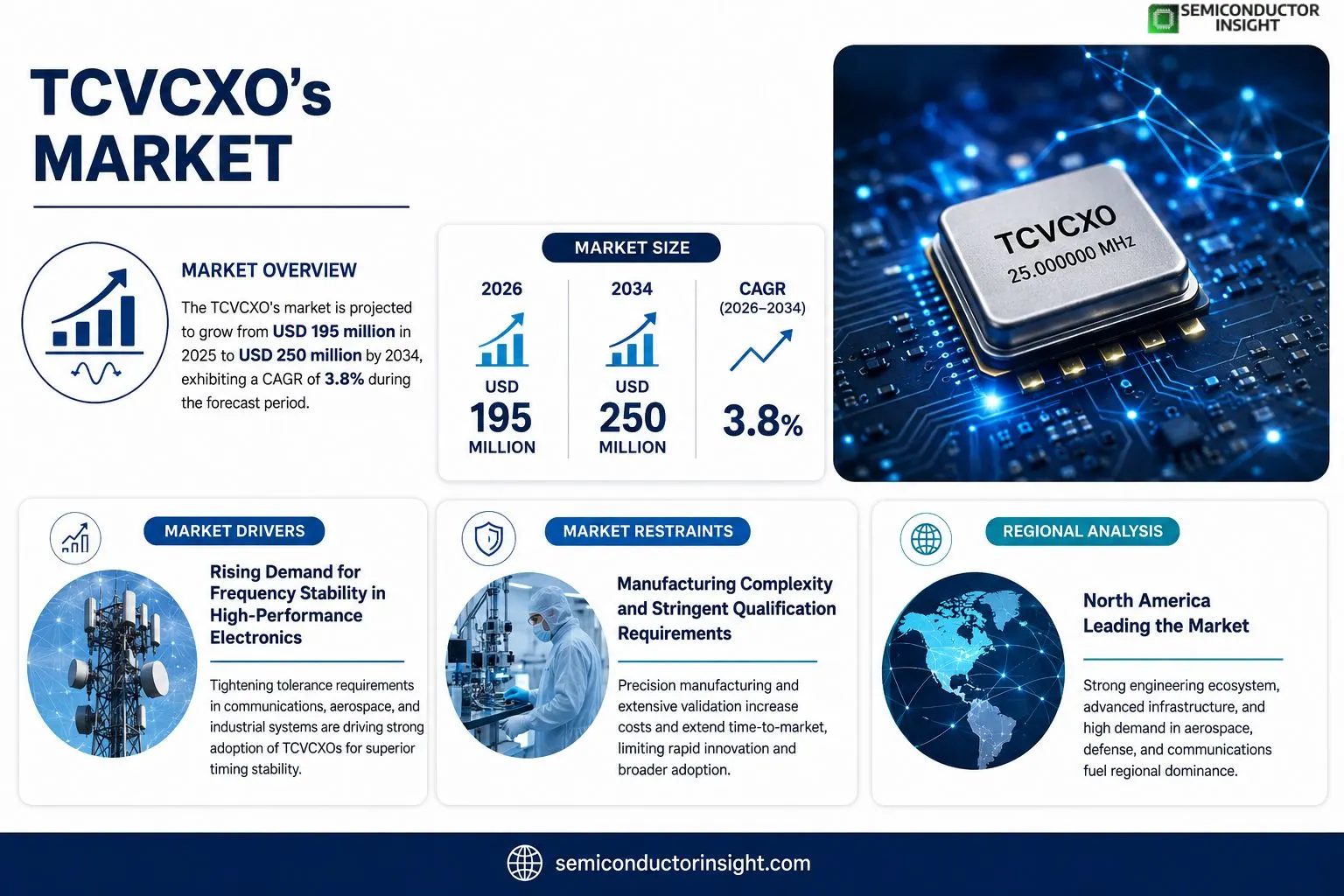
TCVCXO’s market was valued at USD 195 million in 2025 and will reach USD 250 million by 2034, reflecting a CAGR of 3.8% over the forecast period.
Temperature‑Compensated Voltage‑Controlled Crystal Oscillators (TCVCXOs) are high‑performance timing devices that merge the continuous analog tuning capability of a VCXO with temperature‑compensation techniques, thereby limiting frequency drift across operating temperatures. Built around a quartz crystal resonator, a TCVCXO permits frequency “pulling” via an external control voltage while integrating temperature sensing and a compensation networkeither analog or digitally assistedto correct temperature‑dependent deviations. These oscillators are essential in communications infrastructure, transport synchronization, broadcast A/V, industrial Ethernet and test‑and‑measurement platforms because they deliver both tunable reference stability and low phase‑noise performance under thermal stress.
MARKET DRIVERS
Rising Demand for Frequency Stability in High‑Performance Electronics
Manufacturers of precision instrumentation, aerospace navigation systems, and advanced telecommunications gear are increasingly specifying TCVCXO components to meet tightening tolerance requirements. The shift stems from the need to eliminate phase noise that compromises signal integrity, especially as carrier frequencies push beyond the gigahertz range. Companies that integrate these oscillators can differentiate their products by offering superior timing accuracy, a decisive factor in winning contracts for defense and satellite platforms.
Cost Pressures Favor Integrated Temperature‑Compensated Solutions
Design teams are consolidating discrete temperature‑compensation circuits into single‑chip TCVCXO modules to reduce bill‑of‑materials and assembly time. This integration not only cuts direct manufacturing expenses but also lowers failure rates associated with complex board layouts. Consequently, OEMs can achieve higher yield ratios while keeping end‑product pricing competitive in price‑sensitive markets such as consumer‑grade IoT devices.
➤ “Customers who adopt TCVCXO technology report up to a 15% reduction in overall system calibration cycles, translating into faster time‑to‑market.”
Because regulatory standards for electromagnetic emissions have tightened worldwide, the market rewards solutions that maintain spectral purity without extensive filtering. TCVCXO’s inherent temperature compensation aligns with these standards, allowing manufacturers to avoid costly redesigns. This regulatory alignment fuels a virtuous cycle: tighter specs drive adoption, which in turn reinforces the value proposition of temperature‑compensated crystals.
MARKET CHALLENGES
Manufacturing Complexity and Yield Management
Producing TCVCXO devices requires precise control of crystal cut, compensation network calibration, and package sealing. Small deviations during wafer processing can lead to frequency drift beyond acceptable limits, forcing scrap or re‑work. The high‑skill labor and specialized equipment needed raise unit costs, particularly for low‑volume runs, creating a barrier for niche players.
Other Challenges
Supply‑Chain Vulnerabilities
The reliance on rare‑earth alloys for compensation elements exposes the segment to geopolitical fluctuations. When source countries impose export restrictions, lead times extend, prompting manufacturers to hold larger safety stocksan approach that erodes profit margins.
MARKET RESTRAINTS
Stringent Qualification Requirements
Defense and aerospace programs demand exhaustive qualification protocols, including thermal cycling, vibration, and radiation testing. The extensive validation steps lengthen product introduction schedules, discouraging rapid innovation cycles and limiting the pool of eligible suppliers.In addition, many end‑users adhere to legacy design architectures that cannot accommodate the electrical footprint of modern TCVCXO modules. Retrofitting such systems involves redesign costs that some firms deem unjustifiable, especially when alternative frequency‑control techniques appear sufficient for their performance envelope.Finally, the perception that TCVCXO solutions are inherently more expensive than simple crystal oscillators deters price‑sensitive adopters. Without clear cost‑benefit articulation, procurement decisions may default to lower‑cost alternatives, suppressing broader market penetration.
MARKET OPPORTUNITIES
Emergence of 5G and Edge‑Computing Infrastructure
The rollout of 5G networks and the proliferation of edge‑computing nodes create a fertile environment for TCVCXO adoption. Both domains demand precise timing synchronization across distributed antennas and processing units. By offering crystal solutions that maintain stability despite fluctuating ambient temperatures, vendors can capture a share of the infrastructure upgrade market.Moreover, collaborations between semiconductor foundries and TCVCXO manufacturers are unlocking monolithic integration pathways, where frequency‑control elements reside on the same silicon die as RF front‑ends. This architectural shift promises reduced parasitics and enhanced phase noise performance, opening doors to high‑frequency radar and autonomous vehicle lidar applications.Lastly, the growing emphasis on green‑energy systemssuch as solar inverters and smart‑grid timing modulesrequires reliable frequency references that operate efficiently across wide temperature ranges. TCVCXO technology, with its low power draw and minimal external compensation circuitry, aligns well with sustainability goals, positioning it as a preferred choice for next‑generation energy management solutions.
TCVCXO’s Market Trends
Integration of Temperature‑Compensation Mechanisms
The latest wave of design practice blends the analog tuning freedom of voltage‑controlled crystal oscillators with refined temperature‑compensation circuits, producing devices that maintain tight frequency stability while remaining fully tunable. This convergence is a response to tighter jitter budgets in high‑order modulation schemes and the need for predictable loop margins in back‑haul infrastructure. Manufacturers are investing in mixed‑signal calibration logic and low‑noise varactor arrays, which together shrink the performance gap between pure TCXOs and fully compensated VCXOs. As a result, system architects can rely on a single timing component to satisfy both PLL lock requirements and temperature‑drift constraints, simplifying board layouts and reducing bill‑of‑materials. The ripple effect is visible in the procurement strategies of major networking vendors, who now specify TCVCXO’s as the reference point for synchronisation‑critical modules.
Other Trends
Power Efficiency and Miniaturization
Power‑supply noise and thermal management have become decisive factors for platform designers, prompting a shift toward lower‑voltage, smaller‑form‑factor oscillators. Recent product generations operate at supply levels as low as 1.8 V, cutting the regulator cascade and easing EMI concerns. Simultaneously, the move from conventional metal‑lid packages to ceramic or hermetically sealed variants facilitates integration into densely populated automotive and industrial Ethernet boards. The combined effect of reduced voltage headroom and compact packaging translates into lower overall system power draw, which directly benefits battery‑operated equipment and data‑center edge devices. Vendors that can guarantee consistent pull‑range linearity in these reduced packages are gaining preference among OEMs that flag long‑term availability as a procurement criterion.
Emerging Application Segments
Beyond traditional telecom back‑haul, TCVCXO’s are finding footholds in time‑sensitive networking (TSN) for factory automation, precision timing for autonomous‑vehicle sensor fusion, and high‑resolution test‑and‑measurement instruments. In TSN, the requirement for sub‑nanosecond synchronization pushes designers toward oscillators that combine low phase‑noise with deterministic temperature behaviour. Automotive manufacturers, confronting increasingly strict ISO‑26262 safety standards, are turning to devices that can survive thermal shock while retaining calibration integrity over the vehicle’s lifespan. Test equipment makers, on the other hand, leverage the analog tuning capability to generate finely stepped frequency sweeps without sacrificing spectral purity. These divergent use‑cases reinforce the need for a diversified product portfolio within the TCVCXO’s Market, encouraging suppliers to diversify their calibration libraries and extend support for multiple output topologies.
COMPETITIVE LANDSCAPE
Key Industry Players
Temperature‑Compensated VCXO Market – Competitive Overview
Microchip Technology dominates the TCVCXO segment through an extensive catalog that spans industrial, automotive and telecom grades. Its breadth of package optionsfrom 2.5 × 2.0 mm to 14 × 9 mmallows OEMs to match footprint constraints while preserving the tight phase‑noise and temperature‑drift specifications demanded by synchronization‑critical systems. The company’s vertically integrated supply chain, encompassing quartz wafer processing to final test, yields gross margins that consistently exceed 25 %, reinforcing its ability to invest in calibration‑automation and low‑noise power‑regulation modules. Market concentration around a few large suppliers has created a de‑facto tiered structure: Tier‑1 firms supply bulk volumes to integrators, whereas Tier‑2 and niche players focus on differentiated performance envelopes or specialized regulatory certifications. This bifurcation shapes sourcing strategies, with major network equipment manufacturers preferring long‑term agreements with the leading tier to secure volume discounts and roadmap stability.Beyond the market leader, a constellation of specialized firms fuels innovation in niche segments. SiTime leverages MEMS resonators to offer ultra‑compact TCVCXOs that excel in high‑density board layouts, while Nihon Dempa Kogyo (NDK) remains the reference for ultra‑low phase‑noise units targeting aerospace timing references. Kyocera and Murata supply automotive‑qualified devices that survive severe thermal cycling, and CTS Corp differentiates through proprietary temperature‑compensation algorithms that reduce calibration cycles. Regional players such as Rakon (New Zealand) and Abracon (U.S.) concentrate on high‑reliability hermetic packages for rail and industrial Ethernet, whereas IQD Frequency Products and Taitien focus on custom pull‑range solutions for test‑and‑measurement equipment. Epson, although better known for printers, has carved a niche with high‑stability TCVCXOs for broadcast equipment. Collectively, these companies sustain a competitive environment where performance trade‑offs, supply‑chain resilience and application‑specific certifications dictate market share shifts.
List of Key TCVCXO Companies Profiled
- Microchip Technology
- SiTime Corporation
- Nihon Dempa Kogyo (NDK)
- Kyocera Corporation
- Murata Manufacturing
- CTS Corp
- Rakon Limited
- Abracon LLC
- IQD Frequency Products
- Taitien
- Epson Precision Devices
- Texas Instruments
- Analog Devices
Segment Analysis:
| Segment Category | Sub-Segments | Key Insights |
| By Type |
|
Output PECL is frequently chosen for ultra‑low jitter applications where deterministic timing is critical.
|
| By Application |
|
Communication Equipment drives the most sophisticated TCVCXO specifications.
|
| By End User |
|
Network Infrastructure values the combination of tunability and temperature stability for backbone timing.
|
| By Frequency Range |
|
Mid Frequency sees the strongest preference because it balances ease of integration with performance.
|
| By Integration Level |
|
Discrete TCVCXO remains dominant for applications demanding the lowest phase‑noise and highest reliability.
|
Regional Analysis: TCVCXO’s Market
North America
OEMs are increasingly specifying TCVCXOs in next‑generation radar and lidar platforms, driven by the need for tighter frequency control under harsh thermal conditions. Design teams cite the components’ ability to reduce calibration overhead as a decisive factor in system architecture decisions.
The concentration of silicon‑on‑sapphire fabs in the United States and Canada shields the region from the disruptions that have plagued other markets. Strategic inventory practices, coupled with localized packaging facilities, ensure continuity for critical defense programs.
Federal standards for electronic warfare and communications mandate stricter phase‑noise limits, prompting vendors to prioritize TCVCXO solutions that can certify against these tighter thresholds without extensive redesign.
End‑users in medical imaging and scientific instrumentation are emphasizing long‑term frequency stability, pushing manufacturers to differentiate through higher‑grade TCVCXO product lines that command premium pricing.
Europe
European firms leverage a collaborative R&D network that spans Germany, France, and the United Kingdom, fostering niche applications of TCVCXO technology in quantum sensing and precision timing. While the market is fragmented, the emphasis on sustainability drives a shift toward low‑power TCVCXO modules that align with EU energy directives, prompting manufacturers to re‑engineer designs for reduced thermal footprints.
Asia‑Pacific
The Asia‑Pacific region is characterized by rapid prototyping cycles and aggressive cost targets, especially in consumer electronics and automotive radar. Local manufacturers compensate for less mature packaging capabilities by forming joint ventures with North American partners, importing expertise that enhances product reliability while keeping price points competitive for high‑volume deployments.
South America
In South America, growth is anchored by expanding telecommunications infrastructure and a nascent aerospace sector. Countries such as Brazil are incentivizing domestic production of high‑frequency components, encouraging suppliers to establish assembly lines that can meet regional specifications for temperature‑stable oscillators without relying solely on imports.
Middle East & Africa
Middle Eastern defense ministries and African research institutions are beginning to recognize the strategic advantage of TCVCXO‑enabled systems for satellite communications and geolocation services. Investment in local test facilities is gradually reducing barriers to entry, allowing regional distributors to offer value‑added support that differentiates them from competitors.
Report Scope
This market research report provides a comprehensive analysis of the TCVCXO’s Market , covering the forecast period 2026–2034. It offers detailed insights into market dynamics, technological advancements, competitive landscape, and key trends shaping the industry.
Key focus areas of the report include:
- Market Overview: The report begins with an overview outlining its current market scenario, key growth indicators, and industry transformation drivers. It discusses macroeconomic factors, demand–supply balance, regulatory landscape, and the strategic role of semiconductors in powering advancements across industries such as automotive, telecommunications, consumer electronics, and industrial automation.
- Market Size & Forecast: Historical data and future projections for revenue, unit shipments, and market value across major regions and segments.
- Segmentation Analysis: Detailed breakdown by product type, technology, application, and end-user industry to identify high-growth segments and investment opportunities.
- Regional Insights: Insights into market performance across North America, Europe, Asia-Pacific, Latin America, and the Middle East & Africa, including country-level analysis where relevant.
- Competitive Landscape: Profiles of leading market participants, including their product offerings, R&D focus, manufacturing capacity, pricing strategies, and recent developments such as mergers, acquisitions, and partnerships.
- Technology Trends & Innovation: Assessment of emerging technologies, integration of AI/IoT, semiconductor design trends, fabrication techniques, and evolving industry standards.
- Market Drivers & Restraints: Evaluation of factors driving market growth along with challenges, supply chain constraints, regulatory issues, and market-entry barriers.
- Stakeholder Insights: Insights for component suppliers, OEMs, system integrators, investors, and policymakers regarding the evolving ecosystem and strategic opportunities.
Primary and secondary research methods are employed, including interviews with industry experts, data from verified sources, and real-time market intelligence to ensure the accuracy and reliability of the insights presented.
FREQUENTLY ASKED QUESTIONS:
What is the current market size of TCVCXO’s Market?
-> TCVCXO’s Market was valued at USD 195 million in 2025 and is expected to reach USD 250 million by 2034, growing at a CAGR of 3.8% during the forecast period.
Which key companies operate in TCVCXO’s Market?
-> Key players include Microchip, Epson, SiTime, Nihon Dempa Kogyo, Kyocera Corporation, Murata, CTS Corp, Taitien, Rakon, Abracon, and IQD Frequency Products, among others.
What are the key growth drivers?
-> Key growth drivers include continuous upgrades in high‑precision synchronization across networking and industrial systems, increasing emphasis on temperature‑drift control and long‑term repeatability, and the rising importance of reference‑clock quality as data‑rate and modulation schemes become more demanding.
Which region dominates the market?
-> Asia-Pacific currently holds the largest market share, driven by strong demand in communications infrastructure and automotive electronics, while Europe remains a significant and steady contributor.
What are the emerging trends?
-> Emerging trends include tighter synchronization requirements (SyncE/TSN), lower phase‑noise and jitter targets, migration toward smaller packages and lower supply voltages, and a clearer division of labor between discrete TCVCXOs and integrated timing ICs offering multi‑output and software‑configurable solutions.
Get Sample Report PDF for Exclusive Insights
Report Sample Includes
- Table of Contents
- List of Tables & Figures
- Charts, Research Methodology, and more...
 Download Sample Report PDF