General Crystal Oscillators Market Insights
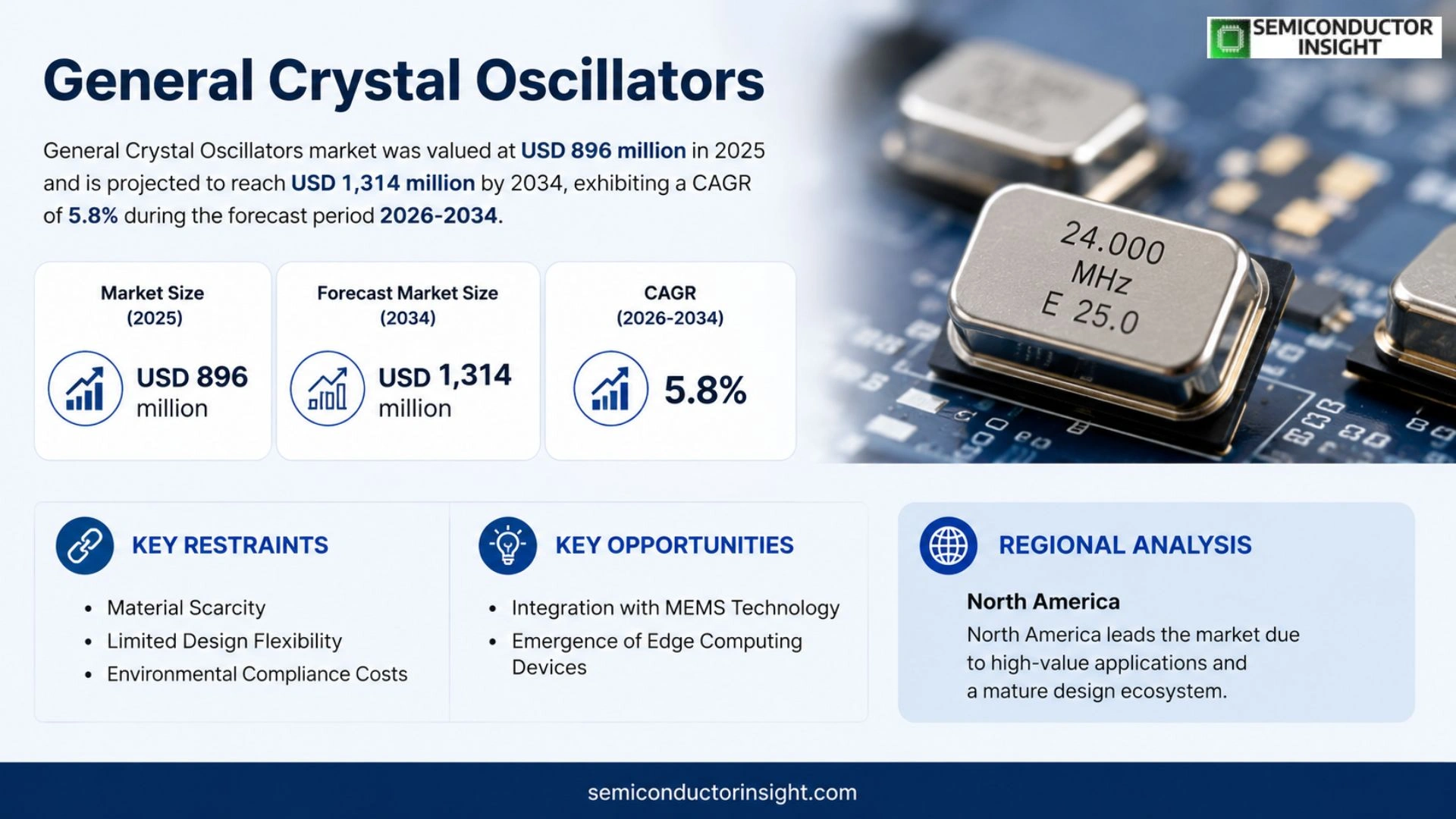
General Crystal Oscillators market was valued at USD 896 million in 2025 and is projected to reach USD 1,314 million by 2034, exhibiting a CAGR of 5.8% during the forecast period.
General crystal oscillators are fundamental timing devices that employ a quartz crystal resonator as the frequency‑selective element combined with sustaining/buffer circuitry within a sealed package to deliver a stable clock signal for diverse electronic systems. They satisfy the core requirement that digital and mixed‑signal circuits need an accurate, repeatable reference frequency for processors, communication interfaces, memory operations, sensor sampling, power management and audio/video subsystems across variations in voltage, temperature and load.
MARKET DRIVERS
Expansion of Consumer Electronics
General Crystal Oscillators Market has been buoyed by the surge in smartphones, wearables, and IoT gadgets that demand sub‑nanosecond timing stability. Manufacturers are opting for crystal solutions that balance low power consumption with high frequency accuracy, a combination that directly translates into longer battery life for end‑users.
Growth in Automotive Systems
Modern vehicles increasingly rely on advanced driver‑assistance systems (ADAS) and electric power‑train controls, both of which require crystal oscillators with rigorous temperature tolerance. The shift toward electric mobility has created a niche where General Crystal Oscillators Market participants can command premium pricing for modules that meet automotive‑grade standards.
➤ Industry insiders note that the convergence of miniaturization and higher data rates is reshaping oscillator design priorities, pushing suppliers toward tighter phase‑noise specifications.
Supply‑chain refinements, especially the adoption of automated wafer handling, have reduced lead times for critical components. This operational efficiency gives manufacturers the flexibility to respond quickly to seasonal spikes in demand, reinforcing the market’s upward trajectory.
MARKET CHALLENGES
Manufacturing Complexity
Producing crystals with exacting frequency tolerances demands clean‑room environments and precision lapping techniques. Small deviations can render a batch unsellable, inflating overhead costs for firms operating at the margin of profitability.
Other Challenges
Cost Sensitivity
End‑users, particularly in the mass‑market consumer segment, pressure suppliers to lower unit prices. This tension forces manufacturers to innovate on cost‑reduction without compromising the spectral purity essential for high‑speed communications.
Regulatory scrutiny over electromagnetic emissions has tightened in several regions, compelling oscillator makers to certify products against stricter standards. Compliance expenditures are rising, adding another layer of complexity to product development cycles.
MARKET RESTRAINTS
Material Scarcity
The quartz crystal substrate, a core raw material, faces periodic shortages linked to mining constraints and geopolitical trade policies. When availability tightens, price volatility spikes, curtailing the ability of smaller players to compete on price.
Limited Design Flexibility
Unlike programmable PLL solutions, crystal oscillators offer limited post‑fabrication tuning. This rigidity can deter designers who prefer re‑configurable timing blocks, especially in rapidly iterated product cycles.
Environmental Compliance Costs
Emerging restrictions on hazardous substances in electronic components necessitate additional testing and certification steps. The associated financial burden slows new product introductions, especially for firms lacking dedicated compliance teams.
MARKET OPPORTUNITIES
Integration with MEMS Technology
Hybrid solutions that combine crystal stability with MEMS agility are gaining attention for next‑generation timing platforms. Companies that master this integration can offer modules that meet stringent jitter requirements while fitting into increasingly compact form factors.
Emergence of Edge Computing Devices
Edge nodes deployed for real‑time analytics require precise clock sources to synchronize data streams across distributed networks. This creates a fertile ground for General Crystal Oscillators Market players to supply timing cores tailored for low‑latency, high‑throughput environments.
Custom Frequency Solutions for 5G Infrastructure
5G base stations and small cells depend on carriers with exact frequency lines to maintain spectrum efficiency. Developing custom‑cut crystal oscillators that support these narrow bands positions suppliers at the forefront of the telecommunications rollout.
General Crystal Oscillators Market Trends
Maturation and Segmentation of the Base Market
Revenue for the sector recorded roughly $896 million in 2025 and is forecast to reach approximately $1,314 million by 2034. Production capacity stood at 3.2 billion units that year, with sales of 2.803 billion units and an average selling price of $0.35. These figures illustrate a market that has long passed its growth‑inflection phase, transitioning into a stable platform where volume remains anchored to the relentless demand from consumer electronics, general‑purpose embedded systems, and a growing cohort of industrial and automotive applications. Margins hovering between 25 % and 35 % reflect the balance between economies of scale and the premium attached to higher‑grade reliability categories.
Other Trends
Supply‑Side Capability Expansion
Suppliers are no longer competing solely on unit cost. The competitive set now prioritizes breadth of product families, depth of quality‑system certifications, and the sophistication of automated aging and binning processes. Companies that have integrated advanced test‑equipment and robust screening workflows are able to claim superior lot‑to‑lot consistency, a factor that resonates with automotive OEMs and industrial customers demanding traceable, long‑term supply. Dual‑sourcing arrangements and inventory buffers have become standard practice, reducing exposure to single‑point failures in the quartz‑processing chain.
Emerging Pressures from Miniaturization and Alternative Timing Technologies
Design teams are pushing for ever‑smaller SMD footprints and lower power envelopes, a trend that forces oscillator manufacturers to refine package materials, stress‑relief structures, and thermal‑cycling endurance. At the same time, MEMS‑based timing devices and integrated clock generators are gaining attention in niche segments where shock resistance and programmability are decisive. While quartz remains the default timing reference for the bulk of designs, the incremental shift in certain high‑frequency or harsh‑environment niches creates a pressure to deliver tighter phase‑noise performance, broader temperature ranges, and clearer substitution guidelines. Companies that can bundle technical support,linking oscillator selection to EMI/EMC behavior and system‑level jitter budgets,will likely capture additional value beyond the raw component price.
COMPETITIVE LANDSCAPE
Key Industry Players
Competitive Dynamics in General Crystal Oscillators Market
Microchip Technology dominates the upper‑tier segment, leveraging its extensive analog portfolio and deep customer relationships in automotive and industrial domains. The firm’s ability to integrate crystal oscillators with its broader mixed‑signal portfolio creates a compelling value proposition for design houses seeking consolidated sourcing. Production capacity, robust test‑and‑age screening infrastructure, and a global footprint enable Microchip to command premium pricing while maintaining tight quality tolerances. This leadership is reinforced by recent capacity expansions in Southeast Asia, which have reduced lead‑time volatility and fortified supply‑chain resilience for high‑reliability applications.
Beyond the market leader, a constellation of midsize and niche specialists competes on product breadth, cost efficiency, and application‑specific performance. Companies such as SiTime and TXC Corporation excel in ultra‑compact packages and low‑power variants, appealing to consumer‑electronics and wearable manufacturers. Japanese firms like Epson, Renesas, and Nihon Dempa Kogyo focus on high‑temperature and automotive‑grade parts, differentiating through rigorous screening protocols. European players,including Murata, Kyocera Corporation, and CTS Corp,emphasize crystal‑based solutions with superior phase‑noise characteristics for communication equipment. Smaller entities such as NEL Frequency Controls, Bliley Technologies, and IQD Frequency Products target niche markets like precision instrumentation and defense, where traceability and long‑term availability are paramount.
List of Key General Crystal Oscillators Companies Profiled
- Microchip Technology
- SiTime
- TXC Corporation
- Epson
- Renesas Electronics
- Kyocera Corporation
- Murata Manufacturing
- Rakon Limited
- Nihon Dempa Kogyo
- ON Semiconductor
- CTS Corporation
- Nel Frequency Controls
- Bliley Technologies
- IQD Frequency Products
- Abracon
Segment Analysis:
| Segment Category | Sub-Segments | Key Insights |
| By Type |
|
Fixed‑Frequency continues to dominate because:
|
| By Application |
|
Consumer Electronics remains the leading application segment because:
|
| By End User |
|
OEMs drive the market because:
|
| By Frequency Range |
|
High Frequency gains traction because:
|
| By Reliability Grade |
|
Oven‑Controlled is the preferred grade for demanding sectors because:
|
Regional Analysis: General Crystal Oscillators Market
North America
Vehicle electrification and the rollout of semi‑autonomous functions have amplified the need for oscillators that can operate reliably under vibration and temperature extremes. Suppliers that embed low‑phase‑noise designs into powertrain control units are seeing deeper relationships with OEMs, creating a feedback loop that spurs iterative improvements.
The migration to 5G and the densification of small‑cell sites place timing accuracy at the heart of network performance. Operators favour oscillators with tight frequency tolerance, prompting manufacturers to prioritize silicon‑based solutions that marry cost efficiency with stringent specifications.
Defense contracts increasingly specify oscillators built to MIL‑SPEC standards, driving vendors to adopt hardened ceramics and hermetic sealing. The resulting product portfolios often spill over into commercial satellite platforms, broadening the addressable market.
Stringent EMC regulations in the United States compel manufacturers to validate oscillator emissions comprehensively. Compliance programs have become a differentiator, encouraging firms to embed testing capabilities early in the design phase rather than retrofitting later.
Europe
European manufacturers benefit from a dense network of automotive and industrial players that prioritize energy efficiency and precise synchronization. The continent’s push toward greener mobility translates into tighter specifications for timing components, particularly in electric‑drive control modules. Meanwhile, the rollout of private‑5G networks in major cities creates demand for compact, low‑power oscillators that can be integrated into edge devices. Regulatory frameworks such as the EU’s RoHS directives influence material choices, nudging suppliers toward lead‑free alloys while preserving performance. Companies that align product roadmaps with these standards enjoy smoother market entry across the EU member states.
Asia‑Pacific
Asia‑Pacific’s acceleration of consumer electronics manufacturing fuels a relentless appetite for cost‑effective crystal oscillators. The region’s massive smartphone and IoT device output requires high‑volume production runs, prompting manufacturers to adopt automated wafer‑level packaging. Concurrently, China’s strategic emphasis on semiconductor self‑sufficiency spurs investment in domestic oscillator fabs, reducing reliance on imports. However, quality perception remains a hurdle; firms that can demonstrate rigorous testing and long‑term stability are positioned to capture premium segments in automotive and telecom equipment.
South America
South America’s market is shaped by expanding renewable‑energy installations and a growing telecom footprint in Brazil and Argentina. Grid‑integration projects need reliable timing sources for synchronizing inverter fleets, while mobile operators upgrade to LTE‑Advanced and early‑stage 5G, both of which depend on precise frequency references. Supply constraints and import tariffs often elevate the cost of high‑grade oscillators, encouraging regional assemblers to seek joint‑venture arrangements with overseas vendors to secure favourable pricing and technology transfer.
Middle East & Africa
The Middle East & Africa region witnesses a modest but strategic uptake of timing components, driven by defense modernization programs and the emergence of smart‑city initiatives in the Gulf states. Satellite communication networks, essential for remote connectivity, rely on robust oscillators capable of withstanding harsh desert climates. In Africa, burgeoning mobile penetration encourages investment in base‑station infrastructure, where timing accuracy directly influences spectrum efficiency. Partnerships between local system integrators and established oscillator manufacturers are increasingly common, facilitating technology diffusion while respecting regional procurement policies.
Report Scope
This market research report provides a comprehensive analysis of the General Crystal Oscillators Market , covering the forecast period 2026–2034. It offers detailed insights into market dynamics, technological advancements, competitive landscape, and key trends shaping the industry.
Key focus areas of the report include:
- Market Overview: The report begins with an overview outlining its current market scenario, key growth indicators, and industry transformation drivers. It discusses macroeconomic factors, demand–supply balance, regulatory landscape, and the strategic role of semiconductors in powering advancements across industries such as automotive, telecommunications, consumer electronics, and industrial automation.
- Market Size & Forecast: Historical data and future projections for revenue, unit shipments, and market value across major regions and segments.
- Segmentation Analysis: Detailed breakdown by product type, technology, application, and end-user industry to identify high-growth segments and investment opportunities.
- Regional Insights: Insights into market performance across North America, Europe, Asia-Pacific, Latin America, and the Middle East & Africa, including country-level analysis where relevant.
- Competitive Landscape: Profiles of leading market participants, including their product offerings, R&D focus, manufacturing capacity, pricing strategies, and recent developments such as mergers, acquisitions, and partnerships.
- Technology Trends & Innovation: Assessment of emerging technologies, integration of AI/IoT, semiconductor design trends, fabrication techniques, and evolving industry standards.
- Market Drivers & Restraints: Evaluation of factors driving market growth along with challenges, supply chain constraints, regulatory issues, and market-entry barriers.
- Stakeholder Insights: Insights for component suppliers, OEMs, system integrators, investors, and policymakers regarding the evolving ecosystem and strategic opportunities.
Primary and secondary research methods are employed, including interviews with industry experts, data from verified sources, and real-time market intelligence to ensure the accuracy and reliability of the insights presented.
FREQUENTLY ASKED QUESTIONS:
What is the current market size of General Crystal Oscillators Market?
-> General Crystal Oscillators market is projected to reach USD 1,314 million by 2034, exhibiting a CAGR of 5.8% during the forecast period.
Which key companies operate in General Crystal Oscillators Market?
-> Key players include Microchip, Epson, SiTime, Renesas, Kyocera Corporation, Murata, Rakon, TXC Corporation, Nihon Dempa Kogyo, Onsemi, CTS Corp, Taitien, NEL Frequency Controls, Bliley Technologies, Abracon, IQD Frequency Products.
What are the key growth drivers?
-> Key growth drivers include ongoing electronics proliferation, continued miniaturization and modularization, strong demand from industrial and automotive sectors, and dual‑sourcing/resilience strategies that emphasize supply stability.
Which region dominates the market?
-> Asia‑Pacific holds the largest market share and is the fastest‑growing region, while Europe remains a significant mature market.
What are the emerging trends?
-> Emerging trends include smaller footprint SMD packages, lower‑power designs, platform‑level substitutability, application‑specific reliability improvements, and tighter integration with EMI/EMC and clock‑tree management.
Get Sample Report PDF for Exclusive Insights
Report Sample Includes
- Table of Contents
- List of Tables & Figures
- Charts, Research Methodology, and more...
 Download Sample Report PDF