Ultra Low Phase Noise Crystal Oscillator Market Insights
Ultra Low Phase Noise Crystal Oscillator market was valued at USD 269 million in 2025 and will increase to USD 413 million by 2034, reflecting a compound annual growth rate of 6.3% over the forecast period.
Ultra‑low phase‑noise crystal oscillators are premium frequency sources built around high‑Q quartz resonators combined with low‑noise oscillator architectures. They minimise phase noise and timing jitter through optimised sustaining circuitry, power conditioning, buffering and isolation. Because spectral purity, coherence and timing stability directly affect performance in wireless communications, radar, satellite payloads, test‑and‑measurement instrumentation, high‑speed ADC/DAC sampling clocks and precision metrology, these devices are engineered for a tight phase‑noise profile across specified offset frequencies rather than merely frequency accuracy.The market expands as demand for higher‑order modulation schemes in emerging 5G/6G networks pushes designers toward cleaner local oscillators. Radar systems for autonomous platforms and advanced electronic‑warfare applications require tighter jitter budgets, while test equipment manufacturers seek lower measurement noise floors. Simultaneously, increased adoption of high‑speed data converters in scientific instrumentation creates pressure for ultra‑low jitter clock sources, prompting suppliers to broaden portfolios and improve lot‑to‑lot consistency.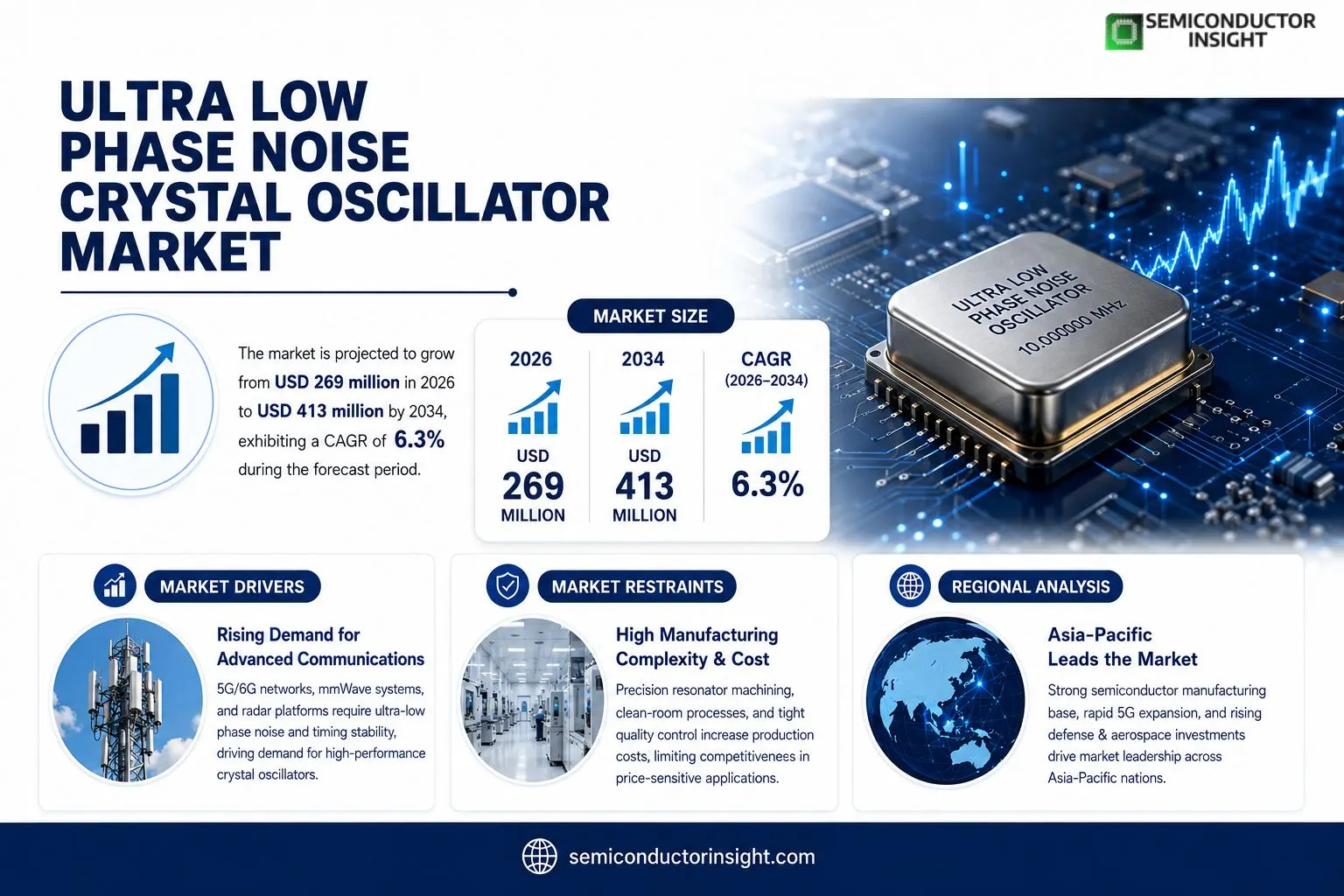
MARKET DRIVERS
Stringent Frequency Stability Requirements
Advanced telecommunications equipment, especially 5G base stations, demand oscillators whose phase noise remains below the noise floor of high‑order modulation schemes. This pressure forces component suppliers to adopt ultra‑low phase noise designs, thereby expanding Ultra Low Phase Noise Crystal Oscillator Marke. Manufacturers that can guarantee sub‑‑100 dBc/Hz performance at offset frequencies around 10 kHz gain a decisive engineering edge.
Growth of Precision Sensing and Navigation
LiDAR, radar, and GNSS modules used in autonomous vehicles rely on crystal oscillators that introduce minimal jitter. As OEMs integrate higher‑resolution sensors, the tolerance for phase noise tightens, prompting a surge in demand for crystal sources that can sustain coherent signal processing. The resulting shift in procurement patterns reinforces the market’s upward trajectory.
➤ “Customers now treat phase‑noise specifications as a make‑or‑break factor for system certification.”
In parallel, the rise of edge‑computing platforms for industrial IoT creates a niche where stable clocking under temperature extremes is non‑negotiable. Companies that embed temperature‑compensated, ultra‑low noise oscillators into ruggedized modules position themselves to capture a growing slice of the market.
MARKET CHALLENGES
Complexity of Manufacturing Processes
Achieving the desired phase‑noise floor requires precision machining of resonator blanks, ultra‑clean encapsulation, and tight control of motional resistance. Small deviations can inflate cost structures, limiting the price competitiveness of high‑performance units, especially for volume‑driven consumer segments.
Other Challenges
Regulatory and Compliance Hurdles
Government standards for electromagnetic compatibility increasingly mandate lower spurious emissions, which in turn pressure oscillator designers to tighten phase‑noise performance. Meeting divergent regional certifications adds layers of testing and validation that strain supplier resources.
MARKET RESTRAINTS
High Capital Expenditure for Advanced Fabrication
Facilities capable of delivering sub‑‑100 dBc/Hz crystals demand multi‑million‑dollar cleanrooms and specialized lithography tools. Smaller players often lack the financial bandwidth to upgrade, which narrows the competitive field and can restrict supply diversification.Furthermore, the limited number of vendors that possess the expertise to produce ultra‑stable quartz resonators creates a bottleneck, potentially leading to longer lead times for critical projects.
MARKET OPPORTUNITIES
Emerging Quantum Computing Platforms
Quantum processors require clock sources with exceptionally low phase noise to preserve qubit coherence. The nascent market for quantum‑ready oscillators presents a premium segment where even modest volume can translate into significant revenue per unit.In addition, the ongoing migration of aerospace avionics toward software‑defined radios opens a channel for custom‑tuned crystal oscillators that meet strict airborne standards while delivering ultra‑low jitter, offering a clear avenue for differentiation.
Ultra Low Phase Noise Crystal Oscillator Market Trends
Shift Toward Higher‑Frequency, High‑Order Modulation Systems
The migration of wireless networks and radar platforms to millimeter‑wave bands forces designers to tighten timing budgets. Ultra Low Phase Noise Crystal Oscillator Market participants have responded by offering variants whose close‑in noise is 3‑5 dB lower at 10 kHz offset, directly improving error‑vector‑magnitude and bit‑error‑rate in 5G and emerging 6G links. This performance gain is not merely a specification win; it translates into smaller antenna arrays, reduced power consumption, and longer link distances for operators. Suppliers that can combine these noise figures with hermetic packaging suited to harsh thermal cycles gain leverage in defense contracts where supply‑chain reliability is a decisive factor. Consequently, OEMs are redefining bill‑of‑materials strategies, prioritizing oscillators that can be swapped across multiple product families without extensive re‑qualification.
Other Trends
Integration of Phase‑Noise Optimized Clock Trees
Recent design cycles show a trend of embedding low‑noise crystal oscillators within broader clock‑distribution networks rather than treating them as isolated blocks. By co‑optimizing the oscillator with downstream PLLs, dividers, and buffers, manufacturers reduce cumulative jitter by up to 20 % in high‑speed ADC/DAC applications. This holistic approach satisfies the growing demand for precision metrology equipment where measurement floor noise directly limits instrument resolution. Vendors that deliver reference designs and application notes outlining these integration pathways see faster adoption rates, as system integrators can bypass many iterative tuning steps. The shift also encourages tighter collaboration between oscillator makers and silicon‑foundry partners, fostering a more predictable performance envelope across the entire timing chain.
Emerging Demand from Private‑Network and GNSS Augmentation Sectors
Enterprise‑grade private wireless deployments and next‑generation GNSS augmentation services are expanding the addressable market beyond traditional defense and aerospace enclaves. These sectors require synchronized timing across densely packed nodes, making phase‑noise performance a critical differentiator for network stability. Suppliers that provide scalable production runs while maintaining lot‑to‑lot consistency are positioning themselves as preferred partners for telecom operators rolling out high‑capacity backhaul links. The business implication is a gradual flattening of the traditionally steep price curve; volume‑driven pricing combined with the premium value per unit enables manufacturers to invest in advanced testing infrastructure, thereby reinforcing the cycle of performance improvement and market acceptance.
COMPETITIVE LANDSCAPEKey Industry Players
Ultra Low Phase Noise Crystal Oscillator: Competitive Dynamics and Market Positioning
The ultra‑low phase‑noise segment is dominated by a handful of firms that have built deep expertise in high‑Q quartz resonator processing and low‑noise oscillator topology. Analog Devices leverages its extensive analog portfolio and proprietary silicon to offer integrated solutions that command premium pricing and secure long‑term contracts in defense‑grade radar and satellite communications. Rakon, with its heritage in precision frequency control, supplies a broad family of oven‑controlled and temperature‑compensated units that are favored by aerospace OEMs for their repeatability and rigorous screening regimes. Microchip Technology complements the landscape by integrating crystal oscillators into its broader microcontroller and timing‑IC offerings, enabling volume customers in telecom infrastructure to standardize on a single supplier while meeting stringent jitter specifications. These market leaders benefit from scale in quartz supply, dedicated test rigs, and a reputation for delivering documented phase‑noise performance across multiple offset bands, which translates into lower system‑level integration risk for end‑users.Beyond the tier‑one players, a cluster of niche specialists sustains the diversity of the market. Crystek focuses on custom hermetic packaging and low‑stress mounting that appeal to high‑frequency test‑and‑measurement equipment manufacturers. Spectrum Control and NEL Frequency Controls differentiate through advanced resonator cut techniques and proprietary aging‑screen protocols, securing repeat orders from radar and electronic‑ warfare programs that demand tight spurious control. Companies such as Skyworks, Renesas, and CTS Corp extend their analog and mixed‑signal line‑ups with ultra‑low noise oscillator variants targeted at emerging 5G back‑haul and phased‑array deployments. Smaller innovators—including QuantX Labs, KVG Quartz, AXTAL GmbH, Golledge, and RFX Group—concentrate on ultra‑compact form factors or ultra‑low voltage options, positioning themselves as preferred sources for portable instrumentation and aerospace payloads where size, weight, and power constraints are decisive. Their agility in co‑development projects and willingness to provide extensive reference designs help them capture niche orders that larger firms might overlook.
List of Key Ultra Low Phase Noise Crystal Oscillator Companies Profiled
- Analog Devices
- Rakon
- Microchip Technology
- Crystek
- Skyworks Solutions
- NEL Frequency Controls
- Renesas Electronics
- CTS Corp
- AXTAL GmbH
- Spectrum Control
- Golledge
- QuantX Labs
- KVG Quartz Crystal Technology
- RFX Group
- Epson
Segment Analysis:
| Segment Category | Sub-Segments | Key Insights |
| By Type |
|
Oven‑Controlled Crystal Oscillator is the leading segment because it delivers the highest thermal stability and phase‑noise purity. – Hermetic metal‑can construction shields the resonator from ambient temperature swings, preserving spectral cleanliness. – Integrated temperature regulation enables consistent jitter performance for long‑duration radar and satellite missions. – Meets rigorous aerospace qualification regimes, making it the preferred choice for defense‑grade timing networks. |
| By Application |
|
Wireless Communications drives the market growth as emerging high‑frequency bands demand ultra‑pure local oscillators. – Reduces error vector magnitude (EVM) and bit‑error‑rate (BER) in massive‑MIMO deployments. – Supports tighter phase‑noise masks required for advanced modulation formats. – Enables coherent beam‑forming across densely packed antenna arrays, improving link reliability. |
| By End User |
|
Defense & Aerospace remains the dominant end‑user because mission‑critical platforms rely on uncompromising timing stability. – Phase‑noise performance directly influences radar resolution and target discrimination. – Long‑term aging stability is essential for satellite payloads with multi‑year lifecycles. – Procurement cycles prioritize proven qualification heritage, reinforcing vendor loyalty. |
| By Frequency Range |
|
High Frequency segment is gaining traction as next‑generation sensors and backhaul links move to millimeter‑wave bands. – Demands ultra‑low close‑in noise to preserve link budget in congested spectrum. – Drives innovation in resonator cut and package thermal management for stable performance. – Acts as a catalyst for tighter integration with PLL‑based synthesizers in advanced transceiver modules. |
| By Packaging |
|
Hermetic Metal‑Can Package dominates due to its superior stress control and environmental isolation. – Provides consistent Q‑factor across temperature extremes, essential for phase‑noise integrity. – Enables reliable lot‑to‑lot reproducibility demanded by aerospace qualification. – Facilitates integration with high‑power bias networks while maintaining low‑noise floor. |
Regional Analysis: Ultra Low Phase Noise Crystal Oscillator Market
North America
Defense avionics, 5G infrastructure, and autonomous‑driving platforms dominate demand, each requiring oscillators that maintain phase coherence under extreme temperature swings and vibration. The convergence of these sectors fuels a steady pipeline of specification upgrades, prompting manufacturers to fine‑tune product lines for niche performance envelopes.
The migration toward silicon‑photonic integration and the rise of mmWave communication standards push customers to select oscillators with sub‑10‑femtosecond jitter. Early adopters benefit from reduced board‑level filtering, translating into leaner designs and faster time‑to‑market.
Federal procurement guidelines for defense and aerospace impose strict phase‑noise limits, reinforcing the need for qualified sources. Compliance testing regimes have become more granular, encouraging suppliers to certify multiple product families against evolving standards.
A handful of legacy players dominate volume sales, yet niche innovators are leveraging advanced packaging to capture high‑margin segments. Anticipated M&A activity could reshape the supplier landscape, especially as larger fabs seek to internalize oscillator capabilities.
Europe
European manufacturers benefit from a strong emphasis on precision metrology and automotive safety standards, which elevates the demand for ultra‑low jitter timing solutions. Collaborative research programmes funded by the EU reinforce cross‑border innovation, particularly in the semiconductor‑photonic convergence space. Automotive OEMs across Germany, France, and Italy are integrating crystal oscillators into advanced driver‑assistance systems, where phase stability directly influences sensor fusion reliability. Meanwhile, telecom operators rolling out pan‑European 5G networks require oscillators that can sustain signal integrity across dense urban deployments. The region’s mixed regulatory environment—balancing stringent CE certifications with agile national initiatives—creates a nuanced market that rewards suppliers capable of navigating both broad EU directives and country‑specific standards. As a result, Europe sustains a solid, though slightly smaller, foothold compared with its North American counterpart.
Asia‑Pacific
Asia‑Pacific’s rapid expansion of consumer electronics and IoT ecosystems fuels a burgeoning appetite for compact, low‑phase‑noise oscillators. Nations such as China, South Korea, and Japan host a dense network of fabless designers who prioritize cost‑effective solutions without compromising spectral purity. The region’s aggressive rollout of 5G and forthcoming 6G trials intensifies the pressure on component suppliers to deliver tighter jitter specifications at scale. Concurrently, defense budgets in India and Australia are allocating resources toward high‑precision radar and satellite payloads, opening additional niches for high‑performance crystal devices. Supply‑chain resilience has become a strategic focus, prompting local manufacturers to invest in advanced packaging lines that reduce dependence on overseas foundries. Collectively, these dynamics position Asia‑Pacific as a fast‑moving market with distinct opportunities for both volume and specialty players.
South America
South America’s market development is shaped by infrastructure modernization initiatives and a growing focus on renewable‑energy grid stability. Countries such as Brazil and Chile are deploying smart‑grid technologies where precise timing is essential for synchronizing distributed generation assets. Telecommunications operators are extending 4G and early 5G coverage, creating modest but steady demand for oscillators that can underpin base‑station frequency references. Local design houses, though limited in size, are beginning to adopt higher‑performance components to meet emerging automotive safety regulations, especially in Brazil’s burgeoning electric‑vehicle segment. While the overall market size remains modest, the region’s trajectory points toward incremental growth as governments prioritize digital and energy infrastructure upgrades.
Middle East & Africa
The Middle East & Africa region exhibits a heterogeneous landscape, with oil‑rich economies investing heavily in satellite communications and defense modernization, while sub‑Saharan markets focus on telecom expansion. United Arab Emirates and Saudi Arabia are commissioning next‑generation satellite ground stations that rely on ultra‑stable oscillators to maintain link fidelity across long distances. In parallel, African nations are accelerating 4G/5G rollouts, where timing accuracy supports network densification and reduces interference. Emerging aerospace programs in Israel and South Africa further diversify demand, emphasizing high‑reliability components for unmanned aerial systems. Despite logistical challenges and a fragmented supply network, the region’s strategic projects create pockets of high‑value demand that attract niche suppliers willing to navigate its complexities.
Report Scope
This market research report provides a comprehensive analysis of the Ultra Low Phase Noise Crystal Oscillator Market , covering the forecast period 2026–2034. It offers detailed insights into market dynamics, technological advancements, competitive landscape, and key trends shaping the industry.
Key focus areas of the report include:
- Market Overview: The report begins with an overview outlining its current market scenario, key growth indicators, and industry transformation drivers. It discusses macroeconomic factors, demand–supply balance, regulatory landscape, and the strategic role of semiconductors in powering advancements across industries such as automotive, telecommunications, consumer electronics, and industrial automation.
- Market Size & Forecast: Historical data and future projections for revenue, unit shipments, and market value across major regions and segments.
- Segmentation Analysis: Detailed breakdown by product type, technology, application, and end-user industry to identify high-growth segments and investment opportunities.
- Regional Insights: Insights into market performance across North America, Europe, Asia-Pacific, Latin America, and the Middle East & Africa, including country-level analysis where relevant.
- Competitive Landscape: Profiles of leading market participants, including their product offerings, R&D focus, manufacturing capacity, pricing strategies, and recent developments such as mergers, acquisitions, and partnerships.
- Technology Trends & Innovation: Assessment of emerging technologies, integration of AI/IoT, semiconductor design trends, fabrication techniques, and evolving industry standards.
- Market Drivers & Restraints: Evaluation of factors driving market growth along with challenges, supply chain constraints, regulatory issues, and market-entry barriers.
- Stakeholder Insights: Insights for component suppliers, OEMs, system integrators, investors, and policymakers regarding the evolving ecosystem and strategic opportunities.
Primary and secondary research methods are employed, including interviews with industry experts, data from verified sources, and real-time market intelligence to ensure the accuracy and reliability of the insights presented.
FREQUENTLY ASKED QUESTIONS:
What is the current market size of Ultra Low Phase Noise Crystal Oscillator Market?
-> Ultra Low Phase Noise Crystal Oscillator Market was valued at USD 269 million in 2025 and is expected to reach USD 413 million by 2034, at a CAGR of 6.3% during the forecast period.
Which key companies operate in Ultra Low Phase Noise Crystal Oscillator Market?
-> Key players include Rakon, Quantic Wenzel, QuantX Labs, Crystek Crystals, NEL Frequency Controls, Epson, Spectrum Control, Microchip Technology, Skyworks Solutions, RFX Group, Analog Devices, Renesas, KVG Quartz Crystal Technology, AXTAL GmbH, Golledge, CTS Corp, and Taitien.
What are the key growth drivers?
-> Key growth drivers include the continuous upgrade cycle of local oscillators for wider bandwidth and higher‑order modulation, expansion of 5G and advanced mobile networks, growth of phased‑array radar and GNSS timing solutions, and increasing demand for low‑jitter sampling clocks in high‑speed ADC/DAC and precision metrology applications.
Which region dominates the market?
-> Asia-Pacific is the fastest‑growing region and holds the dominant share, driven by strong semiconductor manufacturing bases in China, Japan, and South Korea, as well as expanding 5G infrastructure across the region.
What are the emerging trends?
-> Emerging trends include pursuit of lower close‑in phase‑noise performance, tighter integration of ultra‑low‑noise crystal oscillators with PLL‑based synthesizers, and the development of scalable, high‑volume manufacturing processes that maintain 30‑40% gross margins while delivering consistent jitter specifications.
Get Sample Report PDF for Exclusive Insights
Report Sample Includes
- Table of Contents
- List of Tables & Figures
- Charts, Research Methodology, and more...
 Download Sample Report PDF