Linear Voltage Controlled Oscillator Market Insights
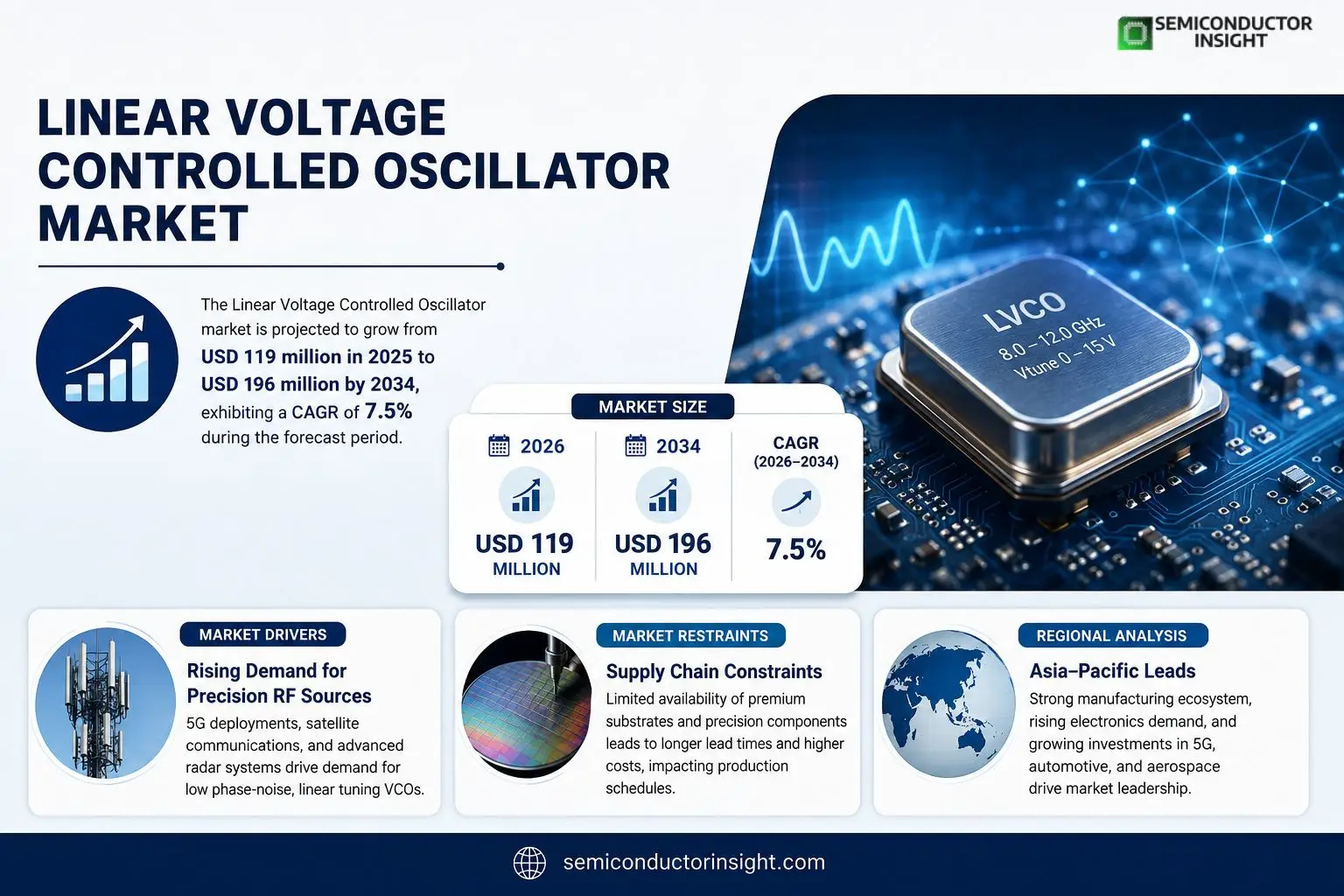
Linear Voltage Controlled Oscillator market size was valued at USD 119 million in 2025. The market is projected to grow from USD 119 million in 2025 to USD 196 million by 2034, exhibiting a CAGR of 7.5% during the forecast period.
A Linear Voltage Controlled Oscillator is an electronic frequency‑source device whose output frequency varies continuously with an applied control voltage while maintaining an approximately linear transfer characteristic within a defined range. It is typically offered as a surface‑mount RF/microwave module, a shielded miniature source module, or a monolithic integrated circuit with dedicated supply, tuning‑voltage and RF‑output pins. Internally it comprises an active oscillation core, an LC tank or microstrip/distributed resonator network, a varactor‑based voltage‑controlled reactance element, bias/isolation circuitry, an output buffer and protective packaging.The market is experiencing rapid growth because system designers increasingly demand low‑phase‑noise sources that support higher‑order modulation and tighter frequency control across microwave, satellite and radar applications. Moreover, expansion of mmWave automotive radar and defense communication links fuels adoption of monolithic VCO solutions that combine linear tuning with compact form factors. Recent product introductions from major RF supplierssuch as integrated PLL‑plus‑VCO modules released in early 2024illustrate how manufacturers are addressing both performance and integration challenges.
MARKET DRIVERS
Rising Demand for Precision RF Sources
Telecommunications operators are upgrading backbone networks to support emerging 5G and private‑cloud services. This transition forces equipment manufacturers to source oscillators that can maintain exact frequency stability under tight phase‑noise specifications. Linear Voltage Controlled Oscillator Market benefits because designers favor linear architectures for their predictable tuning behavior, which simplifies system calibration.
Growth of Test‑and‑Measurement Equipment
Laboratories and OEM test rigs increasingly rely on wideband signal generators that embed voltage‑controlled oscillators. The ability to sweep frequency linearly without abrupt jumps is crucial for characterizing high‑speed transceivers. Consequently, procurement budgets allocate a larger share to components that deliver smooth tuning, reinforcing market momentum.
➤ “Clients value linearity because it reduces calibration cycles and improves overall yield.” – Senior RF Engineer, leading test equipment supplier
Beyond telecom, automotive radar modules are adopting linear oscillators to meet stringent safety standards. The shift toward driver‑assistance systems translates into a broader customer base that seeks components capable of operating across temperature extremes while preserving spectral purity.
MARKET CHALLENGES
Supply Chain Constraints for High‑Quality Substrates
The manufacturing process for low‑noise oscillators demands premium semiconductor wafers and precision passive elements. Recent geopolitical tensions have tightened the flow of these raw materials, prompting lead‑time extensions that can jeopardize product launch schedules. Companies that cannot secure a reliable supply risk losing design wins to competitors with diversified sourcing strategies.
Other Challenges
Cost Sensitivity
End‑users, especially in cost‑driven sectors such as consumer electronics, scrutinize component pricing more closely than ever. Since linear designs often require tighter process control, manufacturers must balance performance against unit cost to stay competitive.
MARKET RESTRAINTS
Thermal Stability Limitations
Linear oscillators are susceptible to frequency drift when exposed to high ambient temperatures. In environments like aerospace or industrial automation, sustaining performance without active cooling imposes design penalties. This technical hurdle discourages some system architects from selecting linear solutions for extreme‑condition applications.
MARKET OPPORTUNITIES
Integration with Silicon Photonics Platforms
The convergence of microwave photonics and silicon photonics opens a niche where linear voltage‑controlled oscillators can serve as on‑chip frequency sources. By embedding the oscillator directly into a photonic integrated circuit, designers achieve reduced footprint and lower parasitic loss, which is attractive for next‑generation lidar and coherent communication systems. This synergy creates a growth avenue for firms that invest in co‑design capabilities.
Linear Voltage Controlled Oscillator Market Trends
Shift Toward Monolithic Integration
Linear Voltage Controlled Oscillator Market is seeing a clear move from discrete modules to monolithic silicon solutions. Engineers prize the reduced parasitic inductance and tighter control over temperature drift that a single‑chip implementation provides. This migration is driven by the need for tighter form‑factors in phased‑array radars and satellite payloads, where every millimeter of board space translates into weight savings. By consolidating the active core, tuning network, and output buffer onto a common substrate, vendors can guarantee a more predictable Kvco curve, which simplifies loop design and shortens time‑to‑market for advanced communication platforms.
Other Trends
Increasing Demand for Space‑Qualified Devices
Customers operating in defense and space sectors are imposing stricter reliability thresholds on Linear Voltage Controlled Oscillator Market. Radiation‑hardened processes, extended temperature ranges, and long‑duration burn‑in testing are becoming prerequisites for qualification. Suppliers that can combine low phase‑noise performance with these durability attributes are positioned to capture contracts that favor lifecycle assurance over outright cost. The implication for manufacturers is a longer design‑in phase but the potential for higher margin contracts that value risk mitigation.
Customization and Application Support as Competitive Differentiators
Beyond raw specifications, system integrators are looking for vendors who deliver tailored tuning curves, calibrated reference data sets, and on‑site engineering assistance. This trend reflects a broader shift from commodity component sourcing to partnership models where the oscillator is considered a platform enabler. Companies that invest in extensive characterization labs and provide API‑driven data sheets enable downstream customers to embed the device directly into software‑defined radios without extensive redesign. The business impact is twofold: it creates a barrier to entry for low‑cost producers and opens revenue streams linked to value‑added services such as firmware updates and field‑support contracts.
COMPETITIVE LANDSCAPE
Key Industry Players
Linear Voltage Controlled Oscillator Market: Competitive Overview
Analog Devices dominates the high‑performance segment, leveraging its deep RF portfolio and extensive design‑in support network. Its monolithic VCO families combine ultra‑low phase noise with tight Kvco linearity, a combination that attracts aerospace and defense programs where predictability outweighs pure cost considerations. The company’s recent 200‑GHz MMIC VCO launch illustrates a deliberate shift toward integrated PLL‑plus‑VCO solutions, signaling an intent to capture next‑generation millimeter‑wave links. Market structure remains oligopolistic at the top tier, with few firms capable of offering both volume‑grade silicon and space‑qualified modules. This concentration creates a barrier to entry for newcomers, as qualification cycles and reliability data sheets consume significant engineering resources. Consequently, system integrators frequently lock‑in a single supplier early in a product roadmap, reinforcing the incumbents’ pricing power and influencing downstream component selection.Beyond the tier‑one players, a constellation of niche firms sustains innovation in specialized resonator technologies and customized frequency bands. MACOM, Qorvo, and Mini‑Circuits excel in modular RF packages that address fast‑time‑to‑market demands for telecom infrastructure upgrades. Companies such as Crystek and RF Bay focus on low‑cost, broadband LC‑tank modules that serve test‑equipment manufacturers and industrial automation vendors. Regional specialistsincluding Shanghai AT Microwave, Qualwave, MARUWA, and Z‑Communicationsprovide space‑grade or ruggedized offerings tailored to Asian defense contracts and satellite platforms. The presence of these diverse suppliers widens the design space for OEMs, allowing them to trade off phase‑noise performance against form‑factor constraints or procurement risk. This layered ecosystem fuels a competitive dynamic in which application‑specific expertise can outweigh sheer scale.
List of Key Linear Voltage Controlled Oscillator Companies Profiled
- Analog Devices
- Qorvo
- MACOM Technology Solutions
- Mini‑Circuits
- Crystek
- RF Bay
- Qualwave
- Shanghai AT Microwave
- MARUWA
- Quantic PMI
- Raditek
- Synergy Microwave
- Z‑Communications
- Skyworks Solutions
- Texas Instruments
Segment Analysis:
| Segment Category | Sub-Segments | Key Insights |
| By Type |
|
Monolithic
|
| By Application |
|
Communications
|
| By End User |
|
Telecom OEMs
|
| By Implementation |
|
Integrated IC
|
| By Resonator Structure |
|
LC‑Tank Resonator
|
Regional Analysis: Linear Voltage Controlled Oscillator Market
North AmericaNorth America continues to dominate Linear Voltage Controlled Oscillator Market thanks to a confluence of advanced telecommunications roll‑outs, substantial defense R&D budgets, and a mature semiconductor ecosystem. Industry players leverage the region’s deep engineering talent pool to push the envelope on phase‑noise performance, enabling emerging 5G base‑stations and high‑frequency radar platforms. Automotive OEMs, particularly those working on autonomous driving stacks, demand oscillators with tight frequency stability, prompting local manufacturers to prioritize low‑power, wide‑band designs. The strategic proximity of design houses to end‑users accelerates feedback loops, fostering rapid iteration of custom LVCOs that meet stringent qualification regimes. Consequently, North America not only captures the highest volume but also sets the technical benchmark that other regions follow.
Telecom infrastructure, aerospace defense, and autonomous vehicle platforms drive the bulk of demand, each seeking oscillators that combine low phase noise with robust temperature tolerance for fielded equipment.
Push for millimeter‑wave frequencies, integration of LVCOs into silicon‑photonic modules, and the migration toward software‑defined radio architectures trigger continuous product refresh cycles.
FCC spectrum allocations and stringent MIL‑STD testing regimes impose rigorous compliance requirements, shaping design parameters and influencing supplier qualification pathways.
Leading fabs and boutique design houses compete on application‑specific performance, while strategic M&A activity consolidates component portfolios to offer end‑to‑end solutions for OEMs.
Europe
European markets emphasize precision instrumentation and high‑reliability automotive electronics, where Linear Voltage Controlled Oscillator Market benefits from stringent emissions standards. Collaborative research programs funded by the EU encourage co‑development of low‑power oscillators for electric‑vehicle power‑train control units. Simultaneously, aerospace suppliers demand devices that meet rigorous DO‑160 environmental criteria, prompting manufacturers to adopt modular architectures that simplify certification across multiple programs. The region’s strong intellectual‑property framework nurtures incremental innovation, allowing firms to differentiate through superior phase‑noise performance while navigating a complex regulatory environment.
Asia‑Pacific
Asia‑Pacific fuels growth in Linear Voltage Controlled Oscillator Market through its expansive consumer‑electronics and IoT production base. Price‑sensitive manufacturers in China, South Korea, and Taiwan invest heavily in monolithic integration to cut bill‑of‑materials, yet they also seek performance gains to support 6G trial networks. The surge in automotive electrification across Japan and India adds a demand layer for oscillators that can operate reliably under high‑temperature, high‑vibration conditions. Local design hubs benefit from close supplier proximity, shortening development cycles and enabling rapid customization for diverse applications.
South America
South America presents a mixed outlook for Linear Voltage Controlled Oscillator Market, with Brazil and Argentina leading modest adoption in automotive telematics and renewable‑energy monitoring systems. Infrastructure constraints and fluctuating currency environments temper large‑scale investment, but niche projectssuch as satellite‑ground stations for remote communicationscreate pockets of demand for high‑stability oscillators. Companies that can offer flexible financing and robust after‑sales support gain a competitive edge, as local OEMs prioritize reliability over headline‑grabbing specifications.
Middle East & Africa
In the Middle East & Africa, Linear Voltage Controlled Oscillator Market is shaped by defense procurement and expanding telecom backbones. Oil‑field instrumentation, requiring resilient frequency sources under harsh conditions, drives interest in ruggedized LVCOs. Meanwhile, 5G roll‑outs in Gulf Cooperation Council nations increase demand for oscillators supporting high‑frequency carrier aggregation. Africa’s nascent telecom markets, while volume‑limited, spotlight cost‑effective designs that still meet international quality standards, encouraging global players to tailor entry‑level product lines for these emerging networks.
Report Scope
This market research report provides a comprehensive analysis of the Linear Voltage Controlled Oscillator Market , covering the forecast period 2026–2034. It offers detailed insights into market dynamics, technological advancements, competitive landscape, and key trends shaping the industry.
Key focus areas of the report include:
- Market Overview: The report begins with an overview outlining its current market scenario, key growth indicators, and industry transformation drivers. It discusses macroeconomic factors, demand–supply balance, regulatory landscape, and the strategic role of semiconductors in powering advancements across industries such as automotive, telecommunications, consumer electronics, and industrial automation.
- Market Size & Forecast: Historical data and future projections for revenue, unit shipments, and market value across major regions and segments.
- Segmentation Analysis: Detailed breakdown by product type, technology, application, and end-user industry to identify high-growth segments and investment opportunities.
- Regional Insights: Insights into market performance across North America, Europe, Asia-Pacific, Latin America, and the Middle East & Africa, including country-level analysis where relevant.
- Competitive Landscape: Profiles of leading market participants, including their product offerings, R&D focus, manufacturing capacity, pricing strategies, and recent developments such as mergers, acquisitions, and partnerships.
- Technology Trends & Innovation: Assessment of emerging technologies, integration of AI/IoT, semiconductor design trends, fabrication techniques, and evolving industry standards.
- Market Drivers & Restraints: Evaluation of factors driving market growth along with challenges, supply chain constraints, regulatory issues, and market-entry barriers.
- Stakeholder Insights: Insights for component suppliers, OEMs, system integrators, investors, and policymakers regarding the evolving ecosystem and strategic opportunities.
Primary and secondary research methods are employed, including interviews with industry experts, data from verified sources, and real-time market intelligence to ensure the accuracy and reliability of the insights presented.
FREQUENTLY ASKED QUESTIONS:
What is the current market size of Linear Voltage Controlled Oscillator Market?
-> Linear Voltage Controlled Oscillator Market was valued at USD 119 million in 2025 and is expected to reach USD 196 million by 2034, growing at a CAGR of 7.5% over the forecast period.
Which key companies operate in Linear Voltage Controlled Oscillator Market?
-> Key players include Shanghai AT Microwave, Qualwave, Analog Devices, Crystek, Emhiser Micro-Tech, MACOM, MARUWA, Mini‑Circuits, Qorvo, Quantic PMI, Raditek, RF Bay, Synergy Microwave, Z‑Communications.
What are the key growth drivers?
-> Key growth drivers include increasing demand for high‑frequency, low‑phase‑noise sources in microwave and millimeter‑wave communications, satellite and space systems, defense radar, automotive advanced driver‑assistance systems, and test & measurement equipment, together with a shift toward monolithic and PLL‑integrated VCO architectures.
Which region dominates the market?
-> Asia‑Pacific leads the market, driven by strong manufacturing capacity and rising demand in China, Japan, and South Korea, while Europe and North America also maintain significant market shares.
What are the emerging trends?
-> Emerging trends include integration of VCOs into PLL modules, development of space‑grade and high‑reliability variants, customized band‑specific designs, and migration toward fully monolithic MMIC implementations.
Get Sample Report PDF for Exclusive Insights
Report Sample Includes
- Table of Contents
- List of Tables & Figures
- Charts, Research Methodology, and more...
 Download Sample Report PDF