VCXO Oscillators Market Insights
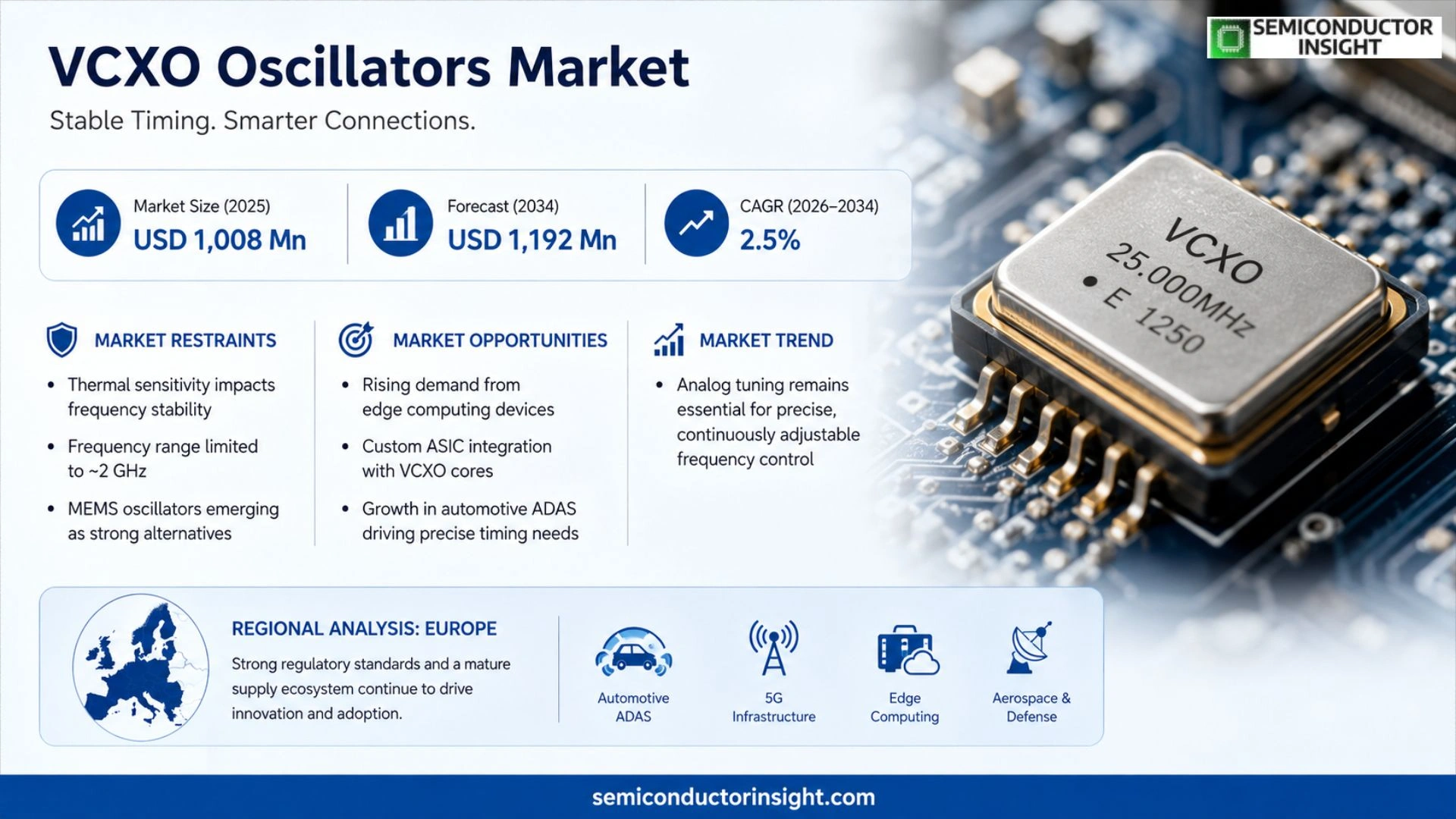
VCXO Oscillators market size was valued at USD 1,008 million in 2025. The market is projected to grow from USD 1,192 million in 2034, exhibiting a CAGR of 2.5% during the forecast period.
VCXO (Voltage‑Controlled Crystal Oscillator) devices are quartz‑based oscillators whose output frequency can be continuously “pulled” over a defined range by an external control voltage. In most implementations a varactor diode or equivalent variable‑capacitance network changes the effective load capacitance seen by the crystal resonator, enabling analog frequency tuning while preserving low phase‑noise and stability advantages of quartz. VCXOs address a key system need: providing fine‑controllable frequency adjustment for PLLs, clock synchronization, jitter‑cleaning architectures and frequency tracking in communications and data‑transport links, as well as synchronization and drift compensation in audio/video broadcast, test‑and‑measurement and networking equipment.
Key drivers include persistent and rising synchronization requirements across communications and networking where higher bandwidths and tighter jitter budgets force continuous optimization of timing chains; industrial automation and critical infrastructure are placing greater emphasis on reliability and maintainability; automotive electronics driven by in‑vehicle Ethernet and domain controllers heighten focus on robust reference clocks; meanwhile integrated clock generators and jitter attenuators are reducing design slots for mid‑range discrete VCXOs, creating pressure on traditional suppliers.
MARKET DRIVERS
Rising Demand for Precision Timing
The expansion of 5G infrastructure and the proliferation of autonomous‑driven vehicles have tightened tolerances on clock stability. OEMs now require oscillators that can maintain sub‑ppm drift across a wide temperature envelope, prompting a measurable uptick in orders for voltage‑controlled crystal devices. As a result, VCXO Oscillators market is seeing a noticeable shift toward higher‑frequency families that can meet stringent phase‑noise specifications.
Cost‑Effective Integration in Consumer Electronics
Smart‑wearables and voice‑activated assistants rely on compact timing blocks that can be bonded directly onto printed‑circuit boards without exotic packaging. Manufacturers favor VCXOs because they deliver the required jitter performance while keeping bill‑of‑materials costs below those of PLL‑based solutions. This cost dynamic has turned VCXOs into the de‑facto choice for mass‑produced handhelds.
➤ Industry analysts note that a 7 % year‑over‑year rise in timing‑module shipments is directly linked to the adoption of VCXOs in edge‑device portfolios.
In parallel, the push for greener data‑center designs is encouraging designers to replace power‑hungry clock generators with low‑power VCXO modules, thereby extending battery life in portable equipment and reducing overall energy consumption in network gear.
MARKET CHALLENGES
Supply Chain Volatility
Global semiconductor shortages have constrained the availability of high‑purity quartz blanks, leading to longer lead times for custom VCXO programs. End‑users report a 15 % increase in procurement costs, forcing many to renegotiate pricing or postpone product launches.
Other Challenges
Manufacturing Yield Constraints
The precision grinding and electrode deposition steps required for tight frequency tolerance still generate a non‑trivial scrap rate. Yield improvements below 90 % translate into higher unit costs, especially for niche frequency bands where volume cannot offset the loss.
Regulatory pressures in the automotive sector, such as stricter functional‑safety standards, add an extra verification layer that lengthens time‑to‑market for new VCXO designs, thereby compressing development budgets.
MARKET RESTRAINTS
Thermal Sensitivity Limits Performance
VCXOs exhibit a measurable frequency drift when exposed to extreme thermal cycles, a condition common in automotive power‑train environments. Designers often have to incorporate additional temperature‑compensation circuitry, which can erode the size and cost advantages of the base device.
Furthermore, the intrinsic frequency range of crystal resonators caps the upper limit of VCXO operation at roughly 2 GHz, restricting their suitability for emerging millimeter‑wave applications that demand higher carrier frequencies.
Competing technologies, particularly MEMS oscillators, are narrowing the performance gap while offering superior shock resistance, making them attractive alternatives for rugged‑industry segments.
MARKET OPPORTUNITIES
Emergence of Edge Computing Devices
Edge nodes now process data locally to reduce latency, and they require highly reliable clocks that can operate unattended for years. VCXO Oscillators market is positioned to serve this niche by delivering modules with extended life‑cycle support and reduced aging rates.
Custom ASIC integration is another growth vector; silicon vendors are collaborating with oscillator manufacturers to embed VCXO cores directly into chipsets, offering a consolidated solution that trims board space and improves signal integrity.
Automotive advanced‑driver‑assistance systems (ADAS) are transitioning from prototype to volume production. Precise timing for radar and lidar sensor fusion hinges on low‑phase‑noise oscillators, presenting a clear opening for VCXO suppliers to capture market share through differentiated performance guarantees.
VCXO Oscillators Market Trends
Analog Tuning Retains Core Value
VCXO Oscillators market continues to be anchored by applications that demand precise, continuously adjustable reference frequencies. Engineers favor the varactor‑based pull range because it preserves quartz’s low phase‑noise character while allowing fine‑step frequency control. This combination is indispensable in phase‑locked loops that underpin modern data‑transport links, where jitter budgets are tight and any drift can degrade system integrity. The persistence of these requirements means that designers rarely substitute discrete VCXOs with fully integrated clock generators unless the architecture can match the analog linearity and noise floor that a dedicated crystal offers. Consequently, OEMs maintain sizable safety stocks of qualified VCXOs, especially for aerospace, telecom and long‑life industrial equipment where supply continuity and proven qualification histories are non‑negotiable.
Other Trends
Shift Toward Integrated Timing Solutions
While the analog advantages of VCXOs are clear, product roadmaps from leading frequency‑control vendors show a parallel investment in clock‑generator ICs that embed digital‑controlled oscillators (DCOs) and PLL blocks. These integrated devices appeal to high‑volume consumer platforms that prioritize board‑level component count and software configurability. The migration is most visible in mid‑tier networking cards and entry‑level consumer electronics, where the cost of a discrete VCXO is weighed against the flexibility of a programmable clock chip. Nevertheless, the transition does not eradicate the VCXO segment; instead, it creates a bifurcated supply chain where high‑performance, low‑noise references coexist with multifunctional timing ICs, each serving distinct design philosophies.
Emerging Automotive and Industrial Ethernet Demands
Automotive Ethernet, industrial TSN (Time‑Sensitive Networking) and high‑speed backplane links impose stricter timing stability than traditional broadband. Vehicles now host multiple gateways, domain controllers and infotainment modules that synchronize over constrained Ethernet fabrics. In this environment, VCXO Oscillators market is responding with higher‑grade temperature‑compensated packages and enhanced shielding to survive harsher electromagnetic environments. Manufacturers are expanding their product portfolios to include narrower pull ranges and lower supply‑voltage variants that fit dense PCB layouts while still delivering the linearity required for synchronized clock distribution. This trend fuels modest volume growth in sectors that value long‑term reliability and deterministic behavior over the integration convenience enjoyed by other markets.
COMPETITIVE LANDSCAPE
Key Industry Players
VCXO Oscillators Market – Competitive Overview
Murata Manufacturing dominates the high‑volume segment of the VCXO market, leveraging a broad portfolio that spans 1.2 × 1.0 mm to 10.0 × 7.0 mm packages and covers supply‑voltage families from 1.8 V to 5.0 V. Its extensive wafer‑processing capability, coupled with rigorous pull‑range screening, allows Murata to sustain gross margins near 25 % while offering low‑phase‑noise devices that are favored in communications infrastructure and automotive Ethernet. The company’s aggressive fab expansion in Asia has tightened lead times, turning Murata into a preferred source for OEMs that demand lot‑to‑lot consistency and long‑term part‑number stability. Meanwhile, Microchip Technology has carved out a niche by integrating VCXO modules with programmable PLLs, providing a hybrid solution that appeals to designers looking to reduce board count without sacrificing analog tuning flexibility. Microchip’s strategy of bundling reference‑clock ICs with support software has generated incremental revenue streams and elevated its position in the industrial‑automation segment, where synchronization tolerances are tightening.
Beyond the two market leaders, a cadre of specialized firms sustains a vibrant ecosystem. Epson’s precision‑cut crystal expertise feeds niche broadcast‑A/V applications that require ultra‑low jitter under harsh temperature swings. SiTime differentiates through MEMS‑based timing products that encroach on the lower‑end VCXO tier, prompting traditional crystal manufacturers to accelerate package miniaturization. Renesas Electronics offers automotive‑qualified VCXOs that integrate with its broader microcontroller portfolio, reinforcing its foothold in in‑vehicle Ethernet gateways. Kyocera, Rakon, and TXC Corporation each command regional strengths in Europe, Oceania, and China respectively, focusing on temperature‑compensated variants for telecom base stations. Nihon Dempa Kogyo (NDK) supplies high‑stability units to test‑and‑measurement equipment, while ON Semiconductor and CTS Corp provide cost‑effective options for consumer‑grade networking gear. Emerging players such as Taitien, NEL Frequency Controls, Abracon, and IQD Frequency Products are expanding their product matrices to include higher‑frequency pull ranges, addressing the growing demand for synchronized network timing in data‑center interconnects.
List of Key VCXO Oscillators Companies Profiled
- Microchip Technology
- Epson
- SiTime
- Renesas Electronics
- Kyocera Corporation
- Murata Manufacturing
- Rakon Electronics
- TXC Corporation
- Nihon Dempa Kogyo (NDK)
- ON Semiconductor
- CTS Corp
- Taitien
- NEL Frequency Controls
- Abracon
- IQD Frequency Products
Segment Analysis:
| Segment Category | Sub-Segments | Key Insights |
| By Type |
|
Output PECL continues to dominate high‑speed communication links because of its superior noise margin and fast edge rates – designers value its compatibility with differential signaling standards. – The PECL family is favored in data‑center back‑plane and telecom transport where jitter budgets are tight. – Its ability to maintain low phase‑noise while handling wide pull ranges makes it a preferred choice for PLL‑based clock recovery modules. |
| By Application |
|
Communication Equipment remains the cornerstone of VCXO demand as network operators require fine‑grain frequency adjustment for synchronized Ethernet, SyncE and TSN deployments – the analog pull capability aligns with stringent jitter specifications. – Manufacturers stress linearity and phase‑noise performance to support high‑order modulation schemes. – The heritage of VCXOs in legacy transport systems guarantees long‑term supply, reinforcing their role in upgrades and retrofit projects. |
| By End User |
|
Telecom Networks prioritize VCXOs for timing reference in base‑station PLLs and distributed antenna systems where continuous analog tuning mitigates frequency drift caused by temperature swings. – The need for robust, qualified parts drives a preference for discrete VCXOs over fully integrated solutions in carrier‑grade equipment. – Emerging 5G and beyond deployments intensify focus on phase‑noise reduction, reinforcing the strategic importance of low‑noise VCXO architectures. |
| By Voltage |
|
1.8 V devices are gaining traction in ultra‑low‑power IoT and automotive gateway designs where power budget constraints intersect with the need for precise clock tuning – the reduced supply voltage simplifies power‑domain integration. – Designers appreciate the compatibility with modern low‑voltage CMOS processes, enabling tighter board‑level integration. – The broader voltage family (2.5 V, 3.3 V, 5.0 V) continues to serve legacy platforms and high‑performance networking gear, preserving flexibility across product generations. |
| By Package Size |
|
1.6 × 1.2 mm packages are emerging as the sweet spot for high‑density board designs in telecom and automotive electronics, offering a balance between mechanical robustness and minimal footprint – this trend aligns with the shift toward smaller form‑factor modules. – Smaller footprints reduce parasitic inductance, improving pull‑range linearity and phase‑noise performance. – The continued availability of larger packages (5.0 × 3.2 mm, 7.0 × 5.0 mm) serves legacy equipment and high‑power applications where thermal handling is a priority. |
Regional Analysis: VCXO Oscillators Market
Europe
Tier‑one suppliers are embedding VCXO modules directly into power‑train control units to guarantee clock integrity under harsh thermal cycles. The shift toward electric drivetrains amplifies the need for precise timing, prompting original equipment manufacturers to favour European sources that can certify compliance with emerging safety standards.
Dense‑cell deployments in urban corridors demand oscillators with ultra‑low jitter to synchronize massive MIMO arrays. European telecom operators are selecting VCXO solutions that balance low power consumption with tight phase‑noise specifications, a combination critical for sustaining network throughput.
Factory‑floor robotics rely on synchronized motion‑control loops; VCXO stability directly influences repeatability. European manufacturers are integrating oscillators that survive electromagnetic interference from high‑current drives, reinforcing overall system reliability.
Sectors such as precision medical imaging and aerospace testing are beginning to source VCXO devices from European firms that can meet low‑temperature performance criteria, expanding the market’s application breadth.
North America
In North America, VCXO Oscillators market is heavily influenced by the convergence of defense procurement and consumer electronics innovation. Suppliers are leveraging advanced silicon‑on‑insulator processes to meet the U.S. Department of Defense’s exacting frequency‑stability requirements for radar and navigation platforms. At the same time, wearable technology firms in Canada are pushing for smaller, low‑power oscillators that can operate reliably within constrained battery envelopes. The region’s robust venture‑capital environment fuels rapid prototyping, allowing startups to test niche oscillator architectures that address latency‑sensitive edge‑computing devices. Regulatory clarity around spectrum allocation further supports a steady pipeline of product introductions, encouraging manufacturers to scale production without extensive redesign cycles.
Asia‑Pacific
Asia‑Pacific represents the fastest‑adapting segment of VCXO Oscillators market, driven by the scale of consumer device manufacturing in China, South Korea, and Taiwan. High‑volume smartphone assemblers demand oscillators that can sustain tight tolerances while remaining cost‑effective, prompting local foundries to adopt advanced mixed‑signal fabs. Concurrently, the region’s burgeoning electric‑vehicle sector requires oscillators capable of operating across wide temperature ranges, leading automotive OEMs to partner with regional component houses for joint development programs. Government incentives for smart‑city initiatives also stimulate demand for timing solutions that underpin intelligent transportation systems, reinforcing the strategic importance of the VCXO niche in the broader electronics landscape.
South America
South America’s VCXO Oscillators Market is shaped by the growing adoption of renewable‑energy infrastructure and the modernization of telecommunications networks in Brazil and Argentina. Grid‑integration projects demand oscillators that can maintain synchronization across distributed generation sites, a requirement that is being met by regional manufacturers tailoring products to tropical operating conditions. Telecommunications providers, in the wake of expanding fiber‑to‑the‑home deployments, are selecting oscillators that ensure signal fidelity across long‑haul links. Although the market still contends with import‑tariff pressures, local engineering talent is increasingly capable of delivering customized solutions that align with the region’s evolving standards.
Middle East & Africa
In the Middle East & Africa, VCXO Oscillators market is propelled by large‑scale satellite‑communication projects and the rise of defense‑related aerospace programs. Nations such as the United Arab Emirates and Saudi Arabia are investing in ground‑segment timing equipment that relies on high‑precision oscillators to support satellite navigation services. Simultaneously, mining and oil‑field automation in Sub‑Saharan countries require rugged oscillators capable of withstanding dust and temperature extremes. Partnerships between multinational oscillator vendors and regional system integrators are fostering technology transfer, enabling local players to participate in complex timing‑system deployments while adhering to stringent performance benchmarks.
Report Scope
This market research report provides a comprehensive analysis of the VCXO Oscillators Market , covering the forecast period 2026–2034. It offers detailed insights into market dynamics, technological advancements, competitive landscape, and key trends shaping the industry.
Key focus areas of the report include:
- Market Overview: The report begins with an overview outlining its current market scenario, key growth indicators, and industry transformation drivers. It discusses macroeconomic factors, demand–supply balance, regulatory landscape, and the strategic role of semiconductors in powering advancements across industries such as automotive, telecommunications, consumer electronics, and industrial automation.
- Market Size & Forecast: Historical data and future projections for revenue, unit shipments, and market value across major regions and segments.
- Segmentation Analysis: Detailed breakdown by product type, technology, application, and end-user industry to identify high-growth segments and investment opportunities.
- Regional Insights: Insights into market performance across North America, Europe, Asia-Pacific, Latin America, and the Middle East & Africa, including country-level analysis where relevant.
- Competitive Landscape: Profiles of leading market participants, including their product offerings, R&D focus, manufacturing capacity, pricing strategies, and recent developments such as mergers, acquisitions, and partnerships.
- Technology Trends & Innovation: Assessment of emerging technologies, integration of AI/IoT, semiconductor design trends, fabrication techniques, and evolving industry standards.
- Market Drivers & Restraints: Evaluation of factors driving market growth along with challenges, supply chain constraints, regulatory issues, and market-entry barriers.
- Stakeholder Insights: Insights for component suppliers, OEMs, system integrators, investors, and policymakers regarding the evolving ecosystem and strategic opportunities.
Primary and secondary research methods are employed, including interviews with industry experts, data from verified sources, and real-time market intelligence to ensure the accuracy and reliability of the insights presented.
FREQUENTLY ASKED QUESTIONS:
What is the current market size of VCXO Oscillators Market?
-> VCXO Oscillators market is projected to grow from USD 1,192 million in 2034, exhibiting a CAGR of 2.5% during the forecast period.
Which key companies operate in VCXO Oscillators Market?
-> Key players include Microchip, Epson, SiTime, Renesas, Kyocera Corporation, Murata, Rakon, TXC Corporation, Nihon Dempa Kogyo, Onsemi, CTS Corp, Taitien, NEL Frequency Controls, Bliley Technologies, Abracon, IQD Frequency Products.
What are the key growth drivers?
-> Key growth drivers include rising synchronization requirements in communications and networking, increased industrial automation, and expanding automotive connectivity such as in‑vehicle Ethernet and Ethernet TSN.
Which region dominates the market?
-> Asia-Pacific is the fastest‑growing region, while Europe remains a dominant market.
What are the emerging trends?
-> Emerging trends include integration of VCXOs with advanced clock‑generator ICs, trend toward smaller low‑noise packages, and adoption of VCXOs in high‑reliability automotive and industrial Ethernet applications.
Get Sample Report PDF for Exclusive Insights
Report Sample Includes
- Table of Contents
- List of Tables & Figures
- Charts, Research Methodology, and more...
 Download Sample Report PDF